
Water filtration · London homes
Water Filtration for London Homes: Reverse Osmosis, Minerals and Hydrogen Water
Carbon filtration, reverse osmosis, storage and optional ionisers — planned as one maintainable drinking-water system.
Find the right treatmentA home water filtration system should solve a clear problem. That might be a drinking-water taste you dislike, limescale affecting household equipment, or a requirement for a carefully specified reverse osmosis system.
Those goals need different solutions. A carbon filter, water softener, RO membrane and water ioniser do not perform interchangeable jobs. Combining them successfully means understanding both their individual functions and the water passing between them.
This guide explains how to plan water filtration for a London home, from whole-house treatment to an under-sink drinking-water system. It covers storage tanks, remineralisation, optional hydrogen enrichment and the practical details that make an installation usable long after the kitchen cupboard is closed.
The aim is not the longest list of treatment stages. It is the right water, at the right outlet, from equipment you can maintain.
/ 01
Start with the water and the result you want
London tap water should not be treated as inherently unsafe because filtration equipment is available. The Drinking Water Inspectorate explains that additional domestic treatment is not generally needed as a health-protection measure for compliant public supplies. A change in taste or appearance should be investigated rather than automatically answered with another filter. DWI guidance on domestic treatment
Before choosing equipment, identify your main objective:
- improving the taste of drinking water;
- reducing hardness and household limescale;
- reducing a particular substance supported by appropriate performance evidence;
- planning a convenient drinking-water outlet;
- adding an optional ioniser or hydrogen-generating device.
Check your own supplier's water-quality information. Thames Water provides a postcode-based service; a general statement about London cannot replace information relevant to your address. Thames Water quality information
Your priorities also matter. A household filling bottles throughout the day needs a different delivery arrangement from someone making occasional drinks. A kitchen renovation creates opportunities to plan equipment and servicing space that may be difficult to add afterwards.
/ 02
Whole home filtration and drinking water treatment
Whole-house treatment, also called point-of-entry treatment, sits on the incoming supply and serves the connected household outlets. Point-of-use treatment serves a particular outlet, commonly a kitchen drinking-water tap. CDC explanation of home water filters
For a combined installation, define which outlets receive which water. Do not assume every appliance needs the same treatment or that every branch should pass through every device.
A practical design might provide household softening while treating drinking water separately. Alternatively, the only change required may be a compact kitchen filter.
The distinction matters in London flats and converted properties, where the incoming supply, shared services and available cupboard space may limit what can be installed. Establish responsibility for the pipework and any necessary permissions before altering it.
Whole-house RO should be assessed as a separate specialist proposal, not assumed to be the next step after buying an under-sink unit. Treating drinking-water demand is a different project from treating the water used by the entire home.
/ 03
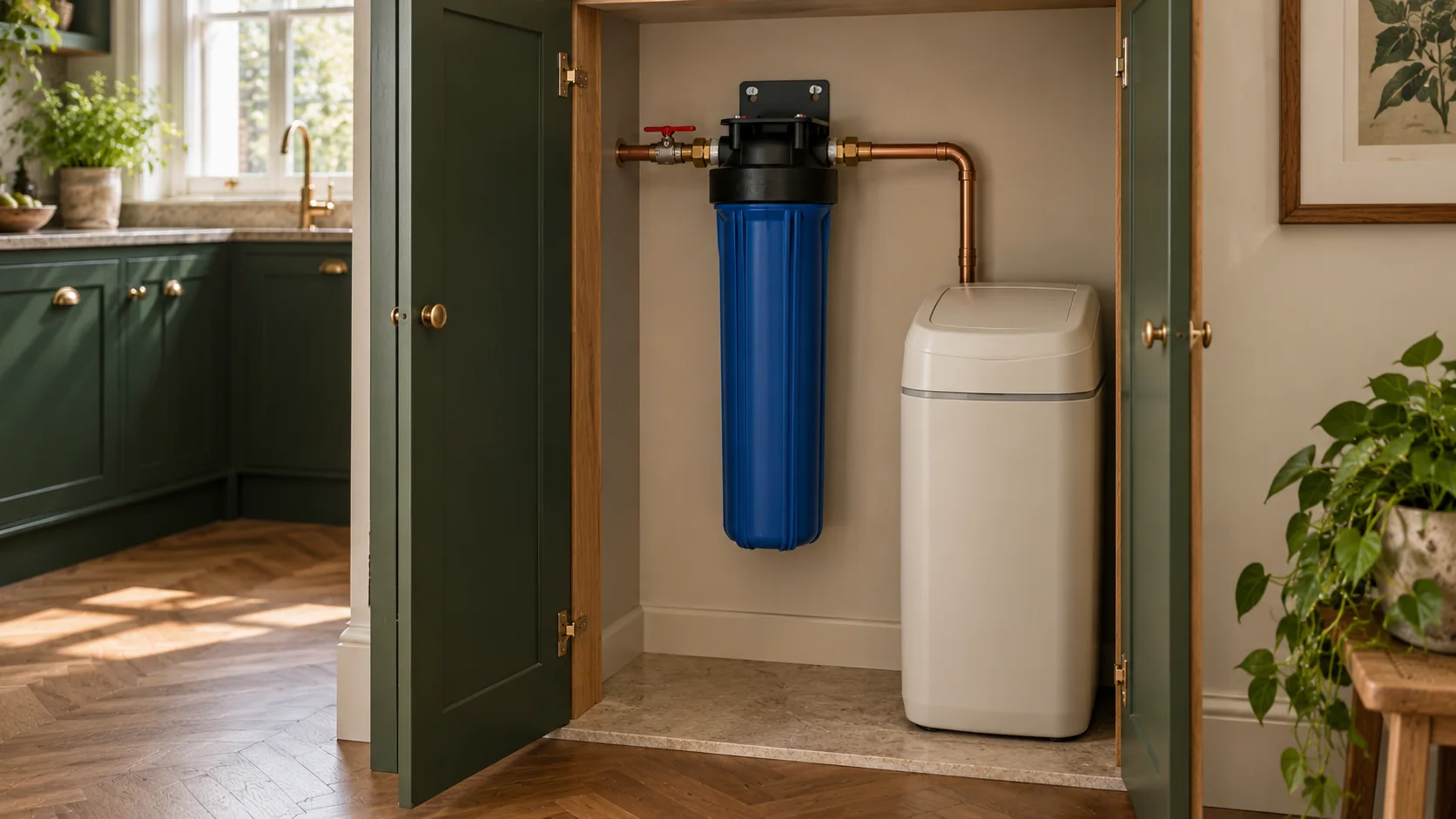
What a carbon filter can and cannot do
Activated carbon is used for treatment such as chlorine reduction and taste improvement. Other reduction claims depend on the selected media and product's tested performance. A plain carbon filter is not a substitute for a conventional water softener. EPA guide to selecting water treatment
A large housing is only part of the specification. Ask about rated flow, capacity, pressure loss, replacement media and the conditions under which performance was assessed. A 30-inch filter cannot be judged by its length alone.
For whole-house installation, consider the downstream system too. Removing disinfectant from the incoming water can allow more microbial growth in household plumbing, making upkeep important. CDC advice on filters and household water hygiene
Leave a workable route for removing the cartridge or servicing the vessel. Isolation and an appropriate bypass arrangement should be considered before the installation is boxed in.
If your concern is only the taste of a glass of water, compare a point-of-use solution before committing to treatment for every outlet. Match the extent of the installation to the actual requirement.
/ 04
Where a water softener fits
Conventional ion-exchange softeners replace calcium and magnesium hardness ions with sodium or potassium ions, depending on the regeneration system. This is softening, not the same process as removing dissolved substances through RO. NSF explanation of treatment standards
Descriptions such as “organic resin” require care. A resin can be suitable for potable-water applications, but its material description alone does not establish the complete appliance's function or the suitability of its final water. Identify the installed media and system rather than assuming it is an RO membrane. DuPont example of a potable-water softening resin
Drinking-water arrangements must be planned separately. DWI advises retaining an unsoftened outlet for drinking and cooking when domestic sodium-exchange softening is used. Do not assume that adding a generic downstream carbon cartridge removes the sodium introduced by the softener. DWI guidance on water hardness and softening
For equipment selection, installation space and ongoing ownership, see our water softeners guide for London homes.
/ 05
How a domestic reverse osmosis system works
Reverse osmosis uses pressure to move water through a semi-permeable membrane. It produces treated water, known as permeate, and a separate concentrate stream containing substances retained by the membrane. EPA explanation of point-of-use RO
A domestic system normally has functions beyond the membrane itself:
- Incoming water receives the specified pre-treatment.
- The membrane performs the RO separation.
- Concentrate follows the designed discharge route.
- Treated water is delivered directly or collected in compatible storage.
- Any specified post-treatment is applied before the drinking outlet.
The exact arrangement depends on the product. Components should follow its approved installation layout, not a generic diagram copied from a different system.
RO can reduce dissolved substances including sodium, but removal performance must be checked for the selected equipment. CDC guidance on selecting filters for specific substances
Check the complete system's performance documentation. NSF/ANSI 58 concerns RO systems, but certification does not mean a product removes every possible contaminant. Verify the particular reduction claims relevant to your concern. NSF guidance on certification scope
A filter installed to address a specific concern should be assessed against that concern. Appearance, taste or a reassuring display number cannot replace the relevant evidence.
/ 06
Why more stages do not automatically mean better water
A five-stage, seven-stage or nine-stage description is not a universal quality ranking. Establish what the manufacturer counts as a stage and what each component actually contributes.
Several treatment functions may be combined within one cartridge. Another configuration may use separate cartridges or multiple membranes. The useful questions concern performance, delivery and maintenance, not the largest number on the box.
For an existing BMB Nova Pro, identify the generation and installed filter set before ordering replacements. Do not assume a currently advertised configuration describes an older appliance.
Ask for the correct consumables, replacement instructions and support information. A system becomes difficult to own when its cartridges cannot be identified or obtained.
/ 07
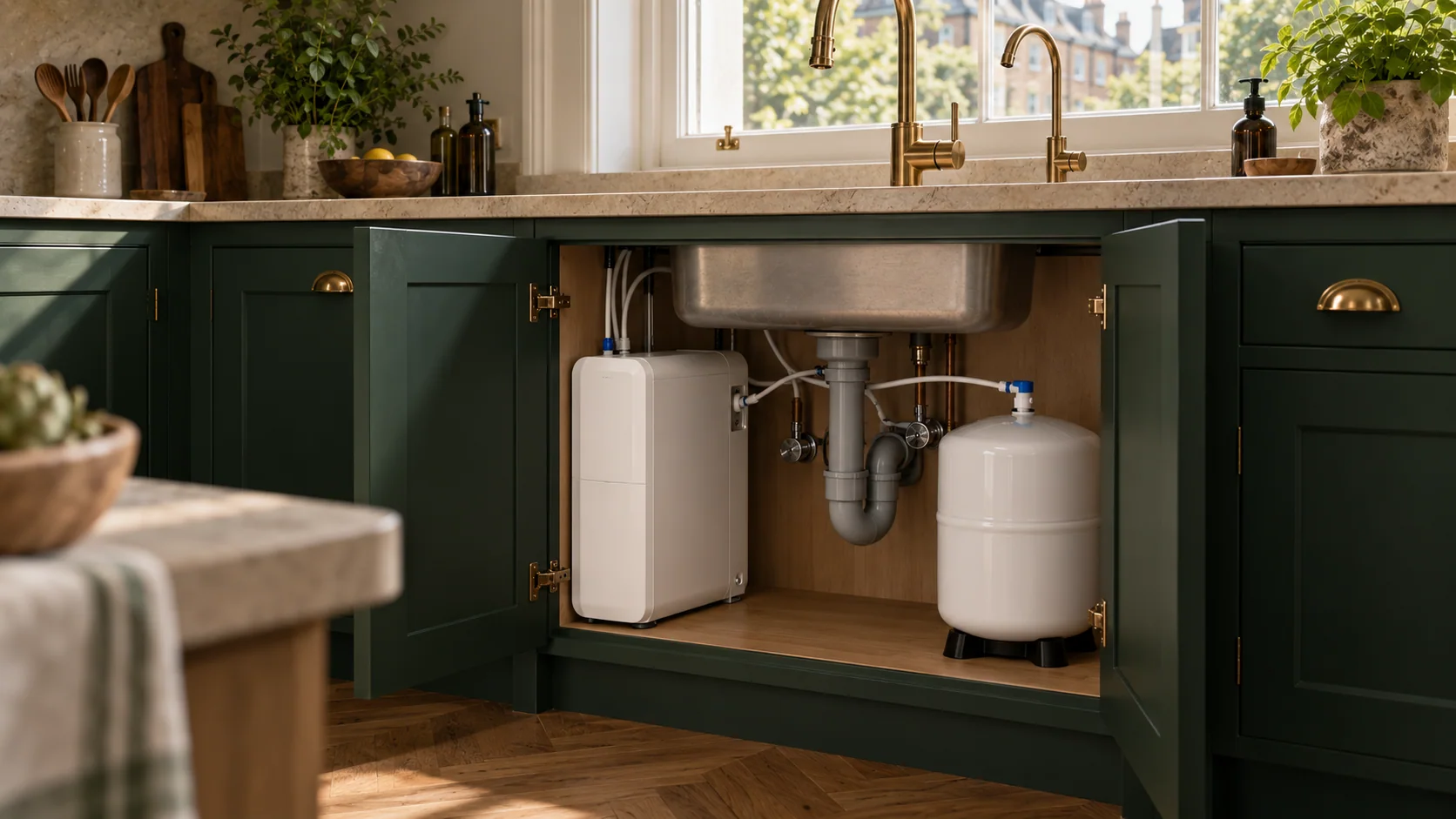
Storage tanks and tankless RO systems
Membrane production and flow from the drinking tap are different specifications. Daily production figures should not be mistaken for the amount immediately available when filling a jug.
A tank-based arrangement stores treated water for later use. A direct-flow or tankless arrangement depends on its designed production and delivery capability. Compare both against your busiest normal period, not daily consumption alone.
For a kitchen system, consider:
- how quickly it fills a glass or cooking pan;
- how much water is available during repeated use;
- recovery after the stored supply has been drawn down;
- equipment noise and electricity requirements where applicable;
- space for servicing the unit and any tank.
Understanding a tank labelled 10 litres
Check whether the advertised figure is total vessel volume or usable water storage. In an air-charged pressure tank, usable storage depends on operating pressures and the manufacturer's design. Watts distinguishes total capacity from water-storage capacity in its tank documentation. Watts tank capacity information
A nominal 10-litre tank should therefore not automatically be described as providing ten litres at the tap.
Adding storage to an existing direct-flow system also requires compatibility checks. Confirm the intended connection, controls, pressure limits and sanitation procedure. A larger tank is not an automatic answer to an unsuitable supply or an underperforming membrane.
/ 08
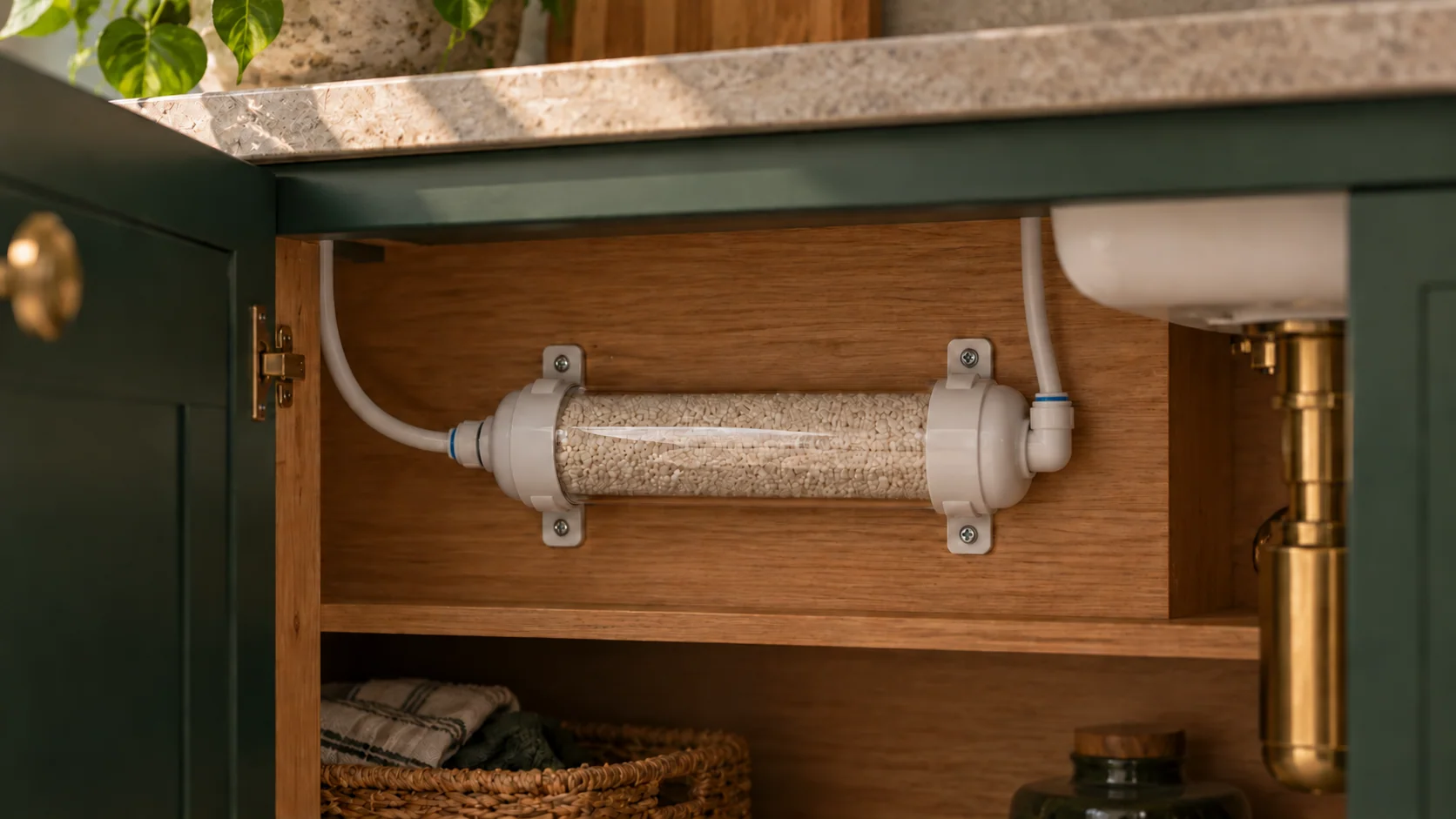
Remineralisation after reverse osmosis
RO reduces dissolved mineral content as part of its treatment. For drinking-water use, final-water composition needs consideration rather than assuming that the lowest mineral reading is the best outcome. DWI advises adding minerals back where RO-treated water is used for drinking. DWI guidance on RO drinking-water treatment
Remineralisation introduces specified minerals through suitable post-treatment. The media, operating flow and manufacturer's instructions matter; the label “alkaline cartridge” does not establish compatibility with every downstream appliance.
When planning the installation, identify where this treatment occurs relative to storage and the final outlet. Use the selected manufacturer's layout and verify the resulting water where a downstream device has particular requirements.
A TDS reading estimates dissolved-solids content. It does not identify individual substances, prove microbiological safety or show that a particular mineral balance has been achieved. Treat it as one piece of operating information, not a complete water-quality test.
/ 09
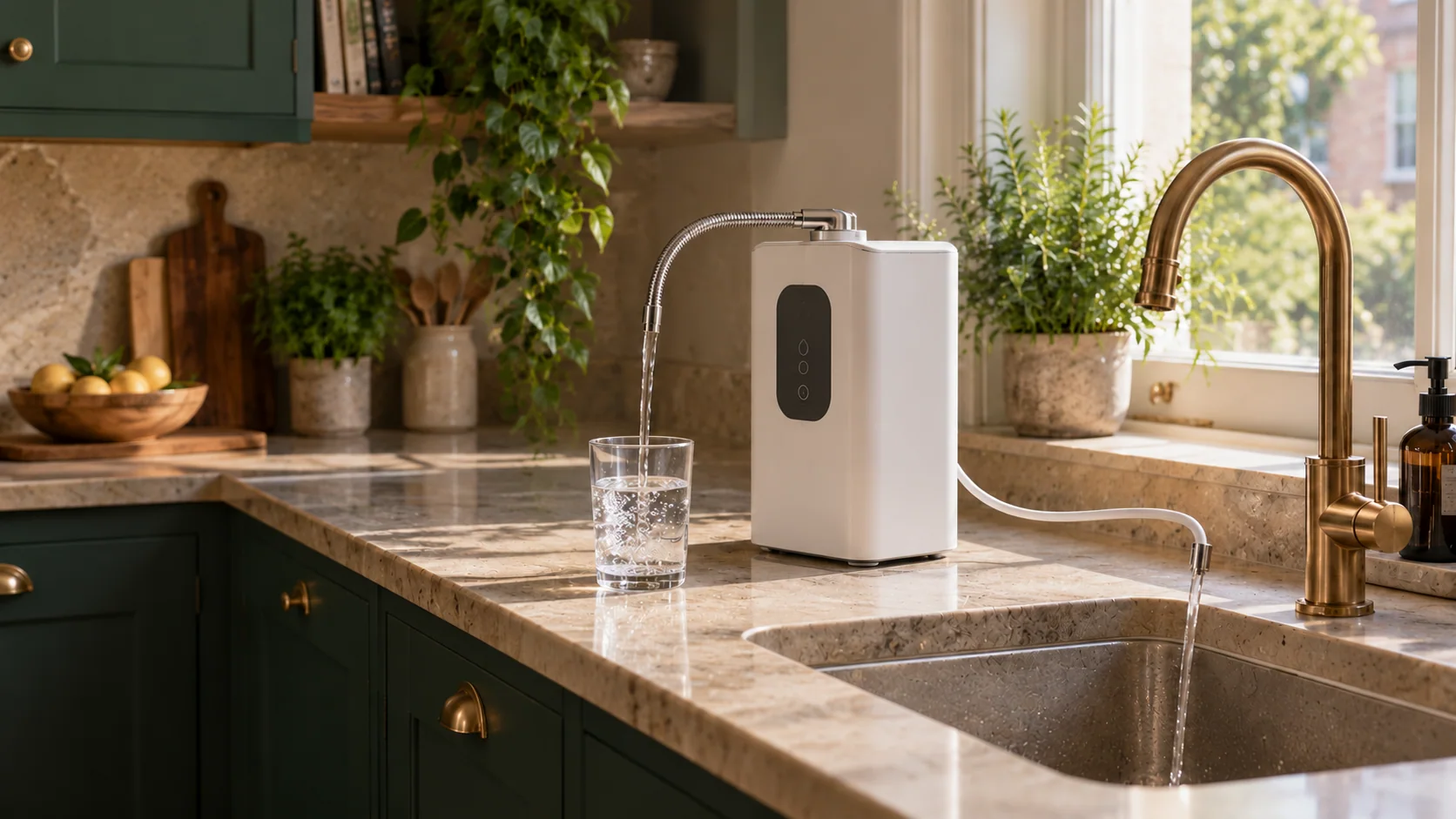
Connecting RO to a water ioniser
An electrolytic water ioniser needs suitable feed water. RO substantially reduces dissolved minerals, so compatibility cannot be assumed simply because the connecting tube fits.
AlkaViva's guidance explains the importance of conductivity and describes RO followed by remineralisation as one option where the original feed has been softened using sodium or potassium ion exchange. It also cautions against feeding its ionisers directly from unsuitable RO water. AlkaViva feed-water guidance
For the exact ioniser model, check inlet-water requirements, permitted pressure, operating flow and the specified pre-treatment. Verify the achieved water rather than assuming a mineral cartridge will always satisfy those requirements.
Plate count alone does not establish output at your drinking tap. AlkaViva also identifies source water and flow rate as influences on measured performance. Comparisons require stated operating conditions. AlkaViva guidance on hydrogen testing
An RO system and ioniser should be specified together when one supplies the other. Buying them separately without checking their interaction risks an expensive arrangement that does not operate as intended.
/ 10
Filtered water and hydrogen water are different things
These descriptions answer different questions:
Swipe or scroll sideways to view the full table →
| Description | What it describes |
|---|---|
| Filtered water | Water treated by a specified filtration process. |
| Softened water | Water whose hardness has been reduced. |
| Remineralised water | Water with minerals added through specified treatment. |
| Alkaline water | Water with a pH above seven. |
| Hydrogen-rich water | Water containing additional dissolved molecular hydrogen, H2. |
A system may combine several characteristics, but none automatically proves the others. A higher pH does not demonstrate contaminant removal, and a hydrogen-generating device should not be assumed to filter its incoming water.
If hydrogen output matters to your specification, ask how it is measured. Dissolved H2 concentration, pH, conductivity and oxidation-reduction potential, or ORP, are different measurements. An ORP number is not a direct measurement of dissolved hydrogen concentration. Research on the limitations of ORP measurements
Research into hydrogen-rich water is ongoing. A published systematic review found preliminary findings but called for larger studies and more rigorous methods. This does not establish guaranteed benefits from a particular domestic appliance. Research review on hydrogen-rich water
Optional hydrogen enrichment should not be presented as a treatment for illness or a substitute for medical advice.
/ 11
Where GRANDER belongs in the discussion
GRANDER is an Austrian brand marketing water-revitalisation equipment. Its manufacturer's explanation distinguishes revitalisation from changing hardness or chemical ingredients and from disinfection. It should therefore not replace filtration, softening or hygiene measures in a system specification. GRANDER manufacturer FAQ
There is published laboratory research involving its water-core magnetic treatment. Such work should be read within its experimental scope, not translated into a promise of human health benefits or proven performance from an individual household installation. Published microbiological study
If an owner chooses to include a GRANDER device, identify its intended role separately. The drinking-water system still needs appropriate equipment, sound connections and maintenance. “Revitalised” is not another name for RO-filtered, disinfected or hydrogen-rich water.
/ 12
Planning water filtration installation in London
A good installation brief covers the water supply, the finished room and future ownership.
Check supply pressure and flow
Confirm the selected equipment's inlet requirements and assess the available supply. A slow kitchen outlet may need diagnosis before additional devices introduce further restrictions.
Our London low-water-pressure guide explains why pressure and flow should be considered separately.
An RO membrane pump is not automatically a solution for weak delivery throughout the property. Whole-home supply improvements are a separate subject covered in our water pressure boosters guide.
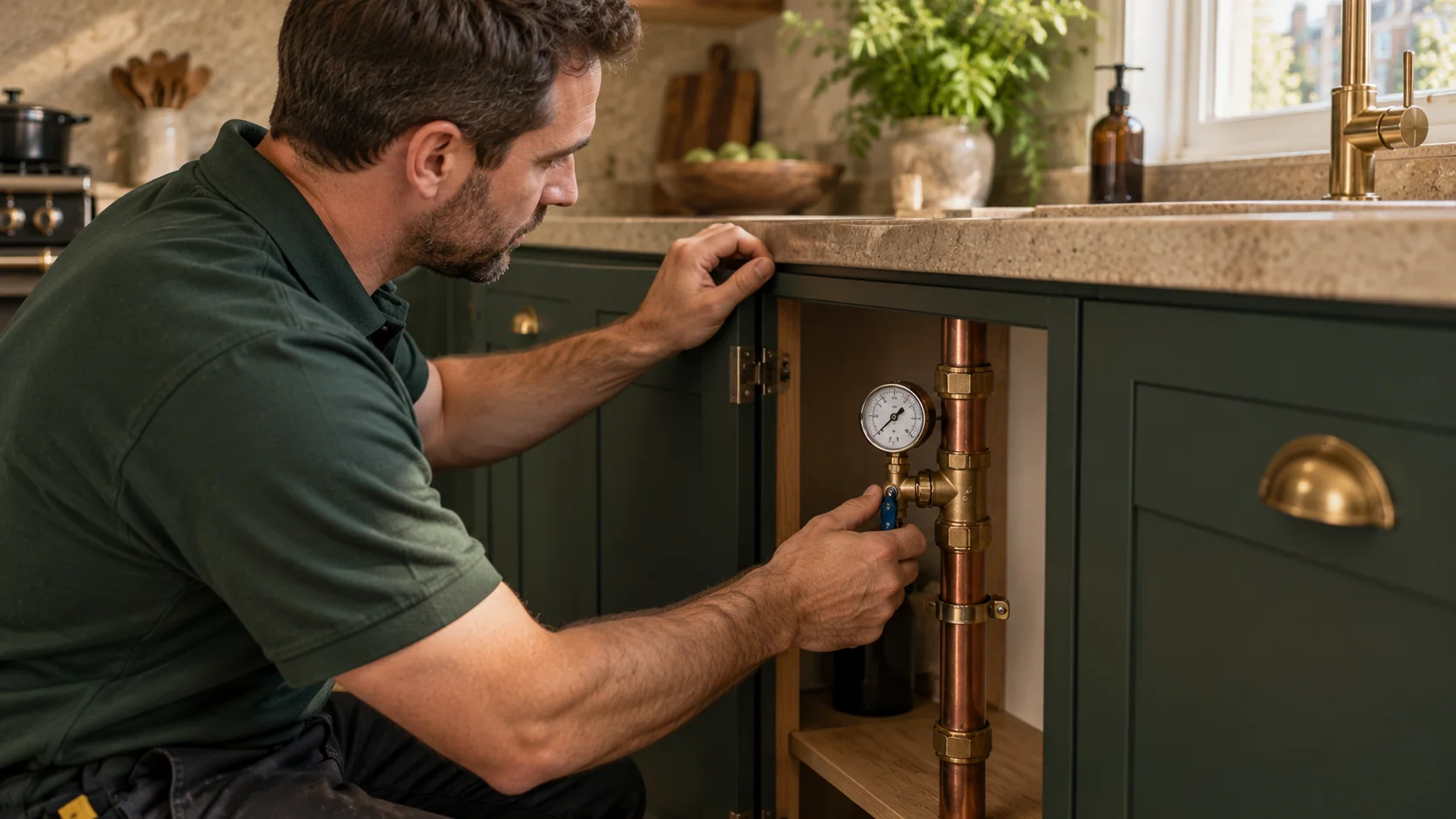
Design the cabinet around servicing
Allow room to disconnect cartridges, remove a tank and reach isolation valves. Consider the waste trap, drawers, bins and other under-sink appliances.
Check clearances with the final kitchen drawings. A tightly packed cupboard can turn a routine consumable change into a furniture-removal job.
Where equipment needs electricity, coordinate suitable accessible connections with the electrical work. Our kitchen renovation electrical guide discusses these shared spaces.
Plan discharge and water protection
Agree a suitable concentrate discharge route and the required protection against contamination or backflow. Use appropriate materials and fittings; overseas performance certification is not, by itself, confirmation of compliance with UK installation requirements.
Consider leak detection and automatic isolation where appropriate, particularly in flats or finished kitchen cabinetry.
For sensor placement, treatment cycles and the limits of automatic isolation, see our water leak protection guide before finalising the filtration cupboard.
Check notification before work begins
In England and Wales, installation of a unit incorporating RO falls within the notification requirements of the Water Supply (Water Fittings) Regulations. Notify the water undertaker and follow the applicable consent process before installation. Water Regs UK requirements
Do not assume product purchase or professional fitting replaces this step.
Commission and hand over the complete arrangement
The agreed scope should include flushing, leak checks, operating checks and any specified water testing. Handover should identify the equipment, treatment sequence, isolation points, consumables and maintenance instructions.
Where an ioniser is included, verify the water reaching it, not only the output immediately after the RO membrane.
/ 13
An example of a combined home water system
PEP's owner describes using a multi-component arrangement at home: a 30-inch carbon filter after the main valve, followed by a softener, with an older nine-stage BMB Nova Pro serving the kitchen drinking-water system.
The setup includes an additional 10-litre water-storage tank, a GRANDER device and a newer nine-electrode AlkaViva Vesta-family ioniser.
This is an owner-described configuration, not an independent product test or a claim that every London home needs the same equipment.
Its value as an example is the separation of tasks: incoming-water treatment, household softening, RO drinking-water treatment, storage and optional downstream devices.
The specification cannot be judged from those names alone. The installed media, actual water composition, tank type and connections, remineralisation arrangement and exact ioniser requirements determine how the components work together.
For another home, fewer components may be appropriate. Treat this example as a starting point for questions, not a universal shopping list.
/ 14
Water filtration costs and maintenance in London
Water filtration installation costs depend on the treatment selected and the work needed to fit it properly. A compact drinking-water filter and a combined whole-house, RO and ioniser arrangement are not comparable quotations.
Plan ownership before installation. The quotation should identify the supplied equipment and who is responsible for initial commissioning, replacement consumables and future support.
A complete budget includes more than the purchase price:
- preparation and installation work;
- replacement cartridges, membranes and mineral media;
- water and wastewater associated with operation;
- electricity where required;
- cleaning, sanitisation and servicing;
- replacement parts and access for repairs.
Compare those costs with your actual household use and the benefit you want. That gives a more useful ownership budget than the appliance price alone.
Understand the water use ratio
RO produces concentrate as well as treated water. Ask for the selected system's waste-to-treated-water ratio, how it was measured and whether flushing is included. The EPA's efficiency guidance explains this distinction; do not apply another model's figure to your installation. EPA RO efficiency information
For illustration, a ratio of two litres discharged for each litre treated would require fifteen litres of incoming water to deliver five litres of treated water, before any additional flushing. This is a calculation example, not a specification for the owner's BMB.
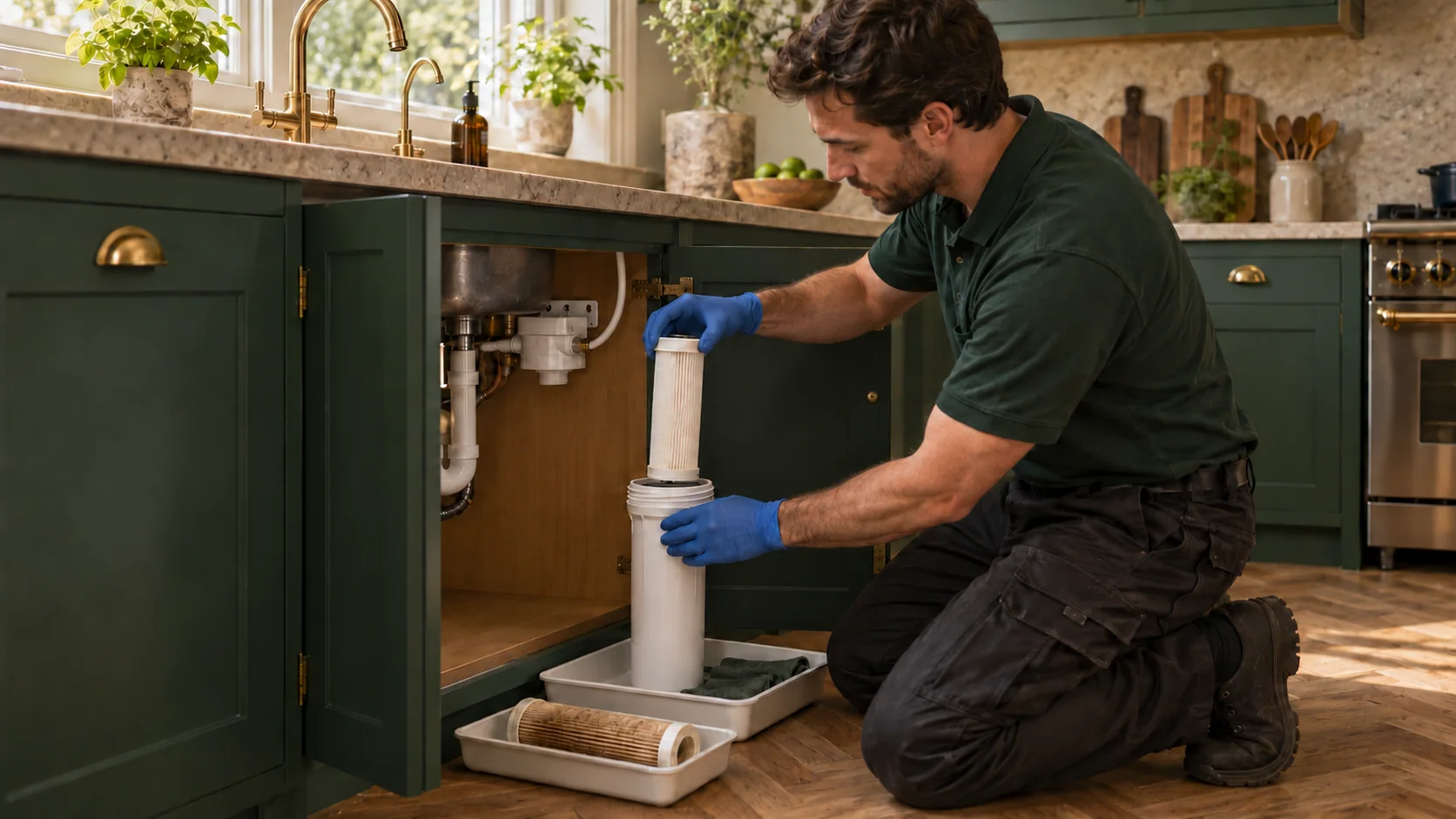
Keep the entire drinking-water path clean
Follow the manufacturer's instructions for the tank, downstream tubing, tap and cartridges—not only the membrane. Use the specified procedures after long periods without use.
Maintain a record of model numbers, cartridge changes and relevant operating checks. Investigate leaks, abnormal discharge or declining delivery rather than simply adding another filter.
/ 15
Choosing the right level of treatment
Swipe or scroll sideways to view the full table →
| Main objective | Sensible starting point |
|---|---|
| Improving drinking-water taste | Assess a suitable point-of-use carbon filter. |
| Addressing household hardness | Review a softener and separate drinking-water arrangements. |
| Specified RO drinking-water treatment | Check performance, delivery, post-treatment and discharge requirements. |
| Adding an electrolytic ioniser | Confirm compatibility of its actual feed water. |
| Optional hydrogen enrichment | Check the device's function, measured output and maintenance requirements. |
| No identified need for treatment | Investigate concerns and review supplier information before buying equipment. |
The best home water filtration system is not necessarily the largest. It is the one that meets your chosen objective without creating avoidable problems with space, delivery, hygiene or servicing.
/ 16
Home water filtration FAQs
Do London homes need a water filter
Not automatically. Start with your supplier's water-quality information and the result you want. A taste preference and a confirmed water-quality problem require different assessments.
Does a carbon filter soften hard water
Plain activated carbon is not conventional hardness-removal treatment. Some products combine different media, so check the complete specification rather than judging by the word “filter”.
Can reverse osmosis be fitted after a water softener
A compatible arrangement may use softened feed, but check the RO manufacturer's requirements. Specify the drinking-water outlet separately; an existing softener does not establish that the final water is suitable.
Do I need remineralisation after RO
It should be considered as part of drinking-water specification and is particularly important when the treated water must meet an electrolytic ioniser's requirements. Verify the selected post-treatment rather than assuming all mineral cartridges are equivalent.
Does a 10-litre RO tank supply ten litres of water
Not necessarily. Check whether the figure describes total vessel volume or usable water storage, and confirm performance under the relevant operating conditions.
Is hydrogen water the same as alkaline water
No. Alkalinity describes pH; hydrogen-rich water contains additional dissolved H2. One measurement does not establish the other.
Is a TDS meter a drinking-water safety test
No. It estimates dissolved-solids content, not individual contaminant concentrations or microbial safety.
How often should RO filters be changed
Follow the installed system's instructions and any specified usage limits. Pre-filters, membranes, mineral media and storage components may have different maintenance requirements.
/ 17
Plan your drinking-water installation with PEP
If you are considering water filtration in London, begin with the outcome you want—not a collection of appliances already ordered.
Send PEP your postcode, existing equipment details, available installation space and the water-supply information you have. Include photographs of the incoming supply and kitchen cupboard where possible.
Through our London plumbing services, we can review the installation requirements and coordinate the relevant plumbing and electrical work within an agreed scope.