
The London homeowner’s guide
Water Pressure Boosters for London Homes: From Compact Pumps to Whole-House Systems
Understand the supply. Match the demand. Choose a system that works for your home.
Find your starting pointA shower that weakens when someone opens the kitchen tap. A bath that takes too long to fill. An upstairs bathroom that never quite delivers the comfort its fittings promised.
These problems are often described as “low water pressure”, but they do not necessarily have the same cause — or need the same solution.
Some homes need a restriction removed or a supply pipe improved. Others can benefit from a compact mains booster. Where several bathrooms need water together, an accumulator or a properly designed pump-and-storage system may be more appropriate.
The right answer depends on what reaches your property, what happens inside the pipework and how your household actually uses water.
This guide explains the main domestic water boosting options, from small systems for London flats to larger installations serving family homes and multi-bathroom properties. It also covers the questions that matter before installation: space, noise, usable storage, hot-water compatibility, regulations and ongoing maintenance.
The aim is dependable water delivery throughout the home — with equipment sized for the job and a clear understanding of its limits.
Start here: which kind of solution might you need?
The following is a starting point for discussion, not a substitute for measurements.
| What you notice | What should be investigated |
|---|---|
| One tap or shower performs badly, while everything else works normally | A local restriction, fitting fault or unsuitable outlet before considering a dedicated booster |
| Water delivery is consistently weak throughout a small home | Incoming supply, internal restrictions and whether a suitable compact mains booster could meet demand |
| One shower works well, but performance falls when another outlet opens | Available flow under load, simultaneous demand and whether accumulation or stored-water boosting is appropriate |
| Several bathrooms must work comfortably together | A complete supply assessment, including pump duty, useful storage and refill performance |
| Pressure has suddenly deteriorated | A new fault, leak, valve issue or supply interruption before any equipment purchase |
A booster should follow the diagnosis. It should not replace it.
Planning an installation rather than comparing equipment? See our water booster and accumulator installation service in London for the assessment, coordinated installation and commissioning scope.
Water pressure, water flow and stored water: three different things
Understanding these three terms makes the rest of the decision much easier.
Water pressure
Pressure is commonly measured in bar. Static pressure is measured when water is not being drawn. Dynamic pressure is measured while water is flowing.
A reassuring static reading does not establish how the system performs during a busy morning. A useful dynamic reading should be recorded alongside the flow being drawn.

Water flow
Flow is the quantity of water delivered over time, normally expressed in litres per minute.
A supply can show reasonable standing pressure yet struggle to deliver enough water when several outlets open. Narrow or restrictive pipework can contribute to that problem.
Stored water
Storage allows a system to meet a period of demand that exceeds the water arriving at that moment.
However, stored water is finite. The system must have enough useful capacity for the intended demand and enough opportunity to replenish it.
A successful design considers all three together. Increasing pressure alone does not establish whether the home can sustain the required flow.
Before buying a booster, find out what is limiting the supply
A survey should establish whether the problem affects the whole property, the hot water only or individual outlets.
It should also distinguish a long-standing limitation from a recent change. A bathroom that has always struggled suggests a different investigation from a shower that became weak yesterday.
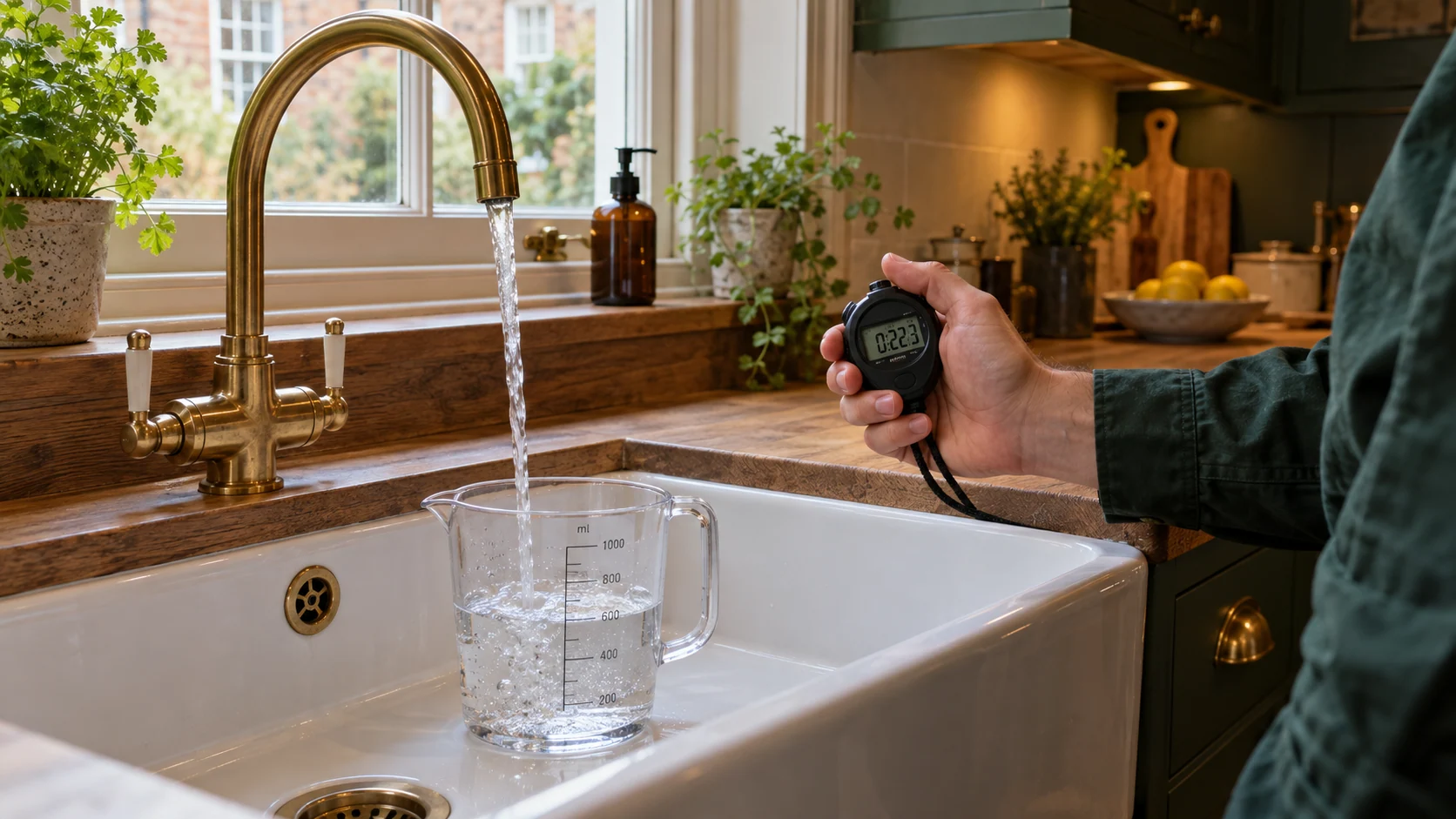
Checks may include:
- Incoming pressure and flow, including performance under simultaneous demand.
- Stop valves, pressure-reducing valves and accessible strainers.
- Filters, water softeners and other equipment in the supply route.
- Pipe sizes, long runs and restrictive connections.
- Possible leakage.
- The arrangement of shared supplies.
- Requirements of the boiler, cylinder and shower fittings.
In a converted building, the pipe serving the flat may be only part of the picture. A shared supply or communal boosting system can require investigation beyond the individual dwelling. Thames Water identifies older terraced properties as one setting where shared supplies may be present. Thames Water — water connections and shared supplies.
If the underlying problem is a defective valve or unsuitable pipework, installing a pump without addressing it can leave the household with extra equipment and disappointing results.
Not sure what is causing the problem? Start with our guide to diagnosing low water pressure in London homes before comparing booster equipment.
The main types of domestic water booster systems
1. Small boosters for individual outlets
A single-outlet booster is intended for a limited application, rather than supplying several bathrooms.
It may be worth considering where one suitable outlet needs assistance and the surrounding installation is otherwise adequate. Compatibility, incoming conditions and the manufacturer’s installation requirements remain important.
The first question is whether that outlet actually needs a pump. A restricted tap, unsuitable shower fitting or local obstruction should be investigated first.
This category should not be confused with a whole-house mains booster. Manufacturers distinguish between products intended for individual outlets and those designed for broader household use. Salamander — domestic mains boosting range.
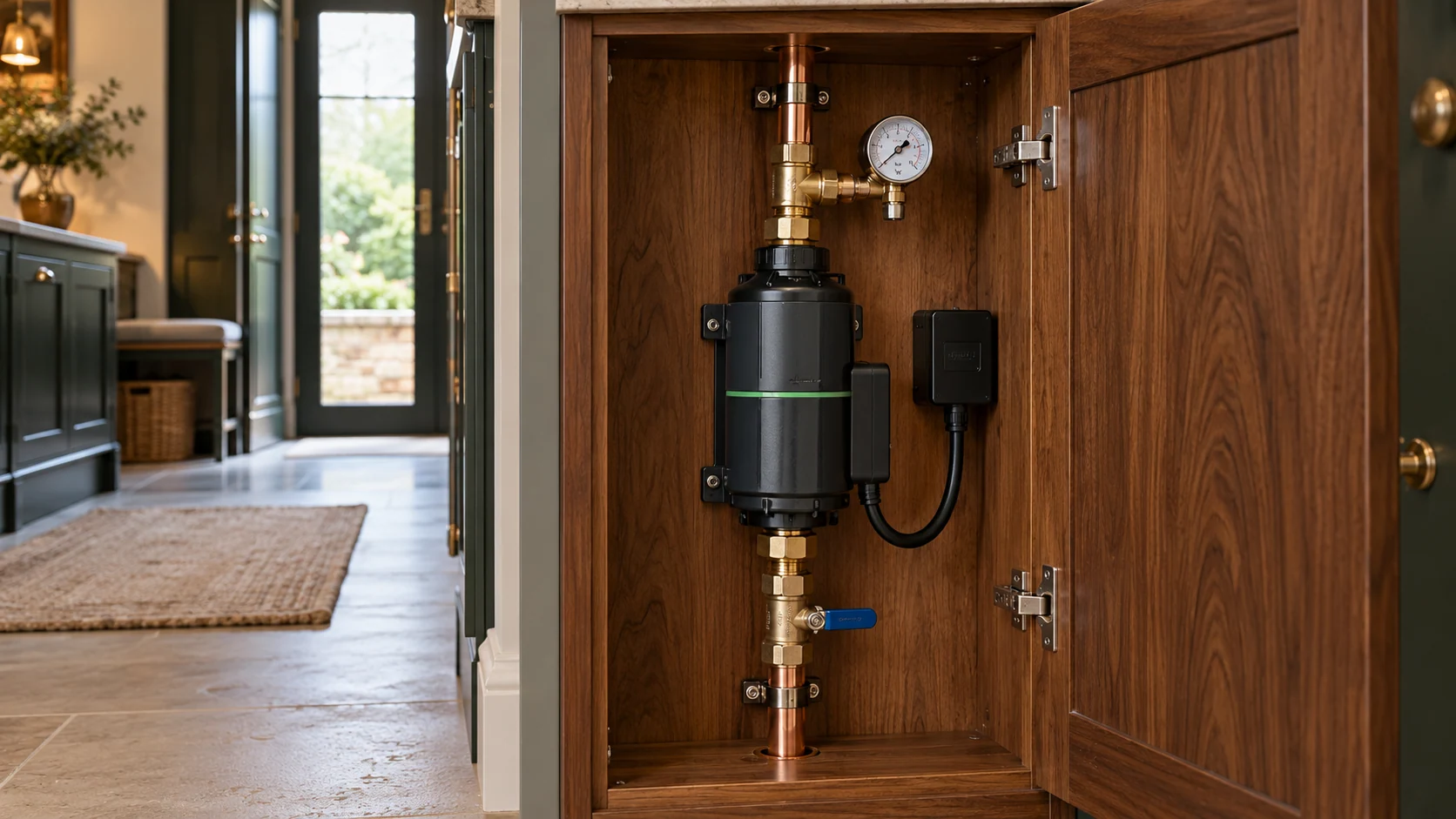
2. Compact inline mains boosters
An inline mains booster is installed in the incoming water supply arrangement and adds pressure within its operating limits.
These devices can be attractive where space is limited and the household’s requirements are modest. Certain models are designed to limit pumped flow to 12 litres per minute; STORMBOOST is one example. Stuart Turner — STORMBOOST.
That figure needs context. It is not an allowance of 12 litres per minute for every outlet operating at once.
A compact booster might improve a one-bathroom home while still being unsuitable for two high-flow showers running together. The installer must also check the minimum incoming conditions, permitted connections and appliance compatibility.
Compact equipment is useful when it matches the problem. Its small size does not make it a universal solution.
3. Unpumped accumulator vessels
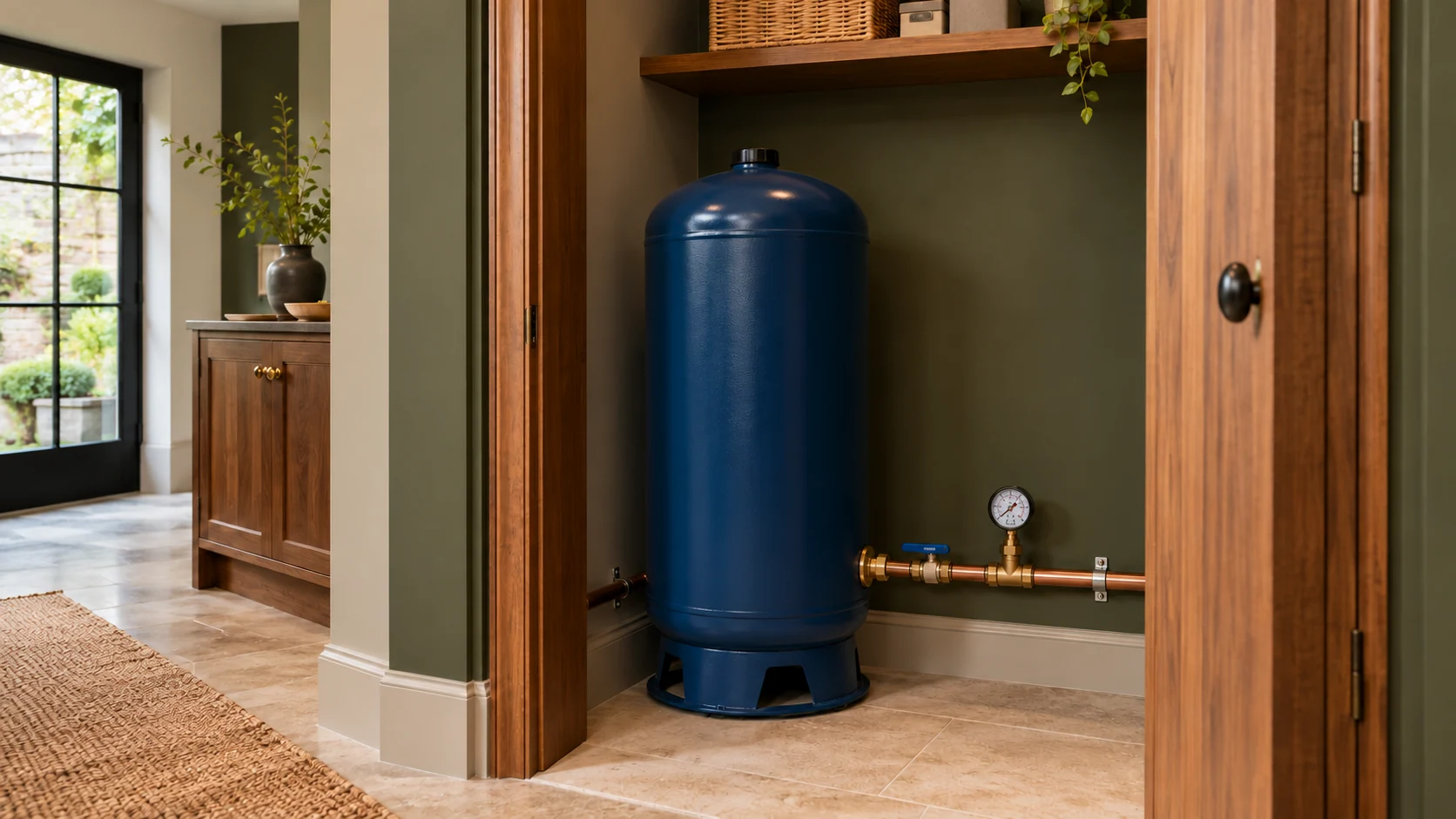
An accumulator stores water under pressure. In an unpumped arrangement, the incoming supply charges the vessel; stored water can then supplement delivery during a period of higher demand.
This can be helpful where the charging pressure is suitable but the available flow struggles when more than one outlet is used.
An unpumped accumulator cannot create pressure above the supply that charges it. Its performance also changes as stored water is drawn down.
The suitability of an accumulator therefore depends on the incoming conditions, vessel selection and required duration of use — not simply the space available for a tank. Salamander — accumulator operating principles.
4. Pump-assisted accumulator systems
Some accumulator arrangements use a pump to support charging or delivery where the natural supply is insufficient for a passive arrangement.
The important questions are how the particular system operates, how much useful water it stores, how quickly it recovers and what remains available after the stored contribution has been used.
A pump-assisted accumulator is not the same as an atmospheric break tank with a downstream booster. They need separate consideration rather than being grouped together as interchangeable “pump and tank” products.
Product-specific requirements matter, including the condition of the incoming supply and protection against excessive pressure. Salamander — accumulator installation guidance.
5. Integrated break-tank and booster packages
A break-tank system stores incoming water in a suitable cistern. A pump draws from that stored supply to serve the property.
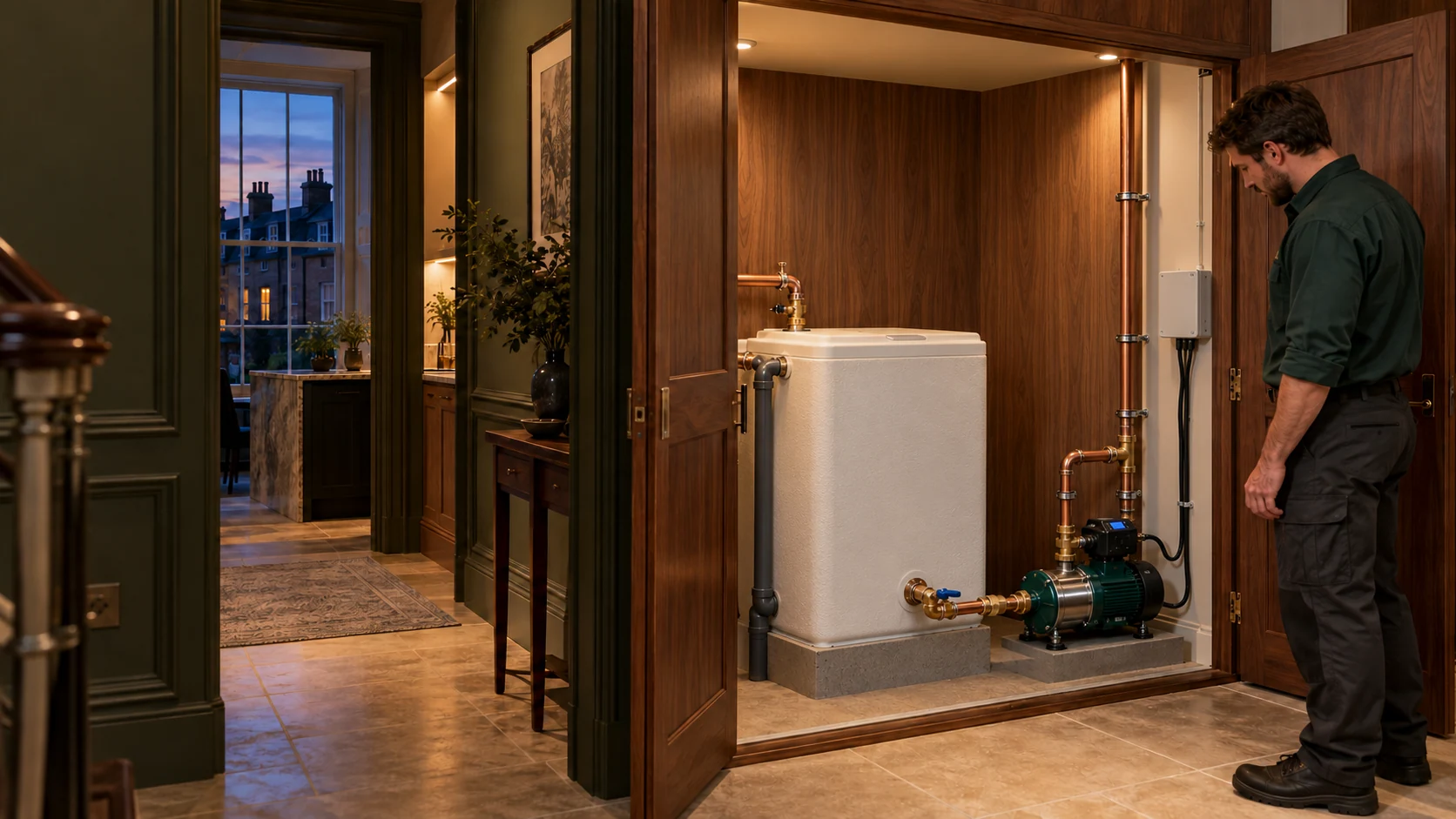
Integrated packages bring the tank, pump and controls into a coordinated assembly. They can provide a practical route where the home needs more instantaneous flow than the incoming supply can deliver.
Their suitability still depends on useful storage, refill rate, pump performance and access. A compact package must be assessed against the household’s busiest period, not just whether it fits inside a cupboard.
Manufacturers offer different storage and performance options within this category. Salamander — TankBoost systems.
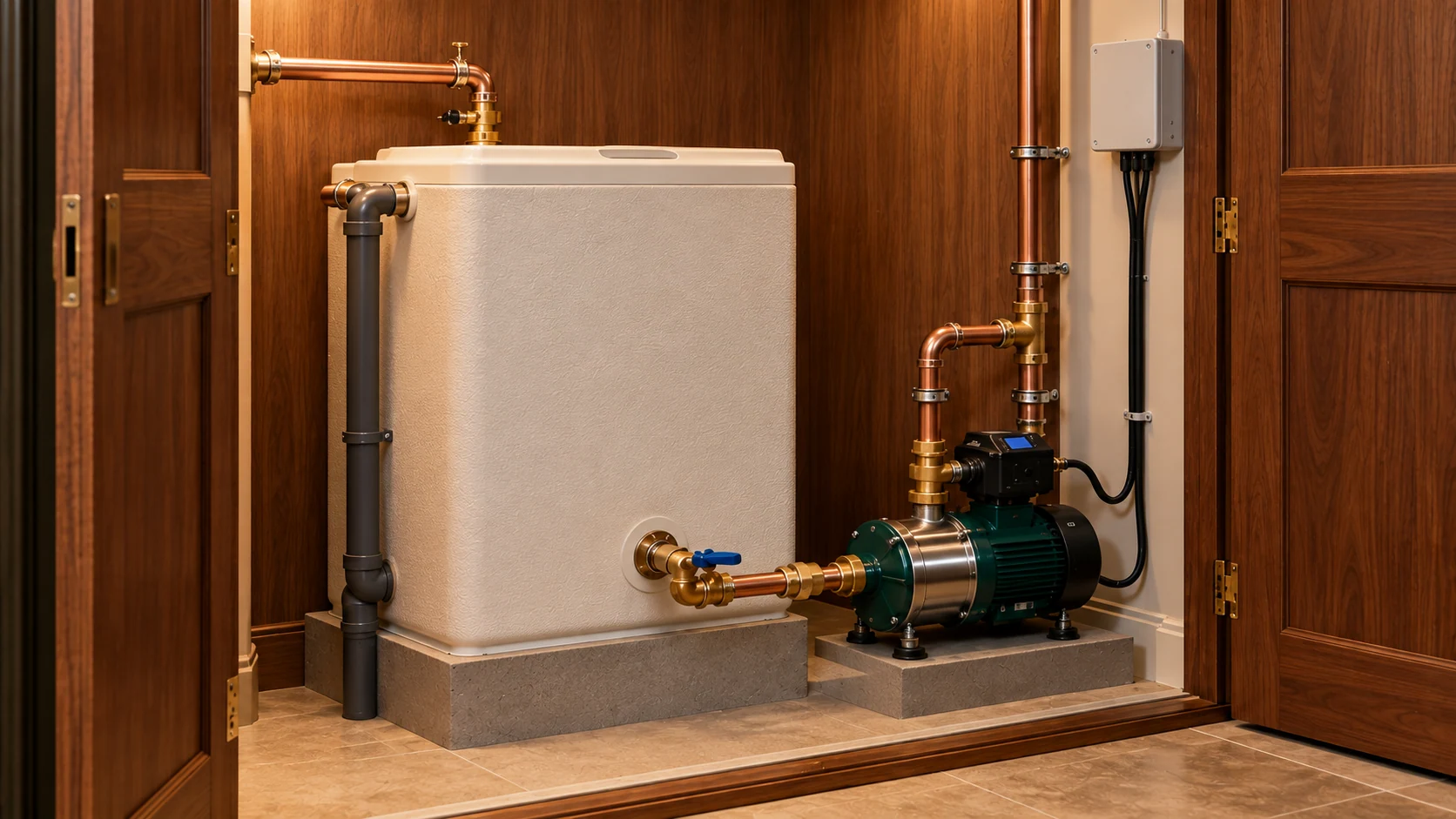
6. Separate tanks and variable-speed pumps
A separately arranged tank and booster can provide greater flexibility where the building does not suit an integrated package.
Tank position, pump location and the connecting pipework can be coordinated around the property. This can be particularly useful during a larger refurbishment.
Variable-speed control adjusts pump operation in response to demand, within the equipment’s capabilities. It does not remove the need for adequate water storage or correctly sized pipework.
Also, a compact pump’s built-in pressure vessel should not be mistaken for a meaningful household water reserve. For example, DAB lists a one-litre integrated vessel in its Esybox Mini³ technical documentation; a storage-fed installation requires its storage arrangements to be considered separately. DAB — Esybox Mini³ product information.
7. Twin-pump systems for larger properties
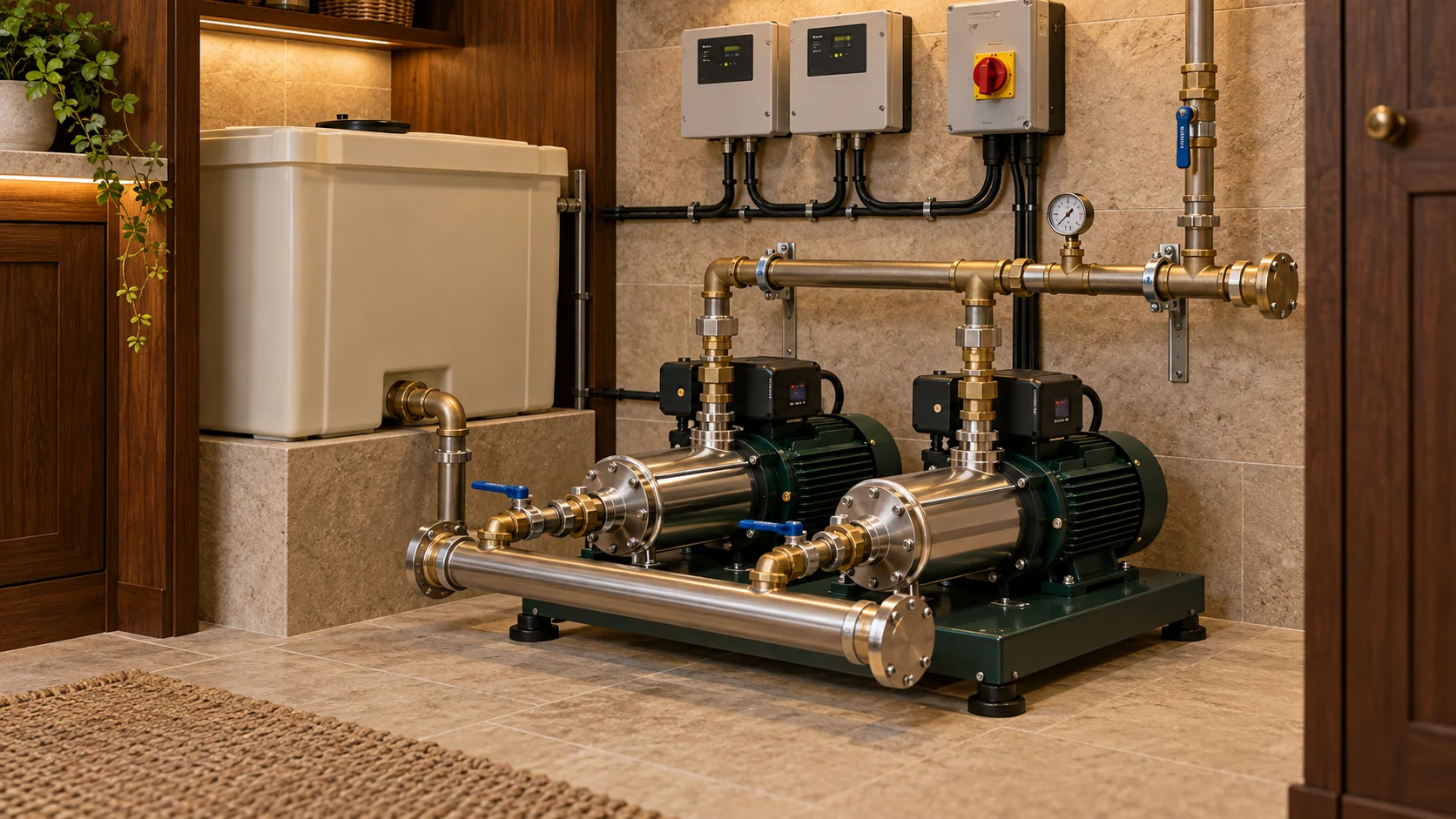
A twin-pump installation may be appropriate where demand, resilience or both justify it.
The operating arrangement matters:
- Duty/standby: one pump operates, with another available as a reserve.
- Duty/assist: an additional pump contributes when demand increases.
Two pumps do not automatically provide twice the usable flow at every pressure. Nor does a standby pump guarantee normal performance under every failure condition.
The specification should explain the intended duty, what happens if a pump becomes unavailable and whether shared components remain potential points of failure. Manufacturers offer both single- and twin-pump tank systems for different applications. Dutypoint — ScubaTANK.
8. Pumps for gravity-fed systems
Homes retaining a cold-water storage cistern and vented hot-water cylinder may need a different type of pump altogether.
A suitable shower or whole-house pump can serve an appropriately arranged gravity-fed installation. Selection depends on the available natural flow, the location of outlets and whether a positive-head or universal arrangement is required.
A conventional gravity-fed shower pump must not be assumed suitable for direct connection to the mains. Grundfos — shower pump applications.
Small homes and large homes need different assessments — not automatic product labels
The following situations illustrate the selection process. They are not equipment specifications.
A flat or small house with one bathroom
Space, noise and access may be as important as pump performance.
The assessment should establish what happens when the shower, kitchen tap and toilet refill overlap. If the incoming conditions and expected demand suit a compact mains booster, a large storage installation may be unnecessary.
However, “one bathroom” is not enough information on its own. A large shower head can create a substantially different requirement from a modest-flow shower.
In a flat, the assessment must also establish whether the water supply is independent, shared or already boosted at building level.
A family home with two bathrooms
Here, the question often becomes: can both bathrooms work comfortably during the same period?
The answer depends on the actual outlets and how the household uses them. Two showers, a bath filling and a kitchen tap create different combinations of demand.
An accumulator may be worth assessing where the charging conditions are suitable. A tank-and-booster system may be more appropriate where greater controlled delivery and stored capacity are needed.
The hot-water system must be assessed alongside the cold-water supply.
Where the property has an unvented cylinder, our guide to cylinder servicing explains the role of inlet controls, expansion provision and safety checks. A booster is not a substitute for resolving a cylinder fault.
If you are also upgrading hot-water storage, our unvented cylinder installation service considers the cylinder and incoming water supply together.
A larger house with several bathrooms
Larger homes need a coordinated view of water delivery from the incoming connection to the most demanding outlet.
The assessment may include several floors, long pipe runs, large baths, high-flow showers and overlapping use by different household members.
A larger tank or twin-pump set may form part of the answer, but neither should be selected merely because the property has several bedrooms.
The design should state what level of simultaneous use it is intended to support. That is more useful than describing a system as “suitable for a luxury home”.

How boosters work with combi boilers and unvented cylinders
Combi boilers: improve the supply, but respect the heating limit
A suitable booster arrangement may help where the combi boiler’s incoming water supply is the limiting factor.
However, the boiler still has a finite ability to heat water as it passes through. Its hot-water output depends on the appliance and the temperature rise required.
Improving the cold supply does not turn a smaller combi into a higher-output model. Nor does it ensure that two showers can receive the desired hot-water flow simultaneously. Worcester Bosch specifically highlights the need to allow for hot and cold outlets being used together when assessing the supply. Worcester Bosch — mains supply and combi performance.
If you are considering removing a cylinder and loft tanks, read our guide to conventional-to-combi boiler conversion in London. Water delivery should be checked before committing to the conversion.
Unvented cylinders: cold supply and hot-water storage must work together
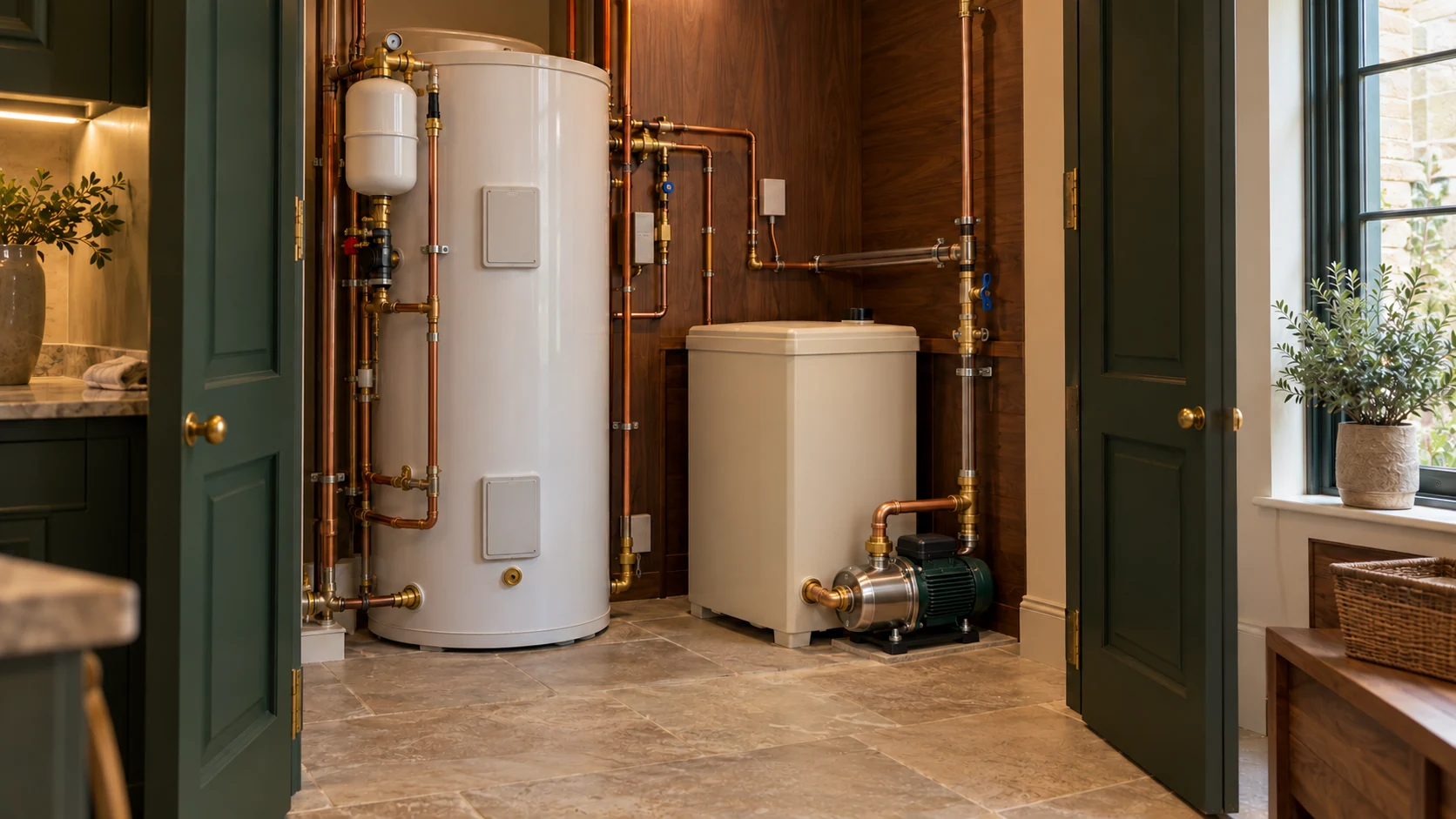
An unvented cylinder stores hot water, but it still needs an adequate cold-water supply to deliver the intended performance.
A booster may address an incoming supply limitation. It does not increase the cylinder’s hot-water storage capacity or recovery rate.
The arrangement must respect the cylinder manufacturer’s requirements, retain the necessary controls and provide appropriate hot-and-cold pressure balance at outlets. Turning up pump pressure is not a substitute for correct integration. Salamander — TankBoost compatibility guidance.
Our guide to vented-to-unvented hot-water conversion in London explains the wider decisions involved.
Choosing pump performance: why the biggest numbers can mislead
Pump literature commonly lists a maximum flow and a maximum head or pressure.
These should not be read as a promise that both are available simultaneously.
What matters is the pump’s ability to deliver the required flow at the required pressure, allowing for the installation’s characteristics. This is assessed using the performance curve and the intended duty point. Grundfos — understanding duty points.
The assessment also needs to account for the route to the outlet: elevation, pipework and components can all affect what arrives there.
A specification should therefore answer a practical question:
What can this system deliver at the outlets we intend to use together?
“Maximum 5 bar” or “up to 80 litres per minute” does not answer that question on its own.
If a water softener is also planned, include its flow and pressure-loss characteristics in the system assessment. Our water softener guide for London homes explains why household demand, treatment capacity and connecting pipework need to be considered together.
Planning filtration as well? Our home water filtration guide explains whole-house and drinking-water arrangements, including flow requirements, treatment stages and maintenance access.
How much stored water does a home need?
There is no reliable universal answer based solely on bedroom count.
Storage selection should consider:
- The expected demand during a busy period.
- How long that demand continues.
- The water entering the tank during the same period.
- The useful capacity available between operating levels.
- The time available to replenish the reserve.
A simple example
Suppose two showers each use 10 litres per minute and a kitchen tap uses another 6 litres per minute.
The combined demand is 26 litres per minute.
If the tank is receiving 10 litres per minute while those outlets run, stored water supplies the remaining 16 litres per minute.
Over ten minutes, that represents 160 litres of drawdown.
This is an illustrative water balance, not a recommendation to buy a 160-litre tank. The final selection must include operating levels, reserve, actual refill behaviour and the installation’s wider requirements.
Nominal capacity is not always usable capacity
This distinction is particularly important with accumulators.
Part of a pressure vessel’s volume accommodates compressed gas, and the amount of water available depends on its operating conditions. A nominal 450-litre accumulator should not be assumed to provide 450 litres of usable water. Salamander’s corresponding product documentation explicitly distinguishes vessel size from water storage capacity. Salamander — accumulator capacity example.
A useful proposal should state usable storage and the demand assumptions behind it.
Water regulations and the 12-litre-per-minute rule
For installations in England, Regulation 5 of the Water Supply (Water Fittings) Regulations requires advance notification and consent for a pump or booster drawing more than 12 litres per minute and connected directly or indirectly to a supply pipe. Water Regs UK — Regulation 5.
This is not the same as saying that every arrangement above 12 litres per minute is prohibited. Equally, adding a break tank does not automatically remove the notification requirement.
The proposed arrangement must be checked against the relevant water supplier’s requirements, including appropriate backflow protection. Smaller systems still need to comply with the applicable installation rules.
Product approval is also different from approval of the complete installation. A suitable component can still be installed incorrectly.
These matters should be resolved during design, before equipment is fitted.
Where can a water booster system be installed?
The right location balances hydraulic performance with the practical realities of the building.
Space and access
A unit fitting through the cupboard door is only the beginning.
There must be suitable access to inspect, isolate, service and eventually replace its components. Boxing equipment tightly behind finished joinery can make routine maintenance unnecessarily disruptive.
A tank-fed booster needs protection designed around the water already stored, not just the incoming supply. Our water leak protection guide explains the difference.
Weight and support
Stored water adds significant weight. The supporting structure and the equipment’s load distribution need consideration, especially on suspended floors.
Large equipment should not be positioned on the assumption that an existing cupboard floor is adequate.
Noise and vibration
Noise depends on more than the pump’s quoted sound level. Mounting, pipe connections, nearby walls and the building structure can influence what occupants hear.
A bedroom-adjacent cupboard requires a different conversation from a separate plant room. Noise control should be planned before installation rather than treated as a finishing detail.
Water hygiene
Cold-water storage should be protected from contamination, excessive warming and avoidable stagnation. Storage volume and turnover need to be considered together.
HSE guidance highlights the importance of appropriate storage conditions, water turnover and avoiding stagnant sections. Maintenance arrangements should be proportionate to the property and system. HSE — cold-water storage considerations.
Leak and overflow arrangements
The design should consider what happens if a fitting leaks or a tank inlet does not close correctly.
Overflow routes, warning arrangements and any appropriate leak detection should be addressed before equipment is enclosed.
From initial survey to a properly commissioned installation
A good installation process produces more than a pump that switches on.
Establish the problem
Record the symptoms, affected outlets and times when performance deteriorates. Review any planned bathroom, kitchen or hot-water changes.
Measure the available supply
Assess pressure and flow under relevant conditions. Where performance varies significantly, additional measurements may be needed.
Define the required performance
Agree which outlets should work together and what level of delivery they require. This creates a clear basis for selecting the system.
Compare suitable options
Consider supply improvements, compact boosting, accumulation and tank-fed systems where appropriate. Review space, maintenance, noise and the implications for existing equipment.
Coordinate the installation
Resolve the equipment location, pipework, electrical supply, controls, access and any required notifications or permissions.
If boosting forms part of a wider refurbishment, plan it within a coordinated heating and hot-water system, with the pump, cylinder, distribution pipework and controls assessed together.
Install and commission
The installation should be checked and commissioned in accordance with its design and the relevant manufacturer’s instructions.
The important test is not simply whether a nearby tap feels stronger. Performance should be assessed against the agreed simultaneous-use conditions, including refill behaviour where storage is involved.
Hand over the system
The owner should receive clear operating information, relevant documentation and an explanation of isolation points, alarms and maintenance requirements.
The result should be understandable as well as functional.
How much does water booster installation cost?
A useful quotation needs a defined scope.
The equipment price for a small inline booster cannot be compared directly with the installed cost of a complete storage-fed system.
The overall cost can include:
- Survey and specification.
- Pump, accumulator or storage tank.
- Controls, valves and associated components.
- Pipework alterations.
- Electrical work.
- Structural support where required.
- Overflow and leak-protection arrangements.
- Access work and making good.
- Commissioning and handover.
- Any separately priced permissions or associated works.
A straightforward installation in an accessible location can be very different from fitting equipment into a finished London flat or creating a plant space during a refurbishment.
For that reason, a meaningful price should follow an assessment rather than a bedroom-count questionnaire.
When comparing quotations, ask what performance each proposal is intended to provide, what is included and what assumptions could change the price. The cheapest equipment package may not represent the lowest complete installation cost.
Running costs, servicing and long-term ownership
Powered boosters use electricity, but their consumption depends on how the household uses water and how the system operates.
Variable-speed control can match operation more closely to changing demand. Actual energy use still depends on the selected equipment, pressure settings and duty. DAB — variable-speed domestic boosting.
Maintenance should follow the manufacturer’s requirements and the needs of the installation. Depending on the system, checks may cover pumps, controls, vessel condition, filters, leaks, tank hygiene and protective functions.
An unpumped accumulator avoids pump electricity consumption, but it should not be described as requiring no inspection or maintenance.
Long-term suitability also includes access to parts, service support and whether individual components can be replaced without dismantling the surrounding room.
When a booster is not the right first step
A booster may be unnecessary, or only part of the solution, where the main issue is:
- A local restriction or faulty fitting.
- A leak or recent supply problem.
- A defective pressure-reducing valve.
- Restrictive internal pipework.
- An inadequate or shared supply requiring wider investigation.
- A combi boiler’s hot-water heating limit.
- Insufficient hot-water storage for the household.
- A problem in communal equipment serving a block.
Low pressure can also be a symptom of leakage, so a recent unexplained change deserves investigation. Thames Water — identifying leaks at home.
Sometimes the best investment is repairing or improving the existing supply. Sometimes boosting and pipework improvements belong in the same project.
The recommendation should follow the evidence.
Frequently asked questions
Will a booster allow two showers to run at once?
It may, if the incoming supply, pump, storage, pipework and hot-water system can support their combined requirements.
The answer depends on the actual shower flows and the rest of the household demand. A product labelled “whole house” is not enough to establish simultaneous shower performance.
Can a booster be installed in a small London flat?
Potentially. Compact solutions exist, but the supply arrangement, equipment compatibility, noise and access must be assessed.
Where the flat shares a supply or uses communal plant, an individual pump should not be selected without understanding the wider system.
Does installing a booster mean bringing back the loft tank?
Not necessarily.
A modern system may use a purpose-designed tank in a utility area or other suitable location. The need for storage, and where it can safely be placed, should be assessed separately from the decision to remove an old gravity-fed installation.
Is an accumulator the same as an expansion vessel?
No. They may share pressure-vessel principles, but their intended functions are different.
An accumulator provides a usable water reserve under pressure. An expansion vessel accommodates volume changes or serves another specified pressure-control function. A small vessel supplied with a pump should not be treated as a substitute for calculated water storage.
Will a booster fix the low-pressure reading on my boiler?
Not necessarily. On many boilers, the displayed pressure relates to the sealed central-heating circuit, not the domestic water supply feeding taps and showers.
Those are different systems. A falling heating-circuit pressure requires its own diagnosis.
What happens during a power cut?
Powered boosting stops unless an appropriate backup arrangement has been designed.
Whether any water remains available depends on the pipework, bypass arrangements, mains conditions and equipment. Stored water alone does not guarantee normal delivery during a power failure. This should be explained at handover.
Can the system be sized for a future bathroom?
Yes, planned demand can be considered during design.
However, future capacity should be specified sensibly. Oversized storage and equipment installed years before they are needed can introduce unnecessary cost and operational compromises.
What should I send before arranging an assessment?
A brief description of the symptoms, the number of bathrooms, which outlets you want to use together and details of any planned changes are useful.
Photographs of the incoming water arrangement, boiler or cylinder and possible equipment locations can help prepare the discussion. Final selection still depends on appropriate measurements and site conditions.
A water supply designed around your home
A comfortable bathroom depends on the system behind it: the incoming supply, the distribution pipework, the hot-water equipment and the way several outlets interact.
For a small home, the right improvement may be compact and straightforward. For a larger property, it may involve storage, variable-speed pumping and coordinated controls.
Either way, the starting point is the same: understand what the property receives, define what the household needs and select an arrangement capable of bridging the gap.
PEP can discuss water-pressure improvements alongside your wider London plumbing requirements, including planned bathroom works and changes to the hot-water system.
Tell us where performance falls short and how you want the home to work. The next step is an assessment — followed by a clear recommendation for the property.