
The London homeowner’s guide
Vented to Unvented Hot Water Conversion: A London Homeowner’s Guide
A better hot-water system starts with understanding the supply, the demand and the installation — not simply choosing a larger cylinder.
Explore the conversionA weak upstairs shower, a slow-filling bath or a cold-water tank occupying valuable loft space can make a traditional hot-water system feel ready for an upgrade.
Replacing a vented cylinder with an unvented hot-water cylinder can be a worthwhile improvement. It changes how stored hot water is supplied to your taps and showers, while allowing you to retain the benefits of a cylinder.
For the ongoing care of the completed installation, read our unvented cylinder servicing guide for annual checks, service records and warning signs that need attention.
However, the result depends on more than the new equipment. The incoming water supply, distribution pipework, household demand and safety arrangements all need to work together.
There is also an important distinction: converting your domestic hot water to unvented operation does not automatically mean replacing your boiler or converting the radiator circuit to a sealed system. Suitable unvented cylinders can work with regular boilers and appropriately designed open-vented heating arrangements. Vaillant’s uniSTOR guidance confirms these combinations.
This guide explains what changes, what may remain, what should be checked before ordering equipment, and what a complete conversion should include.
What does a vented-to-unvented conversion actually change?
A traditional vented cylinder receives its cold-water supply from a separate storage cistern, commonly located in the loft. Gravity provides the pressure, with the available head determined by the height of the water level above the outlet.
An unvented cylinder uses a suitably controlled incoming mains supply instead. It stores hot water in a closed vessel, with dedicated provisions for pressure control, thermal expansion and safety.
Both systems store hot water. The difference is how that water is supplied and controlled.
This is separate from whether the cylinder is directly or indirectly heated:
- A direct cylinder heats its stored water using electric immersion heaters.
- An indirect cylinder receives heat from an external source, such as a boiler, through a heat exchanger.
Choosing vented or unvented describes the water-storage arrangement. Choosing direct or indirect describes the heating method. Vaillant explains these distinctions.
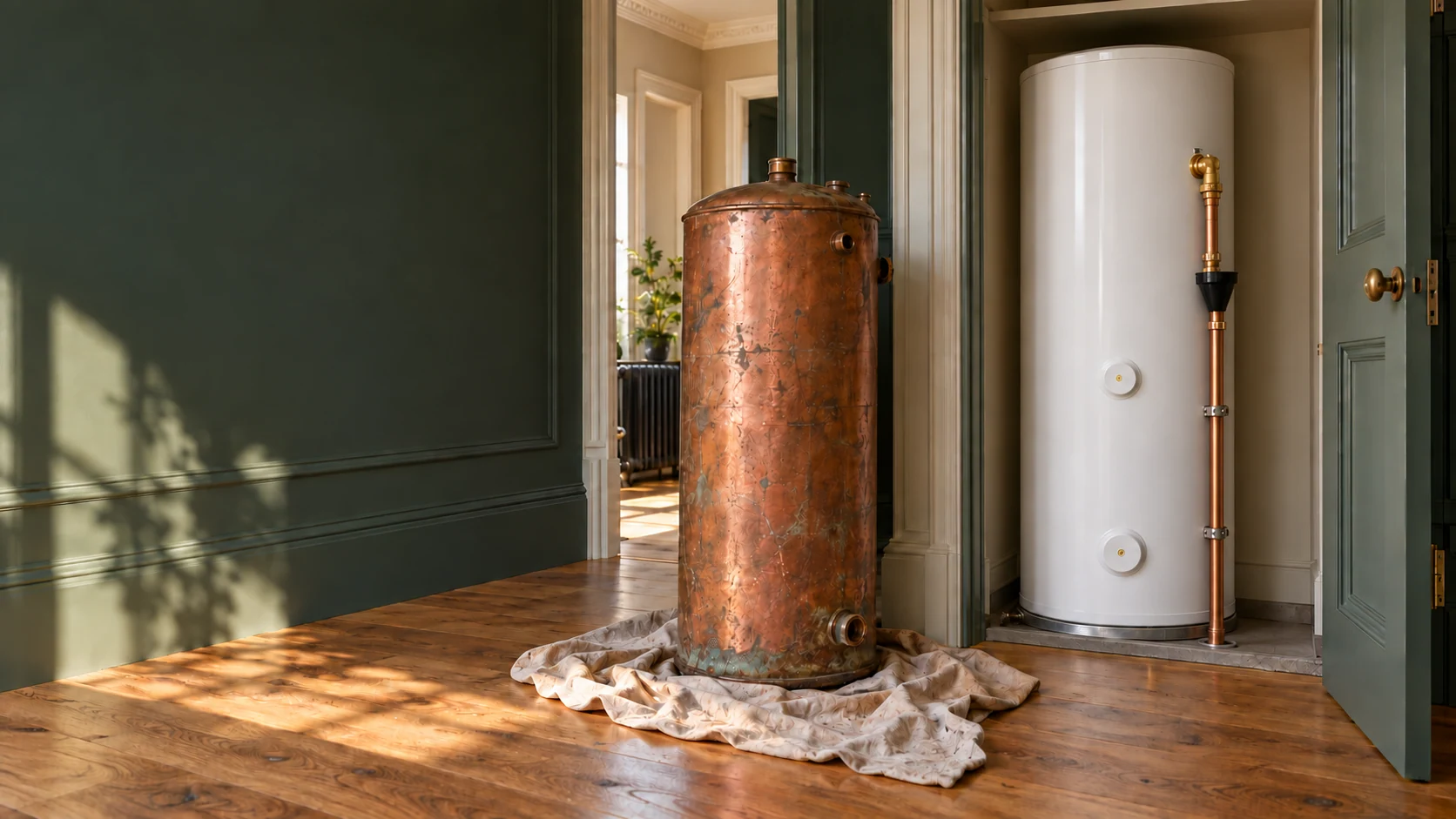
A conversion normally replaces the existing vented cylinder with equipment designed for unvented operation. It is not achieved by blocking the vent on an ordinary copper cylinder and exposing it to mains pressure.
The project also includes the connections, controls, safety equipment and affected outlets. Those surrounding details determine whether the finished installation performs as intended.
What happens to the two tanks in the loft?
In the familiar boiler-and-cylinder arrangement, the two loft tanks have different jobs.
The larger cold-water storage cistern supplies the hot-water cylinder and may also feed cold outlets. The smaller feed-and-expansion cistern serves the heating circuit. Baxi’s heat-only boiler guide explains their separate functions.
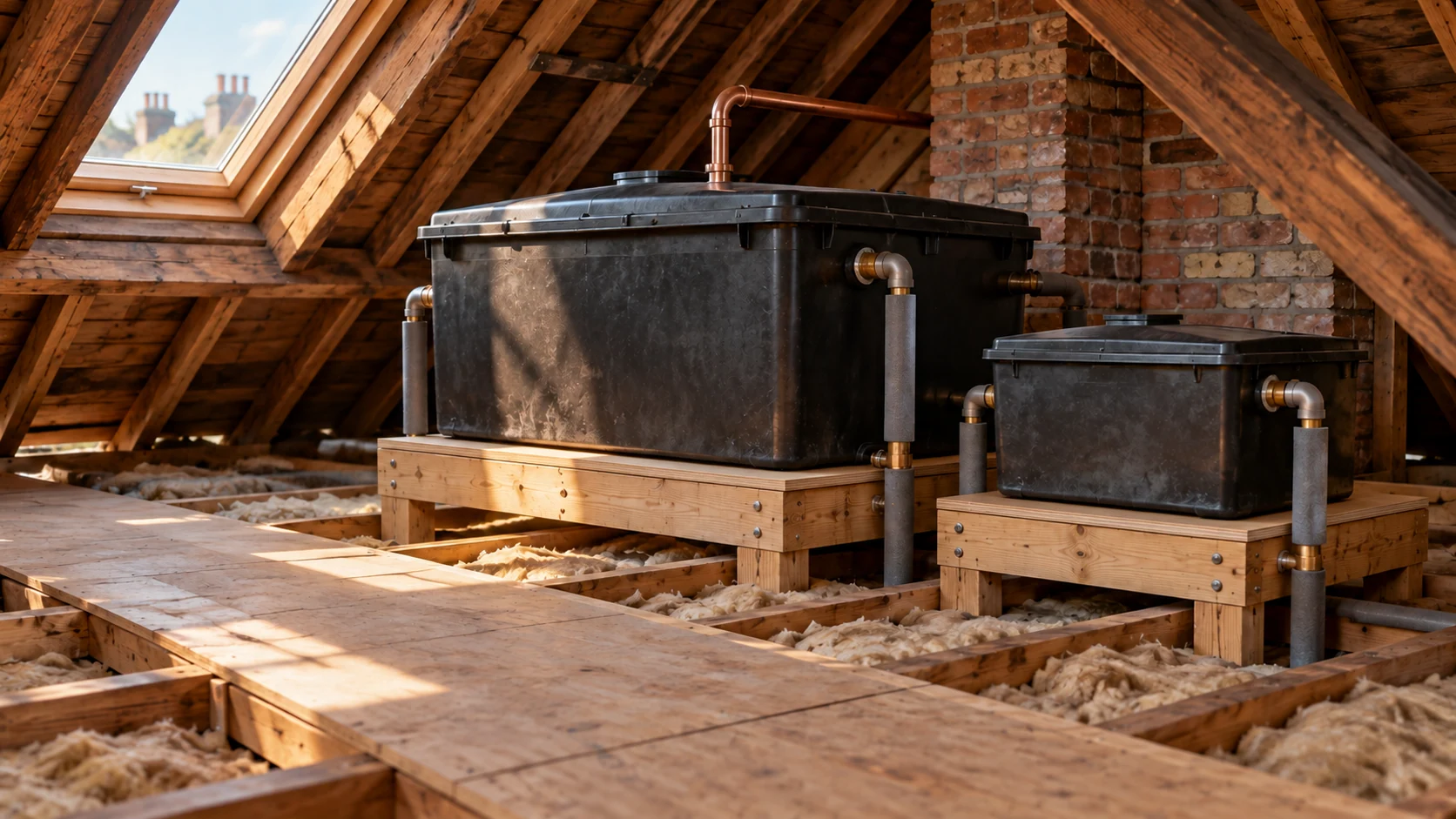
| Existing component | What changes during a hot-water conversion? |
|---|---|
| Vented hot-water cylinder | Replaced with a suitable unvented cylinder |
| Large cold-water storage cistern | Can become redundant once every connected service has been correctly addressed |
| Small heating feed-and-expansion cistern | May remain if the heating circuit stays open-vented |
| Regular or heat-only boiler | May remain if suitable for the proposed installation |
| Existing shower pump | Assessed separately for removal or replacement |
An installer should establish what each tank supplies before disconnecting it. Previous alterations, shared services and concealed pipework can make the arrangement less straightforward than it appears.
Removing the large cistern may release useful loft space. It does not necessarily mean that both tanks can disappear.
If the aim is to remove all loft tanks, that should be stated at the survey stage. It may require a separate change to the heating arrangement.
Also distinguish between disconnecting a tank and physically removing it from the building. A large cistern may not pass through the loft hatch, and removal should be included explicitly in the agreed scope.
Can you keep your existing boiler and radiators?
Often, the answer is yes — but compatibility must be assessed.
An indirect unvented cylinder does not automatically require a new system boiler. A serviceable regular boiler may remain, provided the proposed cylinder, primary circulation, controls and safety arrangements are suitable.
There may still be alterations to pipework or controls. Keeping the boiler does not necessarily make the job a simple cylinder exchange.
It helps to separate three possible projects:
- Converting the domestic hot-water storage to unvented operation.
- Converting an open-vented heating circuit to sealed operation.
- Replacing the boiler.
These can be undertaken together, but they are not the same decision.
If the radiator circuit remains unchanged, a hot-water conversion does not automatically require new radiators. If sealed heating operation is also proposed, the condition and suitability of the retained circuit need separate consideration.
Ask the quotation to identify which changes are necessary, which are optional and why. That makes the proposal easier to understand and compare.
The control arrangement must also distinguish cylinder heating from space heating. Our guide to heating controls and hot-water priority explains how those demands can be coordinated without compromising the cylinder’s independent safety functions.
Why the incoming mains supply matters more than the cylinder badge
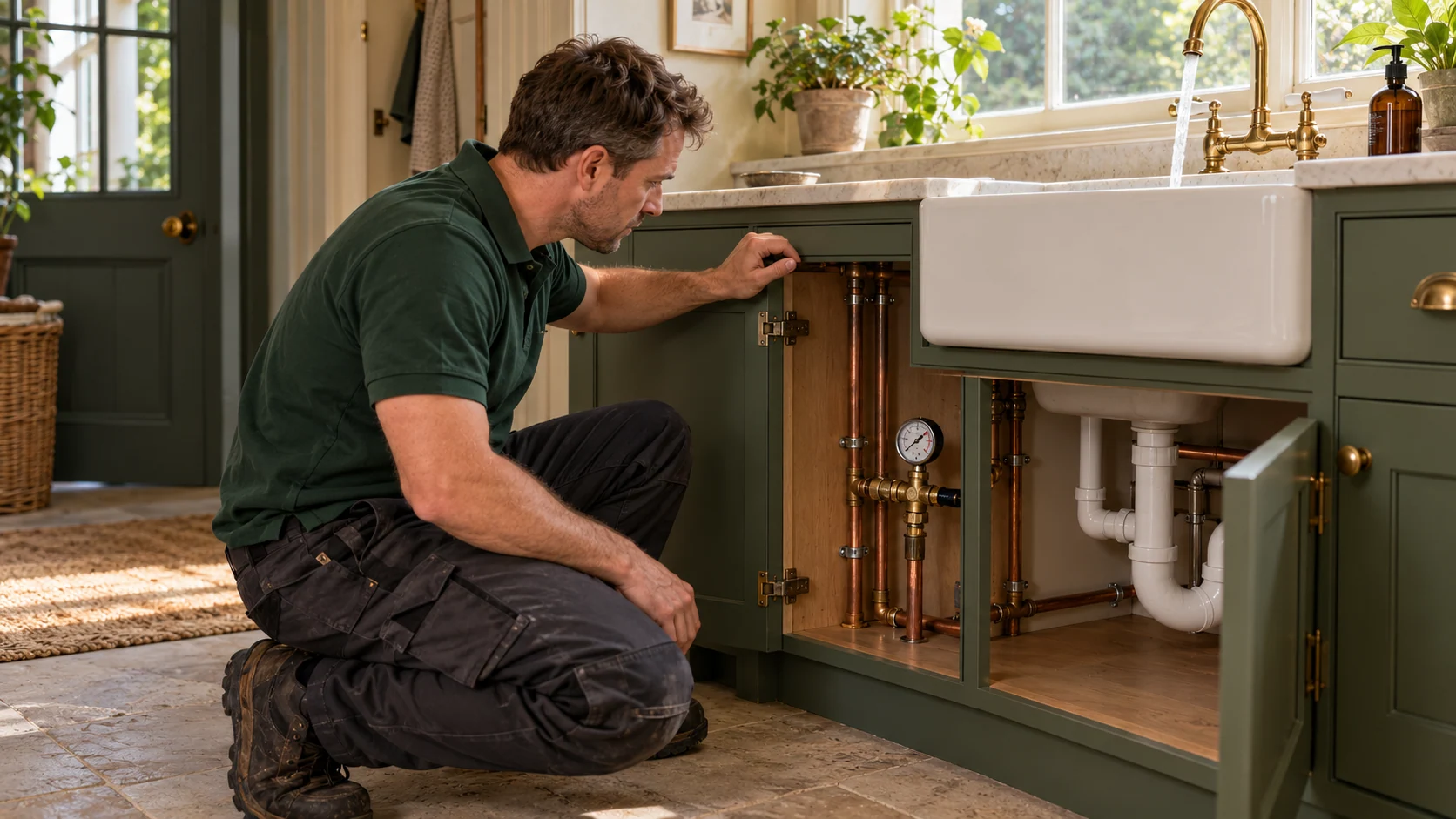
An unvented cylinder stores heated water. It does not manufacture incoming water pressure or unlimited flow.
Pressure and flow are different measurements. Pressure describes the force available to move water; flow describes the volume delivered over time.
A high reading with every tap closed does not establish how the system will perform while water is being used. The assessment needs working pressure and available flow under relevant demand. Manufacturer guidance specifically warns that high mains pressure does not necessarily mean high flow. UK Cylinders’ installation guidance
Consider a simple example:
Two showers using 10 litres per minute each require 20 litres per minute together. Another outlet drawing 6 litres per minute brings the combined demand to 26 litres per minute.
Those figures are illustrative, not a specification for every home. They show why “we have good pressure” is not enough to establish simultaneous performance.
The survey should consider the supply available when you actually need it. A shared connection can behave differently during a quiet afternoon and a busy morning. Thames Water notes that some older shared supplies struggle with modern demand and may require improvement or separation. Thames Water’s connection guidance
What if the incoming supply is weak?
First establish the cause. A restricted pipe, partially closed valve, shared supply or insufficient available pressure can require different remedies.
Options may include improving the supply pipework, separating a shared connection, or assessing home water boosters and accumulators.
Ready to plan the work? PEP’s unvented cylinder installation service sets out the assessment, quotation and handover for a suitable conversion.
Planning this upgrade in Notting Hill W11? Our local page explains planning an unvented cylinder installation in Notting Hill, including the project scope and assessment route.
These are not interchangeable solutions. An accumulator stores water under pressure for periods of demand; a booster uses a pump to increase pressure. A break-tank arrangement introduces a separate stored cold-water supply into the design. The appropriate choice depends on measurements, demand, space and the water supplier’s requirements. Stuart Turner’s homeowner guidance
This assessment should happen before promising the performance of a new cylinder.
For help identifying the symptoms before planning a conversion, read our guide to low water pressure, flow checks and the right investigation. It explains why a single static-pressure reading is not the full picture.
A planned softener also belongs in the supply assessment. Our water softener selection guide covers simultaneous demand, pressure loss and coordinating treatment with the cylinder manufacturer’s requirements.
If the conversion requires improvements to water delivery, our booster and accumulator installation service can be considered as part of the overall design.
Choosing the right cylinder capacity
The right capacity depends on the household’s pattern of use, not simply the number of bedrooms.
Describe the busiest period of the day. Do two people shower together? Is a bath filled immediately afterwards? Are the showers modest-flow models or large overhead fittings?
Useful questions include:
- How many people normally use hot water?
- Which outlets operate simultaneously?
- How long do showers usually run?
- How much water does the bath require?
- How quickly must the cylinder recover between substantial draw-offs?
- Are more bathrooms or occupants planned?
Storage capacity and recovery performance need considering together. The cylinder’s heat exchanger, available heat source and operating conditions influence how quickly the store reheats.
Ask what the published recovery figures assume. A laboratory result is not automatically the recovery time your existing installation will achieve.
Bigger is not always better. An unnecessarily large cylinder occupies more space and may introduce avoidable storage losses. An undersized cylinder may leave the household waiting between baths and showers.
The goal is a suitable reserve, sensible recovery and adequate incoming water — three different considerations that need one coordinated design.
Is every new cylinder suitable for a future heat pump?
No automatic assumption should be made.
If a heat pump is a realistic future plan, discuss it before buying the cylinder. Compatibility includes the heat exchanger, controls and performance required by the proposed source. Manufacturers offer specific heat-pump cylinder ranges for this purpose. Vaillant’s heat-pump cylinder range
“Unvented” alone does not mean “suitable for any future heat source”.
Check the existing shower before changing its supply
A shower that works on a pumped gravity-fed installation cannot automatically be connected unchanged to the new arrangement.
The installer should identify the mixer, any separate pump and any digital processor, then check their permitted supply conditions.
For example, Aqualisa states that its pumped Smart Valve requires replacement when changing to a high-pressure system. Switching an electronic setting does not change the pressure capability of the seals. Aqualisa’s conversion guidance
That does not mean every conversion needs an entirely new shower. Some components may be suitable to retain.
Include the necessary shower alterations in the original scope. Otherwise, the cylinder can be installed successfully while the bathroom still requires unexpected work.
Planning an unvented conversion in a London flat
In a converted house or mansion block, equipment inside your flat may connect to services or building elements outside your ownership.
For a mansion-flat or period-conversion project in W9, our unvented cylinder installations in Maida Vale explain the local installation scope and building coordination.
Before work begins, establish access to shared risers, loft spaces and any affected communal areas. Agree water interruptions that could affect neighbours, as well as arrangements for moving and removing equipment.
Check the lease. Where it requires consent for alterations, obtain the necessary written permission before starting. Building Regulations compliance does not replace the freeholder’s consent. LEASE’s alterations guidance
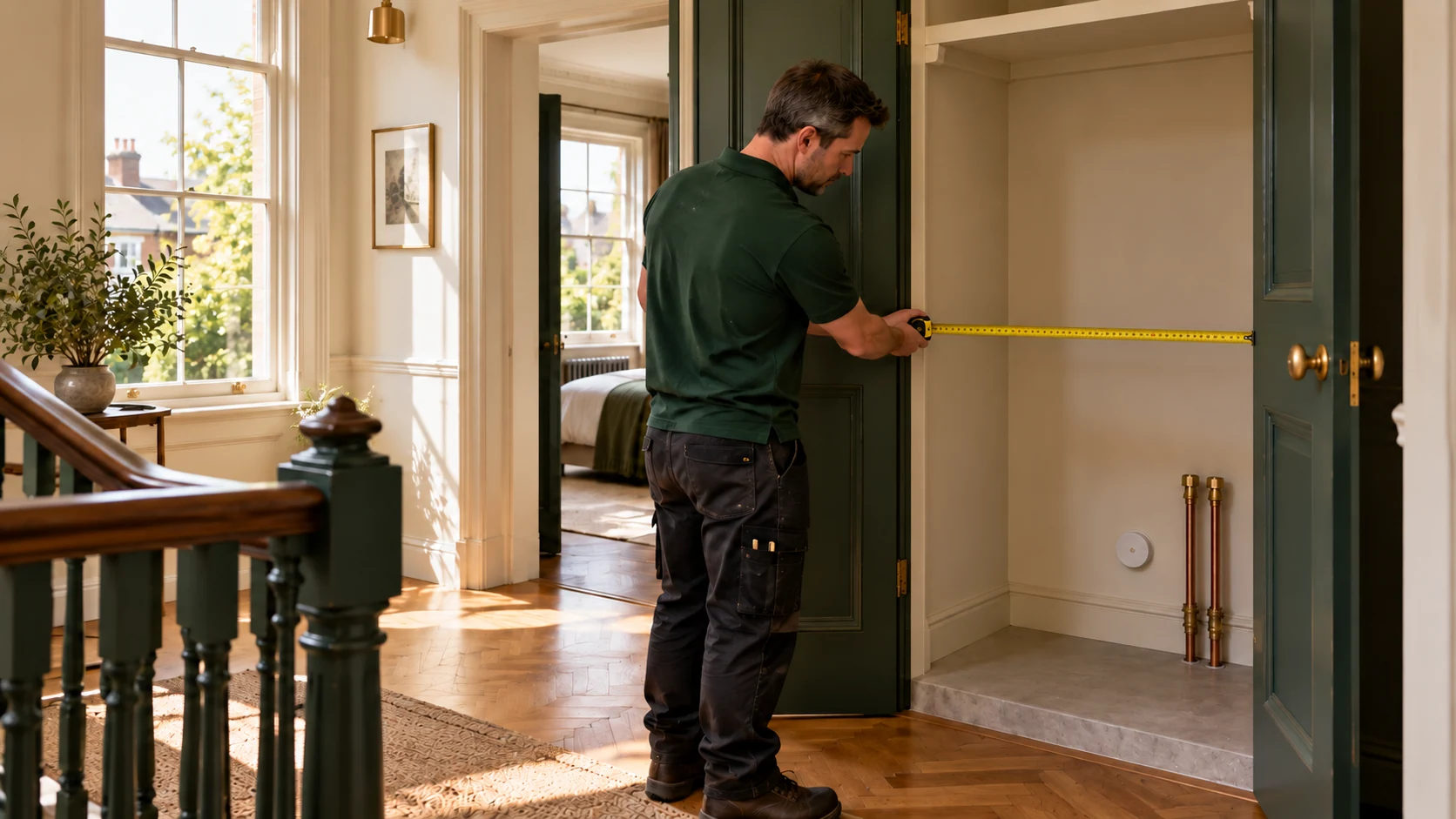
The proposed cylinder position also needs more than a cupboard measurement.
A filled cylinder is heavy. For illustration, 250 litres of water alone weighs approximately 250 kilograms, before adding the vessel and associated equipment.
The floor must support the complete installed load. There must also be access for servicing and component replacement, not just enough space to close the cupboard door. Vaillant’s installation requirements
Resolve those matters before ordering new joinery or completing decoration.
An individual hot-water conversion should not be confused with disconnecting from a communal heating or hot-water system. That requires a different assessment of ownership, permissions and building services.
Safety equipment is part of the installation
An unvented cylinder depends on correctly specified controls and protective devices.
The design must address normal water pressure, thermal expansion, overheating protection and safe discharge from the safety valves. The equipment and settings must follow the selected manufacturer’s requirements.
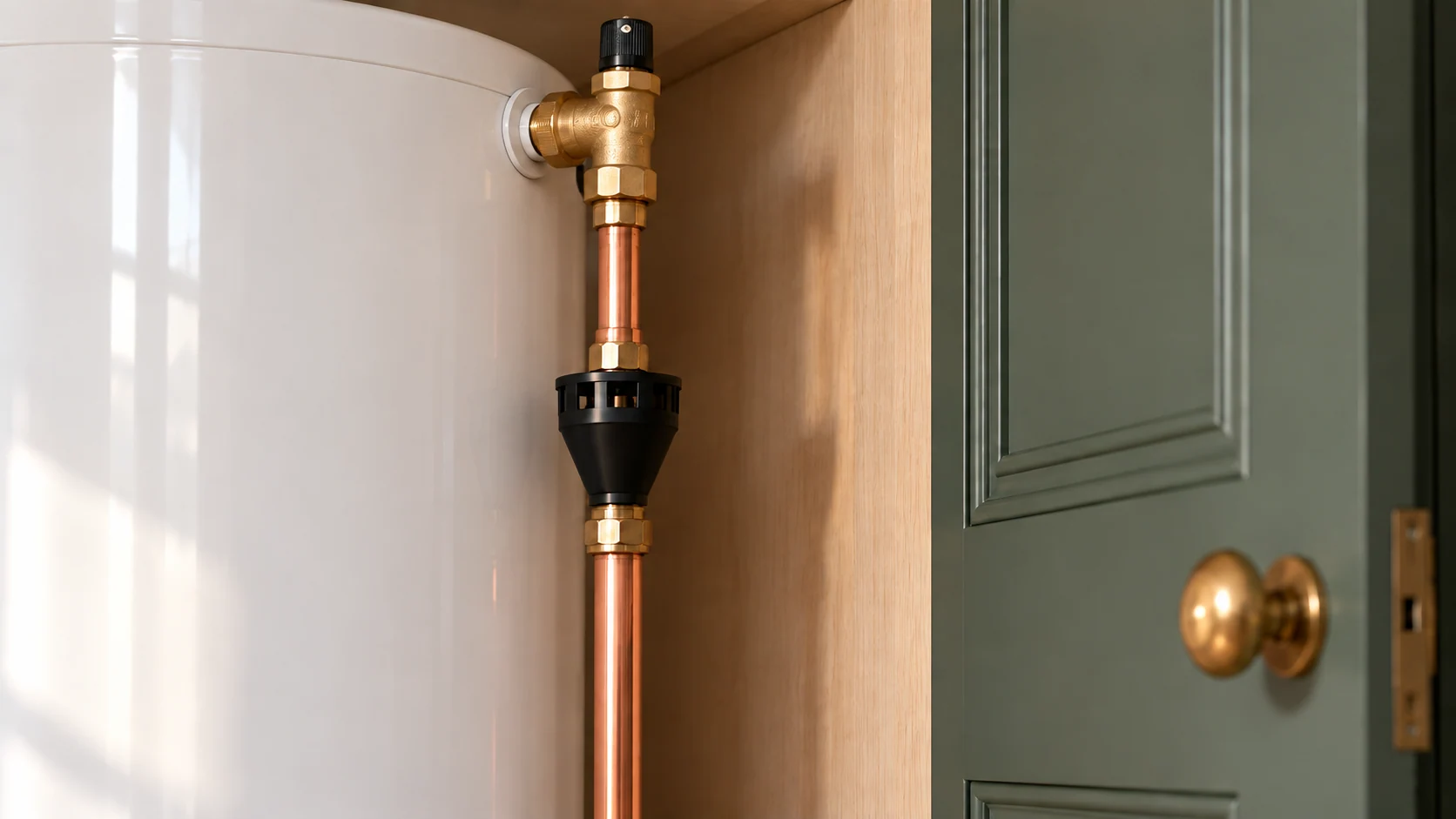
Expansion may be accommodated by an external vessel or an internal expansion arrangement. The correct maintenance approach depends on the design. Hot Water Association guidance
The discharge route is particularly important in flats and internal cupboards. A tundish provides an air break and allows discharge to be observed; the downstream pipework must convey it safely.
The route, material and sizing depend on the installation. Under specified conditions, a suitable connection to a soil stack may be possible; an external termination is not the only arrangement recognised in the guidance. Approved Document G
These are professional design and installation matters. This guide is not a DIY procedure for altering a pressure vessel.
Qualifications, notification and commissioning are different things
A typical domestic unvented cylinder above 15 litres is notifiable building work. CNC Building Control
The installer needs appropriate competence. Membership of a relevant self-certification scheme provides a route for notifying qualifying work; outside that route, Building Control involvement must be arranged. A training qualification alone is not the same as scheme membership. BPEC’s guidance
Where the project includes gas work, that work must be undertaken by a Gas Safe registered engineer competent in the relevant category. Gas registration does not replace the skills required for unvented hot-water work. HSE’s homeowner guidance
What a complete conversion should include
A useful installation proposal should explain the project from assessment to handover.
Establish what you have and what you need
Identify the cylinder, boiler, cisterns, pumps and connected outlets. Discuss the current problems and any planned changes to the home.
The result should be a clear explanation of suitability, not simply a recommended cylinder size.
Agree the design and written scope
The proposal should name the equipment and identify what will remain, what will change and what will be removed.
Agree the cylinder position, service routes, permissions, shower alterations and making good. Clarify how unforeseen defects in concealed or retained services will be handled.
Plan the practical arrangements
Confirm access, floor protection, working areas and disposal.
Ask when hot water, heating and cold water will be unavailable. Total project duration and the period without a usable bathroom are not necessarily identical.
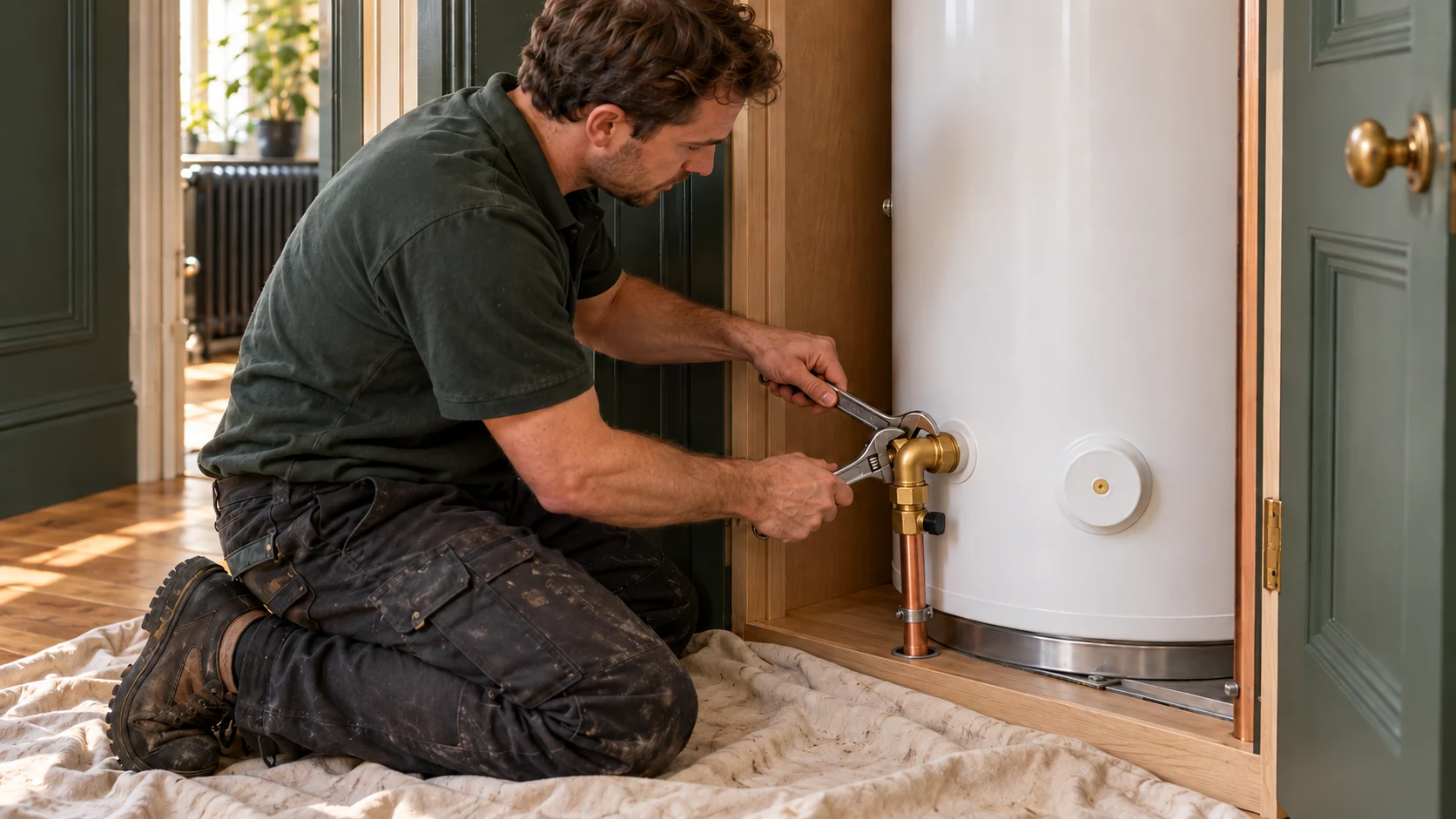
Remove redundant equipment and install the new arrangement
Following appropriate isolation, the affected equipment and services are altered to the agreed design.
Redundant connections need proper decommissioning. Any retained services must remain correctly supplied, controlled and accessible.
Commission the completed installation
Commissioning is more than checking that the water becomes hot.
The installer should verify the required safety functions and controls, check for leaks and assess delivery against the intended usage.
Benchmark places emphasis on suitable equipment, correct installation, commissioning and explanation to the customer. What is Benchmark?
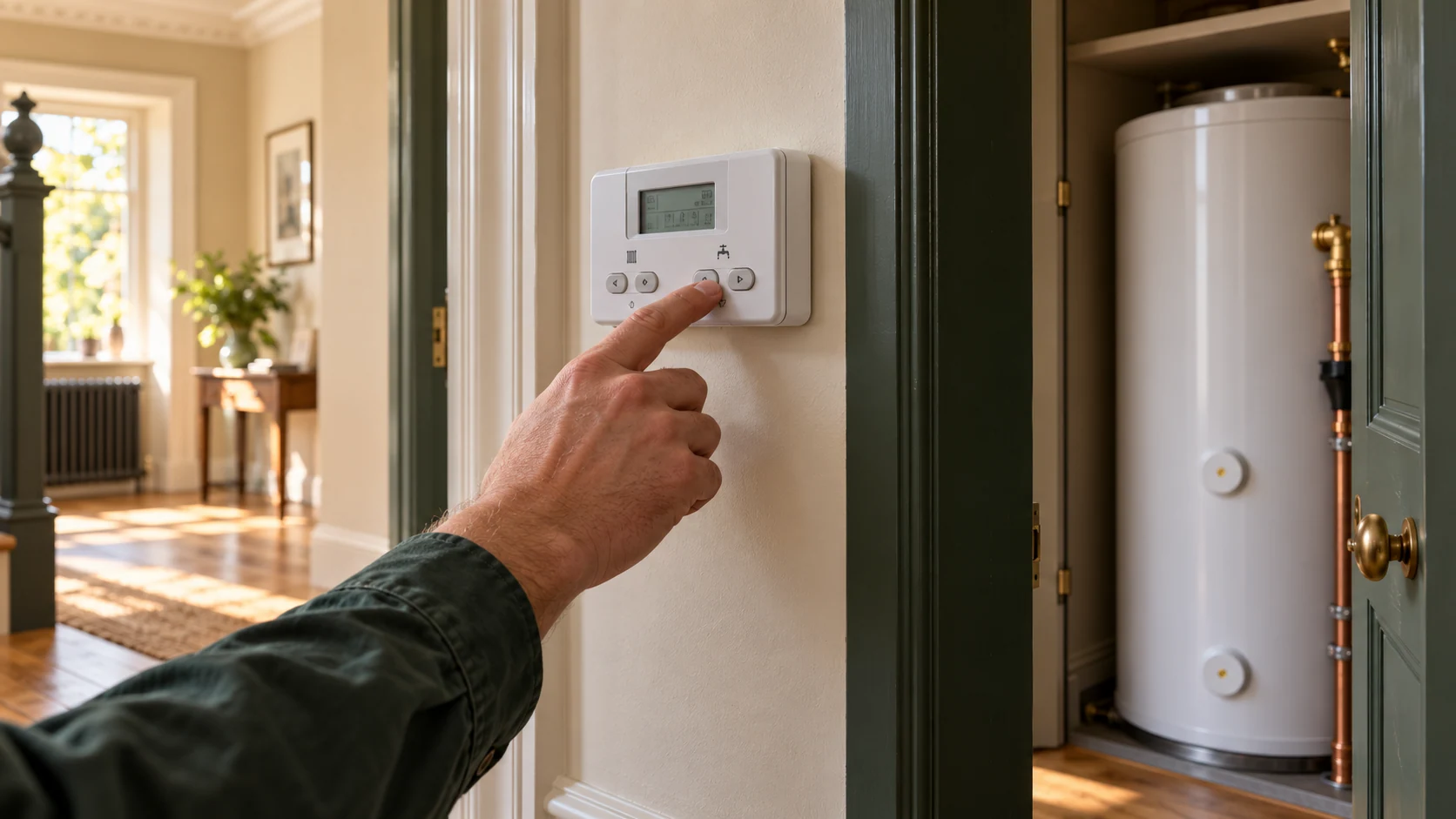
Demonstrate operation and hand over the records
You should understand the controls, normal operation and when to contact the installer.
Confirm the arrangements for the commissioning record, Building Regulations documentation, instructions and warranty registration. These are separate records with different purposes.
A finished installation should leave you with both functioning equipment and a clear understanding of how to use it.
How much does a vented-to-unvented conversion cost?
The meaningful price is the cost of the complete conversion, not the cylinder on its own.
Ask the quotation to identify:
- the cylinder and associated equipment;
- incoming supply and distribution alterations;
- primary connections and controls;
- safety discharge pipework;
- necessary shower or pump changes;
- cistern and cylinder removal;
- testing, commissioning and notification;
- access requirements and making good.
Confirm whether VAT is included and which items are excluded.
A like-for-like unvented replacement is different from converting a loft-fed installation. Adding a supply upgrade, changing the heating arrangement or replacing the boiler changes the scope again.
If boiler replacement is also proposed, ask for its reasons and cost to be identified separately. PEP’s boiler installation and replacement service provides a starting point for discussing that part of the project.
A clear quotation should make competing proposals comparable. “Cylinder supplied and fitted” is not enough if essential alterations remain undefined.
How long will the work take?
Request a programme based on the survey rather than assuming a universal installation time.
Access, tank removal, discharge routing, retained services and testing all affect the work.
Explain any vulnerable occupants, home-working requirements or lack of an alternative bathroom. Agree the expected interruptions before booking the installation.
What changes in everyday use?
The most noticeable improvement may be a shower or bath that performs better under the household’s normal demand. That outcome should be supported by the supply assessment, not assumed from the cylinder label.
You still have stored hot water. Once the useful reserve is exhausted, it needs reheating. The controls and schedule should suit when the household normally needs that reserve.
Hot water also does not appear instantly at a distant tap. Water standing in the connecting pipe must pass through first.
If an immersion heater is included, it may provide an alternative heat source when the boiler is unavailable, subject to the electrical supply and the equipment’s operation. Ask how and when it should be used.
During an incoming water-supply interruption, do not assume the cylinder will continue delivering normal mains-pressure hot water simply because it contains water.
Finally, removing a cistern does not eliminate all leak risks. The completed installation still contains a cylinder, valves, fittings and pipework that require attention.
For the role and limitations of sensors, monitoring and automatic isolation around stored hot water, read our water leak protection guide.
Running costs, servicing and water hygiene
A well-insulated cylinder and pipework can reduce heat losses. However, changing from vented to unvented operation does not itself guarantee a particular reduction in bills.
Energy use depends on the heat source, insulation, controls, distribution losses and the amount of hot water consumed. Energy Saving Trust’s insulation guidance
There is a straightforward practical consideration: if a more powerful shower leads to more water being used, that additional water also needs heating.
Choose the installation for comfort and suitability, then operate it sensibly.
The Hot Water Association recommends servicing every 12 months, following the manufacturer’s instructions. Regular servicing is also commonly a warranty condition. Checks include the expansion arrangement, safety valves, discharge, controls and relevant records. HWA’s homeowner servicing guide
Do not dismiss repeated dripping through the tundish. Ask a competent engineer to assess it, and never obstruct a safety discharge.
Stored-water temperature and safe outlet temperature also need distinguishing. Users should follow the commissioned settings and instructions rather than lowering temperatures arbitrarily to reduce bills.
For rented properties, hot- and cold-water hygiene requires a proportionate assessment. Removing a loft tank does not automatically remove every legionella risk; temperature, water turnover and unused pipework still matter. HSE’s landlord guidance
When conversion may not be the best option
A sound vented installation does not become unsuitable merely because another type is available.
Retaining it may be reasonable where it meets the household’s needs, the incoming supply is limited or conversion costs outweigh the benefit.
Unvented storage deserves careful consideration where simultaneous demand is substantial, provided the complete supply can support it.
For a smaller home using one bathroom at a time, a combi may be another option, particularly where recovering cylinder space matters. Our conventional-to-combi conversion guide explains that different project.
Where inadequate incoming delivery is the main problem, investigate improving mains water pressure and flow before selecting the hot-water equipment.
Any proposed boosting arrangement must also address the water supplier’s requirements. In England and Wales, a pump or booster drawing more than 12 litres per minute, directly or indirectly connected to the supply pipe, falls within Regulation 5 notification and consent requirements. Water Regs UK
Frequently asked questions
Will an unvented cylinder guarantee a powerful shower?
No. Performance depends on available water, working pressure, distribution and the shower itself. The survey should establish what the complete arrangement can deliver.
Can both loft tanks be removed?
Only if both become redundant. The large cistern may no longer be needed after the hot-water conversion, while the smaller heating cistern may remain.
Do I need a new boiler?
Not automatically. A suitable existing boiler may remain, although connections and controls can require alterations.
Is Megaflo the same as unvented?
Megaflo is a brand of unvented cylinder, not the name of every unvented system. Compare the actual product and installation requirements.
Will I need a water booster?
Not necessarily. A booster should address a measured supply problem, not be added automatically. The required solution depends on pressure, flow, demand and available space.
Can the cylinder go in the existing airing cupboard?
Possibly. Check dimensions, full operating weight, connections, service access and the safety discharge route.
Does unvented mean unlimited hot water?
No. The store contains a finite reserve. Its useful capacity and recovery need to match the household’s pattern of use.
Can I convert the old copper cylinder itself?
An ordinary vented cylinder should not be converted by blocking its vent and connecting it to mains pressure. The installation requires equipment designed for the proposed conditions.
Planning a vented-to-unvented conversion in London?
Start with the result you want: dependable showers, sensible bath-filling performance, reclaimed loft space or a hot-water installation that suits a changing household.
If you are planning an unvented conversion in Kensington, our local service explains the survey, access and building-coordination questions to resolve before work starts.
If you are planning an unvented conversion in Chiswick, our local installation page explains the assessment, access and coordinated work for homes in W4.
If you are planning an unvented conversion in Chelsea, our local installation page explains the assessment, access and coordinated work for homes in SW3 and Chelsea SW10.
For an initial discussion with PEP, provide your postcode, number of bathrooms and a description of any pressure or flow problems. Photographs of safely accessible equipment can help explain the existing arrangement.
Mention any shower pump, shared supply, planned refurbishment or future heat-pump installation. There is no need to enter an unsafe loft or remove covers to obtain photographs.
Our London plumbing service is the starting point for discussing a coordinated installation scope.
Contact PEP to discuss your vented-to-unvented conversion.
The right upgrade is not simply a new cylinder in the cupboard. It is an installation whose supply, capacity, controls and safety arrangements have been considered together — with clear expectations for the way you will use it.