
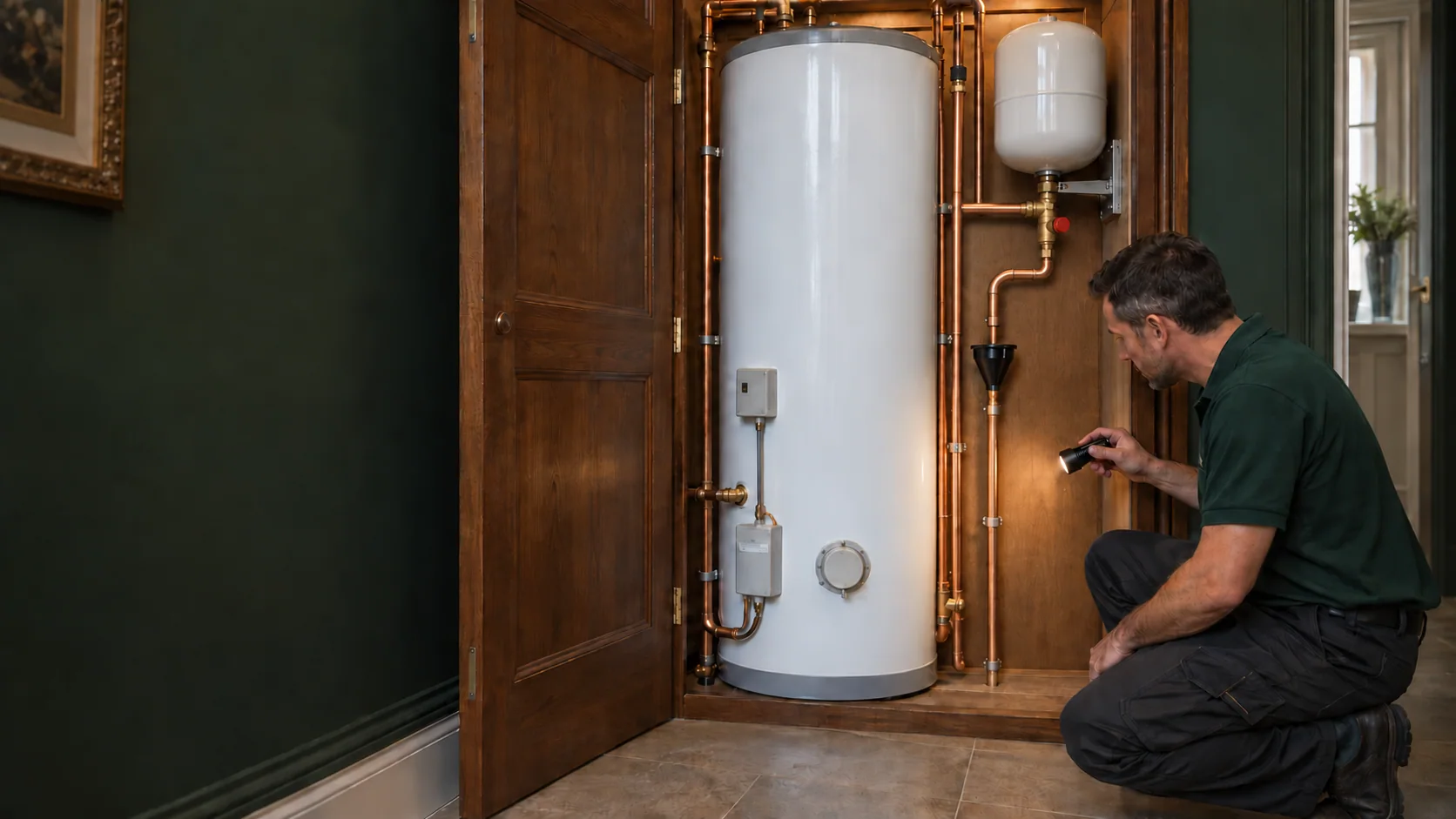
Hot water · Maintenance guide
Unvented Hot Water Cylinder Servicing for London Homes
Annual checks, warning signs and what a proper service should include.
Explore the service checksAn unvented cylinder can keep supplying hot water while a maintenance issue goes unnoticed. A shower that still feels hot tells you little about the condition of the expansion system, electrical connections or safety discharge route.
For homeowners arranging unvented cylinder servicing in London, the useful questions are straightforward: how often should it be done, what should the engineer check, and which work might cost extra?
This guide explains those distinctions, including the differences between Megaflo air-gap systems, separate expansion vessels and cylinders heated by electricity, a boiler or a heat pump. It is a guide to understanding professional maintenance, not instructions for working on a pressurised hot-water system.
/ 01
How often an unvented cylinder should be serviced
Annual servicing is the normal starting point. The Hot Water Association recommends checks every 12 months, with the instructions for the installed cylinder taking precedence over generic guidance. Manufacturer warranty conditions may also require annual maintenance. HWA servicing guidance.
Do not wait for the anniversary if performance changes, a leak appears or water starts discharging unexpectedly. Tell the service provider about the fault when booking: a routine maintenance appointment and a diagnostic visit are not necessarily the same job.
If you have recently moved in, look for the commissioning documents and service history. When the last service cannot be established, arranging an assessment is more useful than assuming the previous owner kept everything up to date.
/ 02
Identifying your hot water cylinder
Two different descriptions matter.
Vented or unvented describes the water-supply arrangement. A typical unvented cylinder receives pressurised cold water rather than relying on an open storage cistern in the loft.
Direct or indirect describes how the water is heated. A direct cylinder usually uses electric immersion heaters. An indirect cylinder receives heat through a heat exchanger from a boiler or another suitable source, and may also have an immersion heater. Vaillant explains cylinder types.
The practical consequence is that two similar-looking cylinders may have different maintenance requirements.
A thermal store, buffer vessel or heat interface unit is not simply another name for the same appliance. The model label matters more than its appearance. If you are planning a system change rather than maintaining an existing cylinder, our guide to vented-to-unvented hot-water conversion covers that decision separately.
/ 03
What an unvented cylinder service should include
The manufacturer determines the required procedures. For the homeowner, it helps to understand the purpose of the checks rather than memorise a universal checklist.
Understanding the installation and its history
Before work starts, explain anything that has changed: less hot water, slower recovery, intermittent dripping, unusual noise or a problem following recent plumbing work.
Provide previous reports where possible. Ask the engineer to distinguish an existing installation defect from a worn component or an adjustment needed during maintenance. These can have different remedies and costs.
Access also matters. A cylinder enclosed behind new joinery may still operate, but the enclosure can prevent necessary inspection or component removal. Any limitation should be recorded rather than overlooked.
Checking the water supply and control components
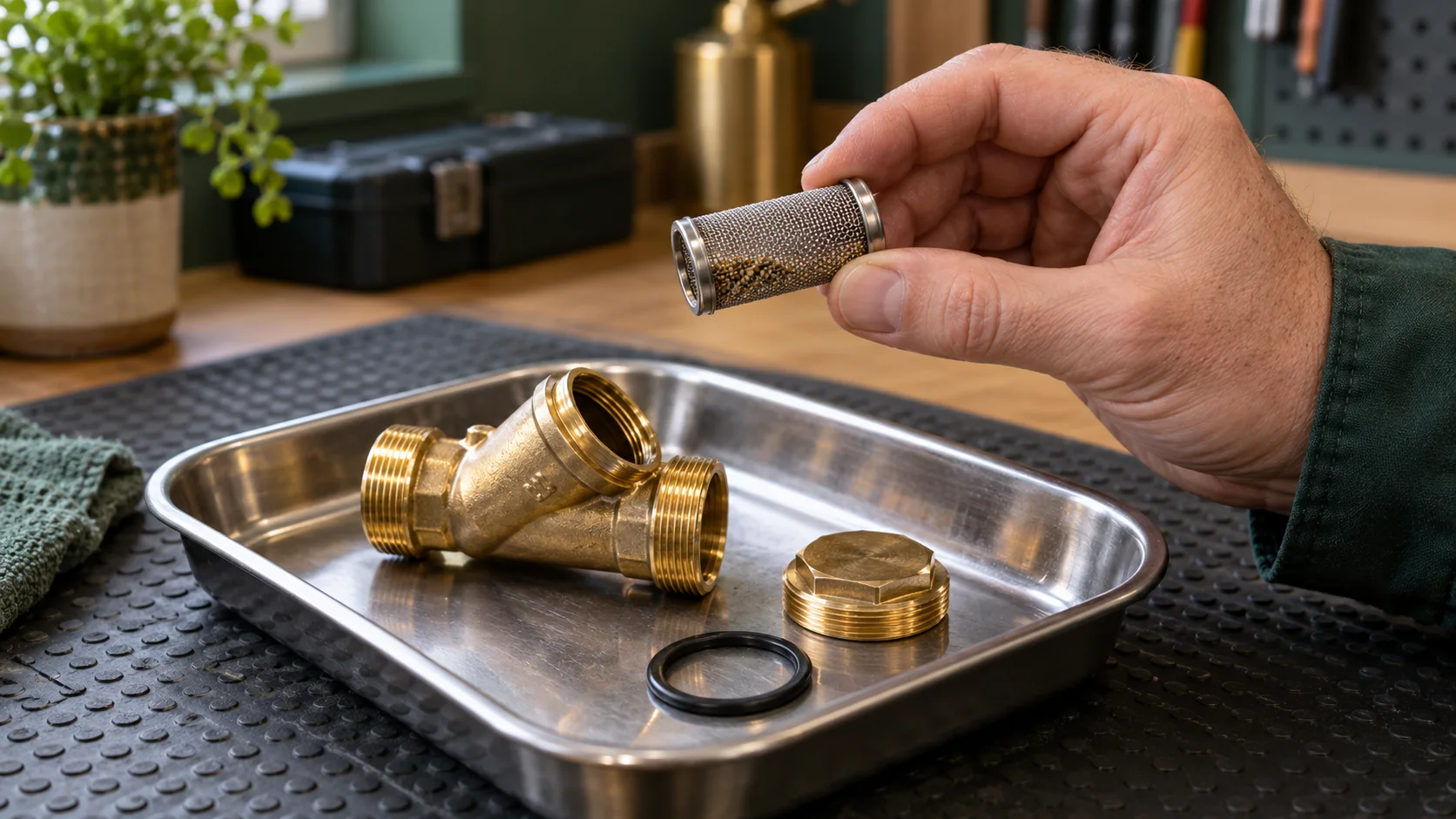
The incoming control assembly manages the conditions under which water enters the cylinder. Depending on the design, it incorporates components such as a pressure-reducing valve, strainer and non-return valve.
The relevant checks include the condition of connections, water delivery and filters. Vaillant's maintenance schedule for its specified uniSTOR range includes annual checks of hot-water output, with filter cleaning where required. A restriction deserves investigation before someone recommends a larger cylinder or a pressure booster. uniSTOR maintenance instructions.
Checking expansion provision
Water needs room to expand as it heats. The engineer must establish how the installed cylinder accommodates that expansion and carry out the appropriate checks.
This is not a matter of choosing a pressure from an online discussion. The correct assessment depends on the cylinder, its components and the manufacturer's procedure.
The distinction between an internal air gap and a separate vessel is important enough to explain below.
Checking safety valves and the discharge route
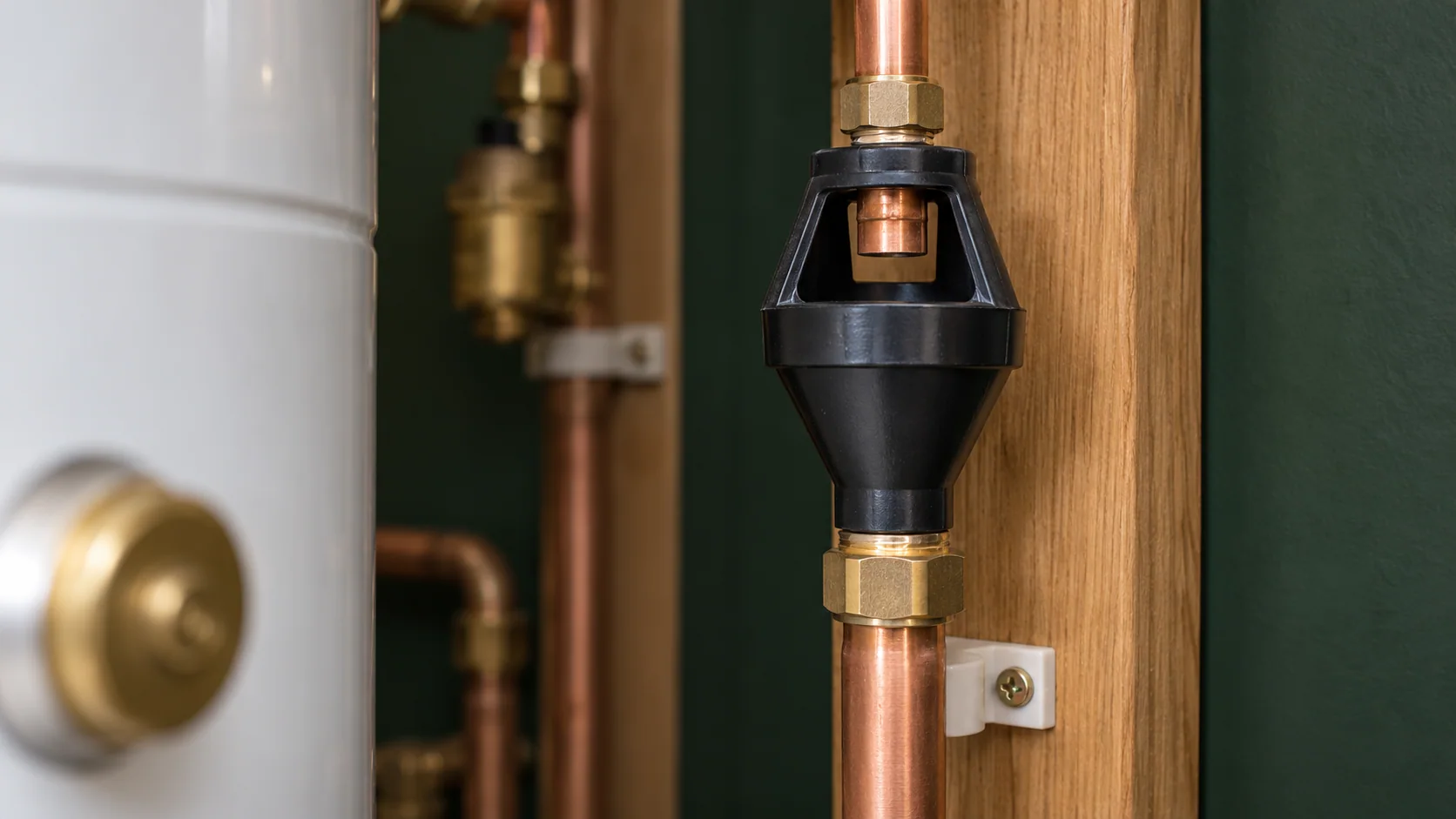
The checks should address both the relevant valves and the route through which discharged water leaves the system.
For example, Megaflo's instructions specify checks that water can flow freely through the tundish and discharge pipework, and that the valves close again afterwards. Manually operating a valve checks particular functions; it should not be described as a laboratory calibration of every automatic safety response. Megaflo Eco maintenance instructions.
The tundish is the fitting through which a safety discharge can be observed. It is not an ordinary overflow to hide or cap.
England's Approved Document G addresses discharge routing, materials and safe termination. Some alternative materials and soil-stack arrangements are permitted under specified conditions, so appearance alone does not establish compliance. Approved Document G.
Checking heating controls and electrical condition
The water thermostat, overheat protection and controls linking the cylinder to its heat source have different roles. Their operation needs to be considered together.
Electrical connections also deserve attention. The HWA highlights the risk of overheating at incorrectly made connections and the importance of suitable wiring, secure terminations and earthing. Electrical inspection and work must be undertaken by someone competent to do it. HWA electrical safety guidance.
A visual inspection is not the same as comprehensive electrical testing. If further investigation is needed, the report should say so.
Completing the work and explaining the findings
Before the visit ends, ask what was checked, what was adjusted and whether any further work is necessary.
A useful record separates completed maintenance from unresolved faults. If the system cannot safely be returned to operation, you need a clear explanation of its status and the next action—not simply a completed appointment.
Ask for the relevant Benchmark service entry or equivalent manufacturer record, together with the findings and any further recommendations. The HWA includes completion of the service record in its guidance. HWA service documentation.
/ 04
Internal air gaps and separate expansion vessels
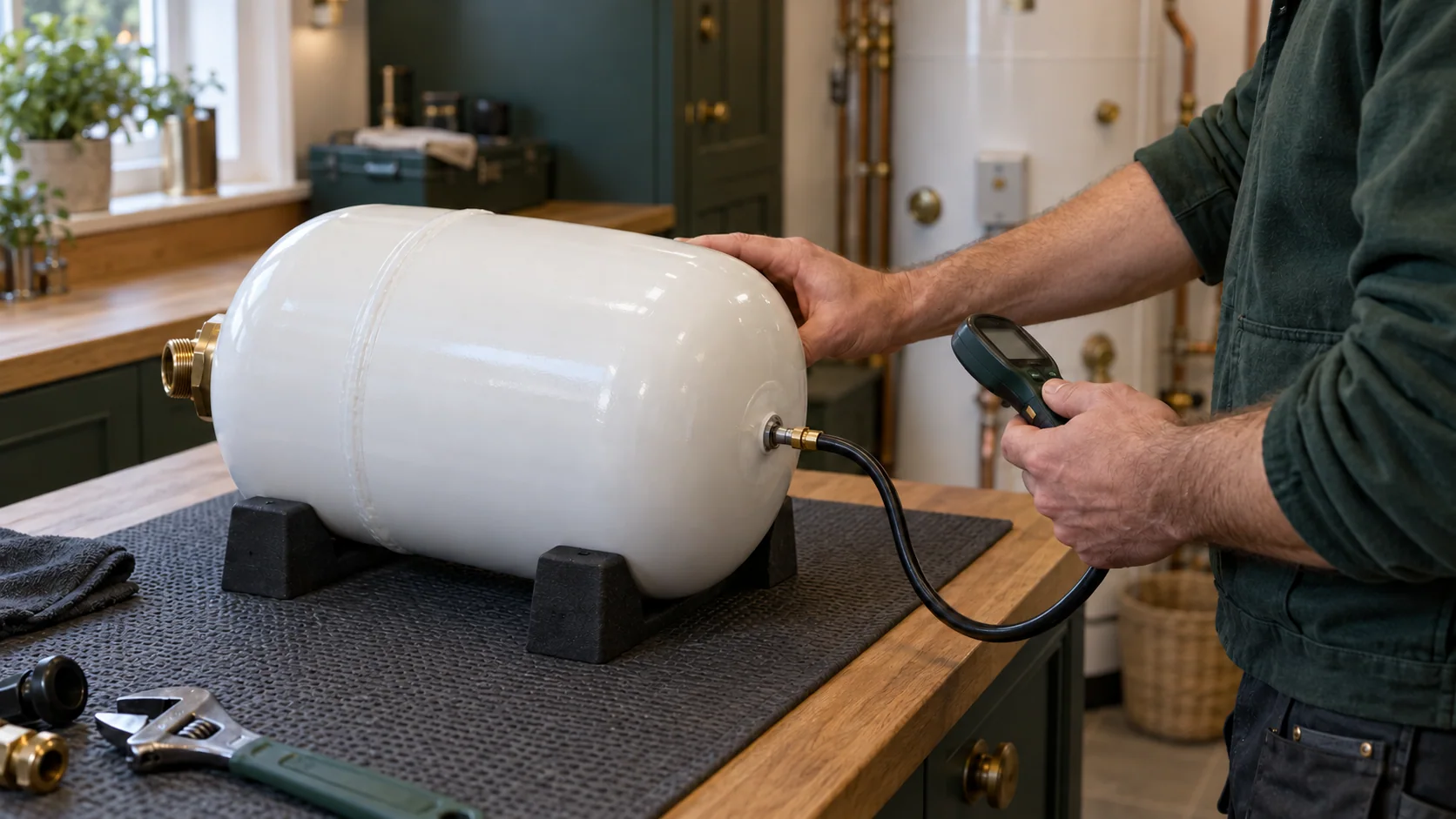
Some cylinders accommodate expansion using an internal air space. Others use a separate expansion vessel. There are also designs with vessels concealed beneath the cylinder's outer cover.
Many Megaflo Eco models use an internal expansion arrangement, but “Megaflo” is a brand name, not a description of every unvented cylinder. Megaflo Eco range.
With a separate vessel, loss of its air or nitrogen charge does not automatically mean the diaphragm has failed. Altecnic distinguishes a charge that can be restored from conditions that justify replacement, including diaphragm failure or physical deterioration. Heating-system vessels and potable-water vessels are not interchangeable simply because they look similar. Altecnic expansion vessel guidance.
If assessment shows that the vessel needs replacing, our unvented cylinder replacement service covers the cylinder and its associated installation. A service issue does not automatically call for a new cylinder.
The useful question is therefore not “Did the engineer pump it up?” It is “Was the correct expansion system identified, assessed and left operating as intended?”
Likewise, replenishing an internal air gap is one maintenance task, not a substitute for a complete cylinder service.
/ 05
Draining and immersion heater removal depend on the model
A service cannot be judged solely by whether the cylinder was emptied.
Some procedures require draining, while others require the water side to be depressurised without the same extent of draining. The correct approach follows the installed model and the work being undertaken.
Immersion-heater inspection also varies. Vaillant's published Direct Cylinder guarantee conditions require removal of the immersion heaters for inspection during servicing. The OSO Super SC manual specifies a different inspection schedule for its heaters. These requirements should not be extended to every product carrying either brand name. Vaillant Direct Cylinder conditions, OSO Super SC instructions.
This is why giving the make and model before the visit helps. It allows the provider to assess the required work, likely access needs and any preparation.
Other model-specific requirements may include checking an anode where one is fitted. This is not a component or replacement schedule to assume every cylinder has.
/ 06
Why a boiler service does not automatically cover the cylinder
The boiler supplies heat; an indirect cylinder stores domestic hot water and has its own controls and safety components. Servicing one does not establish that the other has been serviced.
You may be able to arrange both during one visit, but check that the quotation includes both scopes and the appropriate records.
An electrically heated cylinder still needs maintenance even when there is no gas boiler. A heat-pump installation likewise needs the cylinder and heat source considered in their own right.
Also distinguish cylinder-related problems from boiler and heating-system pressure loss. A boiler pressure reading is not a universal setting for the cylinder's expansion vessel.
/ 07
When you need fault diagnosis rather than routine servicing
Describe a fault before booking rather than expecting an annual service automatically to include its repair.
| What you notice | What the enquiry should make clear |
|---|---|
| Dripping associated with heating | When it starts, whether it stops and whether the pattern has changed |
| Persistent water discharge | That it is ongoing rather than an occasional observation |
| Poor hot-water flow | Whether cold water is also affected and whether the problem occurs at one or several outlets |
| Insufficient or slow-to-recover hot water | When it happens, the normal heating schedule and any recent changes |
| Leakage around the cylinder or fittings | Where it is visible, without removing covers or disturbing components |
These observations help direct an assessment; they do not identify the failed component. Manufacturer fault-finding guidance lists different possible causes for similar symptoms. Megaflo fault-finding guidance.
For supply problems, start with understanding low water pressure and flow. A home water-pressure booster is a separate design consideration, not the default repair for a cylinder fault.
/ 08
What affects unvented cylinder servicing costs in London
The most useful comparison is between written scopes, not headline prices.
A quotation should identify whether it covers planned maintenance on a working cylinder or investigation of a reported fault. Ask whether required model-specific inspection is included and how additional work will be authorised.
Factors to clarify include:
- The cylinder type, model and number of heating sources.
- Access to valves, heaters and concealed components.
- Any required draining or internal inspection.
- Replacement parts, seals and additional labour.
- Whether boiler or heat-pump servicing is included or separate.
- VAT, travel, parking and any return-visit charges.
A low starting price may exclude the work your particular cylinder needs. Equally, a more expensive quote should explain the additional scope rather than relying on a vague description such as “premium service”.
There is no benefit in pretending that every London installation fits one fixed duration. A readily accessible, maintained cylinder and an unfamiliar appliance boxed into a cupboard present different jobs.
Agree whether the engineer should seek approval before repairs, and ask for findings even if you decide not to proceed with the quoted remedial work.
/ 09
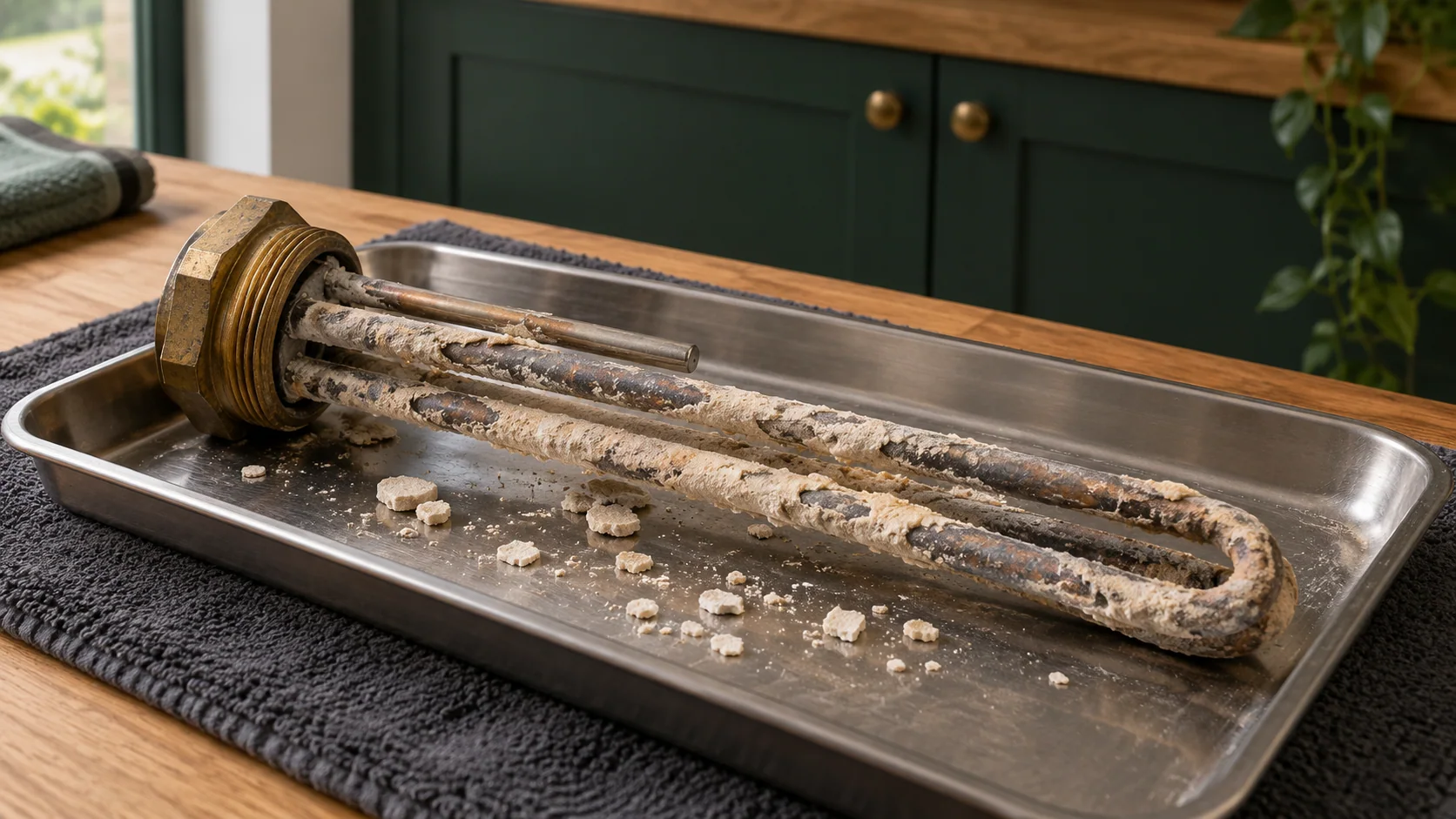
Hard water and cylinder descaling
Thames Water identifies its supply region as a hard-water area. Mineral deposits are therefore relevant to discussions about hot-water equipment in London, although the postcode alone cannot establish the condition inside a particular cylinder. Thames Water on hard water.
Routine servicing and descaling are not interchangeable descriptions. Ask what the proposed work includes, which components require attention and whether additional draining, dismantling or seals are needed.
If recurring scale is a concern, our guide to water softeners for London homes explains the wider options. Any treatment must suit the cylinder manufacturer's water-quality requirements and preserve an adequate supply.
Do not assume that fitting treatment removes existing deposits or eliminates the need for future servicing.
/ 10
Water temperature and modern heating controls
Hot-water temperature involves both hygiene and protection against scalding.
Where temperature is used to control Legionella risk, HSE guidance specifies hot-water storage temperatures of at least 60°C. A temperature measured after a thermostatic mixing valve is not the same as the stored-water temperature. The appropriate controls and monitoring depend on the installation and its use. HSE temperature guidance.
Do not lower cylinder temperatures simply because a generic energy-saving tip recommends it.
Smart cylinders and heat-pump systems need their own documented approach. Mixergy, for example, describes model-dependent cleansing behaviour and circumstances in which a cycle may be interrupted. Having a hygiene programme enabled does not, by itself, establish that it has completed successfully. Mixergy cleansing guidance.
Connected controls also do not replace physical maintenance. Mixergy's installation documentation warns that a cylinder can have more than one electrical supply, which is another reason that switching something off in an app is not safe electrical isolation. Mixergy X servicing instructions.
For the wider relationship between schedules, heat sources and hot-water demand, see our guide to heating controls and system integration.

/ 11
Qualifications and service documentation
Choose someone with the relevant competence and training for unvented hot-water systems, commonly referred to as G3 qualifications. Work on gas appliances requires the appropriate Gas Safe registration as well; do not assume one credential confirms every skill needed for the job. HSE guidance on gas work.
Keep three things distinct:
- Installation documentation, recording the original commissioning and applicable Building Regulations process.
- Service records, recording maintenance actually carried out.
- Warranty terms, setting the manufacturer's conditions and the cover available.
Approved Document G distinguishes installer competence and the notification routes for installation work. An annual maintenance record is not a replacement for missing installation approval. Approved Document G.
Annual maintenance may be a warranty condition, but that should not be presented as a universal statutory annual cylinder certificate for every private homeowner.
Check the terms supplied with your appliance. Cover for the inner vessel can differ from cover for controls, valves and labour, and a service after a long gap should not be assumed to reinstate expired cover automatically. Vaillant Direct Cylinder warranty example.

/ 13
Deciding between repair and replacement
Ask for a diagnosis before comparing replacement prices.
A recommendation should explain whether the issue concerns an accessible component, the vessel itself, an installation defect or an inability to meet the household's needs. It should also identify any uncertainty and whether suitable parts are available.
If assessment points to cylinder replacement in Hampstead, our local installation service explains how the supply, demand and existing system shape the replacement scope.
If assessment points to cylinder replacement in St John’s Wood, our local installation page explains the supply, access and system checks before specification.
The useful comparison includes the proposed repair, its limitations and the implications of replacement. Do not treat age alone—or one episode of dripping—as the complete argument.
If you are considering a broader upgrade, explore the relationship between hot-water storage and heating and plant-room installation, rather than choosing a cylinder in isolation.
/ 14
Preparing for the visit
You can help without dismantling anything.
Send a clear photograph of the model label and a wider photograph showing the installation. Include the postcode, known service history and a short description of the problem or the maintenance requested.
Explain access restrictions before the appointment. Clear removable household items from the work area, but leave electrical covers, insulation and fitted components alone.
Ask whether any advance preparation is needed. Do not drain, depressurise or switch off a normally operating system in anticipation unless the provider gives appropriate instructions. That is separate from the urgent precautions for a suspected unsafe condition.
Before the engineer leaves, make sure you understand any changes to normal controls and whether outstanding work affects continued use.
/ 15
Frequently asked questions
Can a cylinder be serviced without its original paperwork
An assessment can still be arranged. Supply the model and serial number so the appropriate documentation can be identified. Missing history should be recorded, not replaced with invented past service entries.
Does a water softener remove the need for servicing
No. Water treatment does not perform the checks required on valves, controls, expansion provision and electrical components.
Can I book a service without knowing the cylinder make
Send photographs of the appliance and its accessible labels first. Avoid removing covers to look for information. Confirm that the provider can identify and support the equipment before agreeing the visit.
Should I wait for the annual visit if the cylinder starts dripping
Report a new or persistent discharge promptly rather than waiting. Describe what you can observe safely. Suspected overheating requires urgent attention, as explained above.
/ 16
Discuss your hot water system with PEP
If you are reviewing an existing cylinder or planning improvements to your hot-water installation, contact PEP to discuss your system.
Include your London postcode, the cylinder make and model if known, photographs and a description of what you want to address. The first step is to establish the equipment and the work required, so the appropriate scope and availability can be confirmed.
A useful conversation starts with your actual installation—not an assumption that every cylinder needs the same service, the same repair or a replacement.
Discuss your hot water system