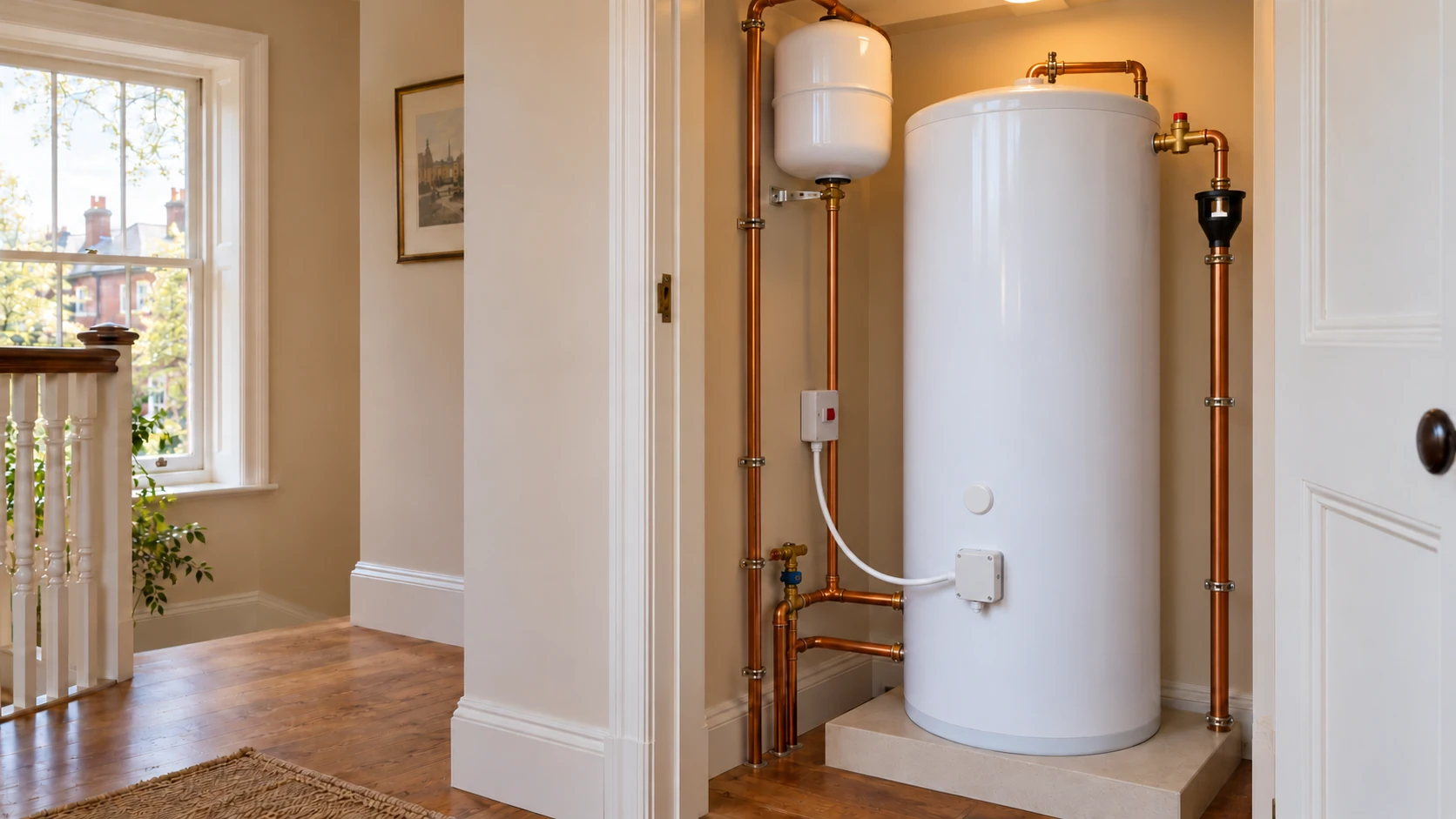


Unvented hot water cylinder with copper pipework and an expansion vessel in a period-style airing cupboard

Hampstead NW3 · Unvented cylinder installation & replacement

Unvented Hot Water Cylinder Installation & Replacement in Hampstead, NW3

Hot water for the home you have now.

Another bathroom. A busier morning routine. A cylinder that no longer keeps up. PEP designs, supplies and installs unvented hot water systems in Hampstead, bringing the storage, water supply, plumbing and controls into one considered installation.

Discuss your Hampstead cylinder project

or call 07843 676 480

Qualified unvented hot-water work
Heating · Plumbing · Electrical controls

Gas Safe RegisterNICEIC

We undertake cylinder replacements, suitable vented-to-unvented conversions and new installations for refurbishments. From an electrically heated cylinder in a flat to stored hot water serving several floors, we establish what needs to change, what can stay and how the finished system should perform.

01 · A home that has grown around you

Your bathrooms may have changed. Has the hot-water system caught up?

A loft en suite, a larger bath or a second shower can change what a household asks of its hot-water system. The equipment may still be working, but the original arrangement may no longer suit the way the home is used.

In a Hampstead house altered over several stages, we look beyond the cylinder label. Which outlets run together? How long are the pipe routes? What happens when the upstairs shower and kitchen tap are both in use? These questions help distinguish a storage problem from a supply, distribution or control issue.

The aim is a useful improvement, with the necessary work clearly defined. If the project also changes bathroom or kitchen pipework, our Hampstead plumbing installation service covers those connections as part of the wider refurbishment.

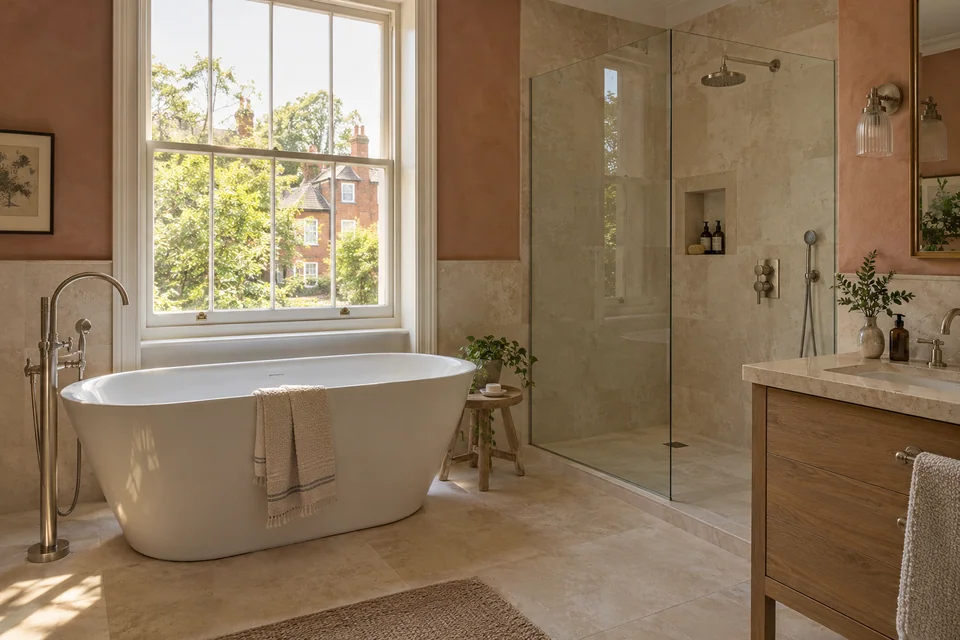
Period-style family bathroom with a bath and separate shower

02 · The scope starts with the existing system

Replacement, conversion or a new installation?

Replacing an existing hot-water cylinder

A replacement may be appropriate when the vessel has failed, the equipment is unsuitable for changed demand or a refurbishment requires a different arrangement. We assess the fault and surrounding installation first. An immersion heater, valve or control problem does not automatically mean the cylinder itself needs replacing.

Where replacement is justified, we review the associated components, connections and access rather than simply match the old capacity.
Moving from vented to unvented hot water

A suitable conversion replaces gravity-fed hot-water storage with a pressurised cylinder supplied from the incoming main or an appropriately designed supply system. We check the available water, existing fittings, heat source and safety-discharge route before recommending it.

The cold-water cistern feeding the old cylinder may become redundant, but a separate heating feed-and-expansion tank may still be required. Our vented-to-unvented conversion guide explains what changes and what may remain.

Planning storage during a refurbishment

Involve us before the cylinder cupboard, bathroom fittings and service routes are fixed. That gives us room to coordinate capacity, connections and maintenance access with the design, rather than trying to recover space after the joinery has been ordered.

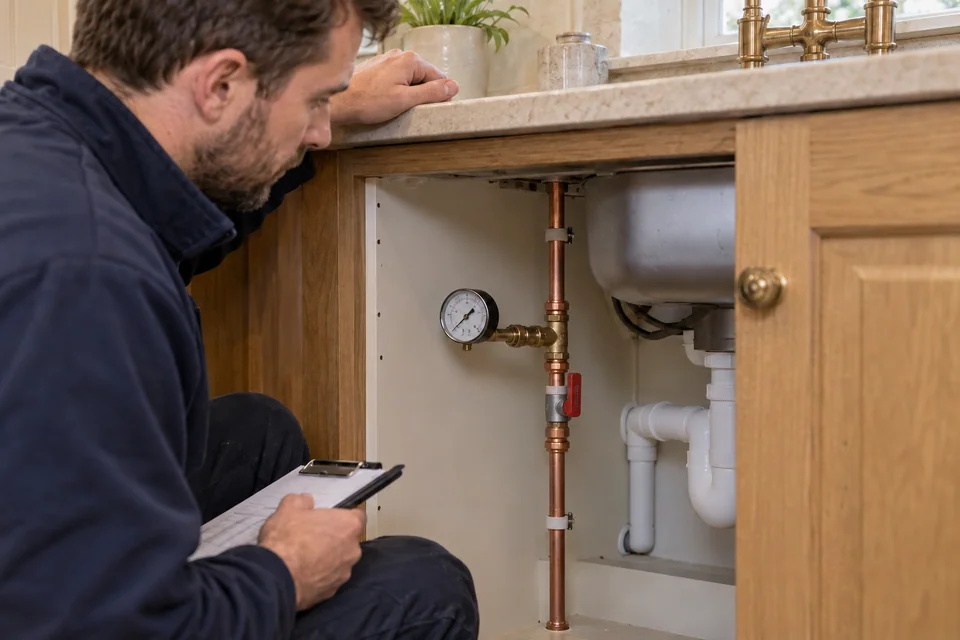
Plumber checking incoming water pressure beneath a kitchen sink

03 · Supply · Storage · Recovery

Check what the supply can deliver before choosing what to store

An unvented cylinder stores hot water under pressure; it does not create an unlimited supply. A larger vessel can provide more stored water, but it cannot remove a restriction in the incoming main.

Our assessment brings together three practical questions:

  • Available supply: what pressure and flow remain while water is being used, including competing demand and any shared supply.
  • Usable storage: how much hot water the household needs during its busiest period, considering showers, baths and occupancy.
  • Recovery: how quickly the chosen cylinder and heat source can replenish that stored water under the intended operating conditions.

A pressure reading with all taps closed cannot answer all three. We also consider restrictions and pipe routes between the supply, cylinder and outlets. Our guide to water pressure and flow explains the distinction.

If the supply is the limiting factor, water-pressure boosting and storage options may warrant assessment. They are a separate design decision, not an automatic addition to every cylinder installation.

04 · Choose the arrangement, then the equipment

Megaflo, direct electric and indirect cylinder installations

Megaflo installation and replacement in Hampstead

If you want to replace a Megaflo or are considering one for a new installation, we assess the appropriate model against the property's supply, demand and available space. Megaflo is a product range, not another name for every unvented cylinder.

Expansion arrangements vary between products. Many Megaflo Eco models accommodate expansion internally, while other cylinders use a separate vessel. The specification follows the selected model, including the space its equipment needs.

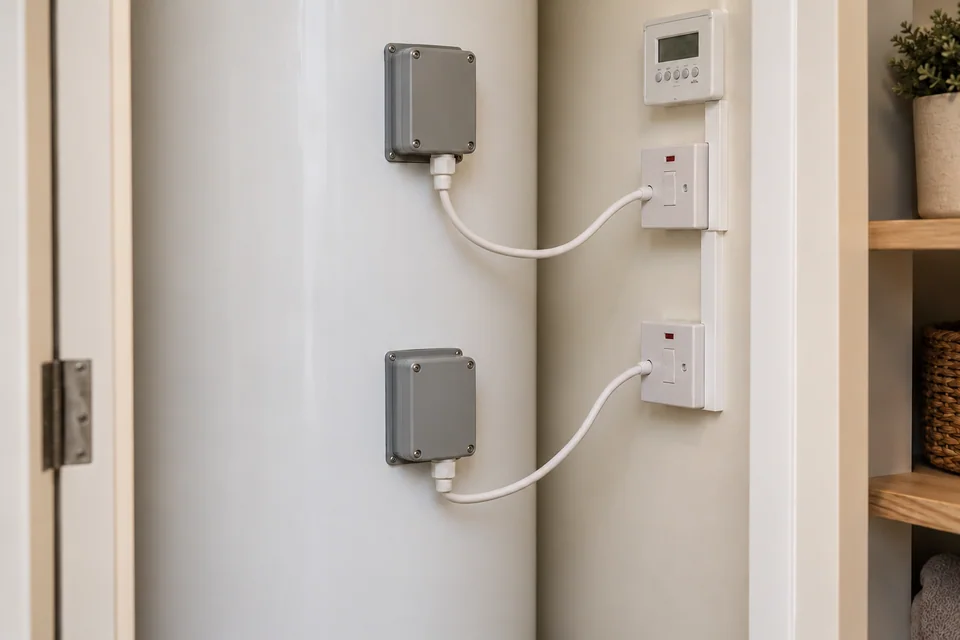
Direct electric hot water cylinder with fixed controls and enclosed immersion connections

Direct electric cylinders

A direct cylinder uses electric immersion heaters and can suit a home without a boiler connection. For a flat replacement, we review the existing electrical supply, controls, heating schedule and plumbing alongside the storage requirement. Changing the cylinder is not a reason to assume the old wiring and controls are suitable.

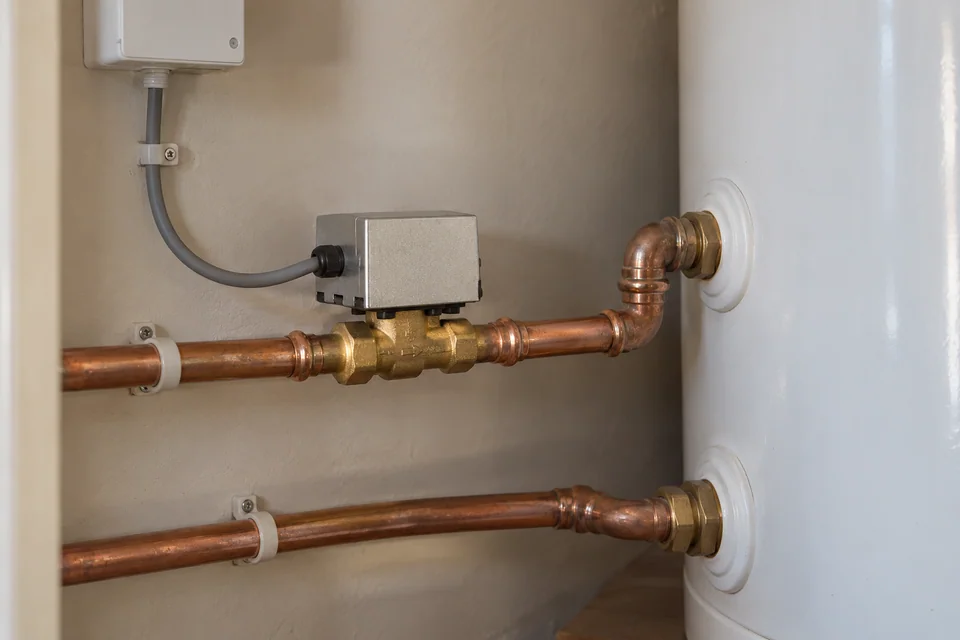
Motorised two-port valve and copper press-fit pipework beside an indirect hot water cylinder

Indirect cylinders

An indirect cylinder receives heat through a coil connected to a suitable external heat source. We consider the cylinder's recovery characteristics, the source's available output and the control arrangement together. A system intended for a heat pump needs an appropriate cylinder specification; a boiler cylinder is not automatically interchangeable.

05 · Space to install. Space to maintain.

Plan from the cylinder cupboard to the top-floor shower

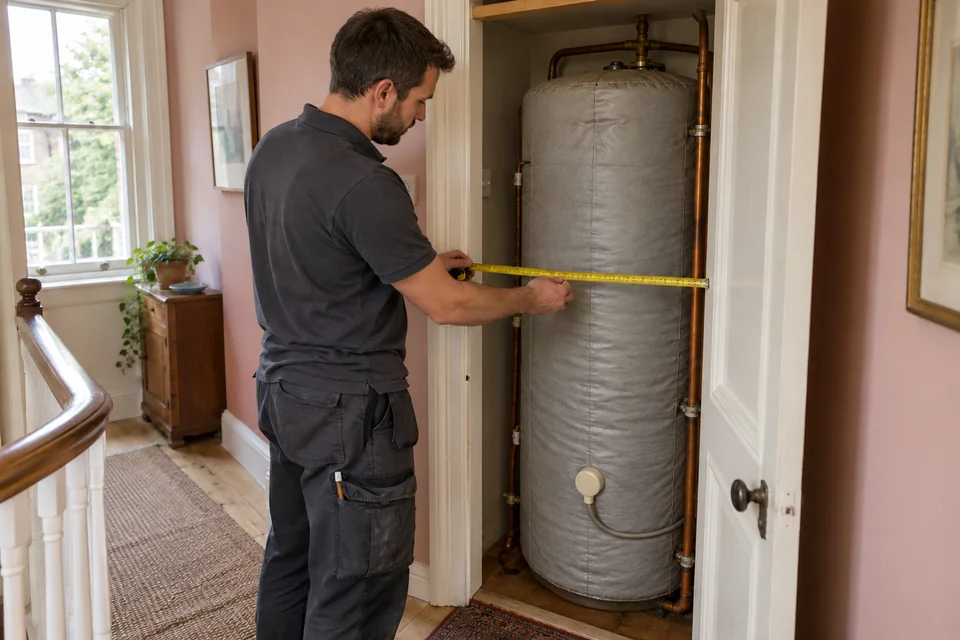
A cylinder that fits on a drawing still needs to reach its position, connect safely and remain accessible after installation. We check the delivery and removal route, cupboard dimensions, support, pipework and working space before the equipment is ordered.

For a home with bathrooms on several levels, the design also considers elevation and losses through the distribution pipework. Long runs may affect waiting time and heat loss. Where secondary circulation is appropriate, its routing, insulation and controls need planning; it is not a universal solution.

Installer measuring an airing cupboard around an existing vented hot water cylinder

Period houses and retained interiors

In properties around Frognal, Fitzjohn's Avenue and Netherhall, routes through retained floors, plasterwork or fitted furniture can shape the installation. We agree access and protection requirements, and identify opening-up or making-good work in the scope.

Where a property is listed or lies within a conservation area, the implications of the proposed alterations must be checked for that address. A postcode alone does not determine whether consent is needed.

Flats and shared buildings

For a converted flat or managed building, we establish who controls the relevant supply, whether isolation affects neighbours and what access the managing agent must arrange. A heat interface unit, thermal store or communal hot-water service requires its own assessment, not an assumed cylinder swap.

06 · One coordinated installation

The cylinder, heat source and controls should work as one

PEP combines qualified unvented hot-water work with plumbing, heating and electrical installation. That matters when a cylinder needs to call for heat, operate the correct valve and work alongside radiators or underfloor-heating zones.

We assess compatibility with retained equipment, including Vaillant and Viessmann systems, at model and control level. A serviceable boiler may be retained where suitable. If a new heat source is part of the project, see our boiler installation service in Hampstead.

Our Hampstead electrical services support the required power and control connections. The heating controls and zoning guide explains the wider coordination.

For a complete system upgrade, our Hampstead central heating and plant-room service covers the broader installation. You can also view PEP's heating and plant-room work across London, including cylinders and associated distribution equipment.

07 · A clear specification before a quotation

What affects unvented cylinder installation cost in Hampstead?

The cylinder's purchase price is only one part of the job. Replacing an accessible unit in its current position is a different proposition from converting a vented system, moving the storage or resolving an inadequate supply.

The quotation needs to account for:

  • The selected cylinder, expansion arrangement and associated controls.
  • Changes to pipework, isolation and the safety-discharge route.
  • Electrical connections and integration with retained heating equipment.
  • Access, removal of redundant equipment and protection of the property.
  • Testing, commissioning, documentation and any agreed making good.

We set out the agreed work, assumptions and exclusions in the written proposal, with the price and VAT basis clear. If further investigation is needed before a part of the work can be priced, we explain that rather than disguise an allowance as a fixed installation cost.

Send the postcode, a brief description and photographs of the current arrangement. We can then establish the appropriate assessment before quotation.

08 · From first enquiry to handover

From the first enquiry to a working hot-water system

  1. Understand the brief. We establish the existing arrangement, what is not working for you and any planned changes to the home.
  2. Assess the installation. Supply conditions, demand, access, retained equipment and safety arrangements inform the specification.
  3. Agree the scope and sequence. The proposal identifies equipment, responsibilities and the expected programme, including interruptions to hot water.
  4. Install and connect. The cylinder, plumbing, electrical requirements and control interfaces are coordinated around the agreed work.
  5. Commission and hand over. We complete the applicable checks, verify operation and explain normal use, documentation and maintenance requirements.

The programme depends on the actual work and access. We discuss whether you will be living in the property and when services will be unavailable, rather than promise the same completion time for every replacement.

09 · Safe operation and ongoing care

Safety, documentation and care after installation

Unvented hot-water work requires appropriate competence and correctly specified safety arrangements. In England, Approved Document G provides guidance on hot-water safety. We establish the relevant Building Regulations notification or certification route for the work; a commissioning record is not a substitute for compliance documentation.

Product warranties also need to be specific. The cylinder vessel may have different cover from valves, controls, immersion heaters and labour. We identify the terms for the selected equipment, including registration and servicing conditions.

The Hot Water Association recommends checks every 12 months, with the manufacturer's instructions guiding the service. Our unvented cylinder servicing guide explains the ongoing care and records to plan for.

10 · Hampstead · Belsize Park · NW3

Unvented cylinder installation across Hampstead NW3

PEP undertakes cylinder installation and replacement in Hampstead Village, Frognal, the Redington and Fitzjohn's Avenue areas, Netherhall, Belsize Park, South End Green and the NW3 side of Swiss Cottage.

We also consider nearby projects in West Hampstead and South Hampstead. Send the full postcode so we can confirm coverage and access requirements. For the wider service, explore unvented cylinder installation across London.

Before you book

Questions before replacing your hot-water cylinder

Can you replace the cylinder without replacing my boiler?

Often, yes. We assess the boiler's condition, suitability and controls alongside the proposed cylinder. A cylinder upgrade does not automatically require a new boiler, although the connections and control arrangement may need changing.

Will we be able to use two showers at once?

That depends on their combined demand, the available supply, distribution and usable hot-water storage. We assess these together before specifying the system. Cylinder capacity alone cannot establish the answer.

Will a larger cylinder improve pressure upstairs?

Not by itself. More storage does not create more incoming pressure or remove pipework restrictions. We assess the supply under use and the route to the upper-floor outlets before recommending changes.

Can you replace a direct electric cylinder in a flat?

Yes. The assessment includes electrical supply and controls as well as the cylinder and water connections. Shared services, delivery access and managing-agent requirements can affect the scope.

Can both loft tanks be removed during a conversion?

Not necessarily. The cold-water cistern supplying the old hot-water cylinder and the heating feed-and-expansion tank serve different purposes. The latter may still be needed if the heating circuit remains open-vented.

How do you choose the cylinder size?

We consider occupancy, shower and bath demand, simultaneous use, recovery and available space. Bedroom count provides context, but it is not a complete sizing method.

Can the new cylinder stay in the same cupboard?

Often it can, subject to dimensions, support, connection routes and service access. We check that the old unit can be removed and the replacement brought into position, not just that the footprint fits.

How long will we be without hot water?

We confirm the expected interruption after assessing the installation. Relocation, conversion work, electrical changes or shared-building access can extend the programme beyond a straightforward replacement.

What paperwork should I receive?

The handover covers the applicable commissioning records, operating information and product details, together with the relevant compliance process. We distinguish those records from manufacturer warranty registration and future servicing requirements.

Do you cover Belsize Park and nearby West Hampstead?

Yes. Belsize Park forms part of our NW3 coverage, and we consider nearby West Hampstead enquiries. Please send the complete postcode and proposed work so we can confirm the next step for your property.

Hampstead NW3 · Let us plan the right installation

Give us the hot-water brief before choosing the cylinder

Tell us what the system needs to do: replace a failing unit, supply another bathroom or support a wider refurbishment. Include the Hampstead postcode, the existing cylinder and heat source, and your preferred timing.

Photographs of the model label, surrounding pipework and cupboard can help. There is no need to remove covers or disturb equipment. We will review the information and agree the appropriate next step towards a properly specified installation.

Discuss your Hampstead cylinder project