
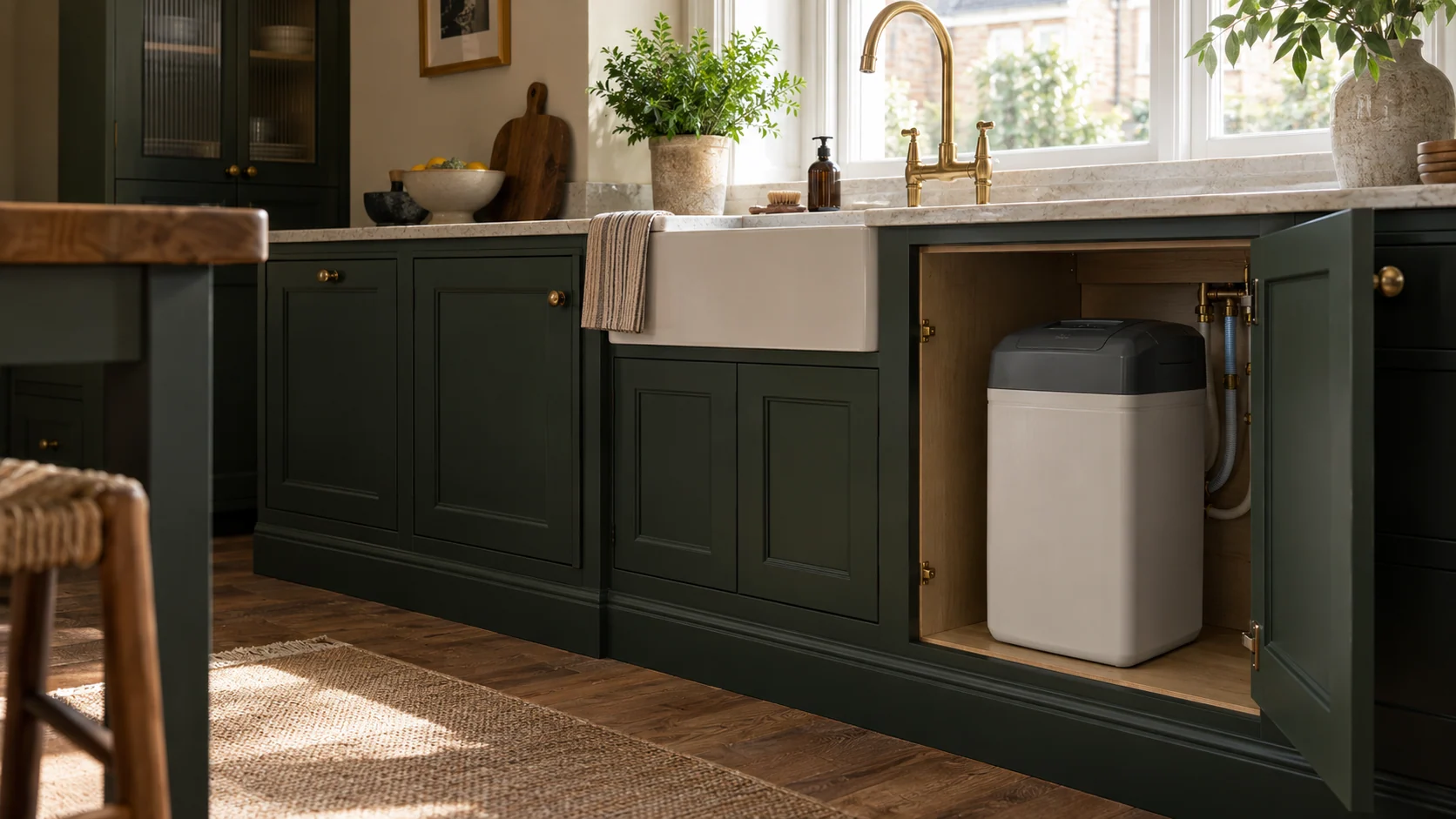
The London homeowner’s guide
Water Softeners for London Homes: Costs, Installation and Choosing the Right System
Less limescale. A properly planned system. Make the right choice for your water supply, your space and your home.
Find the right approachA beautiful bathroom should not need constant descaling. A new kitchen should not be planned around a kettle that repeatedly fills with limescale. Yet choosing a water softener involves more than finding a unit that fits beneath the sink.
The right system must suit your water supply, the way your household uses water and the space available for installation. It also needs to work properly with your boiler or hot-water cylinder, preserve adequate flow to your showers and remain accessible when salt needs replenishing.
For London homeowners, those details matter. A compact flat with one bathroom presents a different challenge from a multi-storey house with several showers, an unvented cylinder and a booster system.
This guide explains what water softeners do, when they are worth considering and what a properly planned installation should include. The aim is straightforward: help you choose a system that fits your home, rather than adapting your expectations to whichever appliance happens to be on offer.
Is a water softener worth installing in a London home?
A water softener is worth considering when hard-water deposits are a recurring nuisance and you want to address the water supplying several parts of the home.
The potential benefits include less limescale on treated outlets and appliances, easier lathering and less persistent residue on bathroom fittings. However, softening is a household choice, not a necessary response to unsafe water: hard water is not, by itself, a sign that your supply is unsuitable for drinking. Thames Water explains the distinction in its hard-water guidance.
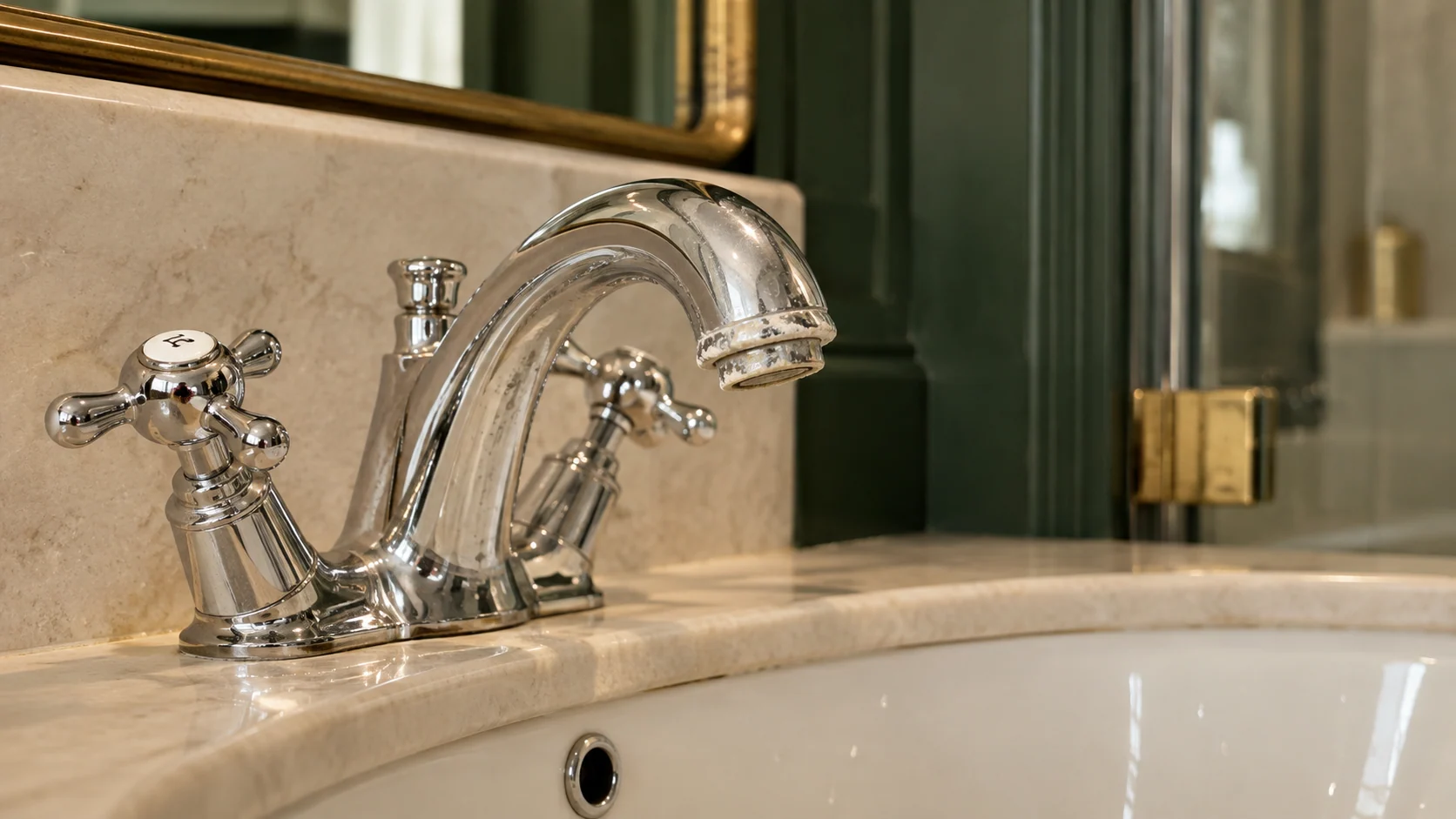
Start with the problem you actually want to solve.
If you are regularly descaling several bathrooms and planning a substantial renovation, whole-house softening may deserve serious consideration. If your only concern is the taste of drinking water, a softener may not be the most relevant starting point.
Likewise, a weak shower needs investigation before new equipment is added. A softener should not be purchased on the assumption that it will restore pressure or clear an unidentified restriction.
A useful decision considers four things together: the benefit you expect, the installation work required, ongoing ownership costs and how long you expect to use the system.
Check your water hardness before choosing equipment
London is widely associated with hard water, but an approximate regional figure is not a specification for your home.
Check your water supplier’s information for the actual address, then confirm the incoming hardness during the installation survey. Record the result and its units; a number without that context is not useful.
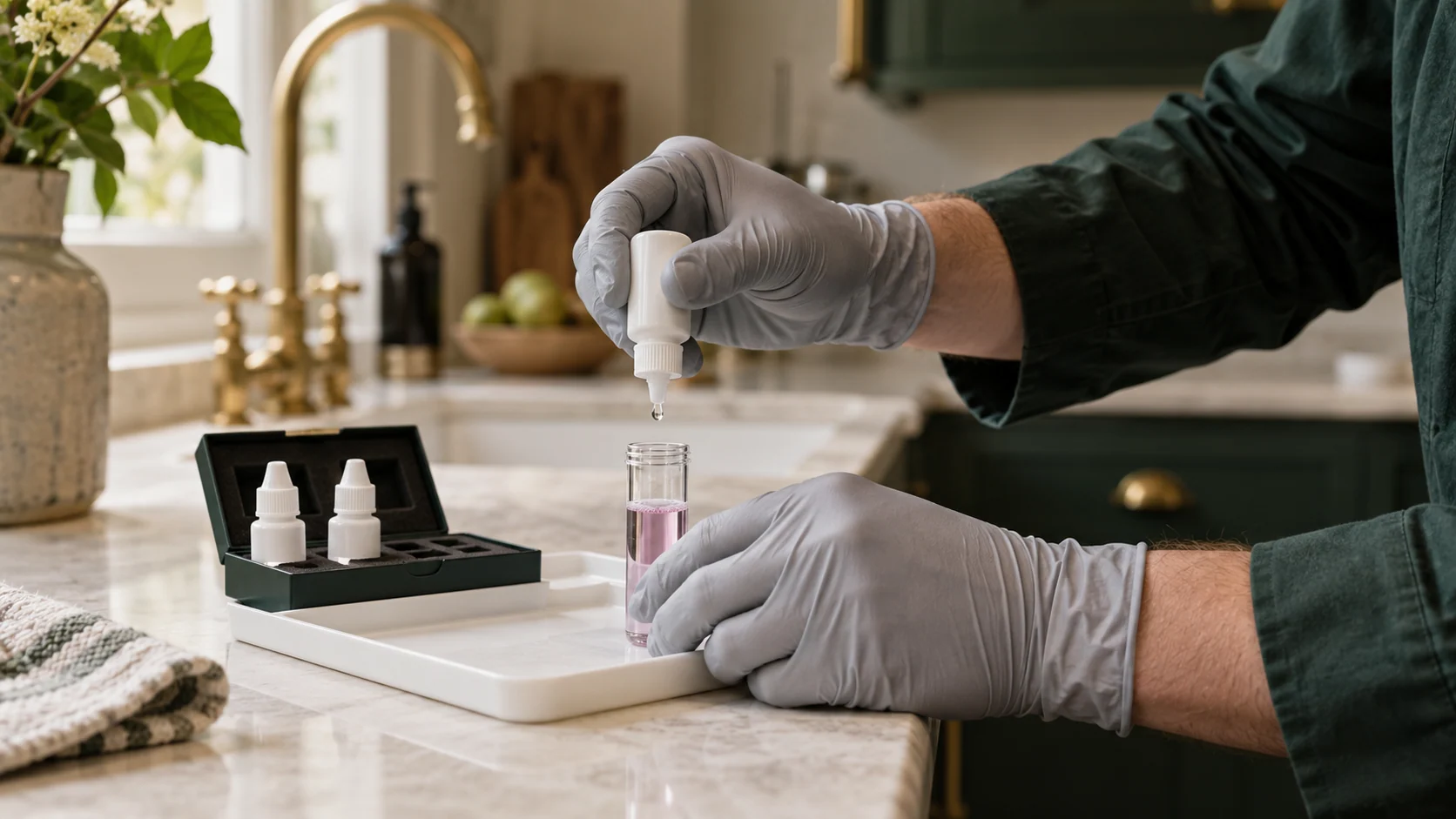
The Drinking Water Inspectorate notes that local variation can be missed by broad hardness maps. Its guidance identifies calcium and magnesium as the principal cause of hardness and recommends obtaining accurate local information from the water company. DWI: water hardness
For a converted property, also establish which supply serves your flat. The nearest visible pipe beneath the kitchen sink is not necessarily the point through which all your water passes.
Water softener, scale inhibitor or drinking-water filter?
These products are often grouped together, although they address different requirements.
| System | Main purpose | Important distinction |
|---|---|---|
| Ion-exchange water softener | Reduce calcium and magnesium hardness in the water passing through it | Requires suitable installation, regeneration and replenishment of the specified salt |
| Scale inhibitor or conditioner | Manage scale formation using a particular treatment method | Does not necessarily remove hardness; performance and suitability depend on the technology |
| Drinking-water filter | Address specified drinking-water characteristics | Its capabilities depend on the cartridge or treatment process |
| Reverse osmosis system | Provide a separate membrane-based drinking-water treatment process | A different design decision from softening the household supply |
Do not accept “salt-free softener” as a complete technical explanation. Ask whether the device actually reduces measured hardness, what evidence supports its performance and what maintenance it requires.
Similarly, a filter fitted for taste is not automatically a whole-house limescale solution. Kinetico’s own treatment guidance distinguishes household softening from a dedicated drinking-water filtration system; the two can form parts of a coordinated installation without being interchangeable. Kinetico: combined home water treatment
How an ion-exchange water softener works
A conventional domestic softener passes water through an ion-exchange resin. The resin exchanges calcium and magnesium ions for sodium ions.
Its treatment capacity is finite. Regeneration restores that capacity using a salt solution, followed by the appropriate rinsing sequence. The regeneration discharge must be accounted for in the installation.
The resin and the salt have different roles. The resin performs the exchange; replenishing salt allows the regeneration process to continue. A sodium-cycle softener is therefore not a fit-and-forget appliance.
What does “organic resin” mean?
The term needs care. In chemistry, “organic” does not automatically mean naturally sourced, biodegradable or environmentally superior.
For example, Purolite C100E is a potable-water-grade resin with a synthetic polystyrene structure. That describes a particular material, not every softener on the market. When comparing products, look for the actual resin specification and suitability for drinking-water applications rather than relying on a reassuring label. Purolite C100E technical data
Single-cylinder, twin-cylinder, electric or non-electric?
These are separate characteristics, not competing names for the same distinction.
Single-cylinder and twin-cylinder systems
A single-cylinder softener has one resin vessel. Depending on its design, softened water may be unavailable during regeneration, which is commonly scheduled for a low-demand period.
A twin-cylinder arrangement can allow one vessel to supply softened water while the other regenerates. That continuity may be useful where water use is less predictable.
Neither description, on its own, tells you whether a particular model can serve your showers adequately. The unit still needs to be selected against its actual performance data. Kinetico explains single- and twin-tank operation.
Electrical controls and non-electric operation
Some softeners use electrical controls; others operate without an electrical connection. Regeneration may be triggered by measured water use rather than simply by a fixed timetable.
Do not assume that every electrical softener regenerates unnecessarily on a timer, or that non-electric operation eliminates running costs. Salt, regeneration water and any required maintenance still need consideration.
Ask what the particular model does, how it responds to changing household demand and what happens during regeneration or a power interruption.
Choosing a water softener for a London flat
In a flat, the best installation position is not always the most obvious empty cupboard.
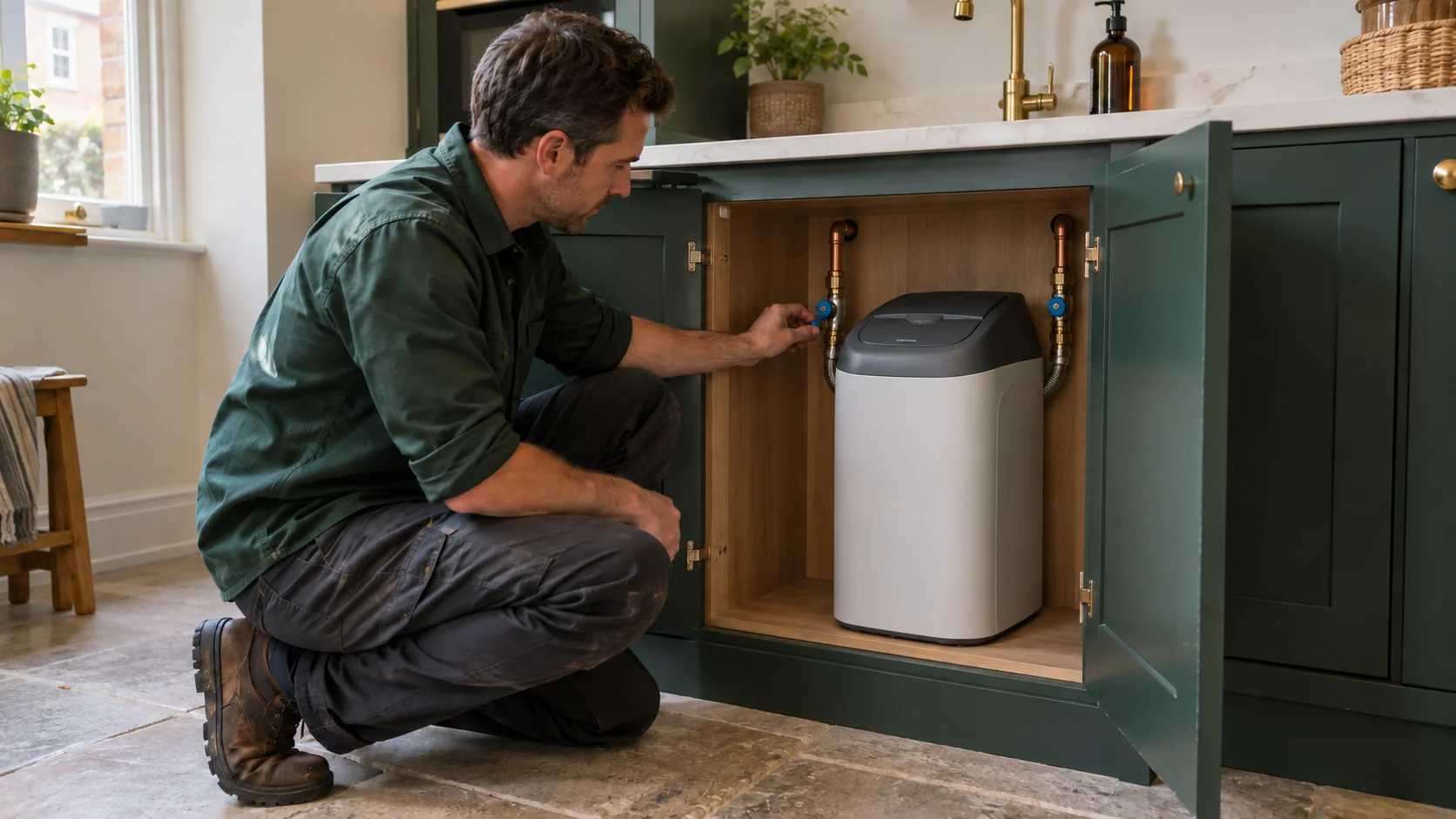
Before choosing equipment, establish:
- Where the incoming supply enters the property.
- Whether it serves only your flat or forms part of a shared arrangement.
- Which branches can be treated from the proposed position.
- How regeneration discharge and any required overflow will be accommodated.
- Whether the appliance can be accessed without dismantling cabinetry.
- Whether landlord, freeholder or building-management permission is needed.
A compact unit may fit beneath a sink, but the published appliance dimensions are only the beginning. Connections, valves, hoses and access for opening the lid also occupy space.
Imagine a neatly fitted kitchen in a Maida Vale or Notting Hill conversion. Losing the only useful storage cupboard may be an unwelcome compromise. Positioning equipment elsewhere could be preferable, but only if the pipe routes and drainage make sense.
Salt handling deserves thought too. An installation that requires awkward lifting or crawling into a cupboard will become frustrating long after the initial work is forgotten.
The right choice is the smallest practical system that meets the measured requirements—not simply the smallest appliance available.
Larger homes: size for simultaneous demand
For a house with several bathrooms, selecting a softener solely by the number of occupants is too crude.
Three separate questions matter:
- How much treated water will the household use between regenerations?
- How much water could be required at the same time?
- What pressure will remain after water passes through the equipment and pipework?
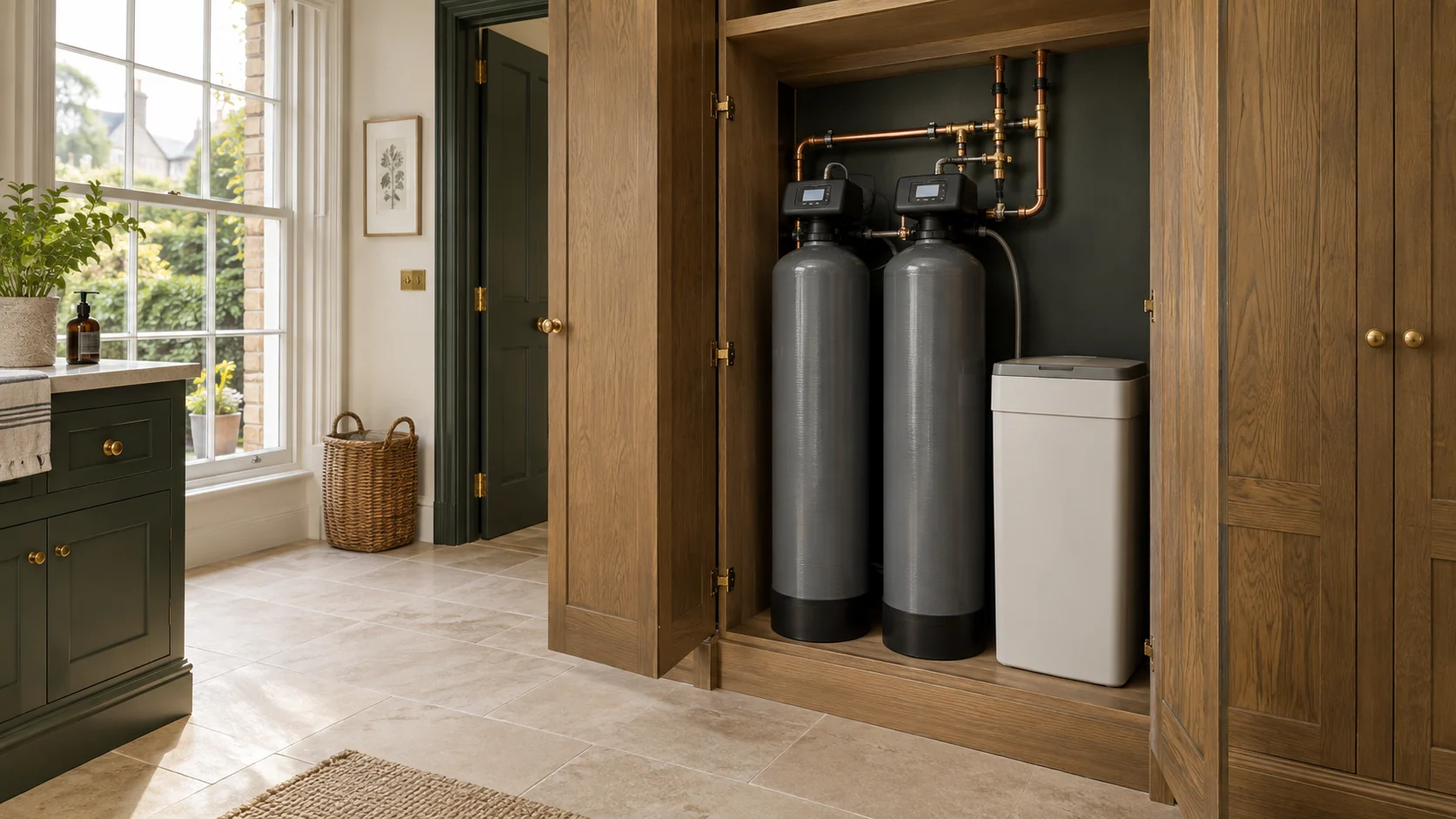
Consider an illustrative household using two showers at 10 litres per minute each while a kitchen tap draws another 6 litres per minute. That is a combined demand of 26 litres per minute. It is an example, not a design allowance for every home.
The chosen appliance must be assessed at the relevant flow and pressure conditions. A headline maximum is not necessarily a suitable continuous operating point.
For example, BWT’s WS555 specification distinguishes a nominal flow of 1,560 litres per hour—26 litres per minute—from its higher maximum figure, with a qualification about continuous operation at that maximum. BWT WS555 specification
For a multi-storey Chelsea, Hampstead or St John’s Wood property, this assessment should form part of the wider plumbing design. A well-chosen appliance cannot compensate for an unsuitable connecting arrangement.
Will a water softener reduce water pressure?
Water treatment equipment introduces resistance as water passes through it. The practical question is whether the complete installation will still deliver the performance your household requires.
An undersized unit is one possible concern, but connecting pipework, valves and hoses also deserve attention. A good pressure reading with every tap closed does not show what happens when several outlets operate together.
If the supply is already disappointing, investigate it first. Our guide to low water pressure in London homes explains why the symptoms and testing conditions matter.
Where a booster is being considered, assess the softener, storage arrangements, pump duty and downstream demands together. There is no universal “put the pump before it” or “put the pump after it” instruction suitable for every property.
See our home water pressure booster guide for the wider options.
Combi boilers, unvented cylinders and the heating circuit
A softener can be considered alongside different domestic hot-water arrangements, but compatibility must be checked against the appliance documentation.
For a combi-boiler home, distinguish the incoming water used to produce domestic hot water from the separate water circulating through the heating system.
Worcester Bosch, for example, permits softening in combination with its boilers while specifying unsoftened water and an inhibitor for the central-heating circuit. Its guidance describes supplying the filling connection appropriately rather than assuming every part of the installation should receive softened water. Worcester Bosch guidance
If you are planning a conventional-to-combi conversion, water treatment is best considered before the new pipe arrangement is finalised.
With an unvented hot-water cylinder, review the cylinder manufacturer’s requirements and the available supply performance as part of the same assessment.
A domestic water softener is also not a replacement for addressing sludge or other faults in the sealed heating circuit. Our powerflushing guide covers that separate subject.
What a properly planned installation includes
A successful installation starts before the appliance arrives. The following stages provide a useful basis for discussing the work with your installer.
Survey the property and incoming supply
The survey should establish the supply route, incoming hardness, relevant pressure and flow conditions, household demand and existing hot-water arrangement.
It should also identify practical restrictions: concealed pipework, finished joinery, shared services, access and the consequences of a leak.
For renovation work, agree the location before cabinetry and finishes make alterations more disruptive.
Confirm notifications and permissions
In England, a new water-treatment installation that produces wastewater or uses water for regeneration falls within the notification categories in Regulation 5 of the Water Supply (Water Fittings) Regulations.
The relevant notification and consent process should be resolved with the water supplier before work begins. Do not assume that employing an approved contractor automatically removes the notification requirement for a regenerating softener. Water Fittings Regulations, Regulation 5
Property permissions are a separate matter. A leasehold flat may involve building-management or freeholder requirements even where the proposed appliance is wholly inside the flat.
Agree which outlets will receive softened water
“Whole-house” should not mean that every branch is connected without discussion.
Draw up a clear plan for the treated supply, the unsoftened drinking-water outlet, outside taps and any appliance-specific requirements.
This is particularly useful in an older property where successive alterations may have left unexpected branches. Establishing what each pipe serves is better than discovering after installation that one bathroom remains on an untreated supply.
Provide isolation, bypass and suitable drainage
A bypass allows the appliance to be isolated while maintaining a water supply. The regeneration discharge and overflow serve different purposes and must be arranged correctly.
The manufacturer’s requirements for pressure limits, backflow protection, drain connection and service access should be followed. Kinetico’s installation manual, for example, specifies a bypass, an appropriate drain air gap and a suitable visible overflow outlet. Those details illustrate the planning required; they are not a universal installation drawing. Kinetico installation manual
Commission and explain the system
Ask for a handover that records the installed model, relevant settings and checks performed.
You should know how to operate the bypass, which salt to use, how to recognise normal regeneration and whom to contact if performance changes.
The finished installation should be understandable to its owner. A tidy cupboard is welcome; accessible valves, clear instructions and a sensible maintenance arrangement matter just as much.
How much does water softener installation cost in London?
The useful comparison is the cost of a complete, suitable installation—not simply the price of the appliance.
As one published market example checked in October 2026, BWT displayed its WS555 at approximately £863, or approximately £1,223 with its standard installation option. That option was subject to survey and availability. It is a manufacturer’s advertised example, not a PEP quotation or a universal London price. BWT’s published package
A quotation should make the following clear:
| Item | What to check |
|---|---|
| Equipment | Exact model and the basis for selecting it |
| Connections | Installation kit, valves, bypass and pipe alterations |
| Drainage | Regeneration discharge and required overflow work |
| Drinking water | Retained unsoftened branch or additional tap arrangements |
| Access | Cabinet alterations, difficult routes and making good |
| Electrical work | Whether the selected model requires it |
| Completion | Commissioning, instructions and initial consumables |
| Commercial terms | VAT, exclusions, warranty and aftercare |
Two quotations can look similar while allowing for quite different work. One may assume everything fits beside the incoming main; another may include a longer pipe route and a new drinking-water branch.
Before accepting a price, ask what assumptions could change it.
Running costs matter as well
Allow for the specified salt, regeneration water, relevant wastewater charges, electricity where applicable and the servicing or consumables required by the selected model.
Those costs depend on actual use and settings. A larger household does not necessarily have the same running costs as the manufacturer’s example.
Treat promised payback periods cautiously. Less descaling may be valuable in its own right, but a purchase should not depend on an unsupported guarantee that it will save a particular sum every year.
Drinking water and future filtration
Plan an unsoftened outlet for drinking and cooking. This follows DWI guidance for domestic sodium-exchange softening and avoids treating the drinking-water arrangement as an afterthought. DWI guidance on softened water
That outlet might be part of the main kitchen tap arrangement or a separate drinking-water tap, depending on the design.
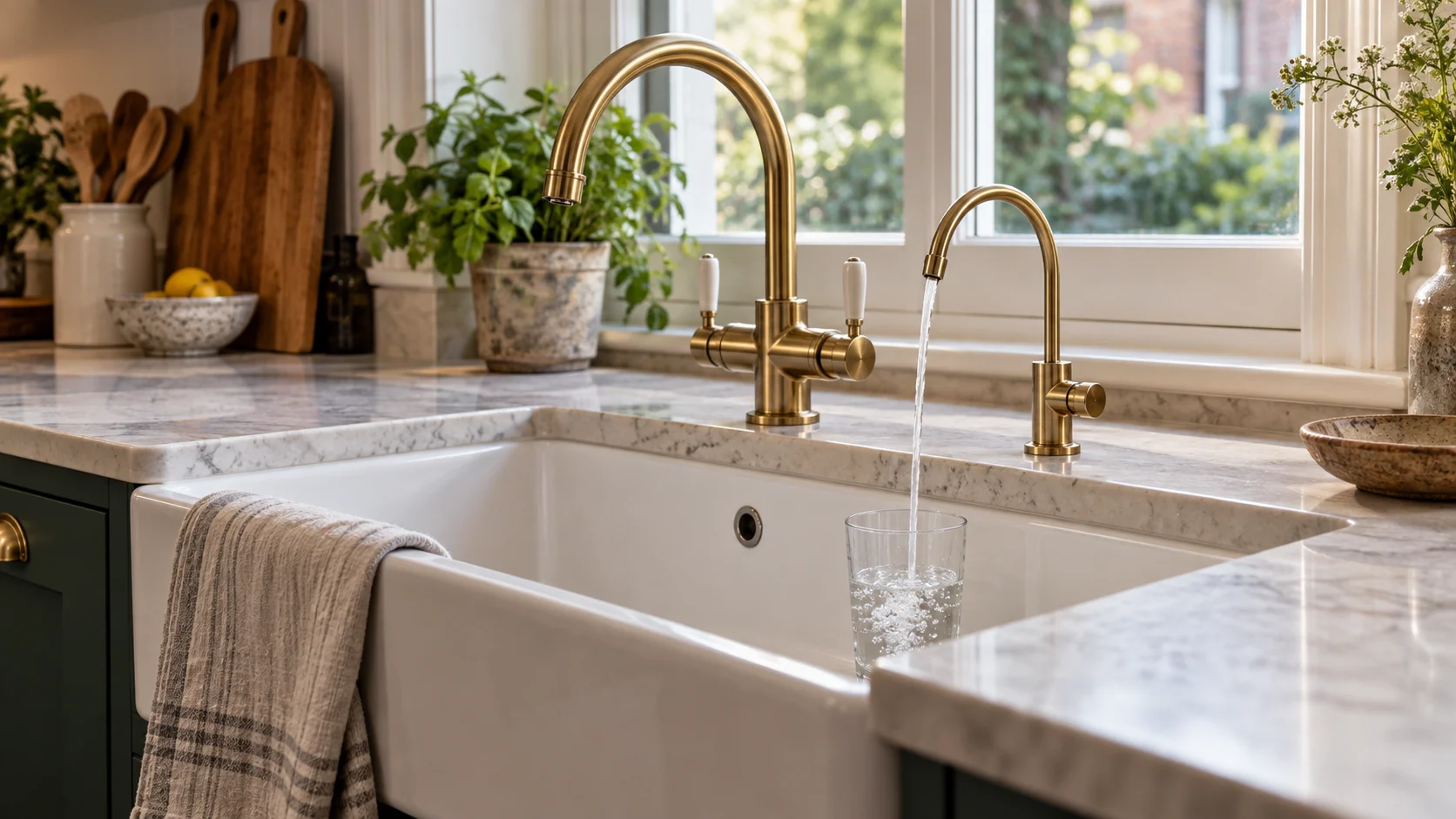
If you also want to address drinking-water taste or investigate reverse osmosis, make that a separate specification. Decide what you want the treatment to achieve, then select equipment supported by appropriate performance information.
Do not assume that a generic filter removes sodium or that installing more treatment stages automatically creates a better system.
A kitchen renovation is a useful opportunity to coordinate the available space, drinking-water tap, cartridges or membrane equipment, and any associated maintenance access. The aim is a coherent arrangement that can be looked after—not a crowded cupboard of unrelated products.
Living with a water softener
Ownership should be straightforward, but the appliance still needs the attention specified by its manufacturer.
Keep the correct salt available, understand how to check the level and avoid substituting unsuitable products. If the system has a display or monitoring function, familiarise yourself with its normal indications.
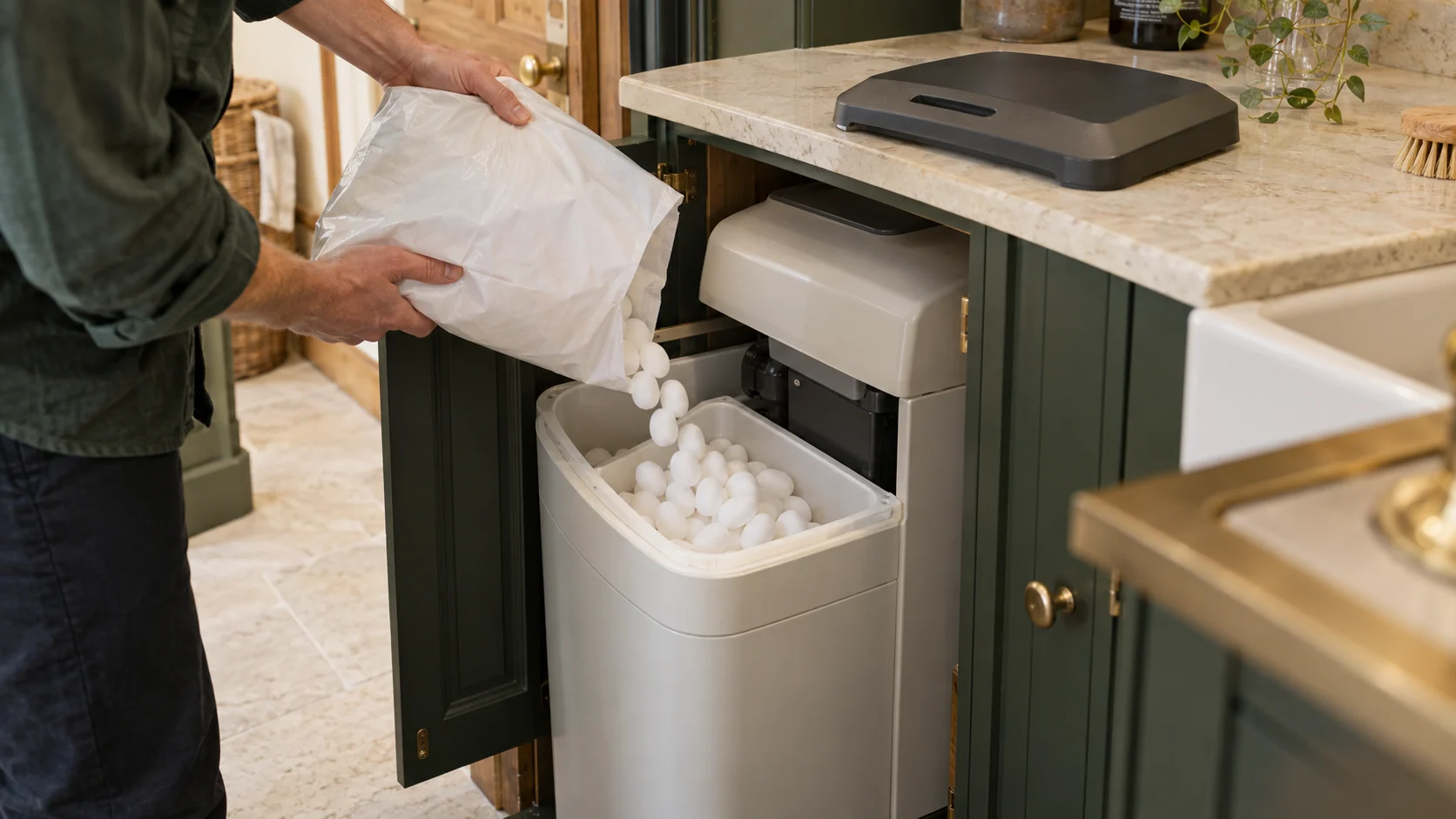
Service requirements vary. Some manufacturers describe models that do not need routine scheduled servicing, while other products have different maintenance instructions. Follow the guidance for the installed model rather than assuming every softener needs the same annual contract—or no attention at all. Harvey’s model-specific service guidance
Arrange an investigation if you notice persistent leakage, abnormal discharge, an unexpected change in performance or a return of hardness despite normal salt use.
It is also worth keeping the installation details with the property’s other manuals. The next person servicing the plumbing should be able to identify the system and its isolation arrangements.
When a softener may not be the right choice
A softener is not automatically the best next purchase because your home is in London.
It may be sensible to postpone or reconsider the installation if:
- Your actual concern is drinking-water taste rather than hardness.
- The benefit does not justify the purchase and ongoing costs for your circumstances.
- Permissions or supply ownership remain unresolved.
- There is no satisfactory installation, drainage or maintenance arrangement.
- Existing pressure or flow problems have not been diagnosed.
Sometimes the right recommendation is to make provision during a renovation and install equipment later. In other cases, a more limited treatment arrangement may meet the objective.
A useful consultation should leave room for those answers.
Water softener FAQs
Can I fit a water softener in a small flat?
Possibly. The decision depends on the actual supply route, suitable drainage, permissions and total installation space. Appliance dimensions alone do not establish whether it will fit properly.
Does every water softener need electricity?
No. Non-electric models are available. Check the chosen model rather than treating a nearby socket as a universal requirement.
Is a twin-cylinder softener always better?
No. Continuity during regeneration can be useful, but price, operating performance, space and household demand still matter. Vessel count is not a substitute for correct sizing.
Can a softener and booster work together?
They can form part of the same installation when appropriately designed. The arrangement should be checked against both manufacturers’ requirements and the complete system’s pressure and flow conditions.
Should my garden tap bypass the softener?
Discuss it when planning the branches. There is usually little reason to consume softening capacity and salt treating ordinary garden-watering demand. The appropriate arrangement depends on what the outlet serves.
Will a softener repair an already blocked pipe or failing appliance?
Do not buy one as a guaranteed repair. Existing restrictions and appliance faults need their own diagnosis. Water treatment is not a substitute for necessary cleaning, repair or replacement.
Can I install one when replacing a boiler or kitchen?
That can be a convenient point to assess it, because access and pipe alterations may already be planned. Agree the water-treatment layout early rather than trying to fit it around finished work.
Plan the right water softener for your London home
The best installation is not necessarily the largest, smallest or most heavily advertised system. It is the one selected around your water supply, household demand and property.
PEP’s London plumbing service can be your starting point for discussing a water softener alongside wider plumbing and hot-water work.
When contacting us, include your postcode, whether the property is a flat or house, the number of bathrooms and what you would most like to improve. Photographs of the incoming supply and proposed installation area can help establish the next step. If you already have an unvented cylinder or booster, mention that too.
From a compact kitchen installation to a coordinated arrangement for a larger home, the priorities remain the same: a suitable specification, a clear scope of work and an installation you can understand and maintain.
Contact PEP to discuss water softener installation in your London home.