
Heating · Diagnosis before treatment
When a London Heating System Needs a Powerflush
Cold radiators. Clear diagnosis.
The right treatment for your heating system.
A cold radiator does not automatically mean the heating system needs cleaning. It does mean there is a problem worth understanding before paying for a treatment.
Perhaps the living room heats quickly while a bedroom stays cold. One radiator may have stopped working after decorating, or several may be warm along the top but cold further down. Those situations can look similar to a homeowner, yet call for different work.
Powerflushing can help where contamination is restricting circulation in a system suitable for cleaning. It cannot repair a failed valve, correct every pipework problem or make an undersized radiator adequately heat a room.
This guide explains how cold-radiator symptoms fit into that decision, what a professional clean involves, and what should be checked afterwards. For the service itself, see PEP powerflushing in London.
/ 01
Start with the pattern of poor heating
Before deciding whether to flush, establish which parts of the heating system are affected and when the change appeared. A record of the symptoms is more useful than simply asking for the strongest cleaning treatment.
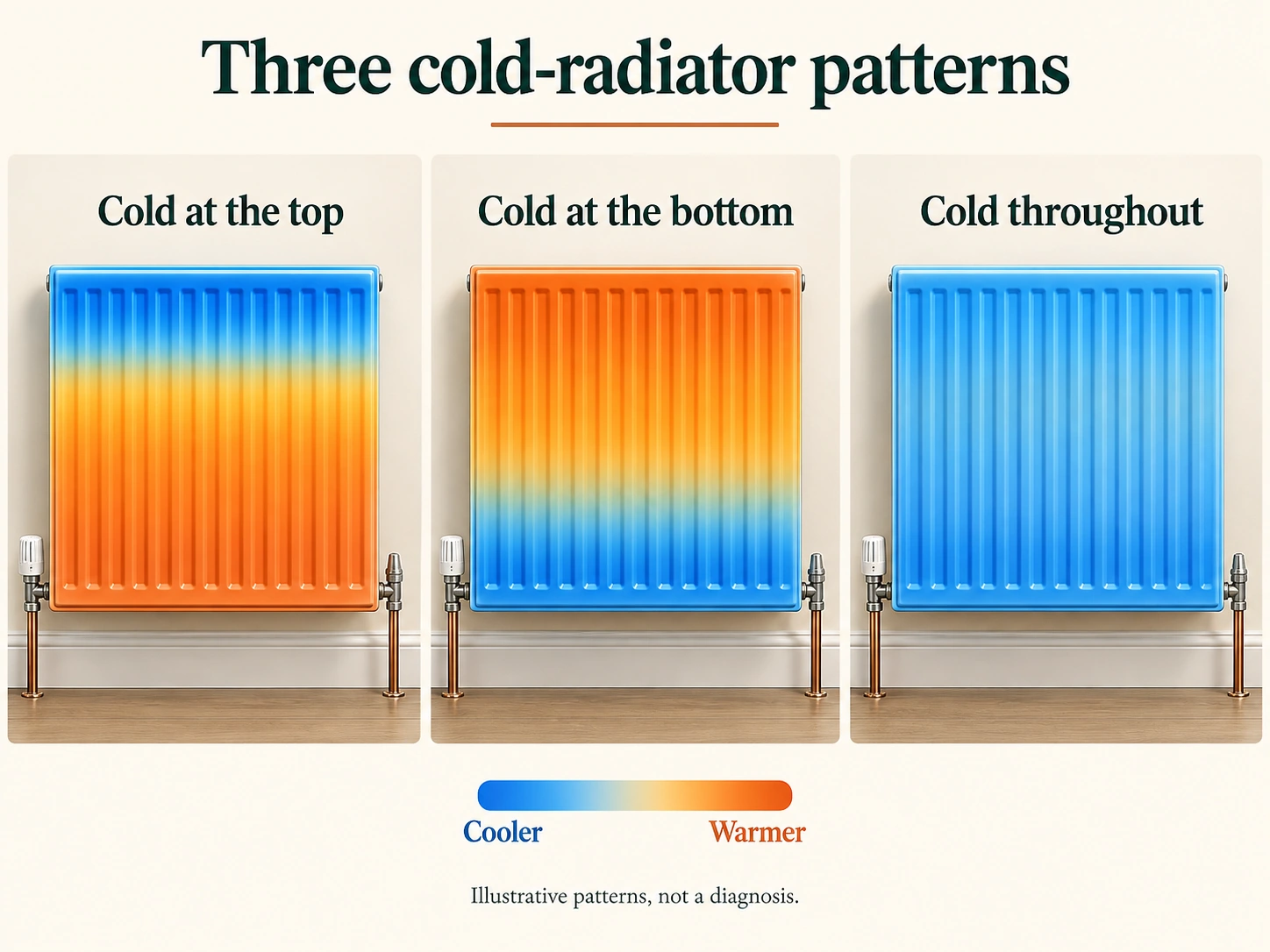
One radiator is completely cold while the others work
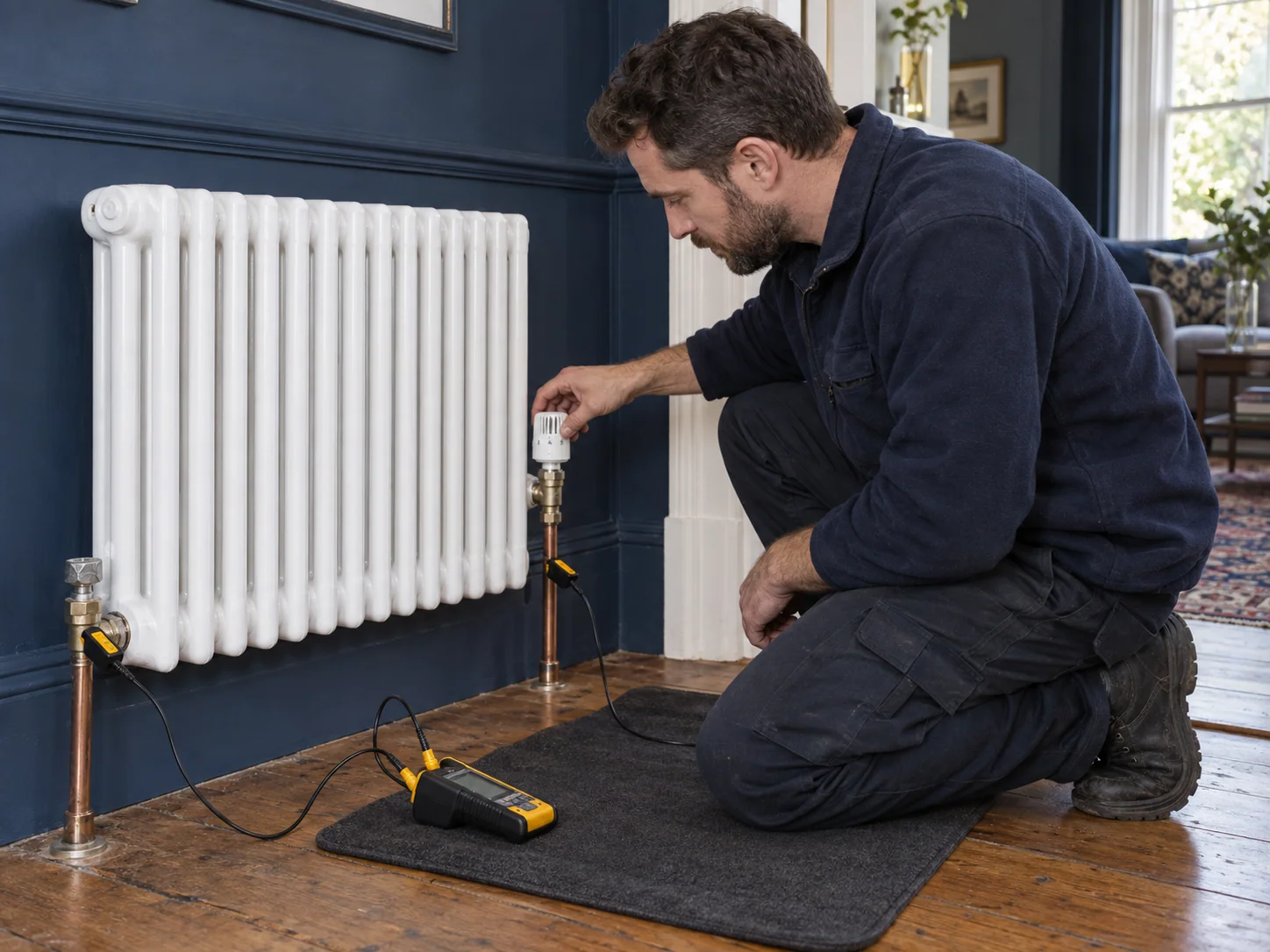
Start with the local controls, valve operation and supply to that radiator. A thermostatic radiator valve, or TRV, might be satisfied because the room is already warm, set too low, or not operating correctly. A valve may have been left closed following work.
If the room is genuinely cold and calling for heat, the investigation should distinguish a local valve or branch restriction from a wider circulation problem. Sludge is one possibility, not the only explanation. Replacing or repairing a faulty valve may be more appropriate than cleaning the entire house. Vaillant explains the distinction between one cold radiator and a whole-system problem.
The radiator is cold at the top
Trapped air is a common possibility. Bleeding releases air; it does not clean sludge out of a radiator. If air keeps returning, repeatedly bleeding the radiator is not a complete investigation.
Only follow the appliance instructions for homeowner maintenance, with the heating off and the radiator cool. Do not force a seized bleed screw, remove valve parts or work on hot, pressurised fittings. If unsure, leave it to an engineer.
The radiator is warm at the top but cold at the bottom
Deposits and restricted flow deserve investigation, particularly when there is a persistent cold patch and the room fails to warm. However, a radiator naturally gives up heat as water passes through it: a temperature difference alone does not prove a blockage.
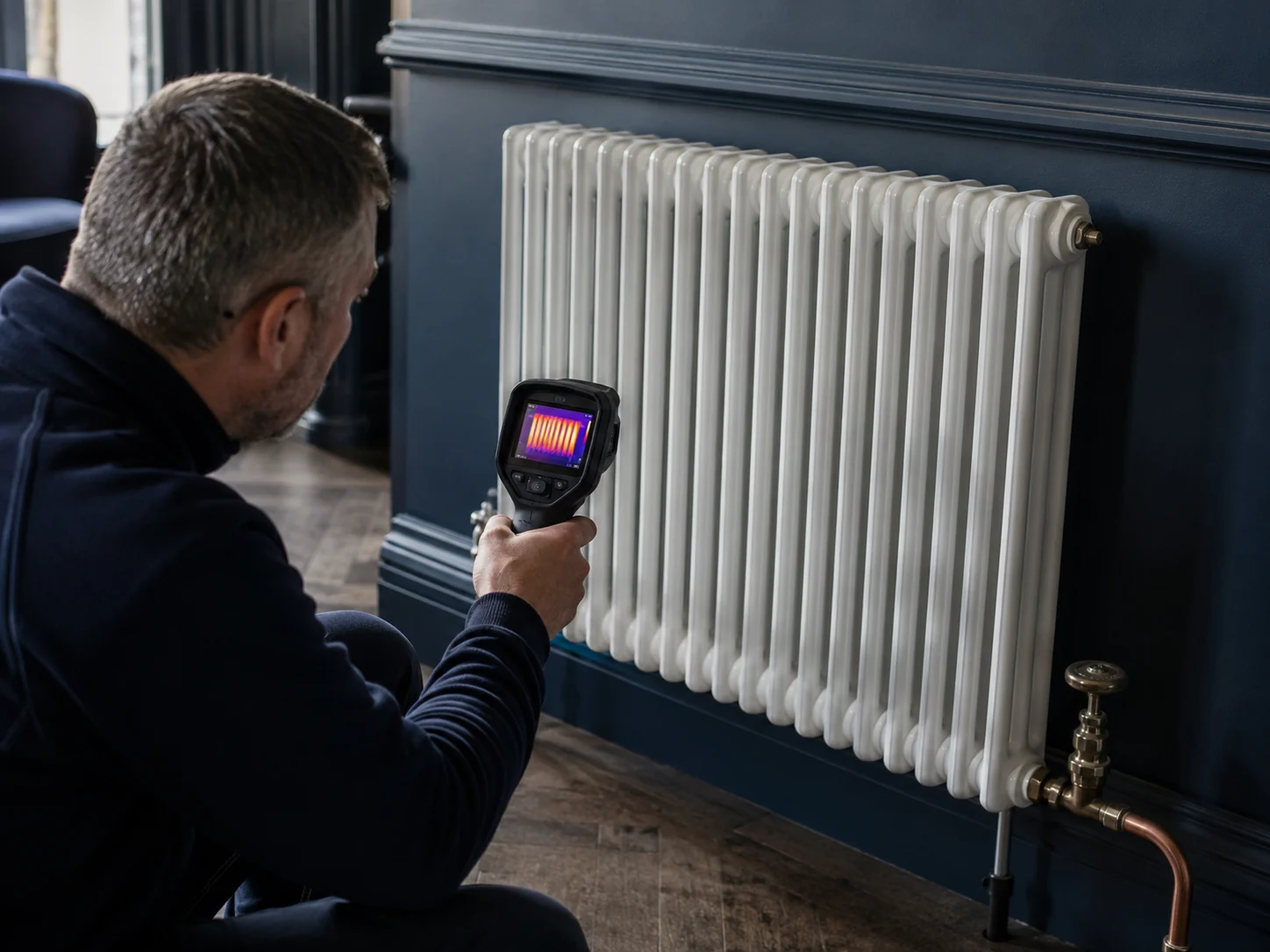
The engineer should consider its heat pattern, valve operation, flow and return temperatures, and the condition of the heating water together. A thermal image can support the investigation, but cannot by itself identify everything happening inside the radiator.
Some rooms or floors heat much more slowly
This may be a distribution problem. Balancing adjusts the flow available to radiators so that the easier routes do not take more than they need while other branches struggle.
Pump performance, valve settings and alterations to the pipework can also matter. Cleaning and balancing are different jobs, although a contaminated installation may need both. Vaillant describes why unequal flow can leave radiators heating at different rates.
All radiators are cold or the problem began suddenly
Check the normal heating schedule, room thermostat and any displayed fault message. A missing heating demand or an appliance fault should not be assumed to be sludge.
If the gauge repeatedly falls, read our guide to a boiler losing pressure. Cleaning is not a substitute for identifying a leak or another cause of pressure loss.
/ 02
When the evidence supports system cleaning
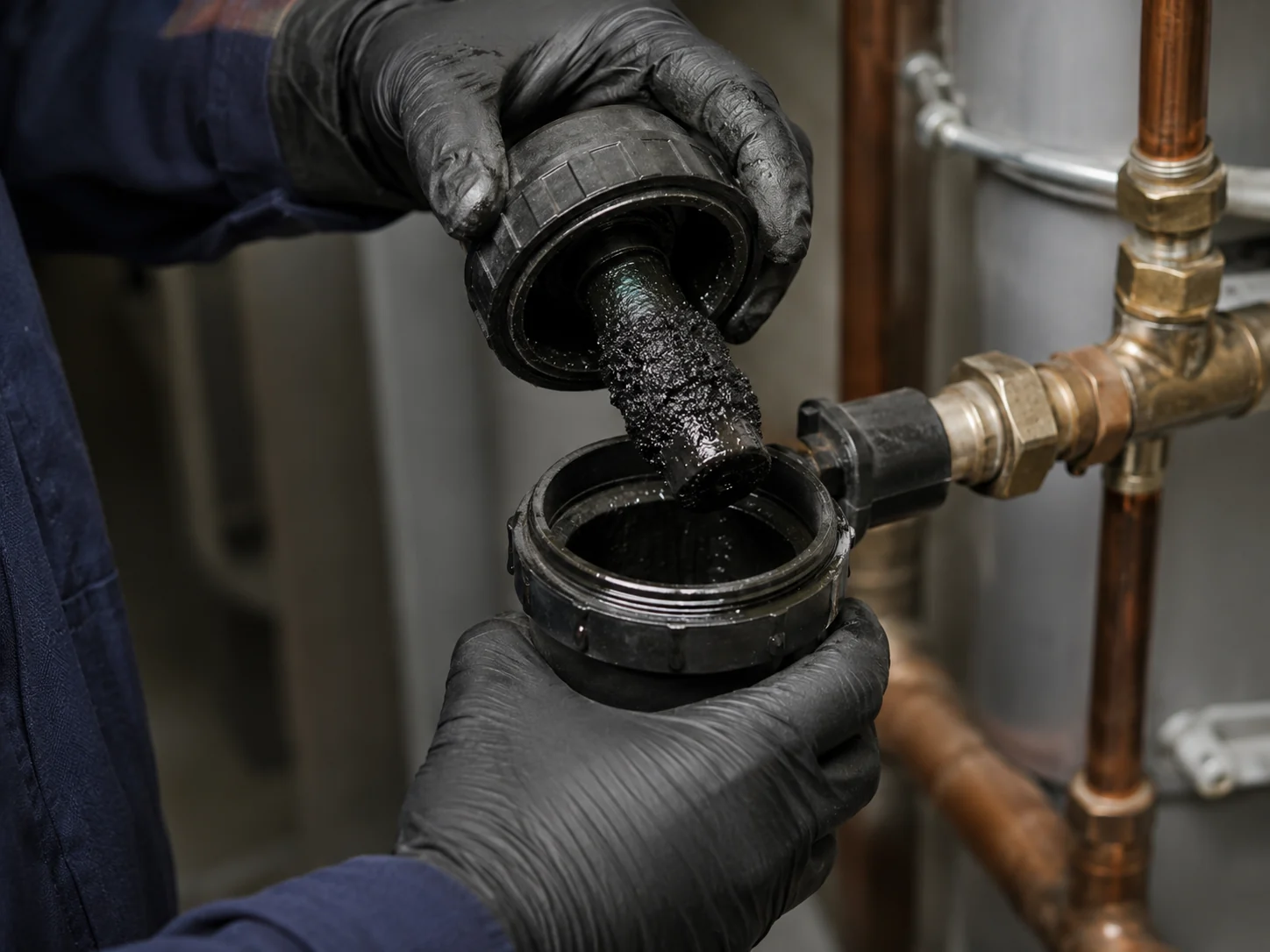
A stronger case for cleaning combines poor circulation with evidence of contamination. Relevant findings might include debris in a filter, deposits identified during component work, or a water sample that supports the wider diagnosis.
Black heating water can contain magnetite, a corrosion product. Other debris may also be present. Water colour alone does not establish how much material remains elsewhere, whether it is causing the complaint, or which cleaning method will work.
An assessment should connect the findings to a proposed remedy. Ask:
- What evidence points to contamination rather than a control or valve fault?
- Is the problem limited to one radiator or present across several circuits?
- Can water circulate through the affected parts well enough to clean them?
- Are any components too deteriorated to retain?
- What improvement should be checked at the end?
Where controls and circulation interact, our heating controls guide explains why the whole system needs consideration.
/ 03
What a powerflush actually does
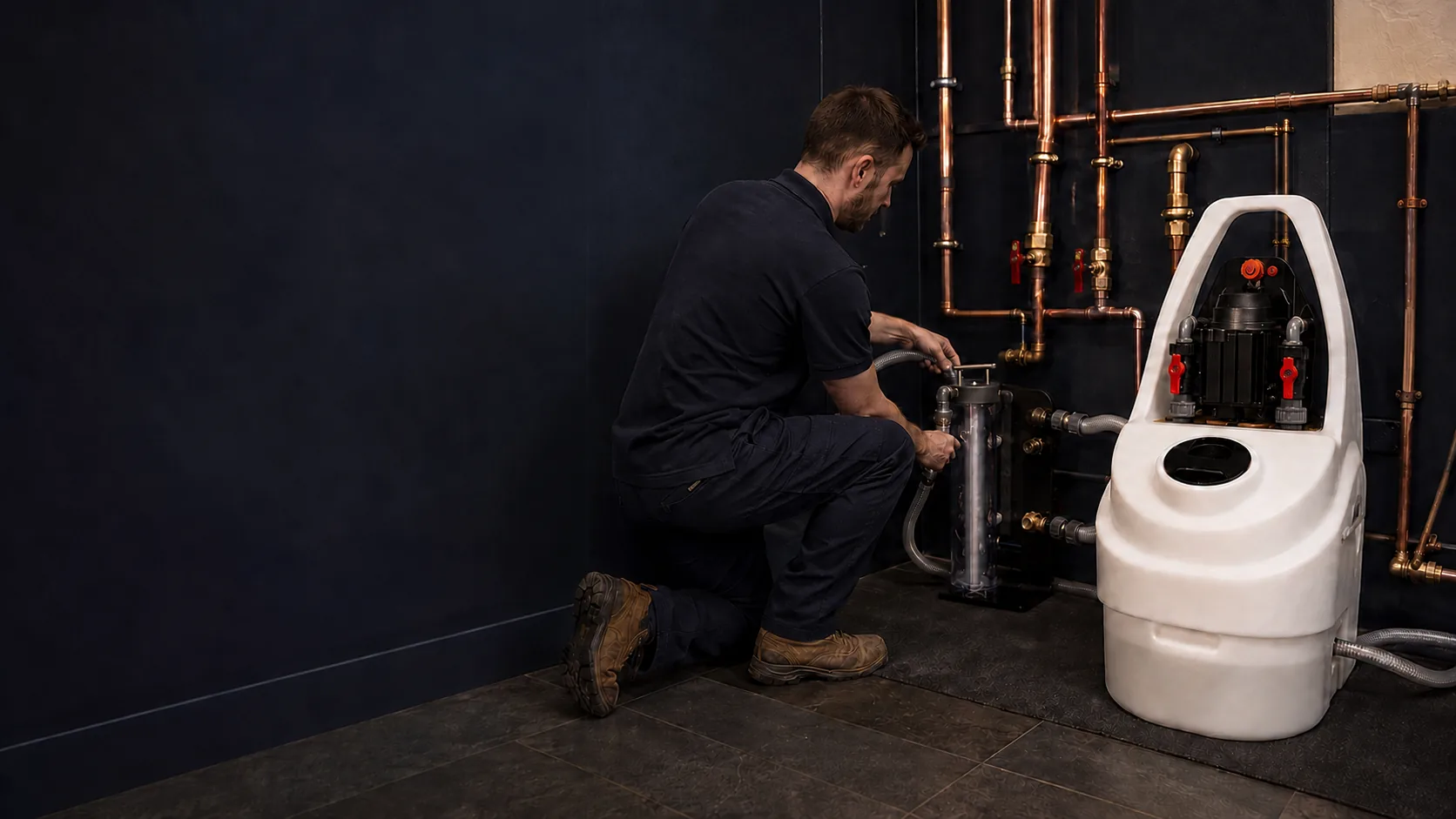
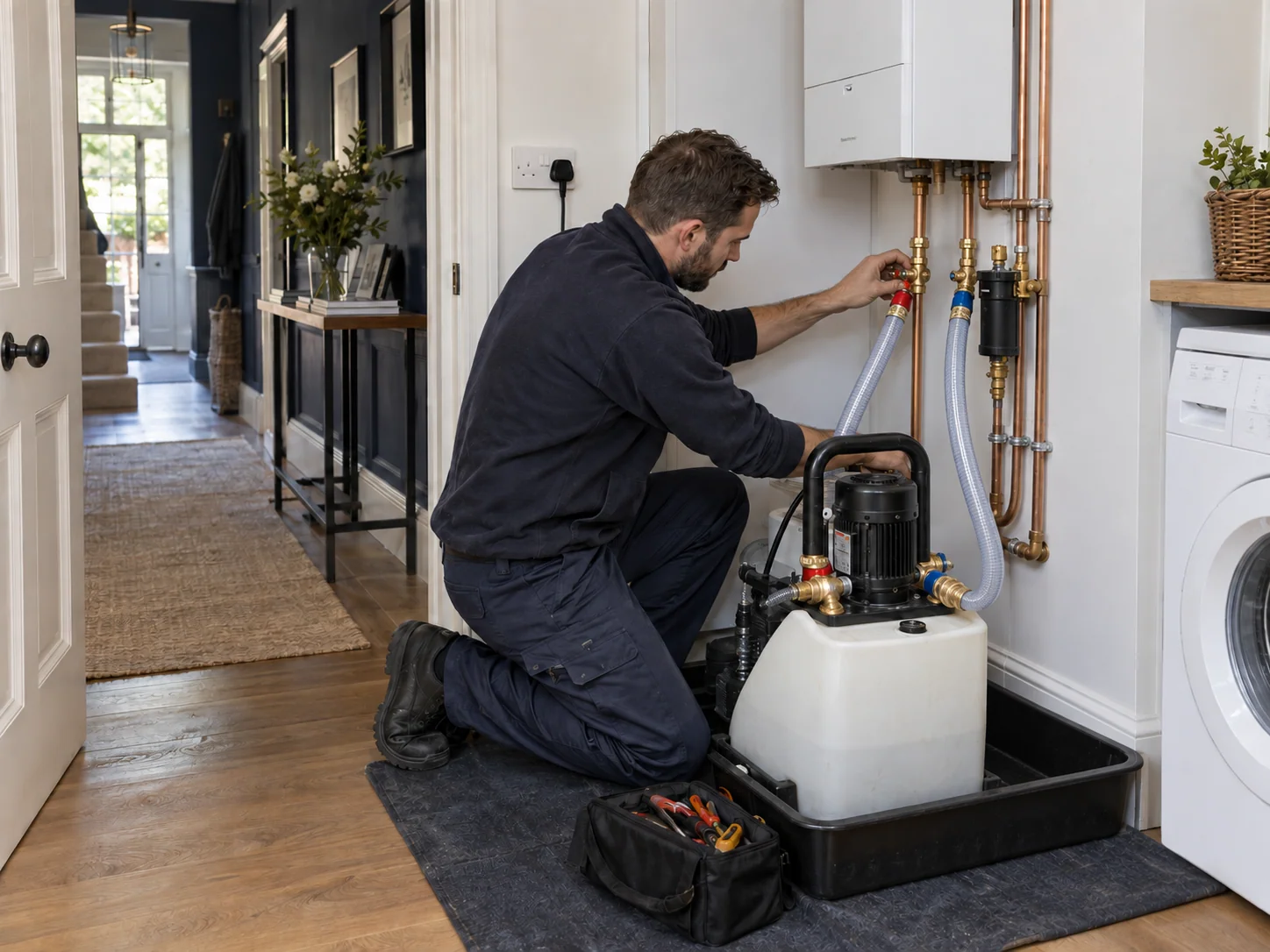
A powerflush uses an external pumping unit to circulate cleaning water through the heating circuit at a high flow rate. Suitable chemicals help loosen contamination, which must then be removed rather than simply moved to another component.
The name does not mean pressure-washing the installation. The equipment, connection arrangement and cleaning method must suit the system. High flow and controlled cleaning are the relevant principles, not maximum pressure.
The circuit being treated contains heating water, not the drinking water delivered from kitchen and bathroom taps. Where a cylinder is involved, the heating coil and stored domestic water are separate circuits.
A successful clean can restore circulation impaired by deposits. It does not reverse metal corrosion or replace failed parts. The realistic outcome depends on what caused the original problem and what condition the retained system is in. Fernox outlines the purpose of powerflushing and the need for an initial condition check.
/ 04
Powerflushing compared with the other options
There is no useful rule that every cold radiator needs a whole-system powerflush. Equally, adding a bottle of cleaner is not proof that an installation has been thoroughly cleaned.
| Option | Main purpose | Important limit |
|---|---|---|
| Bleeding | Release trapped air | Does not remove settled sludge or repair a valve |
| Balancing | Adjust how flow is distributed | Does not remove contamination |
| Valve or component repair | Correct an identified mechanical or control fault | Does not establish that the rest of the system is clean |
| Targeted radiator cleaning | Address contamination in a particular radiator | May leave debris in branches or other components |
| Chemical cleaning and flushing | Disperse contamination, then remove it using a suitable flushing method | Needs adequate circulation, correct treatment time and effective rinsing |
| Powerflushing | Use an external pump and suitable treatment to clean accessible heating circuits | Cannot guarantee recovery of a completely blocked or badly deteriorated section |
Chemical cleaning and powerflushing are not opposites: a powerflush commonly uses a cleaning chemical. Compatibility, concentration and treatment time are product-specific. For example, Fernox F3 guidance distinguishes cleaning, thorough rinsing and subsequent protection.
Magnetic flushing equipment is another approach. ADEY explains that its MagnaCleanse system can work independently or alongside a powerflushing machine. Ask what method is proposed, how each affected circuit will be treated and how the result will be assessed.
/ 05
The professional powerflushing process
The following describes what a homeowner should expect to be discussed. It is not an instruction to hire a machine and alter a heating installation.
Survey and agree the scope
The starting record should identify the affected rooms, radiator condition, heating zones, recent work and relevant water-quality findings. Existing leaks, unsuitable components and any likely exclusions need to be discussed before cleaning starts.
The quotation should distinguish the clean from valve replacements, radiator replacement or pipework repairs.
Protect the property and plan access
Equipment needs a suitable working area, water supply, safe electrical supply and an appropriate route for waste water. Access to radiators matters throughout the work.
In a finished London home, hose routes and protection for floors, carpets and joinery should be planned, not improvised. In a converted flat, also establish whether the heating is independent or connected to a shared building system.
Connect and select the treatment
The engineer chooses connection points and a circuit arrangement suited to the installation. The boiler, pumps, valves and any additional circuits must be accounted for.
The cleaner must be compatible with the materials and appliances being retained. A new boiler should not become a collection point for debris released from older pipework.
Clean the intended circuits
A machine running beside a boiler does not demonstrate that every radiator has received effective cleaning.
The method should address individual radiators and relevant branches, rather than allowing most circulation to follow the easiest route. Flow reversal and suitable agitation may form part of the process. A circuit that will not circulate needs further investigation rather than an assumption that more running time will clear it. Kamco illustrates circuit-by-circuit cleaning in its equipment guidance.
Rinse and check the water
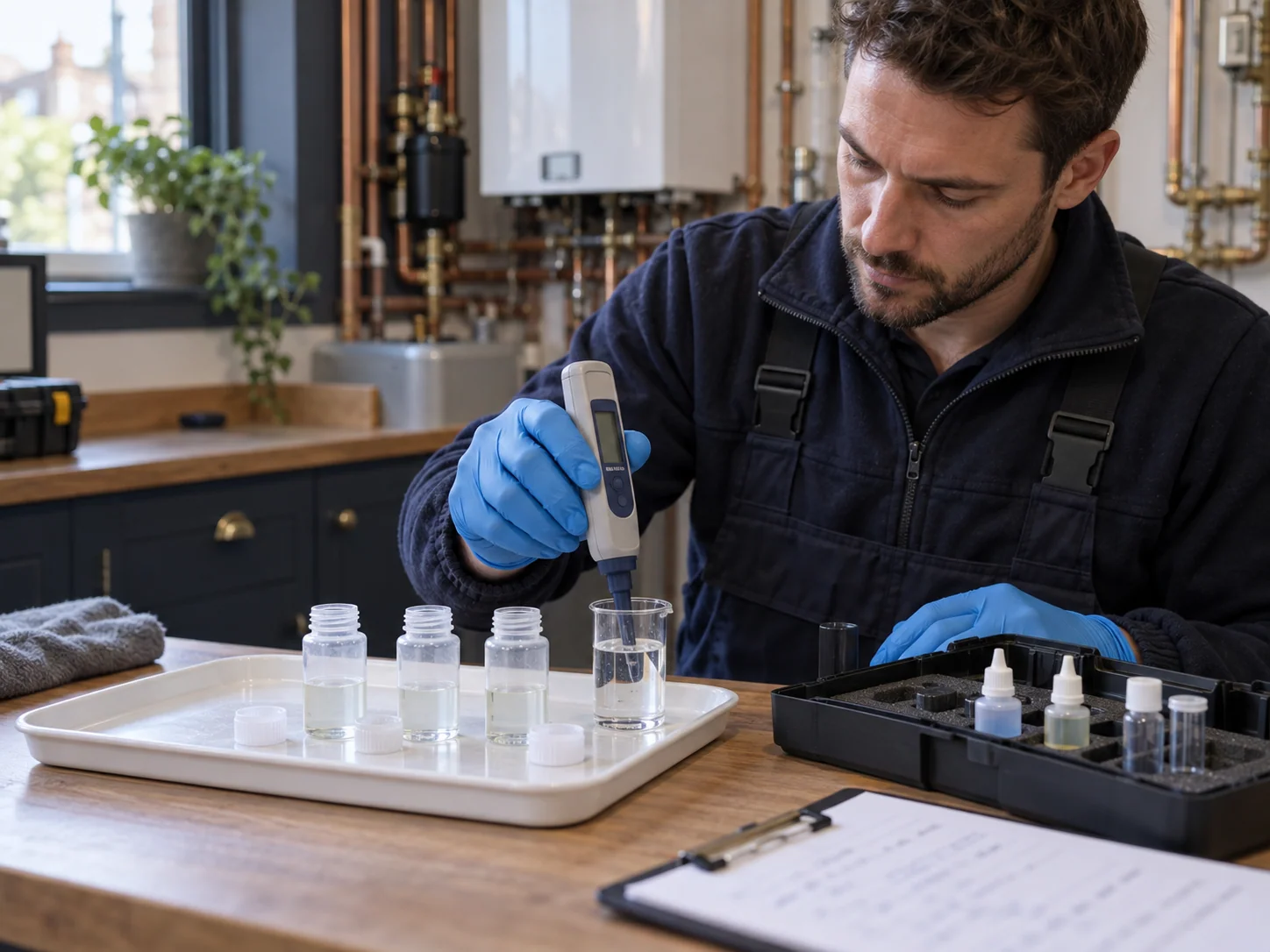
Loosened contamination and the cleaning treatment must be removed as the product instructions require. Clear-looking discharge is useful, but appearance is not a complete water-quality assessment.
Suitable tests depend on the treatment and system. Inhibitor concentration, pH, turbidity and corrosion indicators are different checks; one does not stand in for all the others. Fernox lists the parameters covered by its different on-site tests.
Protect and recommission
The system is refilled and treated with suitable corrosion protection, with the dose established for the installation and checked as appropriate. Filters, valve settings, controls and the heating operation then need attention.
The job should finish with a demonstration of the agreed outcome and a record of outstanding defects, not simply a photograph of dirty water.
/ 06
Balancing and checking the result after cleaning
Once cleaning has finished, revisit the original complaint. Does the previously cold radiator now heat when its room calls for warmth? Do the slower rooms receive adequate heat? Does the system still behave properly when more than one zone is operating?
Flow distribution may need readjustment. Leaving every balancing valve fully open is not the same as commissioning the system.
A useful handover records what was treated, which products were used, relevant water-test results and any remaining limitations. If a room is still cold, the next question may concern radiator output, the room's heat loss, controls or pipework rather than another round of cleaning.
The aim is a functioning heating system. Cleaner water is one part of that outcome.
/ 07
Older radiators and microbore pipework
Age alone does not determine whether a system can be flushed. Condition matters: heavily corroded radiators, weak fittings and already leaking components need an honest assessment.
Cleaning can expose a leak previously held back by corrosion deposits. That possibility should be explained before work, together with how remedial work would be handled. It is not reasonable to promise that any old system is risk-free.
Microbore pipework is not an automatic exclusion either. Narrow branches, restrictions and the connection arrangement can make cleaning more difficult. Some installations are recoverable; a blocked or damaged section may require separate work.
Kamco discusses both corrosion-related leaks and microbore limitations. The important distinction is between cleaning a suitable installation and trying to use cleaning to avoid a necessary repair.
/ 08
Systems combining radiators and underfloor heating
In a mixed installation, establish which circuits are affected before extending the cleaning scope. A cold UFH zone could involve its demand signal, actuator, mixing arrangement, pump or loop flow rather than contamination throughout the property.
The cleaning plan must identify which parts are included, how flow will reach them and any manufacturer-specific treatment requirements. Do not assume a radiator flush automatically covers every UFH loop.
Our underfloor heating troubleshooting guide covers those distinctions. If a renovation is adding UFH to existing radiators, the wider heating design should coordinate cleaning, temperatures, circulation and controls.
/ 09
Cleaning when replacing a boiler
Connecting a new boiler to old, contaminated heating water can undermine an otherwise well-planned installation. The retained system therefore needs an appropriate assessment and preparation.
That does not mean every replacement needs the same powerflush package. The cleaning method should follow the system's condition and the appliance manufacturer's instructions. New installation debris, existing corrosion products and an obstructed branch are not identical problems.
Discuss cleaning, filtration, water treatment and commissioning as part of the boiler installation scope, rather than discovering after installation that the old radiators were excluded.
/ 10
Cost and disruption in London homes
A radiator count is useful for an initial enquiry, but it does not fully describe the work. A compact flat with accessible pipework differs from a house with several floors, multiple heating zones and radiators altered at different times.
The quotation should make clear:
- which radiators and circuits are included;
- the cleaning method and treatment proposed;
- whether filtration, inhibitor, testing and balancing are included;
- access arrangements and expected loss of heating or hot water;
- how additional repairs would be agreed;
- the total price and VAT treatment.
Ask for an expected duration based on the survey, including whether preparation or a return visit may be needed. Request a written quotation for the assessed installation, rather than treating a headline price or a standard time allowance as a complete specification.
/ 11
Keeping the system clean afterwards
A flush should be followed by protection and maintenance appropriate to the installation. A permanent filter collects material reaching it; it cannot prove that every radiator and branch is free from deposits.
Corrosion protection needs to be appropriate for the system, and draining, refilling or significant water loss can affect its concentration. Filter maintenance and water-treatment checks should follow the relevant instructions.
Repeated contamination or recurring air should prompt investigation of the cause. Booking another clean without understanding why the problem returned may repeat the cost without resolving it.
/ 12
Common questions about powerflushing
Will a powerflush fix one cold radiator
It may help if contamination is the cause and the radiator can be cleaned effectively. A closed or failed valve, trapped air, inadequate flow or a control problem needs a different response. Establish the cause before choosing whole-system work.
Why is a radiator still cold after a powerflush
Possible explanations include remaining restriction, a valve fault, air, an unbalanced branch or a problem outside the agreed cleaning scope. Compare the result with the original findings and ask what has been verified before paying for further treatment.
Does black water prove the whole system needs a powerflush
No. It is evidence to assess, not a complete diagnosis. The system's performance, contamination, circulation and condition should determine the proposed method and scope.
Can a magnetic filter replace cleaning
A filter can help capture circulating debris and may form part of a cleaning method. Fitting a permanent filter alone does not establish that existing deposits have been removed.
Will a powerflush reduce heating bills
Removing a restriction may improve heat delivery where contamination was impairing performance. Savings depend on the original fault, controls, temperatures, building and use. No fixed percentage should be promised for an unassessed home.
How often should a heating system be powerflushed
There is no universal calendar interval suitable for every installation. Base the decision on its condition, maintenance history and relevant instructions. Regular checks and appropriate water treatment are different from automatically booking another full powerflush.
/ 13
Discuss the right next step with PEP
Tell us which rooms are affected, whether the problem is constant or intermittent, and whether it followed decorating, a boiler change or other heating work. Include your postcode, approximate radiator count and any available service or water-treatment records.
PEP provides powerflushing in London as part of its plumbing and heating work. The starting point is deciding whether cleaning is appropriate for your system and how it fits with any repairs or planned improvements.
Local service information is available for Notting Hill, Chiswick, Kensington, Chelsea, Hampstead, Maida Vale, St John's Wood, Fulham SW6, Hammersmith W6, Earl’s Court SW5, Shepherd’s Bush W12, Queen’s Park NW6, Paddington W2, Ealing W5 & W13, Acton W3 and Willesden & Willesden Green.