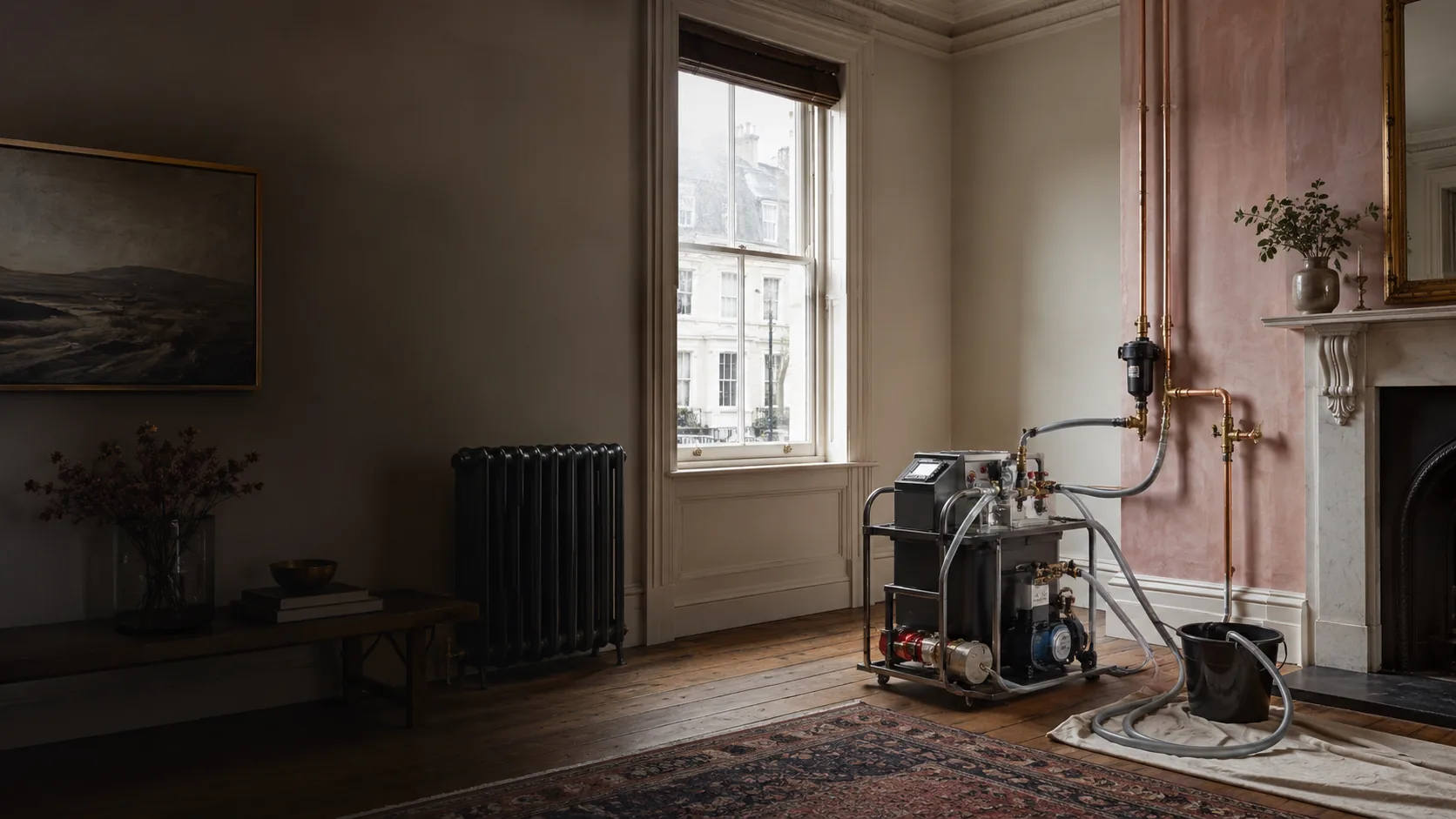
Column radiators cold underneath
Traditional cast column radiators can stay cool along the lower sections while the top runs warm, showing where debris has settled.
 Pure Energy ProjectElectrical · Heating · Plumbing07825 268 434
 Central heating water quality · Notting Hill W11
PEP checks how the system is actually built before recommending a Powerflush. Notting Hill's townhouses and their conversions often carry column radiators, sectioned pipework and controls added across several refurbishments — we trace how each zone behaves, then clean, capture and verify circuit by circuit, with finished floors and joinery protected throughout.
Assessment before equipment. Every time.
01 · Reading the symptoms
No single sign confirms contamination on its own. These are the patterns worth checking before any work is booked.
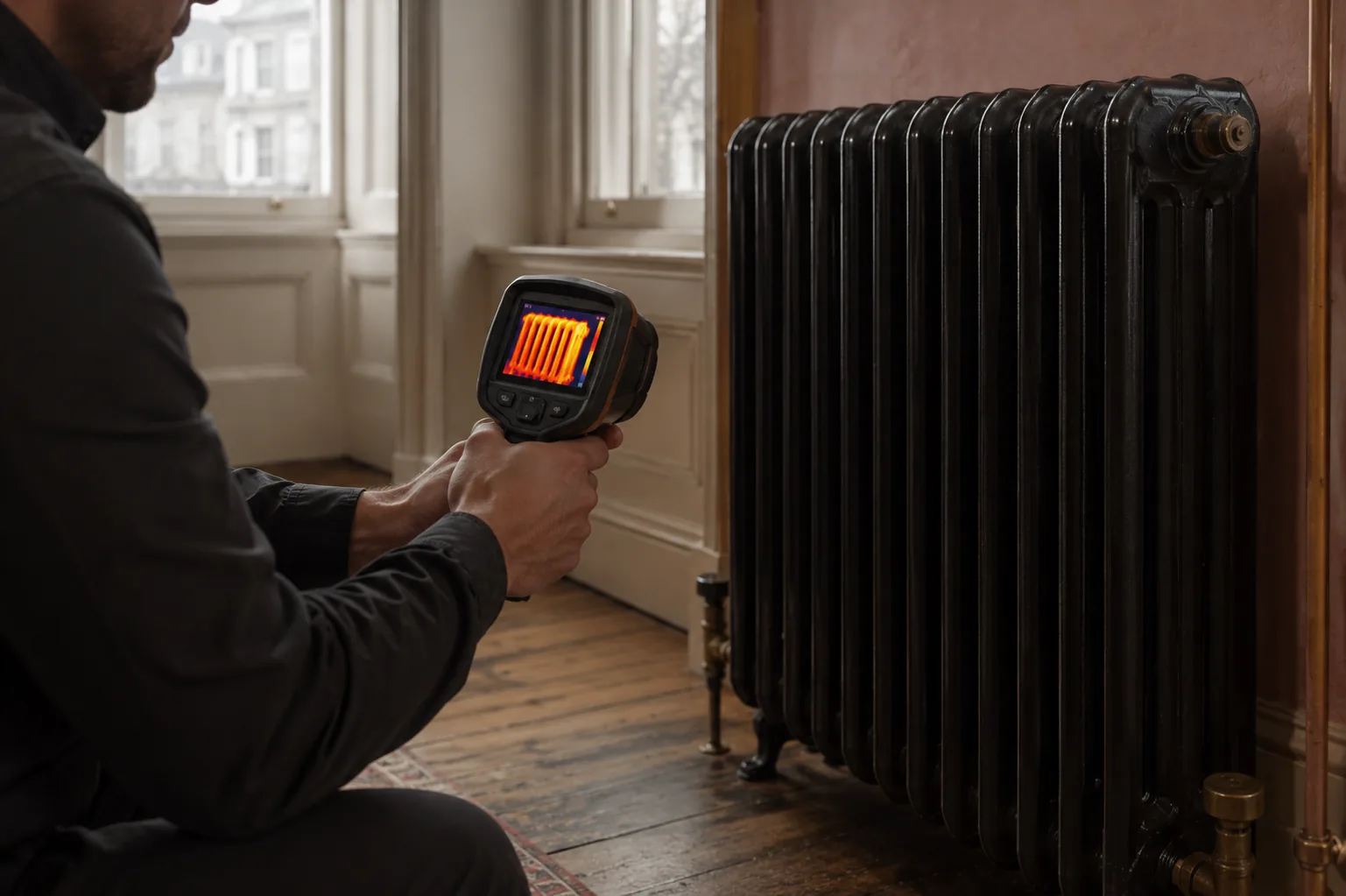
Traditional cast column radiators can stay cool along the lower sections while the top runs warm, showing where debris has settled.
In a taller townhouse, heat can lag on the upper floors long after the ground floor has come up to temperature.
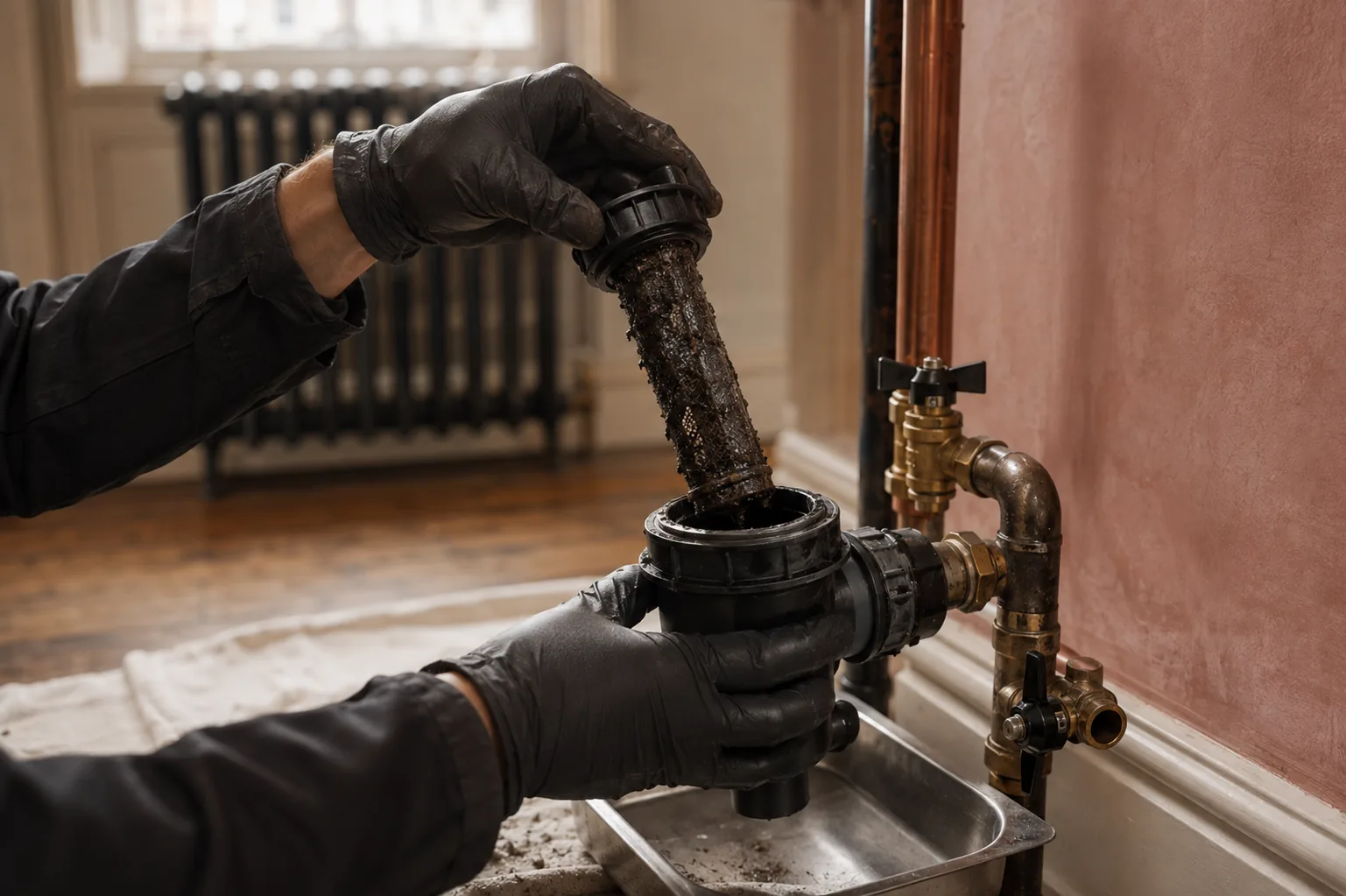
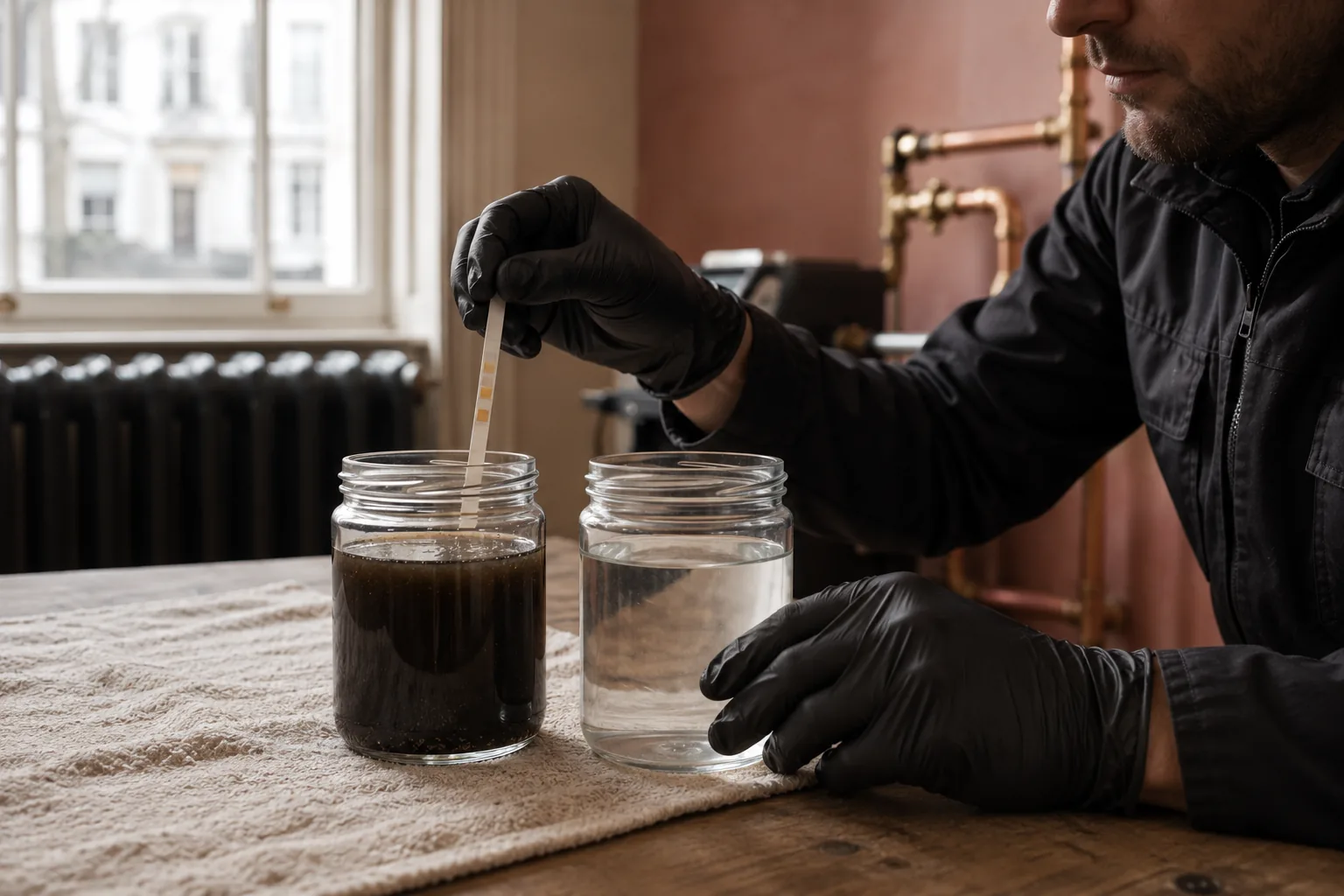
Dark or gritty water drawn off at a radiator valve or filter often points to corrosion by-products moving through the system.
Kettling, gurgling or a labouring pump can follow restricted flow through a contaminated circuit.
A valve, pump or filter that keeps failing again after being replaced usually has an upstream water-quality cause.
02 · Diagnosis before any machine is connected
Uneven heat and background noise can just as easily come from trapped air, an unbalanced zone, a tired pump, a stuck valve, a control fault or pipework that was never sized for today's radiators — all more likely where a circuit has been extended or rerouted across several refurbishments. None of those faults respond to cleaning the water.
Use our guide to review the warning signs that may point to a Powerflush before deciding on treatment.
03 · Evidence of the assessment
Three checkpoints connect the symptom reported to the work actually completed before handover.
04 · The controlled process
The equipment matters, but the sequence matters more. We work zone by zone and verify the system before handover.
Review radiator count, zoning, pipework age and access before agreeing a plan of work.
Dust sheets and floor protection go down before any equipment is connected, particularly around finished joinery and flooring.
High-flow equipment connects at a suitable point without disturbing the wider installation.
Each floor or zone is treated in turn rather than flushed through as one shared circuit.
Magnetic filtration pulls ferrous debris out of circulation while each zone is rinsed until it runs clear.
Inhibitor is renewed, settings restored, and heat-up checked zone by zone before we leave.
05 · Choose the right intervention
The visible symptom can look similar from one fault to another. The correct treatment depends on the cause and its severity.
For established sludge, restricted flow and circuits that keep silting up.
For systems where normal circulation still works and contamination is less established.
For pump, valve, control or distribution faults that cleaning cannot touch.
Important limitation
In an aged or altered circuit, built-up debris can be sitting inside a weak point. Clearing it can expose a leak that was already there. We flag this possibility before starting, not after.
06 · Suitability & limitations
Age on its own is not a reason to rule a system out, and not every Notting Hill circuit carries equal risk — some later-refurbished sections are in good order, while some untouched original runs are not. Condition, layout and access decide the approach, not the age of the property.
07 · Duration & quotation
A realistic programme and price follow the system in front of us — not a headline figure.
A typical zoned townhouse system can be assessed, cleaned, rinsed and recommissioned in a day. Taller properties with several zones, compact access or heavier contamination may need longer.
Areas we cover around Notting Hill — including Notting Hill Gate, Holland Park, Portobello Road, Westbourne Grove, Ladbroke Grove, Pembridge, Colville and Norland, and surrounding W8, W10, W11 and W2 addresses. For the Paddington and Bayswater side of W2, see Paddington and Bayswater powerflushing.
Cold patches on column radiators, dark system water, slow heat-up on upper floors and repeat component faults are worth investigating, but none of them confirm contamination on their own. We check the system first, since a balancing fault, stuck valve or failed pump can look similar.
Usually, yes, though it depends on the radiator's condition, its valves and how the wider circuit has been altered over time. We check these before agreeing the flow rate and method.
A Powerflush uses professional high-flow equipment and controlled circuit-by-circuit treatment to shift established sludge. A chemical clean circulates cleaner through the system's own pump and suits lighter contamination. Which one fits depends on the condition of the water and the system.
Many domestic systems take most of a working day. Properties with several zones, taller floor counts or heavier contamination usually take longer — we confirm the likely programme after checking radiator count and access.
It depends on radiator and zone count, system age, access and how contaminated the water is. We provide a scope and price after assessing the system rather than quoting a flat figure in advance.
The process is built around controlled high flow rather than force, and rooms are protected before equipment is connected. That said, cleaning cannot reverse existing corrosion, and clearing debris can reveal a leak it had been masking — which is why we check the system's condition first.
Only if contamination is actually the cause. It will not correct a failed control, a stuck valve, undersized pipework or a worn pump — those need to be identified and addressed separately.
We rinse the cleaning chemicals out, add fresh corrosion inhibitor, restore the original settings and check heat-up zone by zone. Anything found that sits outside the cleaning work is explained before we finish.
PEP's Powerflush service in Notting Hill sits alongside our wider Powerflush London → coverage and every boiler installation in Notting Hill →, which includes a full system clean as standard.
See our broader central heating installation → work, our whole-system heating installation in Notting Hill → for a full redesign rather than a clean, our Notting Hill plumbing → service, or contact PEP → to discuss a Notting Hill heating system.
Start with the right question
Tell us what the system is doing, which zones or floors are affected, and whether any recent boiler, radiator or control work has been completed.