
Underfloor heating · Troubleshooting
Underfloor Heating Not Working? A Troubleshooting Guide for London Homes
Find the cause before choosing the repair.
Start with your symptomsThe thermostat says the heating is on. The kitchen is still cold. Upstairs, the radiators are working perfectly.
It is an understandably frustrating situation, particularly when most of the heating system is hidden beneath a finished floor. But a cold room does not automatically mean damaged pipework, a failed heating mat or a floor that needs lifting.
Underfloor heating depends on several things working together: the controls must request heat, the system must deliver it, and the floor must transfer enough of it into the room. A problem at any of those stages can produce a similar symptom.
This guide explains how to narrow down the problem, what you can safely observe and when professional investigation is needed. It covers water-based underfloor heating first, followed by a separate section on electric systems.
/ 01
Why is my underfloor heating not working?
Start with two questions: what type of system do you have, and did it previously work properly?
Wet underfloor heating circulates heated water through floor loops connected to a manifold. Electric underfloor heating uses heating cables or mats beneath the floor. Both can have digital thermostats, so a screen on the wall does not identify the system.
The history matters just as much. Heating that suddenly stopped needs a different investigation from a room that has never reached its target temperature. A problem immediately after a thermostat replacement, floor renovation or heating alteration provides another useful starting point.
| What you notice | What it may point towards | Useful next step |
|---|---|---|
| Every UFH room is cold | A shared control, heat supply or circulation issue | Check normal user settings and record visible errors |
| Only one room is cold | Zone control, loop flow or room-specific performance | Compare its thermostat and behaviour with working rooms |
| Thermostat shows heating, but nothing warms | Heat demand is not becoming useful heat | Note the demand indication and how long it has been present |
| Manifold flow meter reads zero | An inactive circuit, a flow problem or an unreliable indication | Record whether that zone is actually requesting heat |
| Radiators work, UFH does not | A problem affecting the separate UFH circuit or its controls | Note whether UFH ever works independently |
| Electric UFH trips a protective device | An electrical fault requiring investigation | Stop attempts to run it and arrange an electrician |
These are starting points, not diagnoses. Several different faults can produce the same observation.
/ 02
What can you safely check before calling an engineer?
Use the normal controls and visible information only. You should not need to remove electrical covers, disconnect an actuator or turn manifold adjustments to establish the basic symptoms.
Check the following:
- Is the correct room selected, with heating enabled rather than holiday, frost or off mode?
- Is the schedule currently asking for warmth, and is the target above the displayed room temperature?
- Are there low-battery, lost-connection or error messages?
- Has a normal user-accessible heating switch been turned off?
- Do other rooms, radiators and hot-water services work?
- When did the problem begin, and what changed beforehand?
Replace batteries only where this is a normal user operation described in the thermostat manual. Record existing settings before making ordinary schedule changes. Avoid factory resets: they can erase useful configuration and create a second problem.
Stop checking if there is water near electrical equipment, a burning smell, visible electrical damage or repeated tripping. Keep clear of affected equipment and arrange appropriate urgent help. Use a clearly identified, user-accessible isolation control only if you can reach and operate it safely. For smoke, fire or immediate danger, leave the area and contact the emergency services.
Do not open wiring centres, bridge terminals, bypass sensors, force valves or repeatedly reset protective devices.
/ 03
Is the whole system cold, or just one room?
The extent of the problem helps identify which components could be involved.
If every room served by one manifold is cold, but a second manifold works, investigate what those affected rooms share. That could include their control centre, supply pipework, valve or circulation arrangement. It is less useful to begin by assuming that every individual floor loop has failed.
If only one room is affected, the investigation becomes more local: its thermostat, zone assignment, actuator operation, loop flow and heat requirement.
A room, a control zone and a pipe loop are not necessarily the same thing. A large kitchen extension may have several loops controlled by one thermostat. Consequently, one part of that room can behave differently while the thermostat appears normal.
Make a simple list of the affected rooms and their thermostats. Photograph existing manifold labels if they are readable without disturbing anything. Where labels are missing or contradictory, that is something to establish during the assessment, not something to guess before adjusting valves.
/ 04
The thermostat is on, but the floor is cold
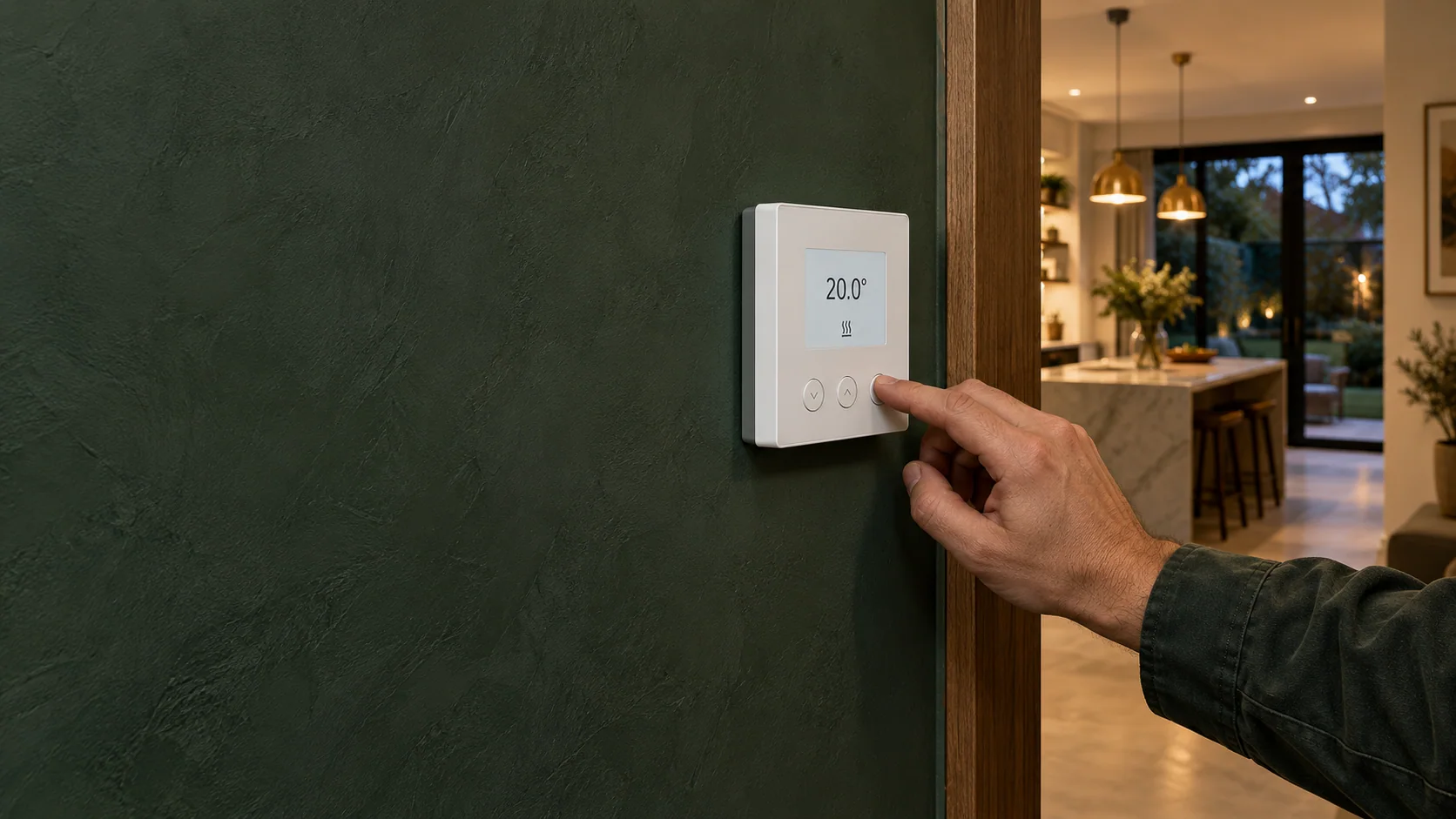
A heating symbol usually indicates that the controller is requesting heat. It does not prove that the equipment downstream has responded.
In a wet system, that request may need to reach a wiring centre, operate the correct actuator or zone valve, enable circulation and obtain heat from the source. Heatmiser's troubleshooting guidance follows this distinction between a thermostat indication and the subsequent system response. Heatmiser: floor not warm enough.
The exact sequence depends on the installation. Some thermal actuators take time to operate, and some controllers deliberately delay pump operation. An immediate lack of visible movement is therefore not enough to condemn a component. Heatmiser: wiring-centre functions.
Nor does every manifold have a separate pump and blending valve. The arrangement must be understood before deciding what should be running.
Where symptoms began after a controls upgrade, compatibility and commissioning deserve attention. A new thermostat needs the correct output, configuration and zone assignment for the system; matching the appearance of the old controller is not sufficient.
Our guide to smart heating controls and multi-zone systems explains why thermostats, manifolds and heat sources need to work as one coordinated installation.
/ 05
Why is there no flow at the underfloor heating manifold?
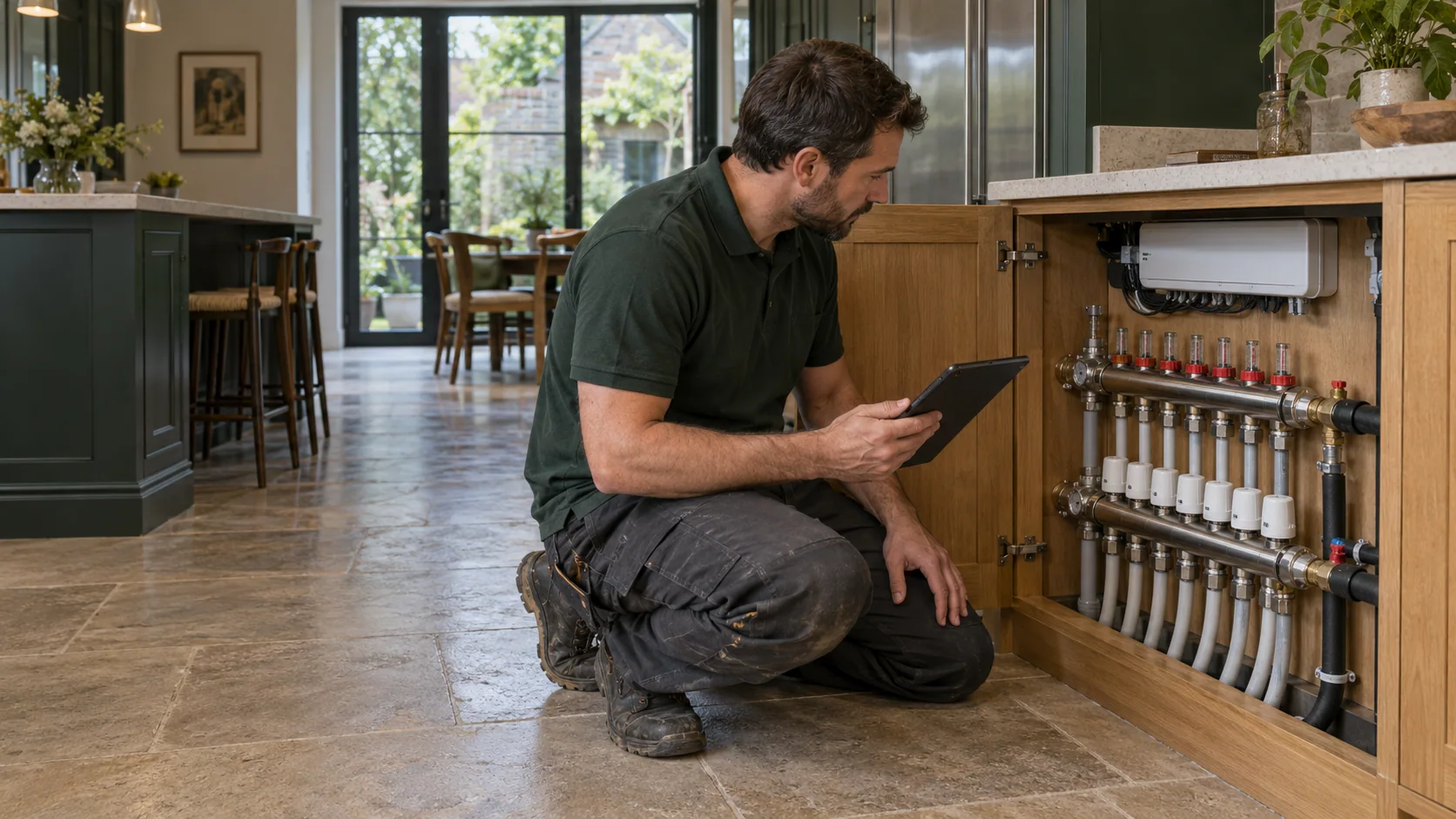
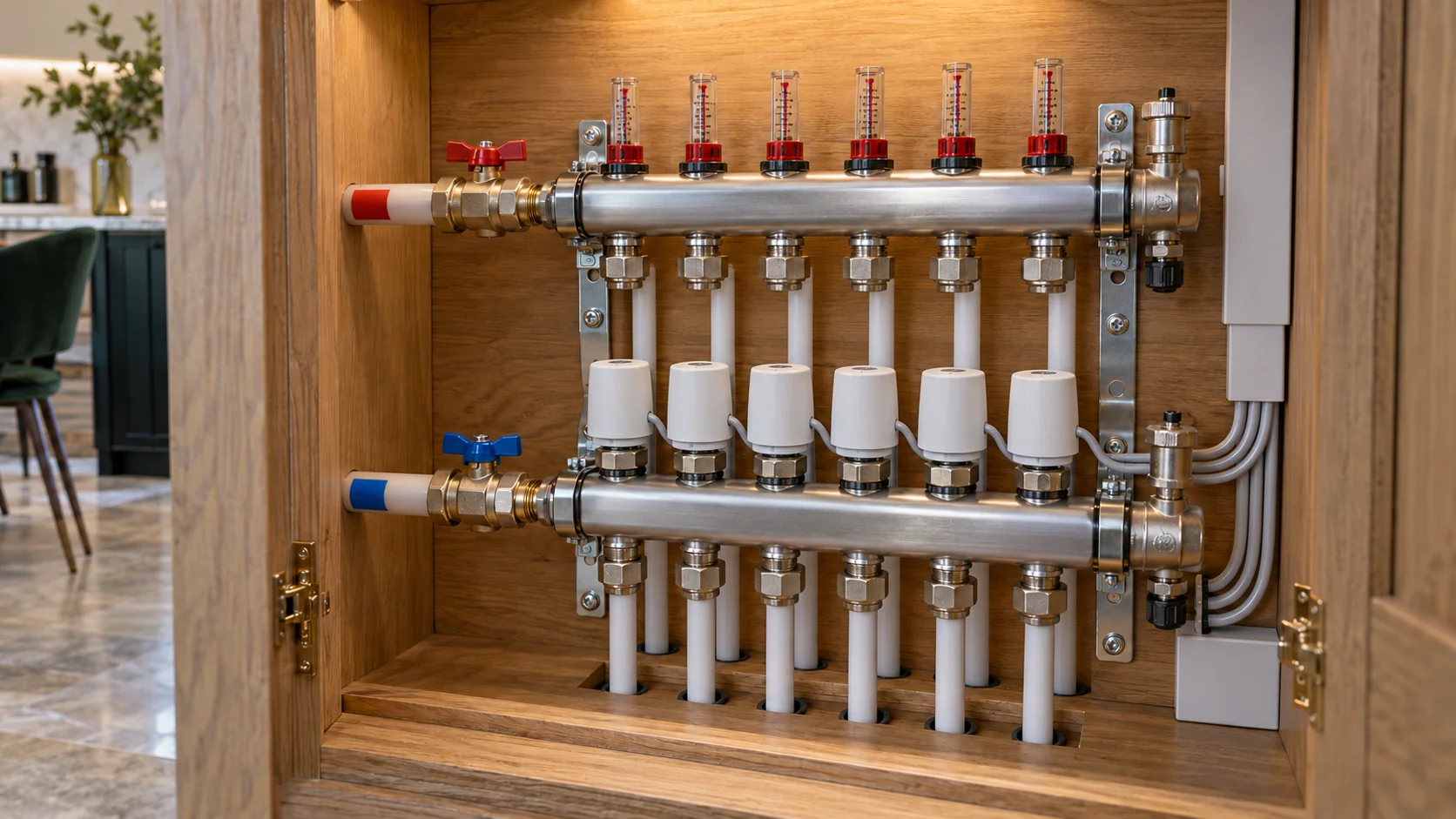
A manifold distributes water between the floor loops. Where flow meters are fitted, they provide useful information, but only when interpreted alongside the operating state of the system.
A zero reading on a closed, satisfied zone may be entirely normal. Zero during a genuine demand could reflect a valve that has not opened, unavailable circulation, an air problem, a restriction or an issue with the meter itself.
The important distinction is between one affected loop and all loops on the manifold. That changes which shared components and individual circuit conditions need investigating.
Do not open every flow meter fully or copy the same litres-per-minute setting across the manifold. Different loops can have different design requirements. Arbitrary adjustment can leave another room short of heat and remove the original balancing information.
An engineer should establish whether water is circulating, whether it is sufficiently warm and whether the distribution matches the system's requirements. Hearing a pump does not, by itself, demonstrate useful flow through every loop.
Air removal, balancing and cleaning are also different operations. A cold floor is not enough evidence to prescribe a powerflush. Our guide to when a London heating system needs a powerflush explains why the cause should be established before selecting a cleaning method.
/ 06
Why are the radiators working but the underfloor heating is not?
Working radiators show that heat is reaching at least part of the property. They do not prove that the underfloor circuit is receiving the correct demand, circulation or water temperature.
This matters in homes combining radiators upstairs with UFH downstairs, or using several manifolds with different control arrangements. A shared boiler does not make every heating circuit identical.
One especially useful observation is whether the UFH works only when the radiators are switched on. Tell the engineer if that happens. It may indicate a control or hydraulic dependency that needs investigating, rather than a fault in the buried floor loops.
The assessment should consider the whole heating system, including how each circuit obtains heat independently and how the circuits behave when operating together.

/ 07
Is it a fault, or is the floor still warming up?
Underfloor heating is not judged in the same way as a radiator that quickly becomes hot to the touch.
A substantial screed floor stores heat and can respond slowly after a long shutdown. A low-profile assembly, suspended-floor system and electric mat have different response characteristics. Caleffi's technical guidance distinguishes warm-up conditions from stable operation when assessing a heating circuit. Caleffi: measuring circuit performance.
There is no single waiting time that proves every UFH installation is healthy or faulty. Starting temperature, floor construction, insulation, available heat and the control strategy all matter.
Keep three temperatures separate: the room air, the floor surface and the heating water. They are not supposed to show the same number. A floor can feel only mildly warm while maintaining a comfortable room.
Observe the trend under consistent, normal settings. Do not repeatedly turn the system on and off while trying to judge a slow response, or push temperatures beyond the system and floor-finish limits.
New screed, adhesives and floor finishes must follow their specified curing and heating-up procedures. Turning the heating up early is not a safe way to accelerate drying.
/ 08
Cold patches and rooms that never reach temperature
A cold patch does not automatically identify a blockage or leak. It could relate to the pipe layout, an intentionally unheated area, floor coverings, unequal delivery between loops or a local construction detail.
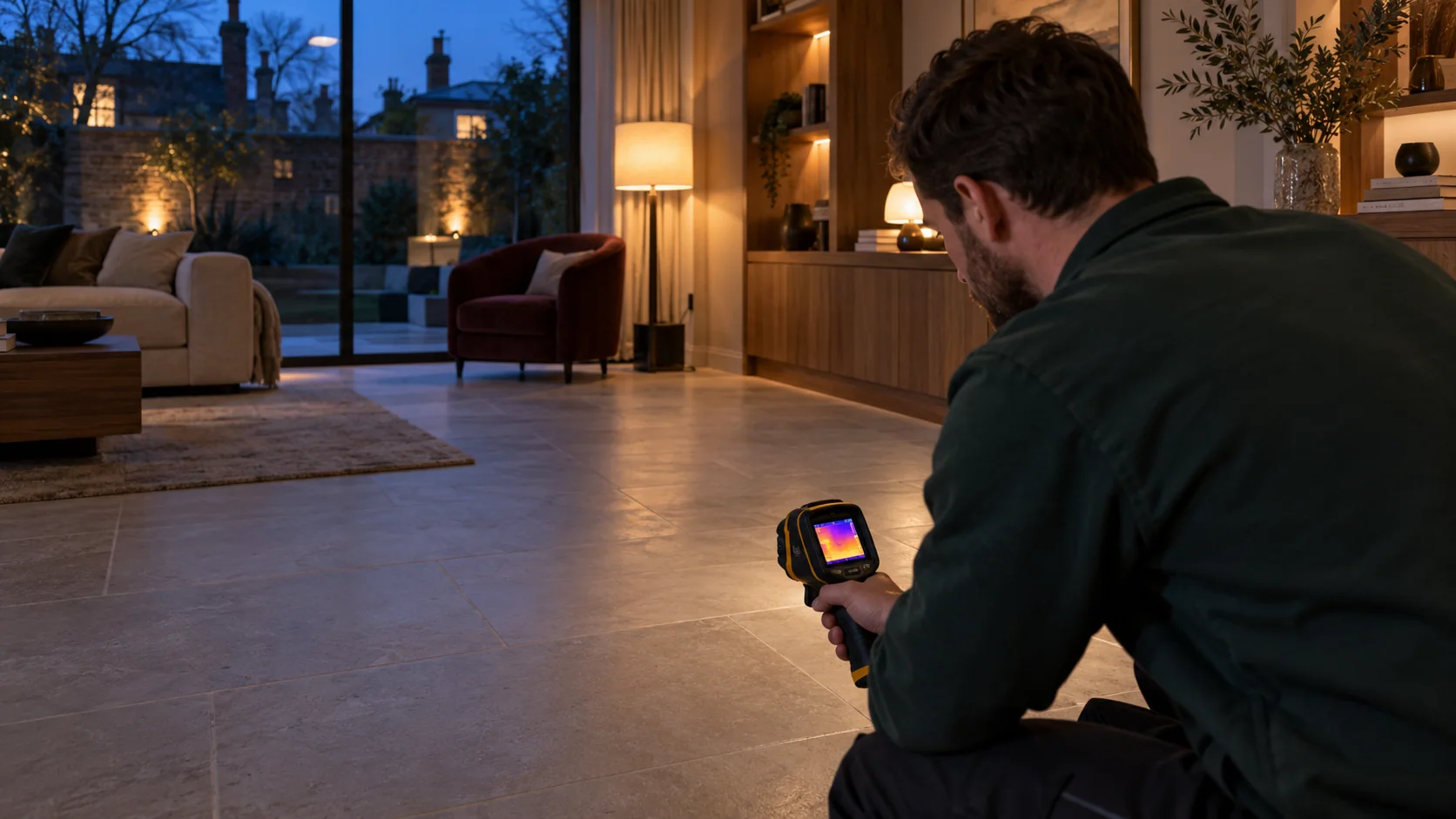
Thermal imaging can help investigate the surface pattern under suitable conditions, but it is not an X-ray of the floor. A temperature difference must be interpreted alongside the installation layout and other evidence. FLIR specifically warns against treating every hot or cold area as proof of a defect. FLIR: common thermal-inspection mistakes.
There is another distinction: a system can be operating without delivering enough heat for the room.
An extension with substantial glazing, a poorly insulated floor or a restricted heated area may require a different assessment from a previously comfortable room that suddenly went cold. Available output needs to be compared with the room's heat loss at the relevant conditions.
Floor changes matter too. A new carpet and underlay, a thick rug or a different timber finish can alter heat transfer. The complete finish must remain compatible with the UFH design and its temperature limits.
Replacing a thermostat cannot create missing heating capacity. Increasing water temperature is not automatically a suitable answer either.
If the room has never performed properly, retrieve the original design and commissioning information where possible. Our guide to retrofitting underfloor heating in London homes explains why construction, insulation, floor build-up and available output need to be considered together.
/ 09
Underfloor heating problems after summer or recent work
After a seasonal shutdown, begin with the operating programme, user-replaceable batteries and visible messages. The heating schedule may not have resumed as expected. Components that have remained inactive may also require professional attention, but that is not a reason to start dismantling them.
After building or heating work, give the engineer an accurate timeline. Useful changes include a replaced thermostat, a new boiler or heat pump, altered wiring, drained pipework, a changed floor finish or a disconnected manifold.
Ask for the previous and current controller model numbers where relevant. “The new thermostat switches on” is not confirmation that its sensor, output and configuration suit the installation.
Follow the system manufacturer's maintenance instructions rather than a generic online exercise routine for pumps and valves.
/ 10
Electric underfloor heating: thermostats, sensors and tripping
Electric UFH needs a separate diagnostic approach. There are no water loops to balance or purge. The investigation concerns the electrical supply, thermostat, sensor, heating cable or mat, and the floor assembly.
If an RCD or RCBO operates when heating starts, our RCD tripping guide explains why heating elements, pumps, controls and other connected equipment need to be distinguished rather than diagnosed from timing alone.
The display works, but the floor does not heat
A functioning display does not prove that power is reaching the heating element. Equally, a heating symbol does not establish that the element is intact.
Warmup advises electrical testing where the thermostat indicates operation but the floor remains cold. Its guidance includes checking the heating element and the thermostat's actual output before deciding what needs replacing. These are electrician's checks, not homeowner tests. Warmup: thermostat on, floor cold.
Retain the installation resistance readings, product information and layout drawings if available. They help the electrician compare the installed heater with its specification rather than make assumptions from room size or a thermostat photograph.
A floor-sensor error appears
Record the exact error and the controller model. A sensor problem needs to be distinguished from an incorrect setting or an incompatible replacement thermostat.
Some controllers regulate room temperature while using a floor sensor as a limit; others use floor temperature as the main control input. The intended arrangement matters. Do not bypass the sensor or disable a protective temperature limit to make the system run.
A replacement probe may be accessible through a suitable conduit if one was installed and remains usable. That cannot be assumed for every bathroom or kitchen floor. Diagnosis should come before promises about how easily a sensor can be replaced.
The RCD or RCBO trips
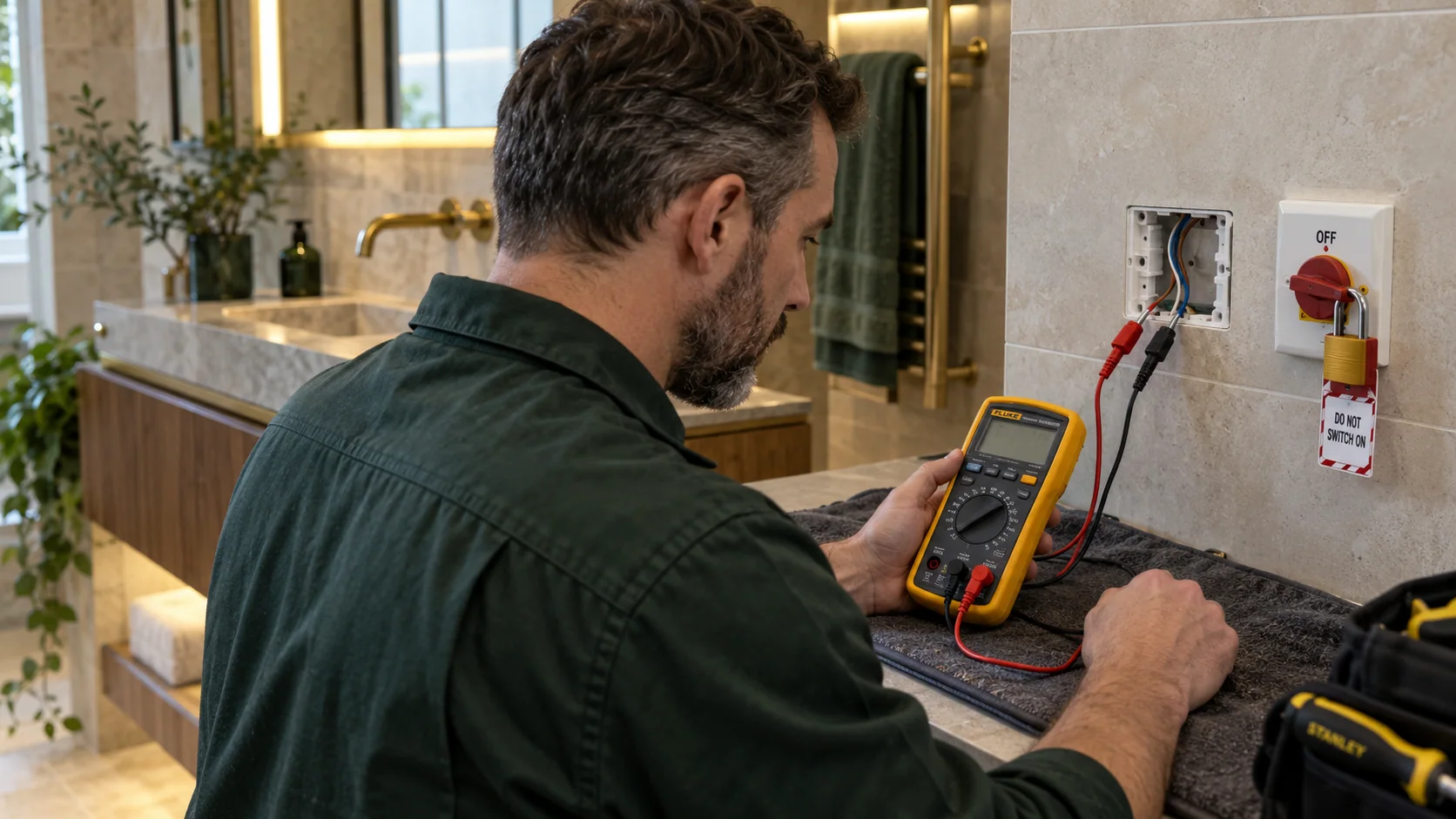
Stop attempting to run the heating and arrange an electrician. Repeatedly resetting a protective device is not a repair, and the protection must never be bypassed.
Tell the electrician whether the trip occurs immediately or after a period of heating. Do not deliberately reproduce it just to collect that information.
The investigation may involve the heater, its connections, associated wiring and protective device. Appropriate tests include insulation resistance and other checks selected for the actual equipment. Warmup's fault guidance calls for professional investigation when electric UFH causes tripping. Warmup: underfloor heating and RCD tripping.
Only part of the floor feels warm
First establish which areas were intended to be heated and whether more than one mat or circuit was installed. A cooler strip near fixed furniture may not contain heating at all. A surface pattern alone cannot identify a broken cable or prove which part has failed.
Recent drilling, floor alterations or water damage should be reported, without assuming that they caused the fault. Do not lift tiles or cut into the floor to search for a cable yourself.
For problems involving supply, controls or electrical testing, see PEP's electrical services in London. Provide the UFH brand, thermostat model and symptoms so the required work can be considered before a visit.
/ 11
Pressure loss, leaks and heating that will not switch off
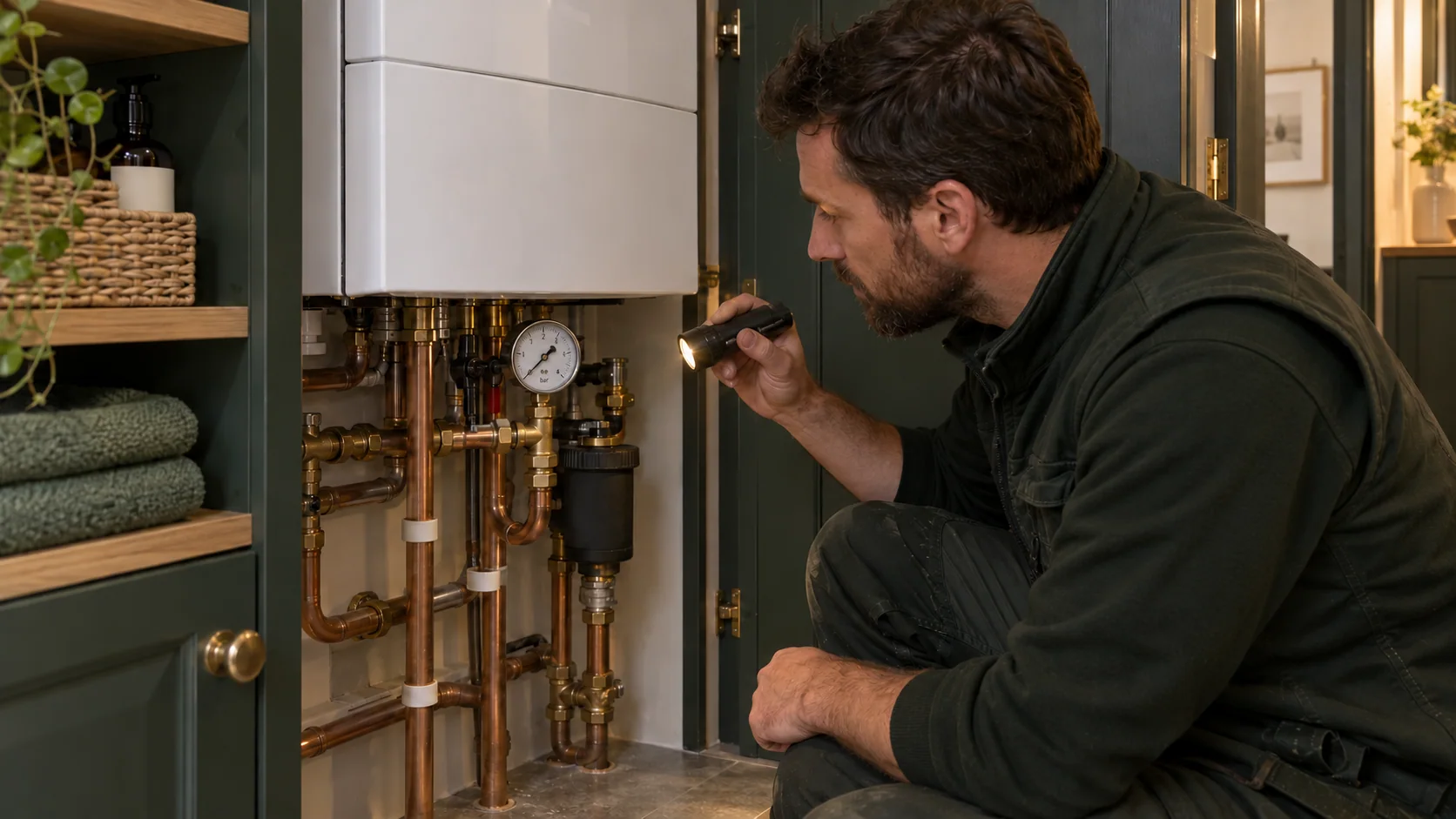
Repeated pressure loss in a sealed wet heating system needs investigation. It does not automatically mean that a UFH pipe has leaked beneath the floor. The wider system, accessible connections and pressure-control components may also be involved.
Our guide to a boiler that keeps losing pressure explains how the timing of the drop, expansion control and visible discharge can help distinguish the next checks.
Record visible readings and when they were taken, together with any history of refilling or visible leakage. Do not keep topping up to conceal a recurring problem, and never leave a filling connection open as a workaround.
Heating-system pressure is not the same as mains-water pressure at the taps. A domestic water booster is not the answer to a sealed heating circuit losing pressure.
If the room remains warm after the thermostat stops requesting heat, stored energy in the floor may explain the delay. If heat continues being supplied, or the room repeatedly overheats, controls and valve operation need checking. The useful question is whether the floor is cooling gradually or still receiving energy, not simply whether it feels warm immediately after switch-off.
/ 12
Flats with communal heating or an HIU
Not every London flat has its own boiler. Some receive heat through a communal network and a heat interface unit, usually called an HIU.
Where both heating and hot water are affected, check the building's fault-reporting arrangements and any supply notices. The heat supplier, managing agent and appointed maintenance provider may have different responsibilities. Switch2's resident guidance explains this distinction between heat supply and maintenance arrangements. Switch2: resident heating questions.
Report whether the problem affects the whole flat, only the UFH or other properties as well. Do not adjust communal equipment or assume that a private contractor is authorised to work on every part of the installation.
/ 13
What should a proper UFH assessment include?
A useful assessment should explain the fault, the evidence and the proposed remedy. It should not consist solely of a recommendation to replace whichever component is easiest to reach.
The starting point is the intended system arrangement and its history. Existing settings and relevant readings should be recorded before changes are made. This systematic approach is consistent with Caleffi's published troubleshooting guidance. Caleffi: the troubleshooting process.
Depending on the installation, the assessment may need to establish:
- Which thermostat controls each zone and which loops serve it.
- Whether the request for heat reaches the appropriate equipment.
- Whether heat and circulation are available under the right operating conditions.
- Whether flow distribution, water temperature and room output are appropriate.
- Whether sensors, wiring or electric heating elements require testing.
- Whether the reported problem returns when zones operate separately and together.
The outcome should distinguish a confirmed fault from an unresolved possibility. After remedial work, the relevant operation should be checked again, with sufficient allowance for the floor's response time.
/ 14
Can it be repaired without lifting the floor, and what affects the cost?
Problems with accessible controls, actuators, valves or manifold equipment can sometimes be addressed without disturbing the finished floor. A cold room alone is not a reason to begin lifting boards or tiles.
If testing identifies concealed pipework or cable damage, targeted investigation and local access may be possible. The repair method depends on the fault, floor construction, system and available information. A promise of no disruption before diagnosis would be premature.
The cost depends on the investigation required, accessibility, affected zones, replacement parts, any specialist fault-location work and subsequent making good. Diagnosis and repair may be separate stages.
Ask what the initial assessment includes, whether parts are additional and how further work will be authorised. If the proposal involves changes to the floor or heating design, ask for the reason and scope in writing.
An evidence-based, limited repair and a system redesign are different jobs. The quotation should make clear which is being proposed.
/ 15
Underfloor heating troubleshooting: common questions
Should the floor always feel warm?
No. The aim may be to maintain room temperature rather than provide a continuously warm surface. Judge comfort and the temperature trend alongside the intended control strategy.
Will turning the thermostat right up heat the room faster?
Not necessarily. A higher target does not guarantee greater heat output; it may simply prolong the demand. It is not a substitute for resolving poor circulation or inadequate capacity.
Will a smart thermostat fix the problem?
Only if the relevant issue is within its control and the replacement is compatible and correctly configured. It cannot repair a damaged cable, restore a blocked water circuit or compensate for an unsuitable floor design.
Should I call a plumber or an electrician?
Electric heating elements and mains-voltage controls need an appropriately competent electrician. Wet UFH can involve both heating and electrical faults. Describe the system and symptoms so the right expertise can be arranged.
/ 16
Discuss an underfloor heating problem in your London home
PEP's underfloor heating work in London brings together floor construction, heating design, installation and controls. When an existing system is not performing, the first step is to understand what has been installed and what has changed.
When you contact us, include your postcode, the affected rooms, whether the system is wet or electric, the thermostat model and when the problem began. Clear photographs of accessible equipment are useful; leave all electrical covers in place.
Mention any recent building work, repeated tripping, leaks or pressure loss. We can then discuss the appropriate next step and confirm the scope we can assist with.
Tell PEP about your underfloor heating problem.
Discuss your underfloor heating