Floors warm at different speeds
A lower zone may reach temperature comfortably while rooms on another floor or in a later extension stay slow, even with the same controls calling for heat.
 Pure Energy ProjectElectrical · Heating · Plumbing07825 268 434
 Central heating water quality · Kensington W8 & SW7
Kensington's mansion blocks, period townhouses and later conversions rarely share one heating history. Original pipe runs sit beside radiators and zones added or renewed at different times, often behind finishes that are costly to disturb. We trace how the whole circuit behaves, identify what is actually restricting it, then recommend the least disruptive treatment the evidence supports.
Assessment before equipment. Every time.
01 · Reading the symptoms
These patterns are worth checking before booking. None of them proves that sludge is the cause on its own.
A lower zone may reach temperature comfortably while rooms on another floor or in a later extension stay slow, even with the same controls calling for heat.
A repeatable cold band across several radiators can point to settled debris, but the valve, balancing and flow rate still need checking first.
Replacing the heat source does not clear a restriction sitting elsewhere in an older or extended circuit.
Discoloured water or magnetic residue drawn off at a valve or filter is useful evidence, read alongside how the radiators are actually behaving.
If a zone falls behind again soon after balancing, there may be a restriction or component fault that balancing alone cannot hold.
02 · Diagnosis before any machine is connected
Cold spots and slow response can come from magnetite, but just as easily from trapped air, incorrect balancing, a tired pump, a seized valve, a control fault or pipework that no longer matches a circuit altered across several refurbishments. A Powerflush cannot correct the wrong diagnosis.
Our guide explains how to recognise the signs that may justify a Powerflush and why they must be considered together.
03 · Evidence of the assessment
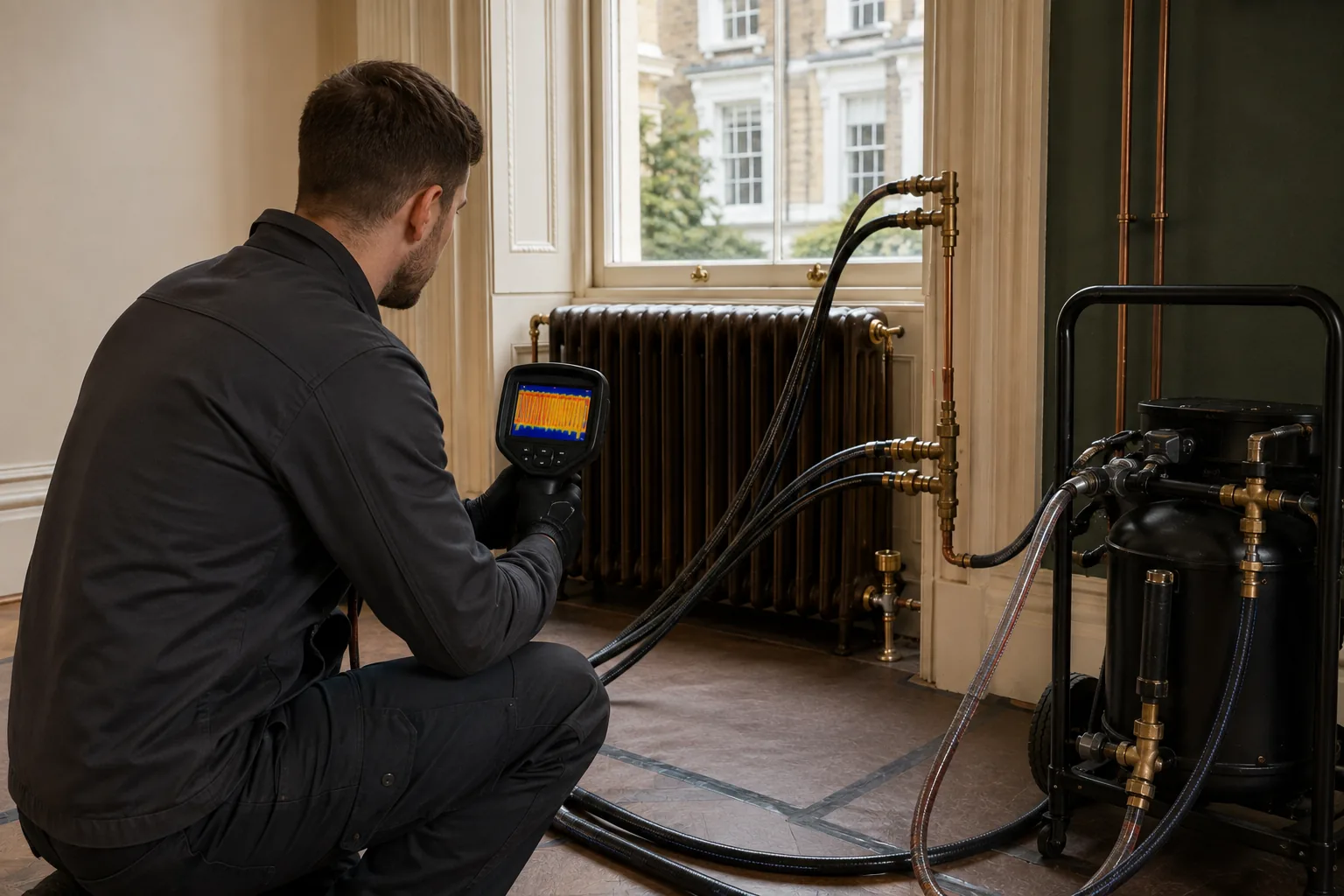
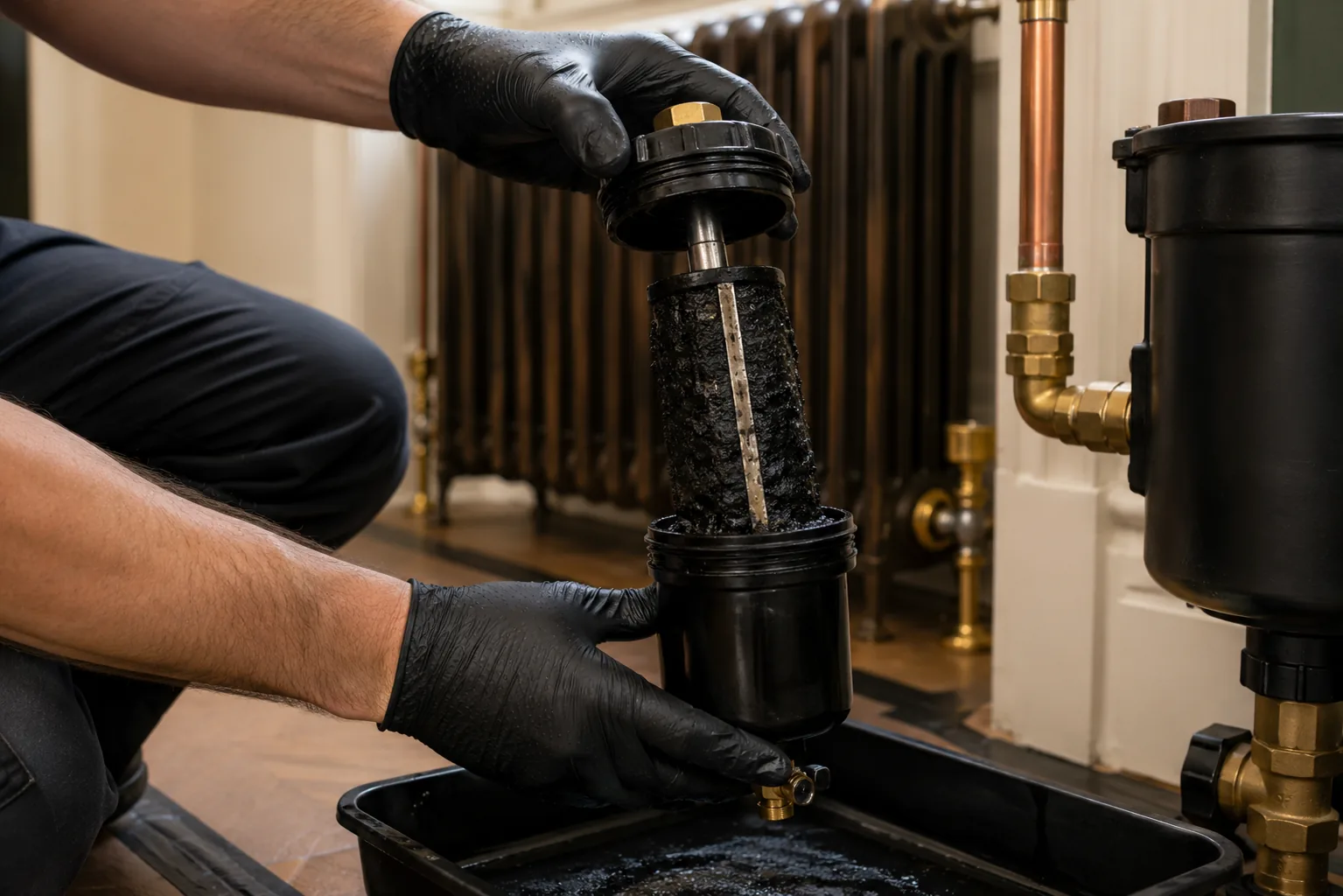
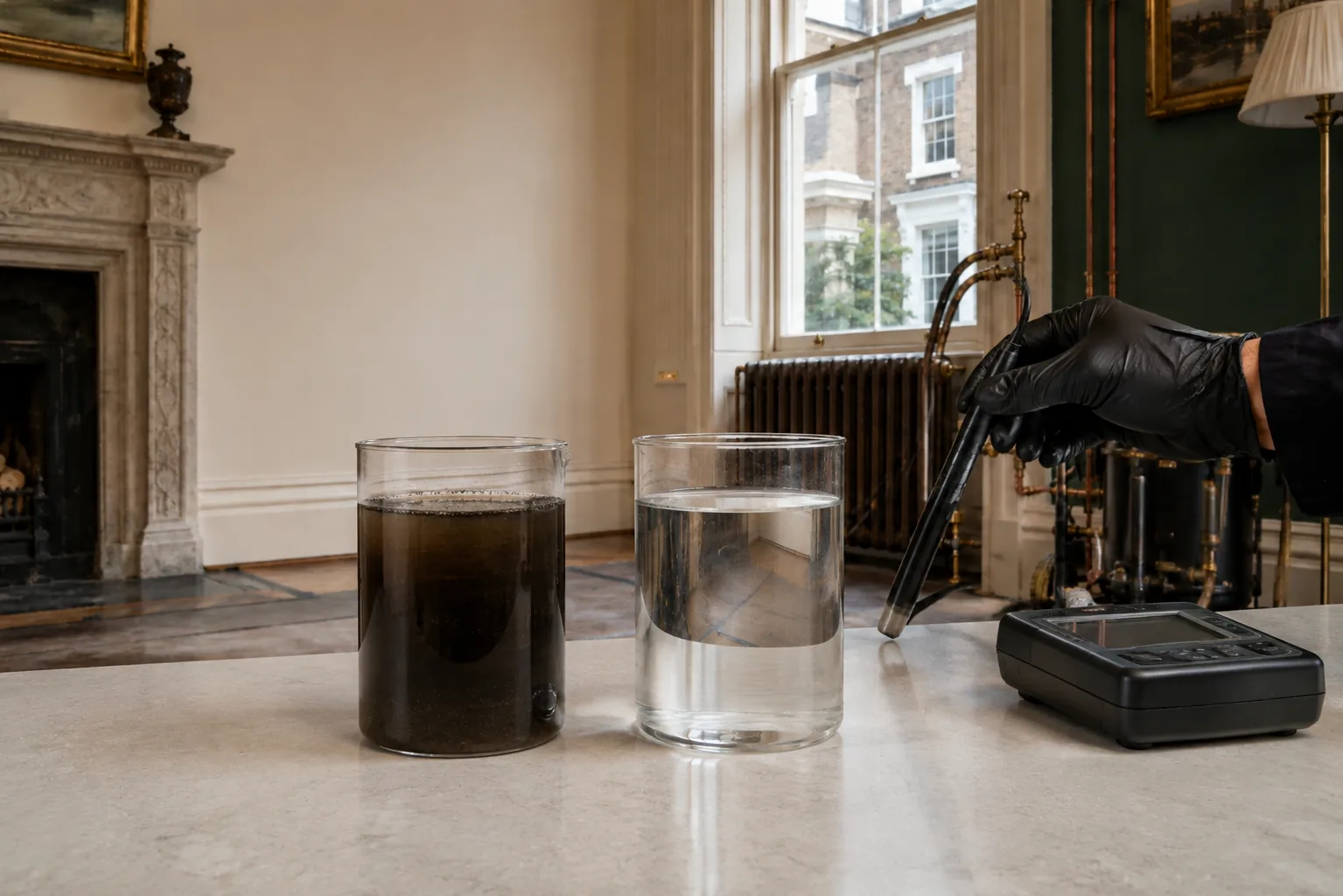
We establish a baseline, capture what is removed and check the water condition before handing the system back.
04 · Controlled circuit work
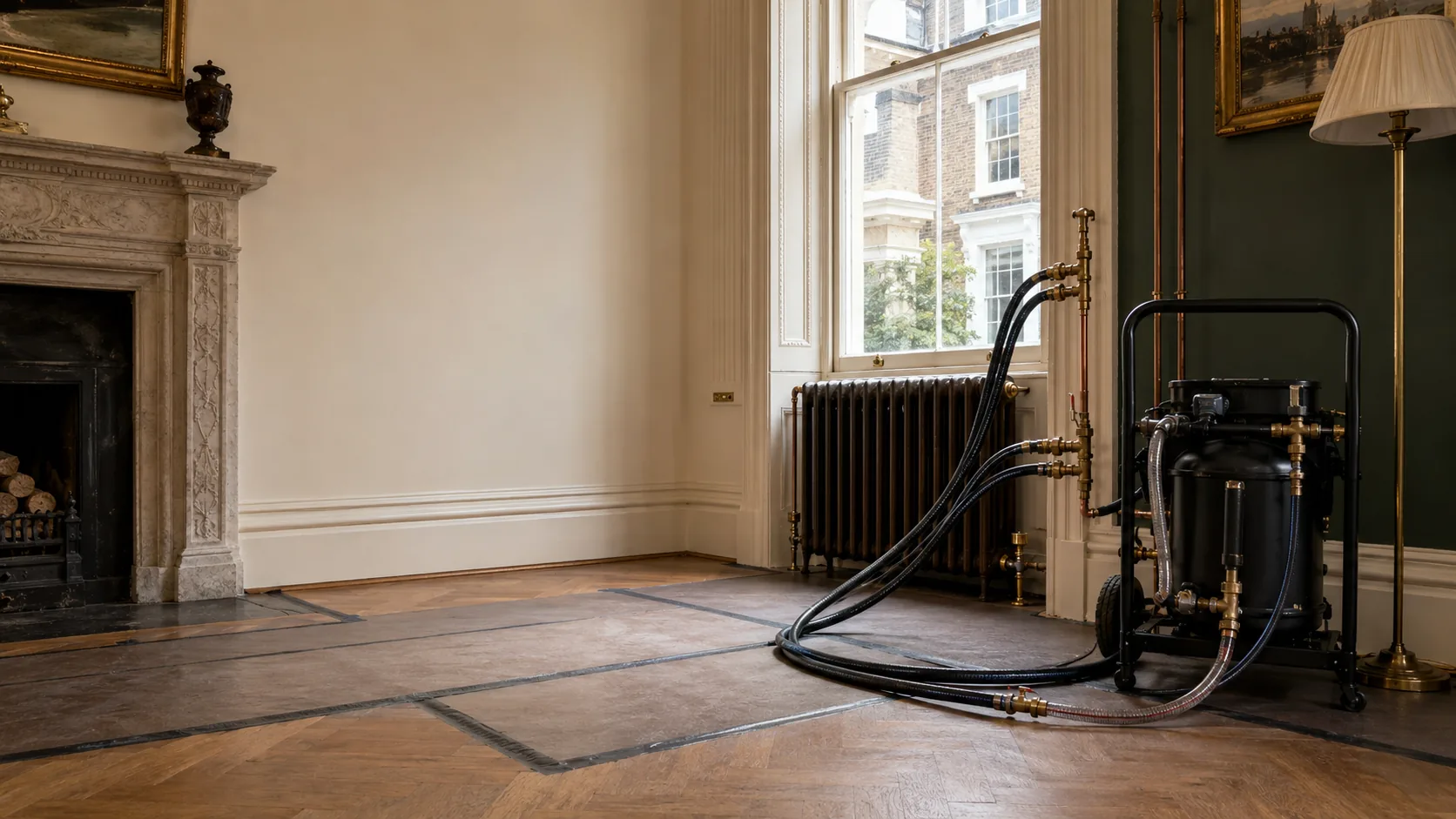
In converted townhouses and mansion blocks, the useful unit of work is the circuit — not the room count. We work through it in a defined order.
Confirm radiator count, controls, known alterations and where equipment can be placed safely.
Cover the working route, floor and connection area before hoses or chemicals enter the room.
Choose the practical point, isolate as required and test the setup before treatment begins.
Use high flow at low pressure, directed through selected radiators and zones rather than washing everything indiscriminately.
Use magnetic filtration and controlled agitation to release debris, then keep rinsing until the outgoing water is acceptable.
Add inhibitor where appropriate, restore settings, rebalance and compare heat-up across the circuit.
05 · Match cause to treatment
The right outcome is the smallest sensible scope that addresses what the assessment actually finds.
For widespread sludge, restricted circulation or several affected radiators where directed high-flow cleaning is justified.
For a system that still circulates adequately and needs proportionate chemical treatment rather than full external equipment.
For a failed valve, worn pump, trapped air, control issue or pipework limitation that cleaning cannot correct.
Important limitation
On an older or altered system, clearing debris can reveal a pre-existing weak point or leak. We discuss that risk before work begins, not after.
06 · Suitability & limitations
Condition, access and layout decide the approach, not the age of the property. Original pipe runs can sit beside recently renewed radiators; one zone may tolerate treatment while another needs repair first.
07 · Programme and quotation
A straightforward domestic system is often completed within one working day. Several zones, a high radiator count, constrained access or heavy contamination can require longer.
A straightforward domestic system is often completed within one working day. Several zones, a high radiator count, constrained service access or heavy contamination can require longer.
No generic fixed-price promise: the proposed scope follows the assessment.
Areas we cover around Kensington — including High Street Kensington, Kensington Church Street, Campden Hill, Palace Gate, Queen's Gate, Gloucester Road, Cromwell Road and South Kensington, and surrounding W8 and SW7 addresses.
No. A single cold radiator may have trapped air, a stuck valve, poor balancing or a local restriction. We compare its heat pattern with the rest of the circuit and check the system water before recommending cleaning.
Often it can, but suitability depends on condition rather than age alone. We check accessible pipework, radiator valves, known leaks and altered sections first, then agree a controlled high-flow, low-pressure method or recommend another route.
We agree access before arrival, protect the working route and connection area, keep equipment contained and check joints throughout. The plan is adjusted to the property rather than forcing the property around the machine.
A Powerflush uses specialist equipment to move a high volume of water through selected parts of the circuit while magnetic filtration captures loosened debris. A chemical clean relies mainly on the system's own circulation and can suit lighter contamination. Diagnosis determines which is proportionate.
A straightforward domestic system is often completed within one working day. Several zones, a high radiator count, restricted access or heavy contamination can extend the programme. We set expectations after mapping the circuit.
The quotation reflects radiator and zone count, system layout, access, water condition and any faults that must be dealt with separately. We scope those factors first rather than advertising a flat price that may not fit the property.
Only when contamination is contributing to the symptom. Cleaning will not repair a weak pump, failed control, stuck valve, trapped air or undersized pipework. Those findings need their own remedy.
We rinse out cleaning residues, add fresh corrosion inhibitor where appropriate, restore controls, rebalance the system and compare radiator response and water condition. Any remaining issue outside the cleaning scope is explained clearly.
PEP's Powerflush service in Kensington sits alongside our wider Powerflush London → coverage and every boiler installation in Kensington →, which includes a full system clean as standard.
For neighbouring SW5 addresses, see our powerflushing service in Earl’s Court.
See our broader central heating installation → work, our whole-system heating installation in Kensington → for a full redesign rather than a clean, our Kensington plumbing → service, or contact PEP → to discuss a Kensington heating system.
Start with the right question
Tell us which rooms are slow, what has already been changed and whether the problem is local to one zone or system-wide. We will arrange the right assessment.