

Water leak protection · London homes
Water Leak Protection for London Homes
Choosing water leak sensors, flow monitoring and automatic shut-off that work with your plumbing.
Understand the protectionA failed connection beneath a kitchen sink can affect far more than the cabinet around it. Water may travel under flooring, through ceiling voids and into the flat below before anyone notices. In a finished London home, repairing the pipe can be the simplest part of the job; finding the damage, drying the building and reinstating the finishes may take much longer.
Water leak protection is intended to shorten that gap between a fault occurring and somebody taking action. Depending on the system, it can sound an alarm, send a notification, monitor unusual water use or automatically close a valve.
These are different functions, not interchangeable promises. A sensor that sends an alert does not necessarily turn off the water. A shut-off valve does not identify a leak without a suitable detection signal. And closing the incoming mains cannot stop every source of water in a building.
The right solution starts with understanding the property: its supply arrangement, vulnerable locations, stored water, heating system and normal patterns of use. This guide explains the options and how to choose protection that is useful in everyday life.
/ 01
If water is already escaping
Deal with the immediate problem before considering a new protection system. If it is safe, close the appropriate accessible water isolation valve and arrange professional help. In a flat, notify the building manager and any affected neighbours.
Do not touch wet electrical equipment or enter a flooded area to reach controls. An active leak needs a safe response, not repeated app resets or an assumption that an automatic valve has stopped everything.
/ 02
Detection and automatic isolation
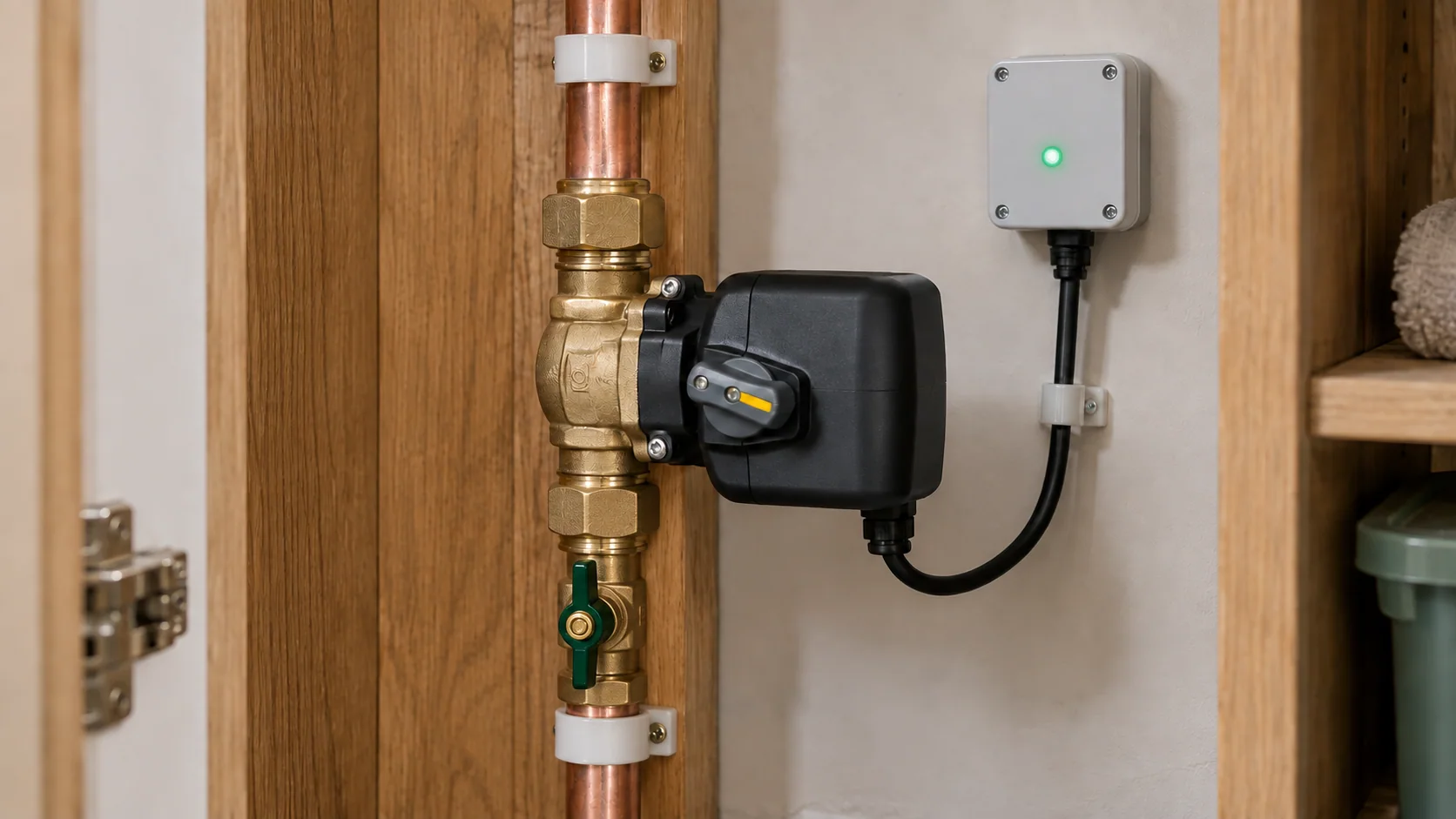
A leak alarm detects water at a particular location. A monitoring device looks for conditions that may indicate leakage. An automatic shut-off valve physically interrupts the supply it controls.
These components can work together. For example, a sensor beneath a washing machine can signal a controller to close the incoming valve, while flow monitoring provides another way of noticing unusual consumption elsewhere.
The purpose is to reduce the duration and consequences of a qualifying leak. It is not a substitute for sound pipework, safe installation or investigating an existing fault.
Likewise, detecting that something is wrong is different from locating the exact damaged pipe. An alert may narrow the investigation to a sensor zone, but hidden leaks can still require specialist tracing.
/ 03
Accessible manual water isolation
Before adding electronics, check the basics. Do you know which valve controls your supply? Can you reach it quickly? Does it work?
A stopcock hidden behind fitted furniture is a weak starting point for an emergency plan. An accessible manual control or suitable remote water isolation switch can make shutting off the supply more practical. A remote manual switch should not be confused with automatic leak detection: somebody still needs to operate it unless separate detection and controls are fitted. Manufacturer guidance on remote water isolation.
A leaving-home routine may help where the plumbing arrangement allows it, but agree this with the installer. Some equipment requires an available water supply. A blanket instruction to switch everything off whenever the property is empty is not appropriate for every home.
/ 04
Point sensors and water leak alarms
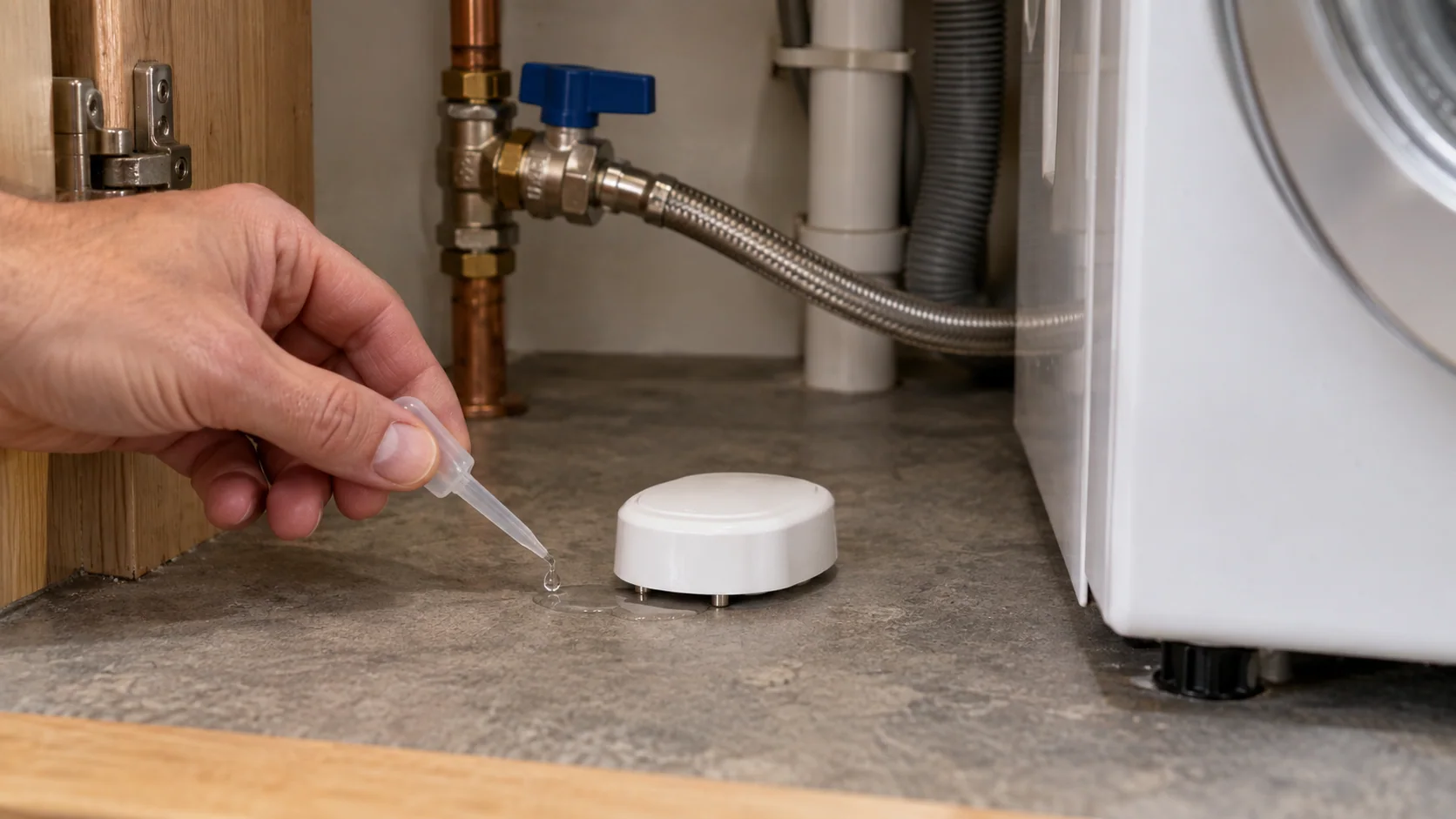
A point sensor detects water when it reaches the sensing contacts. A simple version sounds a local alarm. Connected versions may also send a notification or communicate with a compatible shut-off controller.
Placement determines whether the sensor will be useful. Under a sink, it needs to intercept the likely route of escaped water, not sit on a raised shelf because that is easier to reach. Beneath an appliance, account for the floor slope and any tray or cabinet base that could divert water.
Potential locations include kitchen connections, washing machines, dishwasher hoses and accessible areas around water treatment equipment. Bath and shower installations also deserve attention where sensors can be installed and maintained without compromising waterproofing.
A sensor cannot cover an entire room merely because it is somewhere inside it. Water may take another route or remain within a concealed void. Ask where a leak would actually travel and whether the sensor can still be tested after the cabinetry is finished.
/ 05
Sensing cables and tapes
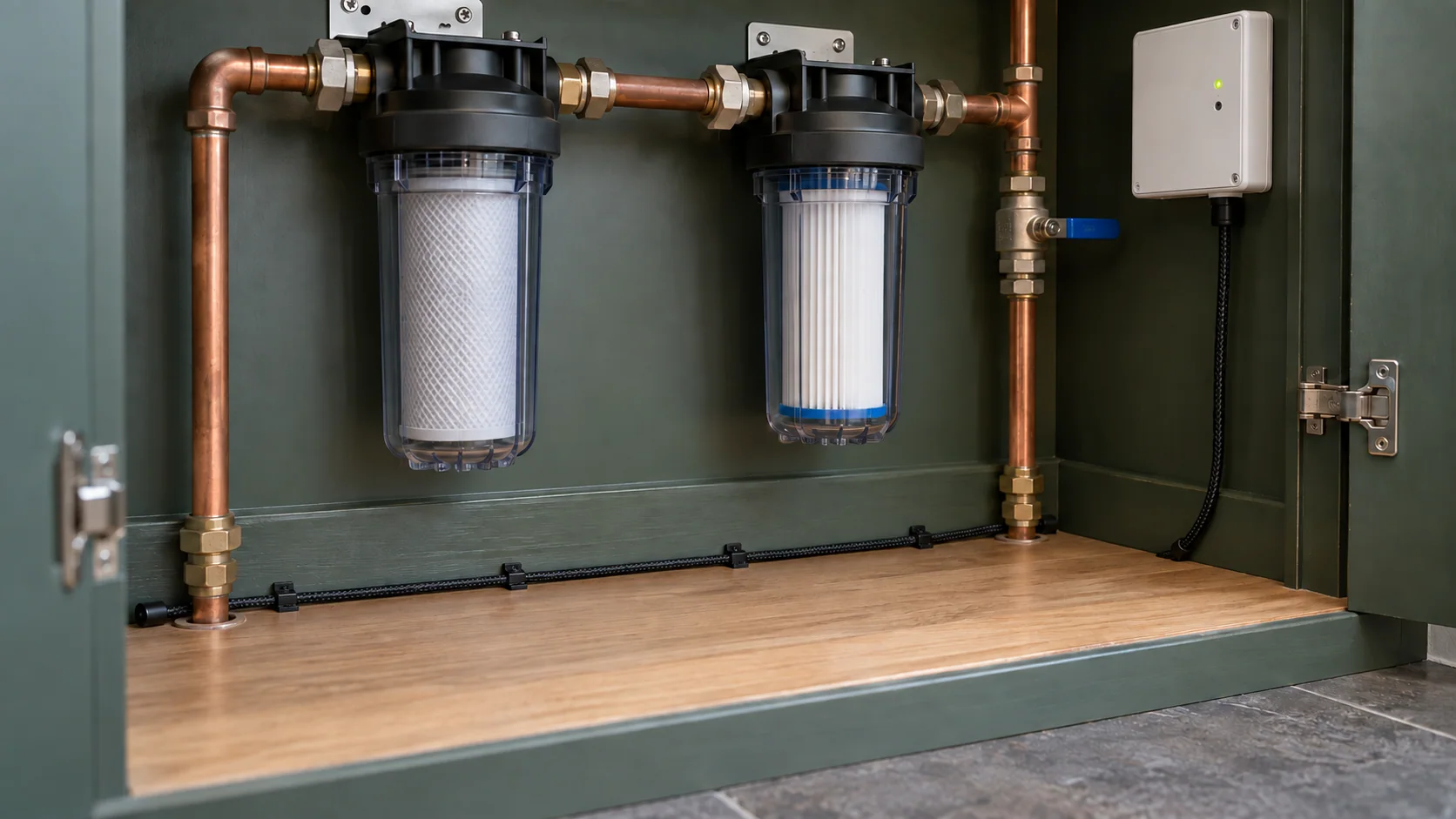
Leak detection cable or tape extends the sensing area beyond one small contact point. It can follow a route beneath equipment or around a defined risk area.
This is useful where several connections are spread across a plant cupboard or where the likely leak path is difficult to cover with one sensor. Compatible systems can identify the activated zone and trigger automatic isolation. Manufacturer guidance on sensing tape and valve control.
The layout still matters. Unsupported cable, inaccessible connections or a sensing strip repeatedly wetted during ordinary cleaning can undermine the installation. Cable type, permitted routing, fixing and replacement procedures must follow the selected system's instructions.
/ 07
Monitoring without cutting pipework
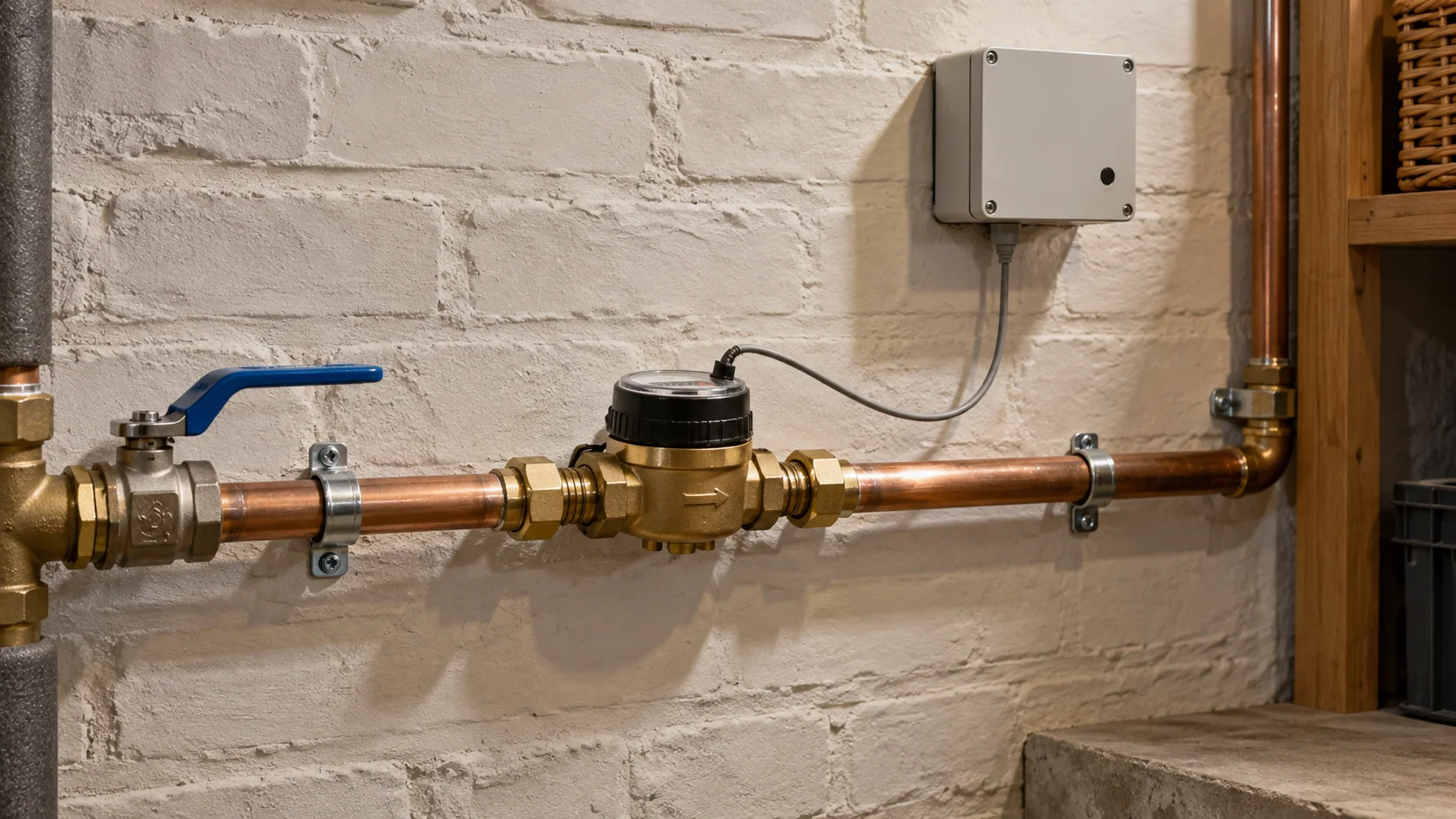
Some devices monitor an existing pipe without cutting into it. Depending on the technology, they may use measurements such as pipe and ambient temperature to identify patterns associated with persistent leakage. Manufacturer explanation of temperature-based monitoring.
That can make detection easier to retrofit. It does not, by itself, provide a valve capable of shutting off the water.
Check the installation requirements, applicable pipe materials and supply arrangements. An easy-to-fit monitor may be useful as an alerting tool, but it should not be described as equivalent to an integrated automatic isolation system.
/ 08
Automatic water shut off valves
An automatic valve is the part that takes action. When the configured detection system signals a qualifying event, the valve closes the supply it controls.
Some installations use an inline motorised valve. Others use an actuator fitted to a compatible existing valve. They are not interchangeable: suitability depends on the valve, mounting arrangement, operating requirements and manufacturer's instructions.
For an automatic water shut-off valve installation, the survey should establish:
- Which supply and downstream branches the valve will control.
- Pipe size, normal demand and acceptable pressure loss.
- Space for installation, servicing and manual operation.
- Power, communications and the required failure behaviour.
- Whether additional sensors or separately controlled zones are needed.
A valve must not be selected on connection size alone. A restriction on an already limited supply can affect normal water use. Check the product's performance data against the property rather than assuming every valve will suit every home.
Required fire-protection supplies must not be inadvertently interrupted. Cylinder safety devices, discharge arrangements and other essential safeguards must also remain effective. These are installation design matters, not settings to improvise in an app. Manufacturer safety guidance illustrating the need to protect sprinkler supplies.
/ 09
Comparing the main options
These functions can be combined; the table is a comparison, not a list of mutually exclusive products.
Swipe or scroll sideways to compare the options →
| Option | Useful function | Main limitation |
|---|---|---|
| Accessible manual isolation | Makes it easier to stop a controlled supply | Needs someone to take action |
| Point sensor or alarm | Detects water at a chosen location | Water must reach the contacts |
| Sensing cable or tape | Covers a defined route or larger local area | Uncovered areas remain outside its reach |
| Supply monitoring | Looks for signs of leakage on the monitored supply | Detection rules and supply layout limit coverage |
| Automatic shut-off valve | Stops further supply through that valve when instructed | Needs suitable detection and does not remove stored water |
For many properties, a combination deserves consideration: local sensing at vulnerable connections, wider supply monitoring where useful, and an automatic valve with accessible manual control. The proportionate arrangement depends on the risk, not on how many devices can be added.
/ 10
Water leak protection for London flats and houses
In a flat, the first task is identifying the individual supply. Converted buildings can have pipe routes and branches that are not obvious from the position of the kitchen stopcock. Shared risers or communal equipment must be assessed with the building manager; closing a valve must not unintentionally affect another home.
Your own shut-off valve cannot stop water coming from the flat above. A sensor may warn that water has arrived, but resolving the source requires access and coordination elsewhere in the building.
In a house, the survey should establish whether every relevant branch passes through the proposed monitored section. Kitchens, utility rooms, garden supplies and basement equipment may require different treatment.
Occupation also matters. A local alarm can help somebody who is at home. A property left empty needs a plan that does not depend solely on a resident hearing it. For a renovation, consider protection before finishes conceal the pipework: access, sensor routes and power provision are easier to resolve then.
These are property-specific design considerations, not reasons to assume that every London home needs the same whole-house package.
/ 11
Water softeners and filtration systems
Leak monitoring must distinguish a fault from the water use your equipment legitimately requires.
A water softener uses water during regeneration. The timing and duration depend on the model and its controls. That demand needs to be understood when configuring a flow-based protection system. Manufacturer explanation of regeneration.
Reverse osmosis equipment can draw water to produce drinking water, discharge reject water and refill a storage tank. Some other filtration systems have backwash cycles. The particular equipment, not a generic assumption about filters, should determine the settings. Manufacturer documentation illustrating RO supply, drain and storage arrangements.
For the wider arrangement, see our guide to home water filtration.
In practical terms, include treatment equipment in commissioning. Test relevant cycles and consider local sensing around housings, small-bore connections and storage vessels. Where suitable, dedicated branch protection may add another layer.
Do not solve nuisance trips by switching off useful protection indefinitely. Investigate whether the cause is an unsuitable setting, an installation issue, normal equipment operation or a genuine leak.
/ 12
Boosters and stored water
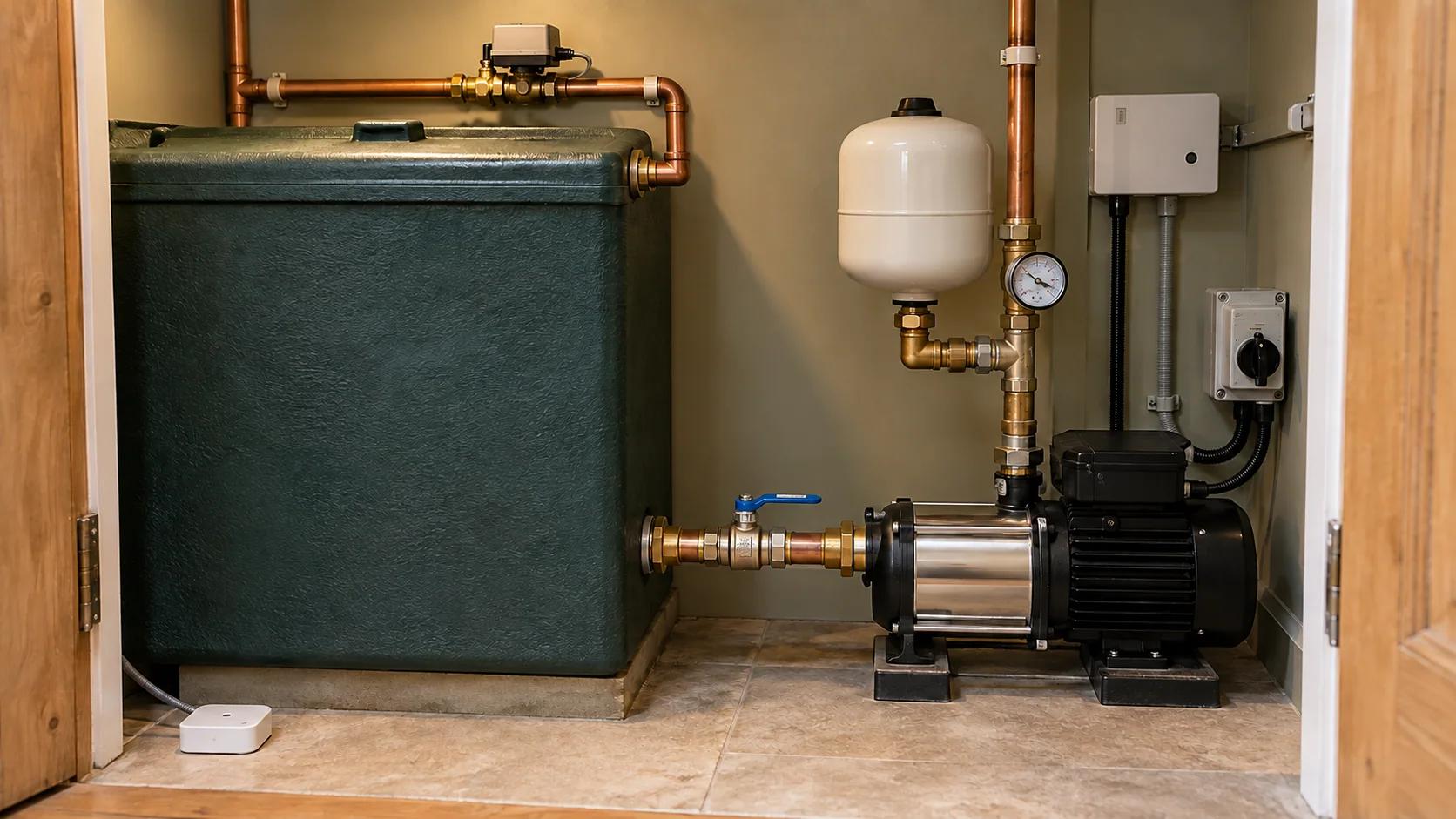
A home water pressure booster may be connected directly to the supply or form part of an arrangement with stored water. The distinction changes the protection design. Manufacturer overview of mains-fed and stored-water boosting arrangements.
If a tank continues supplying a pump after the incoming mains closes, stopping replenishment does not necessarily stop a downstream leak immediately. A fault in the tank itself can also release water already stored.
The survey should therefore consider the tank, its filling arrangement, pump controls, outlets and the likely path of escaped water. Depending on the design, local sensing, level alarms or coordinated controls may be appropriate.
Hot-water storage deserves the same care. An unvented cylinder is not made leak-proof by fitting a valve upstream. The response depends on the location and nature of the failure, system pressure and available stored water.
Our guide to vented-to-unvented hot-water conversion explains the wider system arrangement. Any additional protection must preserve its required safety functions and be designed by someone competent to work on that equipment. Water Regs UK guidance on unvented hot-water safety.
/ 13
Central heating and underfloor heating
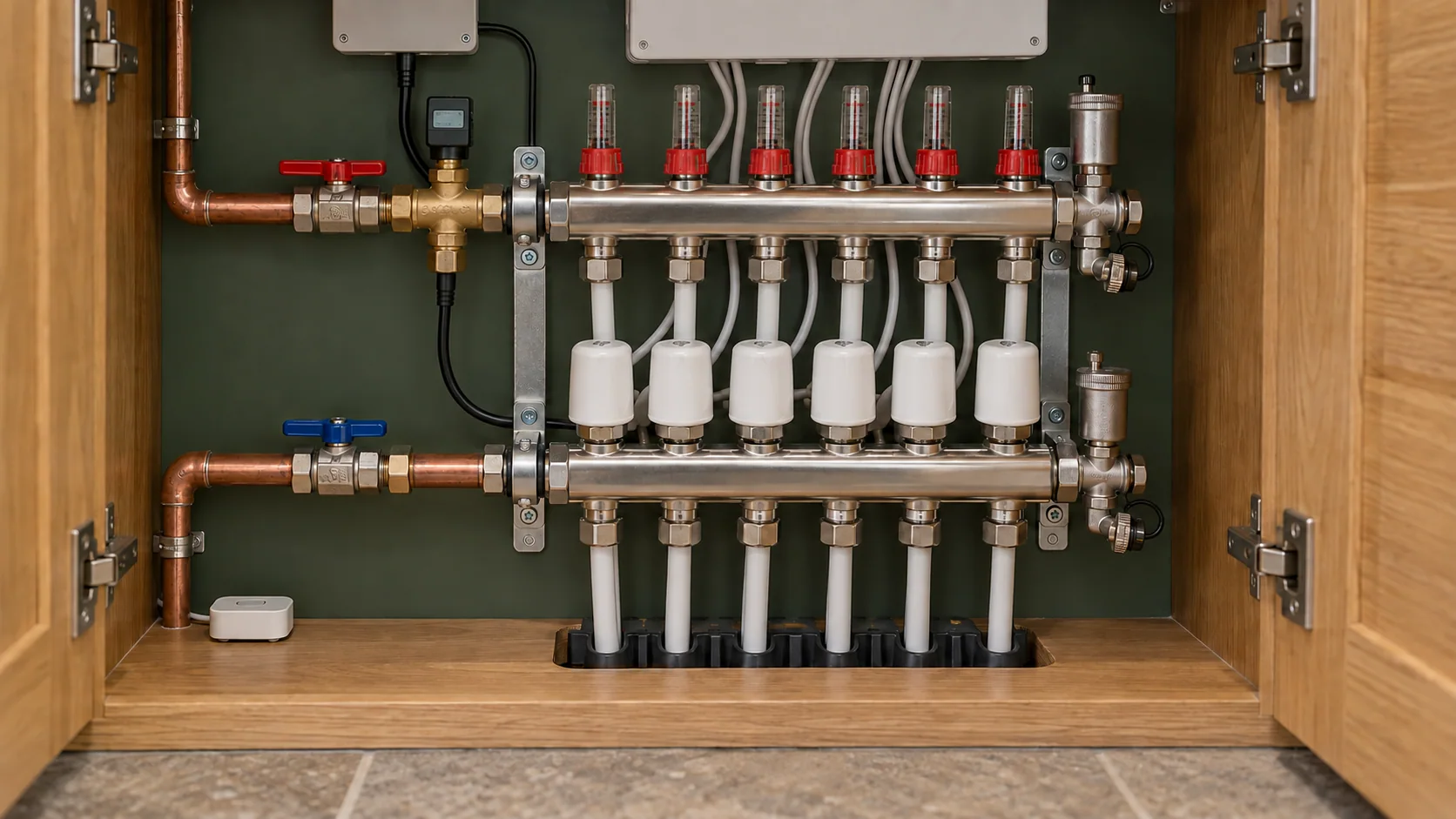
Sealed heating circuits contain water that circulates separately from the incoming domestic supply. A mains-water monitor should not be treated as complete protection for radiators or wet underfloor heating.
Local sensors near manifolds or accessible plant can detect water reaching them. Separate pressure monitoring can also raise an alert when the heating circuit behaves abnormally. Manufacturer description of heating-circuit pressure monitoring.
However, falling pressure is not automatically proof of a hidden pipe leak. Expansion-vessel problems, safety-valve discharge and other faults can require investigation.
For more on this distinction, our boiler pressure loss guide explains why expansion control, visible discharge and accessible connections should be considered before assuming that concealed pipework is leaking.
Repeatedly topping up the heating system is not a repair. Nor should an automatic refill arrangement be used to conceal unexplained losses. Protection should help identify and respond to a problem, not continually replace the escaping water.
/ 14
WiFi power cuts and local operation
Internet access, local communications and electrical power are separate dependencies.
Some systems can detect a leak and close their valve locally while internet access is unavailable. Remote notifications or app functions may still be affected. Other functions depend on a hub, network connection or cloud service. An example of manufacturer-documented local operation.
Power failure is a different question. Do not assume every valve closes when electricity is lost. Check the exact model's behaviour, backup arrangements and manual operation.
Ask what happens if the router is offline, a sensor battery runs low, a radio signal is lost or the controller loses power. Test the supported failure modes during commissioning where safe and permitted.
A smart-home dashboard can be convenient, but critical protection should not rely on an untested custom automation.
/ 15
Installation and commissioning
A successful installation needs more than fitting the valve and connecting an app. The following is a practical checklist to discuss with the installer.
Survey the supply and the risks
Confirm the supply route, existing isolation, visible condition of the pipework and relevant stored-water equipment. Identify vulnerable connections and the areas where a leak would cause significant damage.
Any existing leak or defective valve should be addressed rather than hidden behind new monitoring.
Define what the system will do
Agree the protected area, detection methods and response to each event. Specify which alarms close which valve, who receives notifications and what happens when the property is empty.
Record exclusions as well as coverage. The homeowner should understand the difference between an alert-only zone and a zone that triggers isolation.
Install suitable equipment
Water fittings must be suitable for their environment and installed without compromising the water supply. Appropriate materials, support, potable-water suitability and service access matter just as much as the electronics. Water Regs UK guidance on water fittings.
For product compliance, WRAS is not the only available certification route. The Drinking Water Inspectorate also lists other recognised schemes for products used within a property boundary. DWI guidance on product approval routes.
The installer should check whether the proposed work requires water-company notification and any other relevant permissions. This depends on the scope; it should not be assumed that every protection device has identical requirements.
Configure normal water use
Check legitimate high-volume or prolonged demands, treatment cycles and tank refill behaviour. Where available, configure home and away modes appropriately.
Settings should reflect the actual household and equipment. Simply choosing maximum sensitivity can cause unnecessary interruptions; making thresholds too permissive can weaken useful protection.
Test the complete response
Use the manufacturer's approved test procedure for each sensing zone. Verify the alarm, actual valve closure and notifications, not just the appearance of a connected device on a screen.
Test permitted failure scenarios and manual controls. Confirm what remains supplied after closure, particularly where tanks or separate branches are present.
Hand over a usable plan
Provide clear labels, instructions, recorded settings and maintenance requirements. The people responsible for the home should know how to recognise a fault, isolate water manually and arrange help.
Reopening after an alarm requires investigation. A dry sensor or cleared notification does not prove that the cause has been repaired.
/ 16
Maintenance and routine testing
Choose a system you can keep working, not just one you can install.
Follow the manufacturer’s schedule for testing sensors, exercising valves, replacing batteries and inspecting sensing cable. Keep devices accessible and avoid moving them during cleaning or storage.
Check that alarm recipients are still correct. An alert sent to an old phone or former property manager is not a useful response plan. Review connectivity after a router change, refurbishment or equipment replacement.
If repeated alarms occur, investigate them. They may indicate an intermittent leak, misplaced sensing equipment or unsuitable settings. Quietening the alarm without understanding the cause can remove the very protection you paid for.
/ 17
Water leak protection installation costs
The cost of a simple audible alarm is not directly comparable with a professionally installed system combining monitoring, sensors and automatic isolation.
A meaningful quotation should explain the equipment, number of zones, pipework alterations, electrical work, access requirements and commissioning. It should also identify any subscription, communications charge, consumables or ongoing maintenance.
A straightforward accessible supply may be easier to protect than pipework concealed behind expensive finishes or an installation serving several stored-water zones. These differences matter more than a generic online starting price.
Compare quotations by their coverage and completed scope. Ask whether testing, handover and making good are included. A lower equipment price does not necessarily mean an equivalent installed result.
/ 18
Insurance requirements
If your insurer asks for water leak protection, obtain its requirements before selecting the equipment. Confirm the accepted system type, required automatic shut-off functions, installation evidence and maintenance conditions.
Some insurers may offer different terms where suitable protection is installed, but there is no universal premium discount or guarantee that a claim will be accepted. Policy wording and individual underwriting requirements still apply. Howden guidance on selecting a system acceptable to your insurer.
Keep installation records and test evidence where required. A device described as insurance-friendly is not a substitute for written confirmation from your insurer.
/ 19
What protection cannot guarantee
No domestic system makes a property waterproof.
Water may escape before detection and valve closure. Stored water can remain available after the incoming supply stops. Unmonitored branches, other flats, roof leaks, groundwater and drainage problems are outside the control of your incoming shut-off valve.
Appliance-specific hose protection and drip trays can be useful additions, but they have their own limits.
The realistic objective is earlier warning and a suitable response to the risks the installation is designed to address. Protection works alongside maintenance, accessible isolation and a clear plan for dealing with an incident.
/ 20
Frequently asked questions
Does a water leak alarm turn off the water
Not necessarily. Some alarms only sound locally or send a message. Automatic isolation requires a compatible valve and a configured connection between the detection system and that valve.
Can a system find the exact pipe that is leaking
Usually not from supply monitoring alone. A local sensor can identify where water reached it, but the actual failed connection may be elsewhere. Hidden leaks can still require specialist investigation.
Does water leak protection work without WiFi
Some systems retain local detection and valve control without internet access. Others have network-dependent functions. Check the exact model and installation; remote notifications and local protection may have different requirements.
Will my valve stop a leak from the flat above
No. It controls your supply, not your neighbour's. Sensors may help warn you of incoming water, but the source needs to be addressed through the affected property and building management.
Can protection be fitted without cutting the pipe
Some sensors and non-invasive monitors can. Certain compatible valve actuators may also retrofit without replacing the valve. An inline automatic valve normally requires plumbing work. Suitability needs checking before purchase.
Will a softener or RO filter cause false alarms
Not automatically. Their legitimate water use should be included in the design and commissioning. Investigate repeated trips rather than assuming all alarms are faults or disabling protection permanently.
Does closing the mains stop a leaking tank
It can stop further filling through the controlled supply, but water already stored may still escape. Tank-fed and hot-water systems need a response designed around their actual layout.
How often should the system be tested
Follow the manufacturer's instructions and any insurer's conditions. Also review the system after changes to plumbing, occupancy, connectivity or equipment. A commissioning test does not prove indefinite reliability.
/ 21
Discuss water leak protection with PEP
The useful starting point is your plumbing arrangement, not a favourite brand or the longest feature list.
If you are planning a refurbishment, protecting a finished home or meeting an insurer's requirements, contact PEP to discuss the property and the appropriate next step.
Tell us about the individual supply, any previous leaks, water treatment equipment, boosters, stored hot water and periods when the home is empty. These details help frame a proportionate solution and a meaningful installation scope.
For related repairs and improvements, explore our London plumbing services.
Discuss your protection plan