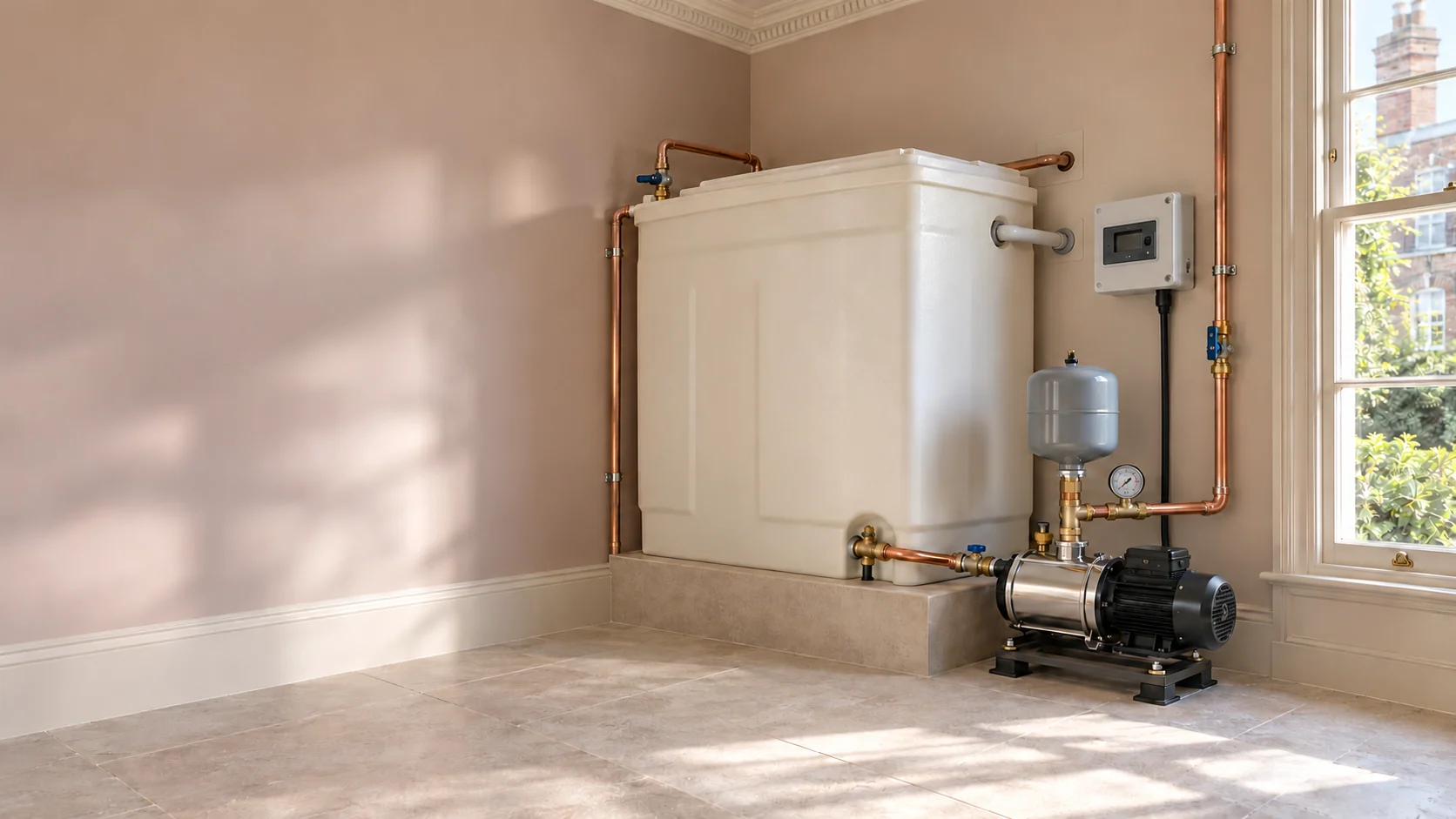
Cold-water storage tank and booster pump in a period-house utility room with a sash window

Water supply improvements · Chiswick W4

Water Pressure Booster & Accumulator Installation in Chiswick

Water that keeps up with a busier home.

Plumbing enquiries: 07843 676 480

Mains water boosters · Accumulator installation · Cold-water storage and booster sets

NICEIC

PEP installs water pressure boosters, accumulators and cold-water storage systems for houses and flats in Chiswick W4. We assess the existing supply, establish the demand you want to support and coordinate the plumbing, electrical connections and commissioning.

Whether a loft conversion is adding an en-suite or two existing showers struggle when used together, the starting point is the same: understand what the water supply can deliver before choosing the equipment.

Chiswick W4 · Plan for the whole home

A new bathroom changes what your water supply needs to do

A house may work well with one shower in use, then feel very different once a second bathroom, a larger bath or a new kitchen is connected. The issue is not necessarily the quality of the fittings. Several outlets may be competing for more water than the existing supply can deliver.

For a Chiswick refurbishment, we look at the completed home rather than just the next room being fitted. That includes a loft en-suite, a family bathroom on the floor below, and the kitchen or utility used during the same morning routine.

In a converted house or apartment, the questions may be different: which pipework belongs to the flat, whether the incoming service is shared, and where equipment can operate without disturbing adjoining rooms.

Where new distribution pipework is needed, the work can be coordinated with our plumbing installation service in Chiswick.

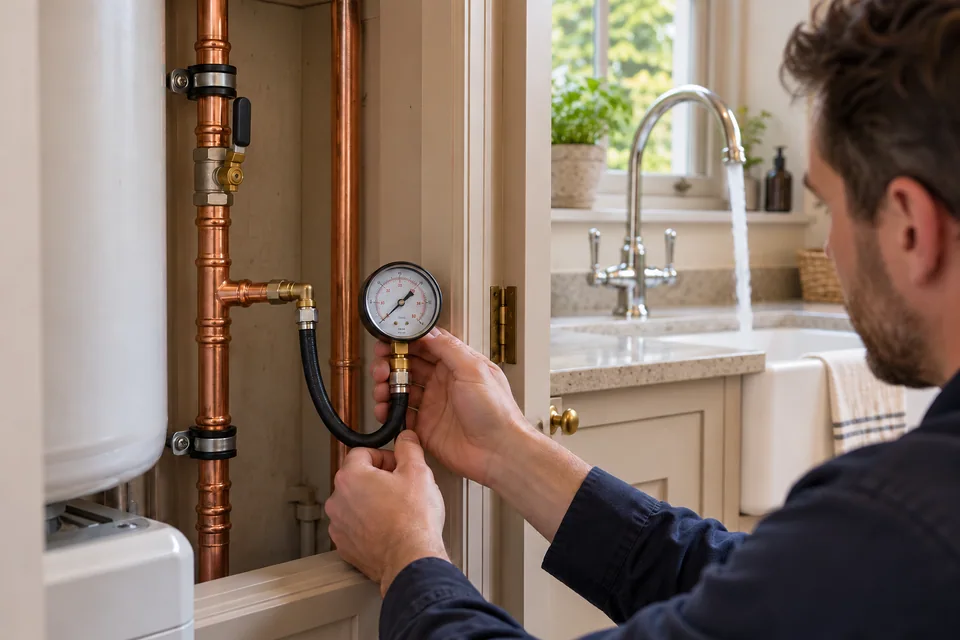
Engineer checking a pressure gauge connected to the incoming water supply in a utility room.
Measure the available supply under demand before choosing equipment.

01 · Understand the supply

Find the limiting factor before specifying a pump

Pressure is the force behind the water; flow is the amount available over time. A healthy pressure reading with the taps closed does not prove that an upstairs shower will perform properly while a bath is filling.

Our assessment considers:

  • Incoming pressure, pressure during demand and the available flow.
  • The size, route and condition of the pipework serving the intended outlets.
  • Valves, filters or local restrictions that may need attention.
  • Existing hot-water equipment and the changes planned for the property.
  • Shared supply arrangements and any variation in performance at different times.

The right first step may be a repair, distribution alteration or investigation of the incoming connection. If the problem lies with the water supplier or a communal system, that needs identifying before a private booster is specified. Our guide to low water pressure and poor flow explains the distinction.

02 · Select the right arrangement

Booster pump, accumulator or stored-water system?

These arrangements solve different problems. We select against the measured supply, the required performance and the space available, rather than treating them as interchangeable upgrades.

01 · Compact boosting
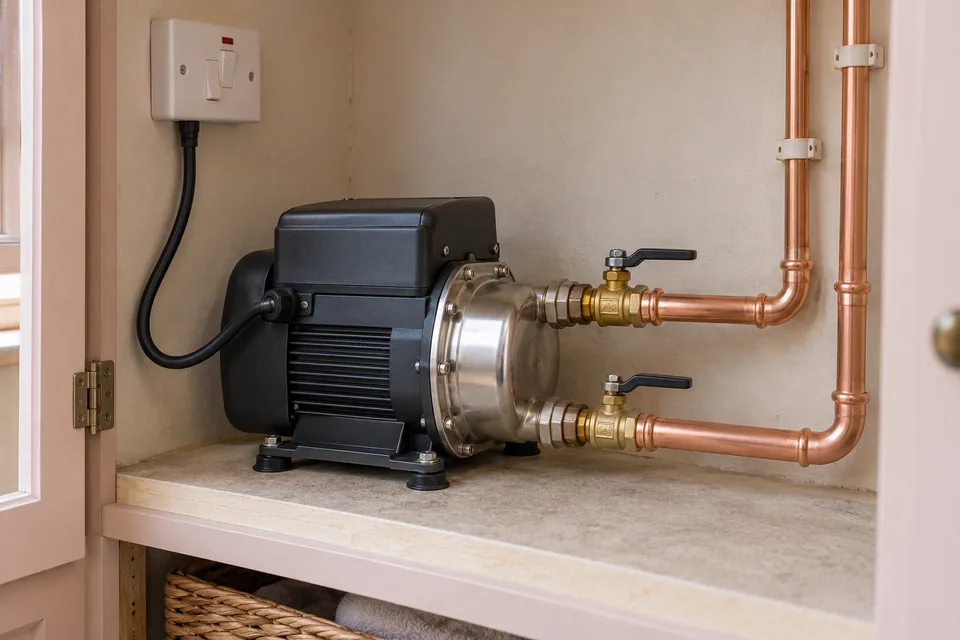
Compact water booster pump with separate inlet and outlet pipework, vibration-isolating feet and an electrical isolator.
A compact pump must suit the measured supply and intended demand.

A compact mains water booster

An inline booster can be suitable where an appropriately assessed, smaller requirement does not justify a large stored reserve. Its permitted connection arrangement and operating limits must suit the incoming supply.

Limited dimensions do not mean unlimited capacity. A compact unit should not be selected for several demanding showers simply because it fits in a cupboard.

02 · Pressurised reserve
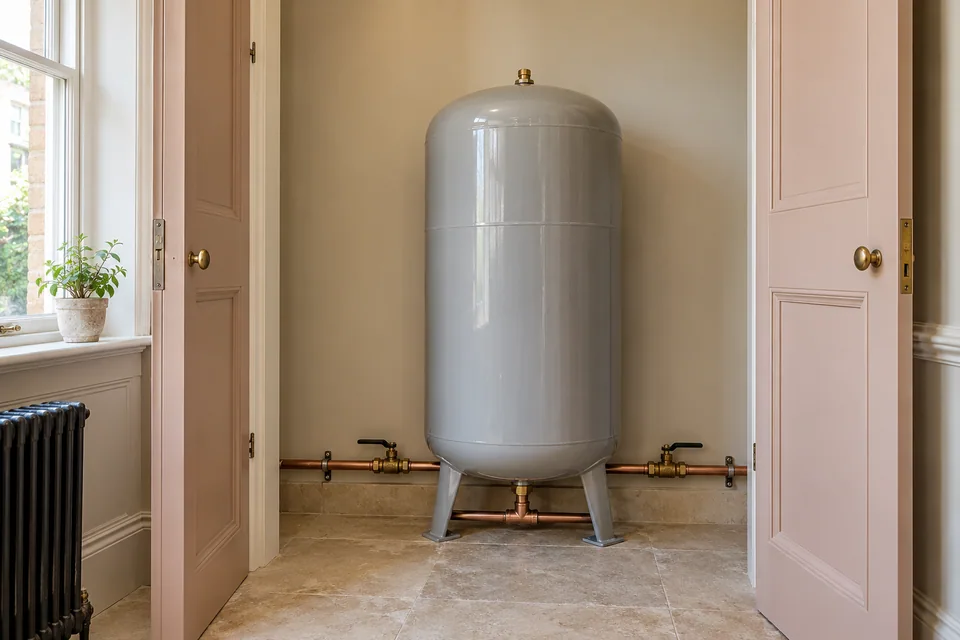
Floor-standing cold-water accumulator with a bottom pipe connection and accessible isolation in a service cupboard.
A pressurised cold-water reserve is different from a hot-water store.

An unpumped accumulator

An accumulator holds a pressurised reserve and releases water as demand rises. An unpumped vessel needs adequate incoming pressure to charge; it does not independently create higher pressure.

The usable water reserve is less than the nominal vessel volume and changes with operating conditions. We consider how much support is available, for how long, and how the vessel recharges between periods of use.

A pump-assisted accumulator

A compatible charging pump and accumulator can be considered where the assessed conditions call for that arrangement. Pump, vessel, controls and charging requirements need to work as a designed system, not as independently chosen components.

A break tank and booster set

A break tank stores cold water, while a dedicated pump supplies the property from that reserve. Integrated packages and separate tank-and-pump layouts can suit different spaces and duties.

This arrangement can support periods of higher demand than the incoming refill rate. It cannot do so indefinitely: useful storage, refill rate and the expected duration of use determine what is sustainable.

For a more detailed comparison, see our home water booster and accumulator guide.

Demand · Reserve · Refill

Design for the second shower, not just the first

The useful question is not simply how many bathrooms the property has. It is which fittings you want to use together, what they require and how long that demand is likely to last.

A loft shower and the main bathroom may need to operate during the same morning period. Adding a bath or a high-flow shower changes the requirement again. We account for the height difference, distribution losses and hot-water provision as well as the booster itself.

For systems with storage, we also consider recovery after that busy period. A brief demonstration from a full vessel is not the same as confirming that the household's normal pattern of use is supported.

The intended operating arrangement is agreed before installation and checked at the relevant outlets during commissioning.

03 · Coordinate cold and hot water

Better water delivery needs the right hot-water capacity

An unvented cylinder stores hot water; it does not remove a restriction in the cold-water supply feeding it. Where both need attention, we coordinate the water supply improvements with unvented cylinder installation in Chiswick.

Cylinder capacity, recovery and suitable hot and cold supplies to the mixers all matter. Improving one side without reviewing the other can leave the original comfort problem unresolved.

With a combi boiler, the available hot-water flow also depends on the boiler's heating output and the required temperature rise. A booster cannot increase that heating capacity. If the combi is already the limiting factor, the proposal needs to recognise it.

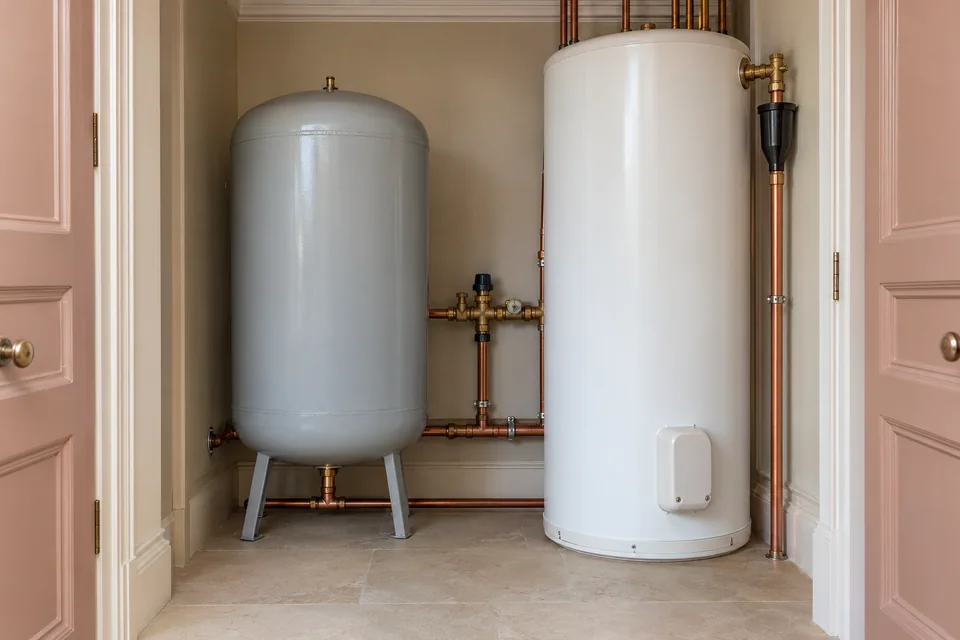
Cold-water accumulator beside an unvented hot-water cylinder, with accessible pipework in a service cupboard.
Water delivery and hot-water capacity are separate design considerations.

Space now · Access later

Make room for installation, quiet operation and future servicing

The smallest footprint is not always the most practical layout. A tank or vessel must reach its proposed location, sit on suitable support at its full operating weight and remain accessible after the room is finished.

For period houses, routes may need to work around retained floors, joinery and other services. In flats, the position relative to bedrooms, party walls and communal pipework can be equally important.

  • Noise and vibration: assess the equipment, mounting, pipe support and proximity to occupied rooms. No pump should be assumed silent.
  • Access: allow for inspection, isolation, maintenance and eventual equipment replacement.
  • Water storage: provide an appropriate location, hygienic arrangement, turnover and any required overflow route.
  • Building interfaces: identify structural preparation, protected fabric or communal services that need separate agreement.

We establish the installation requirements before equipment is ordered, rather than leaving the joiner or builder to find space afterwards.

Plumbing · Heating · Electrical

Plumbing and electrics within one agreed scope

A successful water booster installation includes more than positioning the unit. Depending on the selected design, the scope may cover equipment supply, pipework alterations, isolation, backflow protection, electrical supply, controls and integration with the hot-water system.

PEP coordinates these elements alongside its electrical installation work in Chiswick. For a larger refurbishment, the water supply can also be planned within a wider heating and plant-room installation.

Our heating and plant-room portfolio includes a completed Chiswick installation, illustrating our work with heating, hot-water storage and controls. Your booster specification is developed separately around your own property and requirements.

04 · A clear installation process

What happens from the first enquiry to handover

  1. Describe the property and the problem. Send your postcode, the number of bathrooms and what happens when more than one outlet is used. Plans or photographs are helpful if you have them; you do not need to choose a pump first.
  2. Assess the supply and agree the approach. We establish the measurements, location and building constraints needed for a recommendation. The quotation identifies the equipment, connections, included work and any preparatory requirements.
  3. Plan the work around the property. Access, delivery, electrical work and expected water interruptions are agreed. Any work affecting shared services requires the appropriate arrangements before it proceeds.
  4. Commission and explain the installation. We check operation under the agreed demand, the relevant controls and protective functions. Handover includes the applicable commissioning record, operating information and maintenance requirements.

Pipe routes, isolation points and service access should remain understandable after the installation is concealed or the cupboard is completed.

A quotation for the complete scope

Water booster installation costs in Chiswick

A compact pump fitted to suitable existing pipework is a different project from a storage-based installation supplying several bathrooms. A useful quotation explains the complete work, not just the equipment price.

The main cost factors include the required duty, usable storage, pipework changes, electrical connections, access and integration with existing hot-water equipment. A difficult delivery route, structural preparation or a new incoming supply can materially change the scope.

Our proposal distinguishes the installation from associated work such as joinery, decoration and other making good. Included items, exclusions, options and VAT are set out so that you can compare the actual scope.

The aim is to specify what solves the measured problem: neither an undersized device that leaves the same restriction nor unnecessary storage where a simpler alteration is sufficient.

Requirements · Permissions · Handover

Water regulations and the conditions of your installation

Notification and consent requirements, protection against backflow and the manufacturer's installation conditions are considered for the proposed arrangement and the water supplier serving the property.

Water Regs UK guidance identifies notification to the local water undertaker where a pump induces demand above 12 litres per minute, including direct and indirect connections. That is not a blanket limit on what every home may use, or an exemption from other requirements for smaller pumps.

In a shared building, freeholder or managing-agent arrangements may also be needed. The installation should not proceed on the assumption that communal pipework can be altered solely for one flat.

Chiswick · Bedford Park · Grove Park

Water supply improvements across Chiswick W4

We consider planned installations across Chiswick, including Bedford Park, Turnham Green, Grove Park, Strand-on-the-Green, Chiswick Mall, Gunnersbury and W4 addresses in Acton Green.

From an established house undergoing renovation to a flat with limited service space, the system is selected for the individual property. The postcode alone does not tell us whether a booster is needed.

For Stamford Brook and nearby postcode boundaries, send the full address with your enquiry. Our wider water pressure booster installation service in London sets out the overall service and system options.

Before you book

Questions about water boosters in Chiswick

Could a booster let us use the loft shower and family bathroom together?

That can be an agreed design objective, provided the incoming water, distribution pipework, hot-water capacity and any storage support it. We need the requirements of the actual fittings, not just a bathroom count, before recommending a system.

Can I improve the supply without installing a large tank?

Possibly. A compact booster, an appropriately sized accumulator or an alteration to existing pipework may be suitable. The answer depends on the restriction and the demand. Limited storage should not be presented as equivalent to a larger system's usable reserve.

Is an accumulator the same as a hot-water cylinder?

No. A mains-water accumulator provides a pressurised cold-water reserve. A hot-water cylinder stores heated water. They may form parts of the same wider installation, but one does not replace the function of the other.

What if the supply pipe is shared with another flat?

We first establish how the building is supplied and which parts can be altered. Restrictions, other occupants' supply and the necessary permissions must be considered. A separate incoming connection or a building-wide solution may be more appropriate than a pump within one flat.

Would replacing the incoming pipe be better than fitting a booster?

It can be, particularly where the existing connection is the main restriction. Access, ownership and water-company requirements affect what is possible. We consider the underlying supply before recommending equipment intended to compensate for it.

Will the installation be noisy?

Noise depends on the selected equipment, mounting, pipework and location. We consider neighbouring rooms and vibration transmission when planning the work. A quiet installation is a design consideration, not a reason to describe every pump as silent.

How long will the work interrupt our water supply?

The interruption depends on the required connections and the extent of the alterations. We agree the expected shutdowns before work starts. A tank-based project may be staged differently from a compact installation, so there is no single duration for every property.

What maintenance should we allow for?

It depends on the chosen system. Pumps, controls, filters, pressure vessels and any cold-water storage have their own inspection and maintenance requirements. We explain the applicable schedule at handover and plan the layout so that this work remains accessible.

Can we suggest a particular brand or model?

Yes. Send the details with your enquiry. We assess the model against the available supply, required duty, installation space and current manufacturer requirements. The choice should be supported by the measurements rather than the name on the equipment.

Chiswick W4 · Plan the next step

Tell us what needs to work better

A stronger shower, an additional bathroom or a complete refurbishment: start with the result you need from your Chiswick home.

Send PEP your W4 postcode, a short description of the existing problem or proposed changes, and any photographs or plans you already have. We can establish the assessment needed and develop an installation scope around the property.

Discuss your Chiswick booster installation

Plumbing enquiries: 07843 676 480