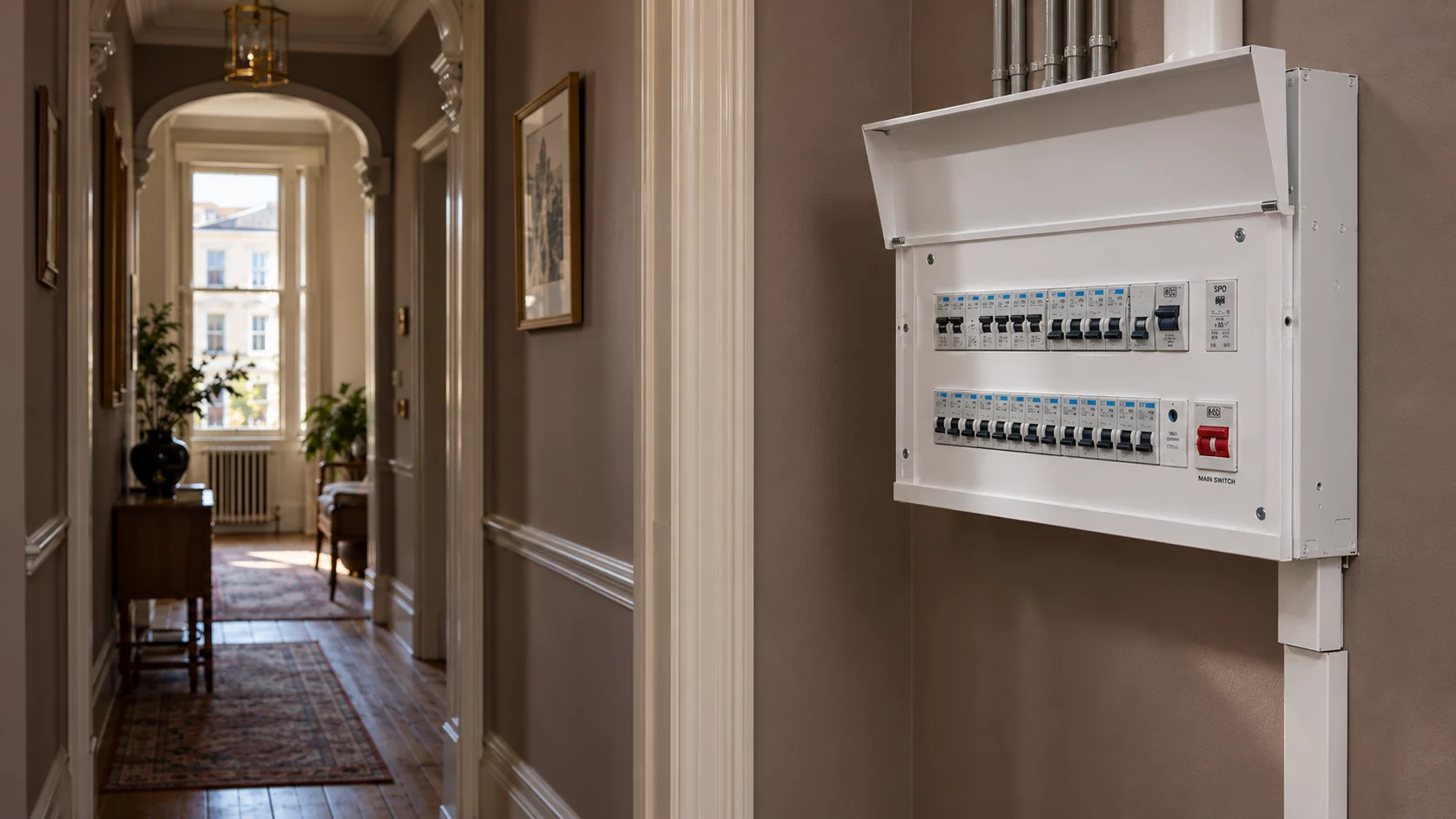
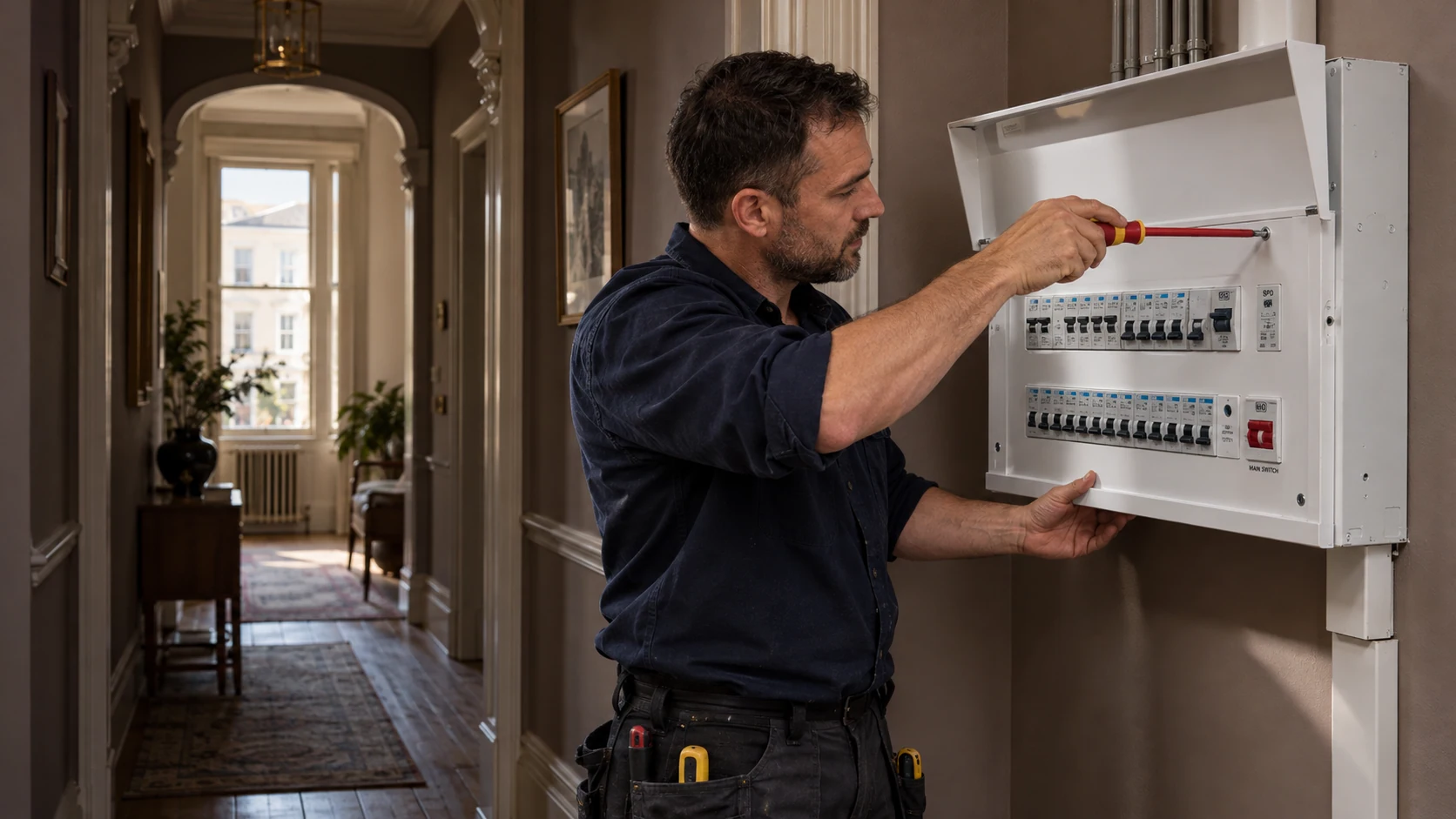
Electrician fitting the front cover of a two-row consumer unit in a period hallway.

Fuseboard upgrades · Paddington W2

Consumer Unit Replacement in Paddington, W2

Modern protection. A carefully planned changeover.

PEP replaces consumer units and older fuse boxes in Paddington flats and houses, bringing the protection, circuit layout and handover together in one agreed scope.

NICEIC Domestic Installer Scheme · Residential electrical work · Inspection, testing and certification

NICEICDomestic Installer
Scheme

Whether your board has become unsuitable for the installation or you are preparing for a refurbishment, we establish what needs changing before recommending equipment. The existing wiring, the building’s supply arrangements and the practicalities of living through the work all matter.

From a converted flat near Sussex Gardens to an apartment around Paddington Basin, our approach is to plan the replacement around the property it serves.

01 · Understand the reason for replacement

Does your fuse box need replacing — or does the fault need finding?

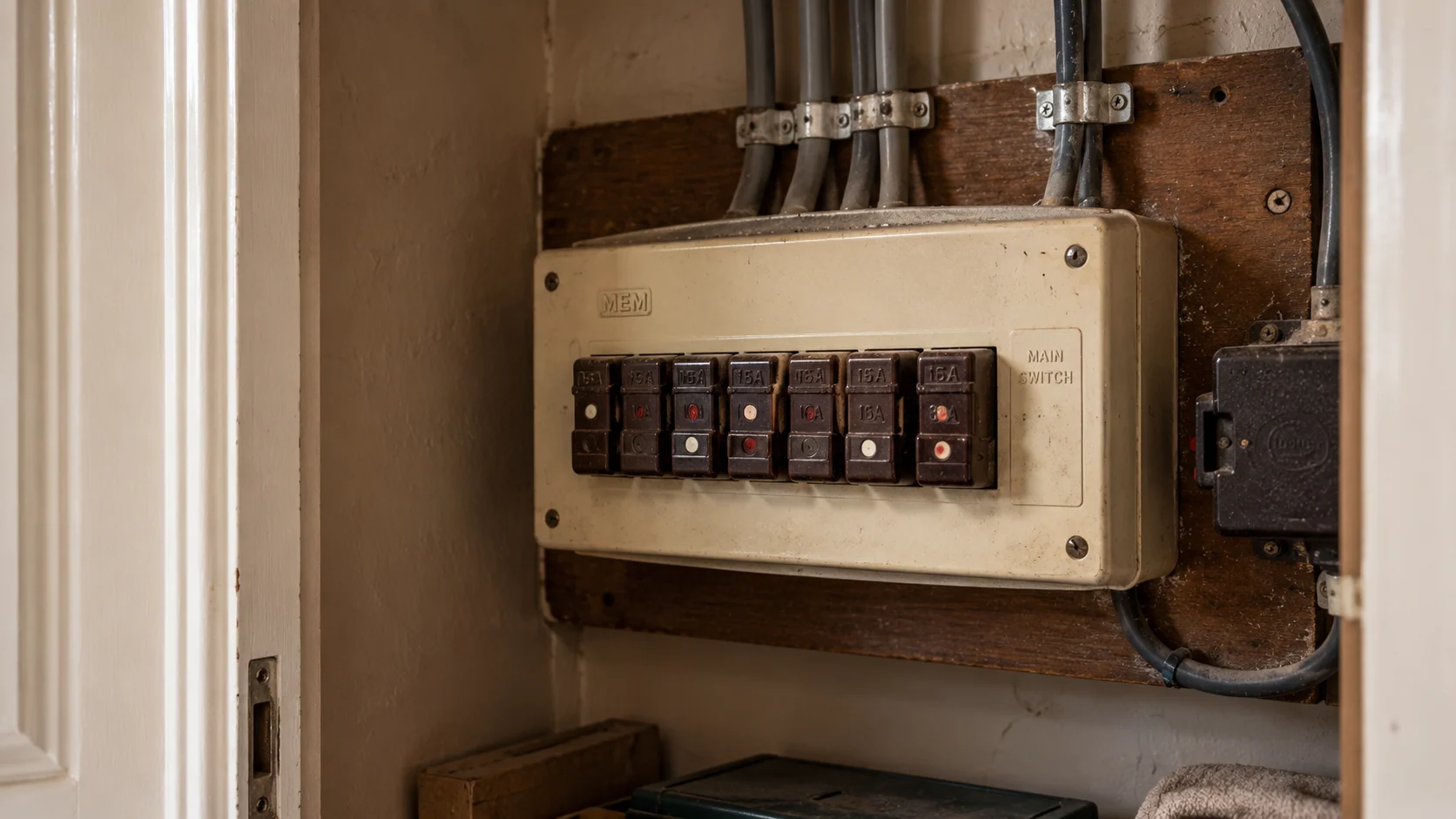
Older rewireable fuse board mounted in a domestic electrical cupboard before assessment.
Assess the installation. Not just the age of the enclosure.

A fuse box that keeps tripping is a reason to investigate, not proof that the entire board needs replacing. The cause could be an appliance, moisture, damaged wiring or the way existing circuits share protection.

Equally, a board that rarely trips is not necessarily suitable for the electrical work you are planning.

We help distinguish between a problem requiring diagnosis, an appropriate upgrade to existing equipment and a complete consumer unit replacement. Where the wiring itself needs renewal, that becomes a different scope of work.

An older enclosure does not, by itself, establish that the installation is unsafe. The recommendation should follow the condition and suitability of the installation, rather than a judgement based on its appearance.

For recurring trips, our guide to an RCD that keeps tripping explains why identifying the cause comes first.

02 · The flat and the building

Your consumer unit is only one part of the building’s supply

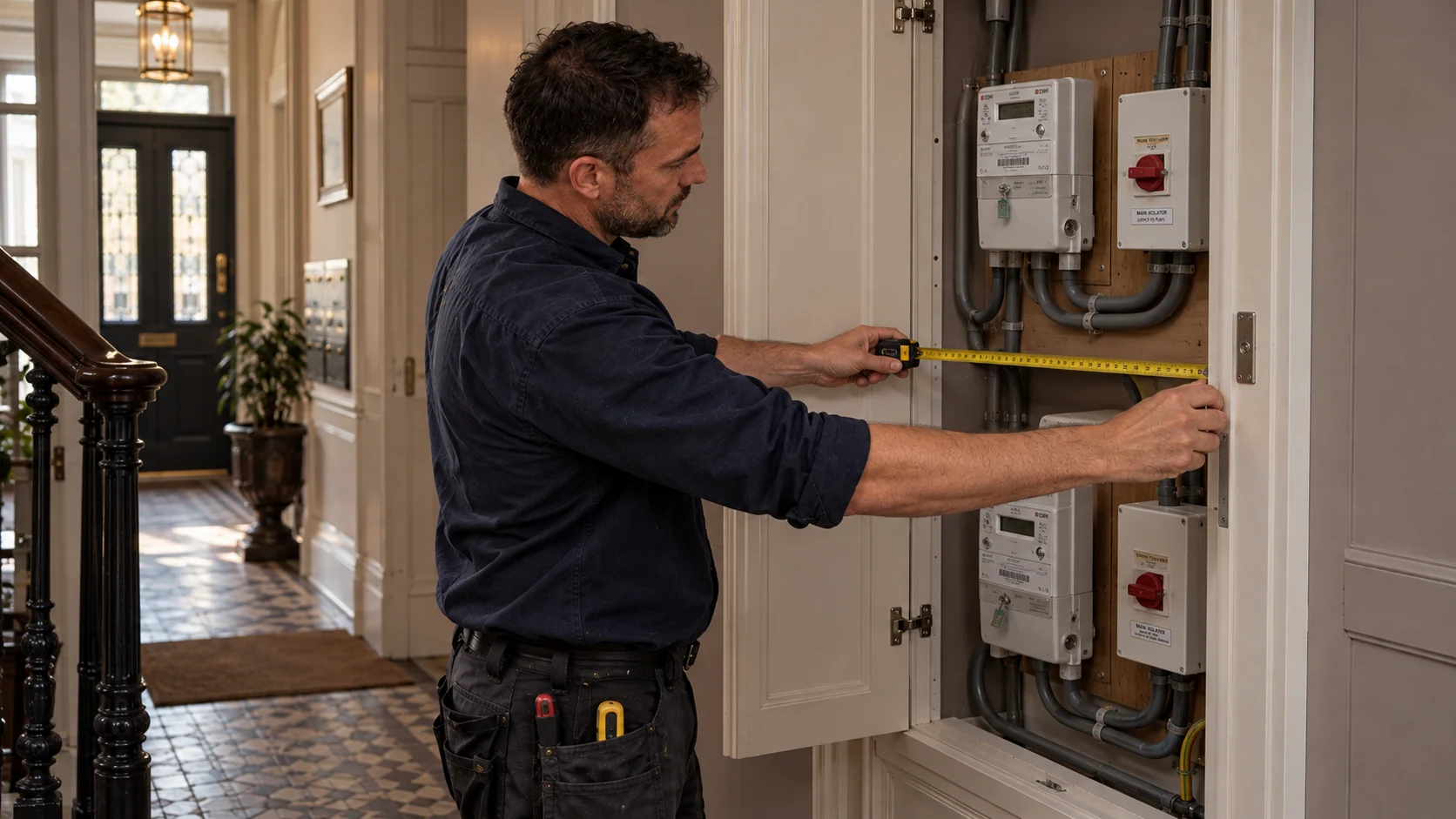
Electrician checking access to enclosed meter and isolation equipment in a converted period property.
The right equipment. The right access. An agreed changeover.

In a Paddington flat, the consumer unit inside your home may be some distance from the electricity meter or incoming supply equipment. A hallway cupboard can contain equipment serving one flat, several flats or the building’s common areas.

Before arranging the changeover, we establish which equipment serves your property, where isolation can take place and who controls access.

That can mean coordinating keys, access hours or arrangements with a managing agent. Where the electricity supplier, network operator or building network operator needs to be involved, this must be identified before installation day.

Replacing your own consumer unit is not permission to alter communal wiring or interfere with sealed supply equipment. Lease requirements and any permissions relating to common parts also need to be checked against the proposed work.

The benefit is practical: the electrician arrives with the right access and an agreed route to carrying out the replacement safely.

03 · Keep suitable circuits. Address what needs attention.

Can the existing wiring stay?

Often, yes — provided assessment shows that the circuits are suitable for reconnection. A consumer unit replacement and a full rewire are not the same job.

We consider the relevant wiring, circuit identification, earthing, bonding and supply arrangements before settling the scope. Known faults should be discussed at this stage, including intermittent problems that may not be present during a visit.

Electrical Safety First recommends an EICR before a planned replacement. Where that is not undertaken, its guidance requires a pre-work survey; the necessary assessment cannot simply be skipped. Read the consumer unit replacement guidance.

If the findings point to cable renewal, we explain the reason and the options. Our house and flat rewiring service in Paddington covers that wider work.

You can also read our consumer unit replacement or rewiring guide before deciding how to proceed.

04 · A purpose for every protective device

Choose the protection around the circuits

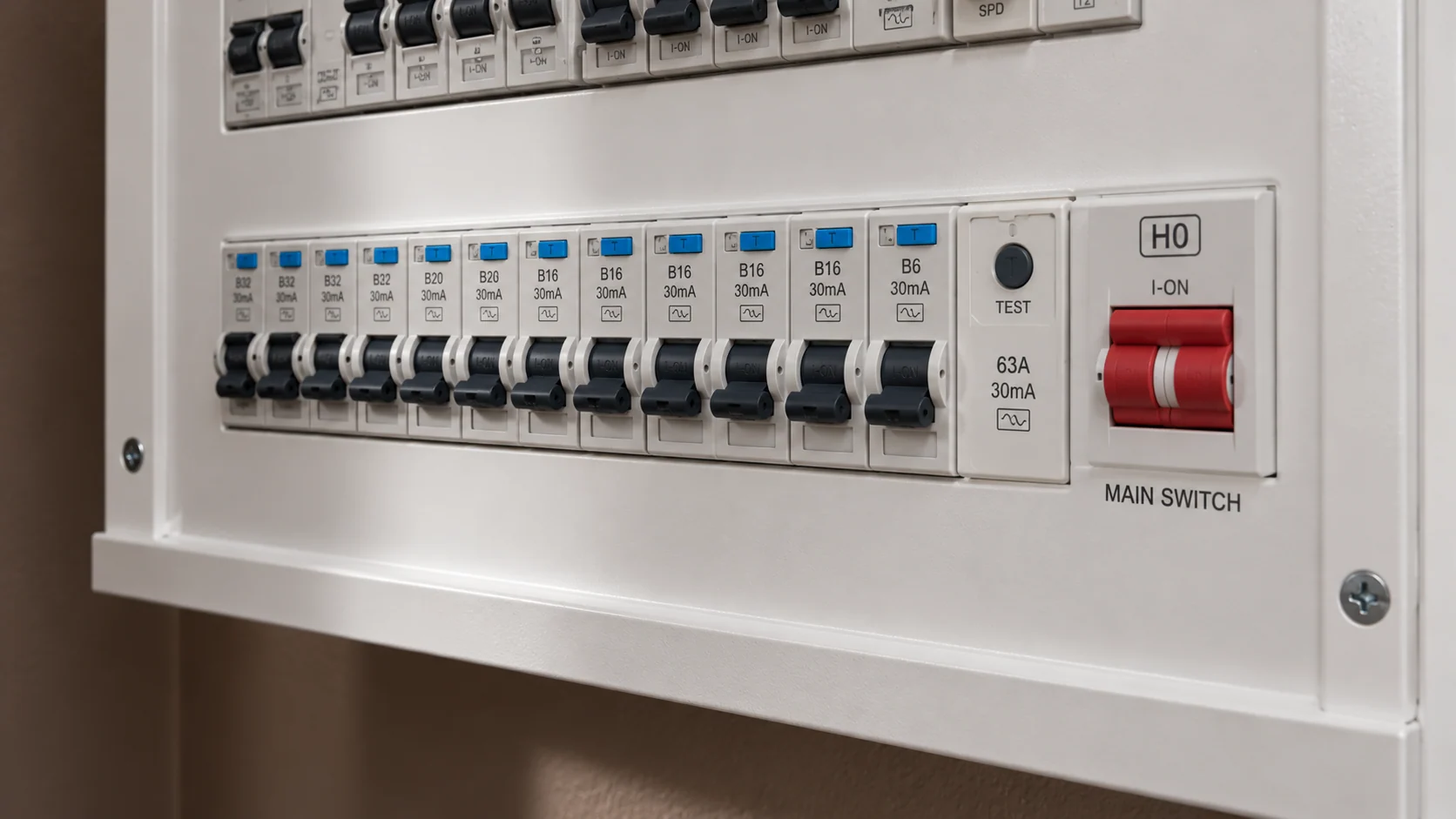
Close-up of protective devices in a two-row metal consumer unit with the front safety cover fitted.
Protection specified around the circuits.

The specification should explain what the protective devices do and why they suit your installation.

RCD and RCBO protection

An RCD detects an imbalance in current that can indicate leakage to earth and disconnects the supply. An RCBO puts this function together with protection against overloads and short circuits, serving a single circuit.

By giving circuits individual RCBO protection, a suitable design can help contain the interruption when a fault develops. That is useful when a problem on one circuit would otherwise interrupt several unrelated parts of the home.

It does not eliminate faults or guarantee uninterrupted power.

Surge protection

A surge protective device helps limit transient overvoltages that can affect electrical equipment. It has a different purpose from an RCD or RCBO; these devices are not interchangeable.

NICEIC’s consumer unit guide explains the main protective devices in more detail.

A compatible, properly specified assembly

We consider the enclosure, device compatibility, circuit requirements and any need for additional protection, including arc-fault detection. The specification follows the applicable edition of BS 7671 and manufacturer requirements, rather than assuming that every flat needs an identical board.

The IET maintains the current wiring regulations and amendment information.

05 · Understand the whole quotation

Consumer unit replacement cost in Paddington

The price depends on the work needed to complete the installation, not simply the number of switches visible on the old board.

A replacement in an accessible position with suitable existing circuits is different from a relocation involving cable alterations, restricted access and repairs.

Our quotation sets out the proposed equipment and installation work, together with the agreed testing and documentation. It also identifies associated work, such as earthing or bonding improvements, that needs to be included.

When reviewing the price, the important distinctions are:

  • The consumer unit replacement itself.
  • Necessary repairs or associated electrical work.
  • Optional changes, such as relocation or additional circuits.
  • Work by other parties, including supply alterations or building repairs.
  • VAT and any stated exclusions.

A photograph can help us understand the starting point, but it cannot establish the condition of concealed wiring.

If further findings change the scope, we explain what has been found and agree the additional work before proceeding, while ensuring that any unsafe condition is dealt with appropriately.

06 · Space to install, operate and maintain

A suitable position — with room to use and maintain it

The replacement board may not have the same dimensions or cable-entry arrangement as the existing one.

We check the available position, surrounding joinery and access for installation, operation and maintenance. A cupboard should allow the electrical equipment to remain accessible after the shelving, doors and stored belongings are back in place.

If you want the board moved, mention this at the outset. Relocation can affect cable routes, connections, making good and the overall programme.

In a period conversion, the route through existing finishes may be as important as the final position. In a managed apartment, access requirements and the building’s rules may influence how the work is organised.

Agree the electrical layout before new joinery is manufactured.

07 · Agree the interruption

Plan the time without power before the appointment

Replacing a consumer unit requires the supply to the affected installation to be safely isolated. The expected interruption should be part of the conversation before the date is booked.

Tell us about working from home, refrigeration, medical equipment, alarms, access systems or other essential supplies. We need to understand these requirements rather than discover them when the power is about to be switched off.

The length of the visit and the period without electricity are not necessarily the same. Circuit testing, access constraints, relocation and existing faults can all affect the programme.

We explain the expected arrangements for your property and any dependencies on other parties. If you intend to remain at home, we also agree how the working area and testing access will be managed.

08 · From assessment to handover

From assessment to a labelled, tested installation

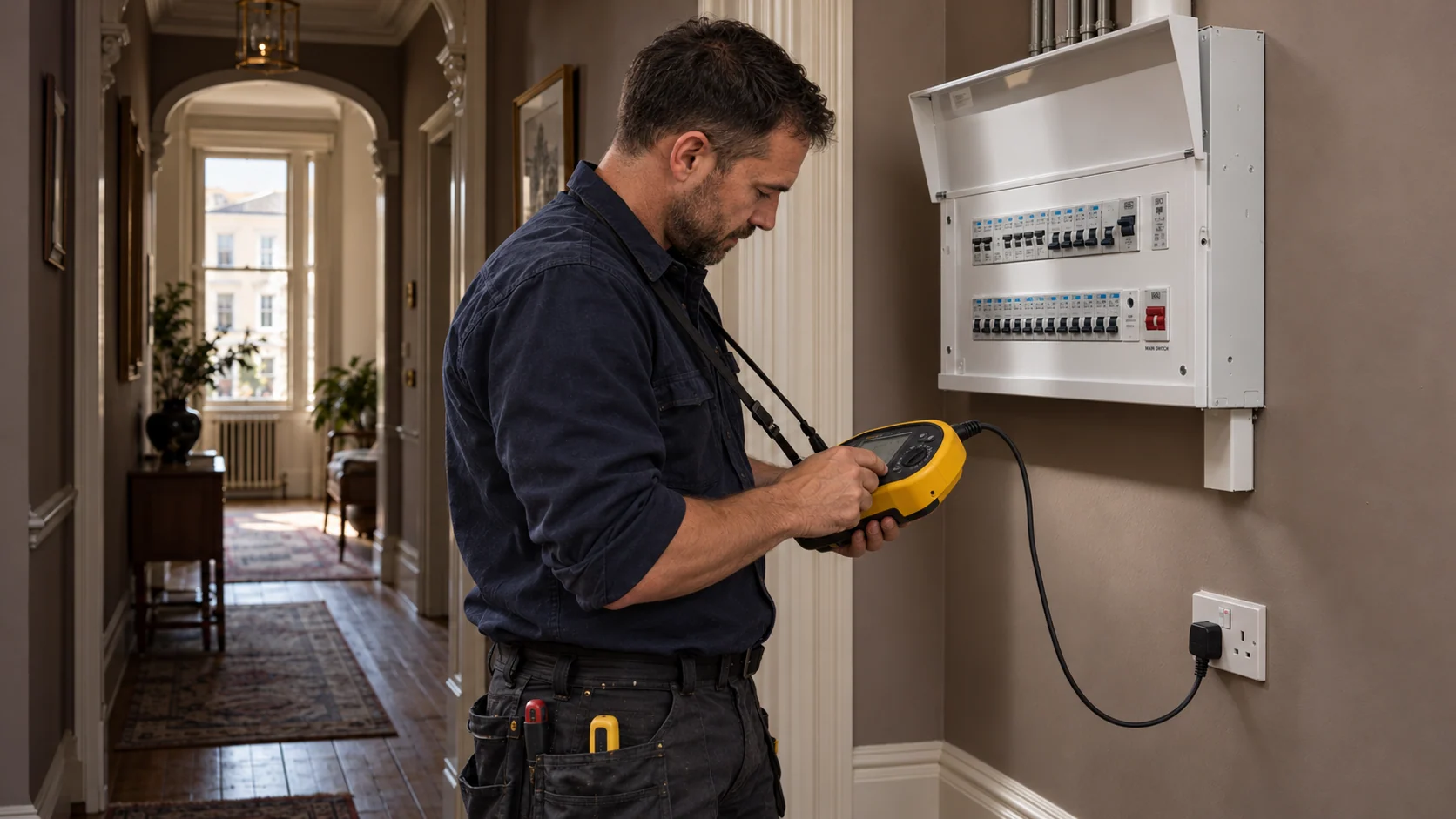
Electrician using a yellow multifunction installation tester at a UK socket after consumer unit work.
Test the circuits. Verify the completed work.
  1. Establish the scope

    We review the reason for replacement, assess the relevant installation and confirm the proposed equipment. Access, isolation, associated work and the expected interruption are included in the planning.

  2. Complete the agreed replacement

    The installation is carried out with the relevant supply safely isolated. Retained circuits are connected as appropriate to the agreed specification.

    If a circuit cannot safely be reconnected, it may need to remain disconnected until the necessary remedial work has been completed.

  3. Verify and hand over

    Inspection and testing are part of completing the job. We identify the circuits, finish the relevant records and explain the new arrangement.

    The handover should leave you able to recognise the circuit labels, understand the manufacturer’s user instructions and know what to do if a protective device operates.

    Any outstanding matters are identified rather than hidden behind the appearance of a new enclosure.

09 · Know what you will receive

Certification and Building Regulations

Completed two-row metal consumer unit with circuit identification and clear maintenance access.
A finished enclosure. A documented handover.

Consumer unit replacement in a dwelling in England is notifiable work under Building Regulations. We include the appropriate notification arrangements in the scope. Approved Document P explains the requirements.

For the completed replacement, the documentation includes an Electrical Installation Certificate with the relevant inspection and test schedules.

The Building Regulations compliance certificate is a separate document. It should not be confused with either the installation certificate or an EICR, which reports on the condition of an existing installation.

Keep these records with your property documents. They describe the work carried out and can assist future electrical alterations, property transactions and discussions with your managing agent.

10 · Plan new loads before choosing the board

Planning new kitchen equipment or electric heating?

Let us know what else may be changing before the board is specified.

An induction hob, additional cooking appliances or electric floor heating can affect circuit requirements. Space for future circuits may be sensible, but unused ways in a consumer unit do not prove that the incoming supply has spare capacity.

We assess the proposed demand and the wider installation rather than treating a larger board as an automatic supply upgrade.

Our electrical services in Paddington cover associated installation work. Where underfloor heating in Paddington is also planned, we can coordinate the electrical supply and controls with the heating work.

Water-based heating controls and electric floor heating have different requirements; the specification should reflect the actual system.

11 · One coordinated plan

Why arrange your replacement with PEP?

A standalone fuseboard replacement deserves the same attention to planning as a larger refurbishment.

We bring the electrical work into the conversation early: what the installation needs, how it will fit within the available space and how the appointment will affect the people using the property.

If a kitchen, heating installation or wider renovation is happening alongside it, we can discuss the overlapping work and define the responsibilities.

If nothing else is changing, the objective remains focused: an appropriate replacement, an understood scope and a documented handover.

Paddington · Bayswater · Lancaster Gate

Paddington, Bayswater and nearby W2 neighbourhoods

We welcome consumer unit replacement enquiries from Paddington and nearby W2 addresses, including:

  • Praed Street, Norfolk Square and Sussex Gardens.
  • Westbourne Terrace and Gloucester Terrace.
  • Paddington Basin, Merchant Square and Paddington Central.
  • Bayswater, Queensway, Porchester and Craven Hill.
  • Lancaster Gate, Hyde Park Estate, Connaught Village and Tyburnia.
  • Relevant W2 addresses around Royal Oak and Westbourne Green.

Please provide your full postcode so we can confirm the location and discuss the access arrangements.

For neighbouring W9 addresses, see consumer unit replacement in Maida Vale. For W11, see our Notting Hill service.

Our London consumer unit replacement page covers the wider service.

Before you book

Questions about replacing a fuse box in W2

Does an old plastic consumer unit automatically need replacing?

No. Its condition, protective arrangement and suitability for the intended work need assessment. The enclosure material alone does not determine the whole recommendation.

Can you replace the board without rewiring my flat?

Yes, where the existing circuits are suitable to retain. If assessment identifies necessary repairs or cable replacement, those are explained as part of defining the job.

Will a new consumer unit stop repeated tripping?

Not necessarily. A fault in wiring or connected equipment can remain after replacement. The cause needs to be established rather than assuming that a new board will resolve it.

Will the work switch off electricity to other flats?

The isolation arrangements must be established for the actual building. Tell us if equipment is in a communal cupboard; we do not assume that access to your board means unrestricted control of the building’s supply.

Do I need my managing agent’s approval?

It depends on your lease, the building’s procedures and the work involved. Check the requirements early, particularly where common areas or equipment outside your flat are affected.

Can you replace a separate board serving electric heating?

We can assess it as part of the enquiry. Tell us about any second board, off-peak supply or separate meter arrangement so the relevant circuits and supply controls can be identified.

How much will the work cost?

We quote for the assessed installation and agreed specification. Circuit count, condition, access, protection, relocation and associated work all influence the price; there is no reliable universal figure based on postcode alone.

Can I stay at home while the work is carried out?

Discuss this with us when planning the appointment. Safe working access and your household’s needs during the interruption determine the arrangements.

Talk to PEP

Let’s plan your Paddington consumer unit replacement

Send us your full postcode, the type of property and a short explanation of why you are considering replacement. Tell us where the board is located and whether any other electrical work is planned.

If it is safe to do so, include a photograph of the closed board and its surroundings. Do not remove covers or approach damaged equipment to obtain a picture.

We will help establish the next step and prepare a replacement scope suited to your home.

Discuss your Paddington fuse box upgrade

Call PEP: 07825 268 434