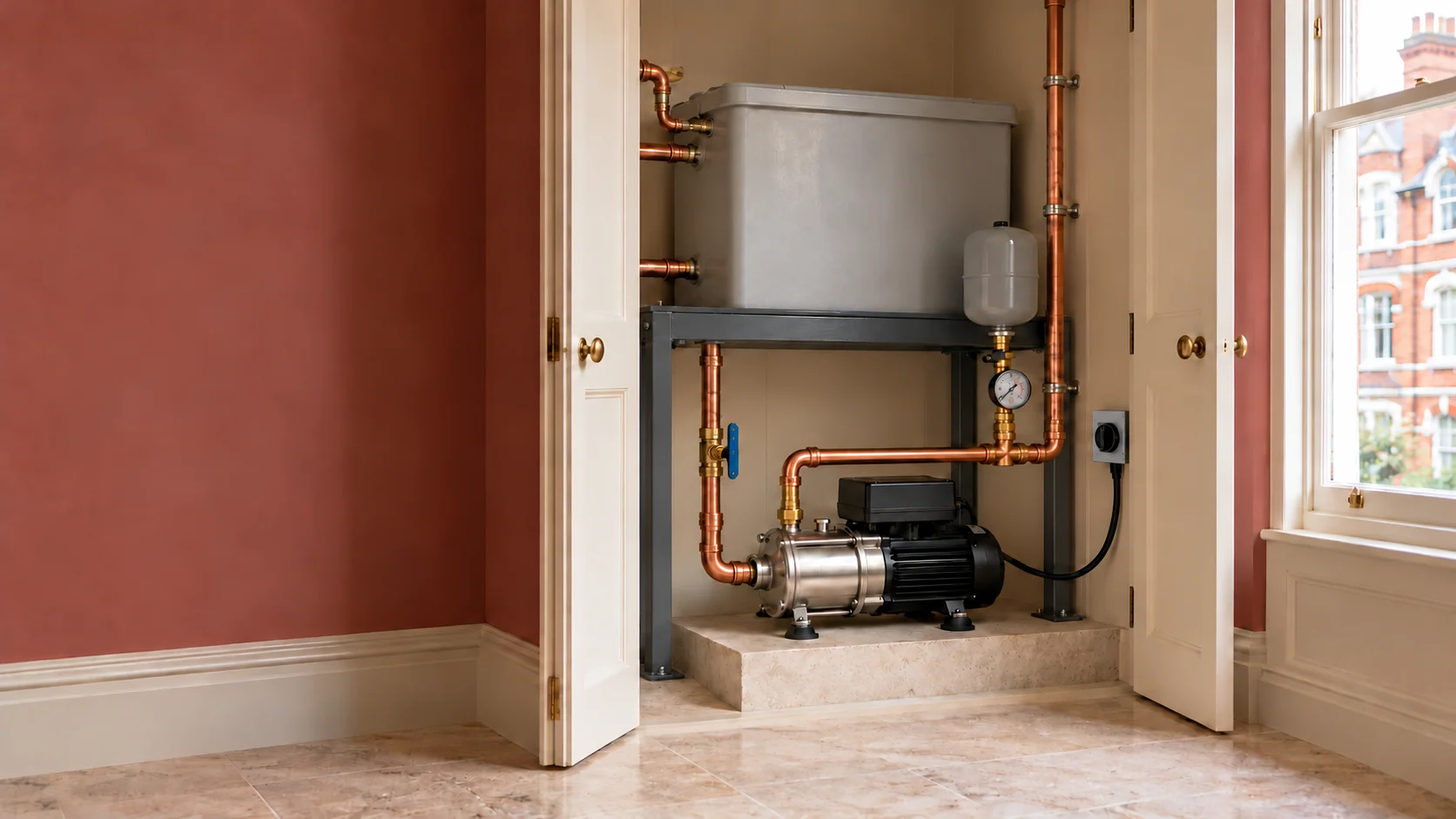
Tank-fed water pressure booster with a stainless-steel pump and copper pipework inside a cream utility cupboard

Water booster pumps · Accumulators · Complete installations

Water Pressure Booster Installation in Maida Vale, W9

Better water delivery starts with understanding your home — and the building around it.

Plumbing enquiries: 07843 676 480.

Mains water boosters · Accumulator installation · Cold-water storage and booster sets

NICEIC

A shower that fades when another tap opens is frustrating. Choosing equipment without understanding the supply can leave you with the same frustration and less cupboard space.

PEP designs and installs water pressure boosters, accumulators and tank-fed systems for Maida Vale homes and flats. We assess what reaches your property, what your household needs and how the installation can fit, bringing plumbing, hot water and electrical work into a considered plan.

Maida Vale W9 · Your flat and your building

A better water supply for your flat — and the building around it

In a Maida Vale mansion flat, the route from the street to the bathroom may include shared pipework, several floors and equipment outside your control. In a converted house, the division between individual supplies may be less obvious. A family home with its own connection presents a different set of choices.

We plan around those differences. A new bathroom, a replacement cylinder or a refurbishment is the opportunity to agree how the water system should perform before joinery and finishes restrict the options. For an occupied property, access, interruptions and the space you can reasonably give up matter just as much.

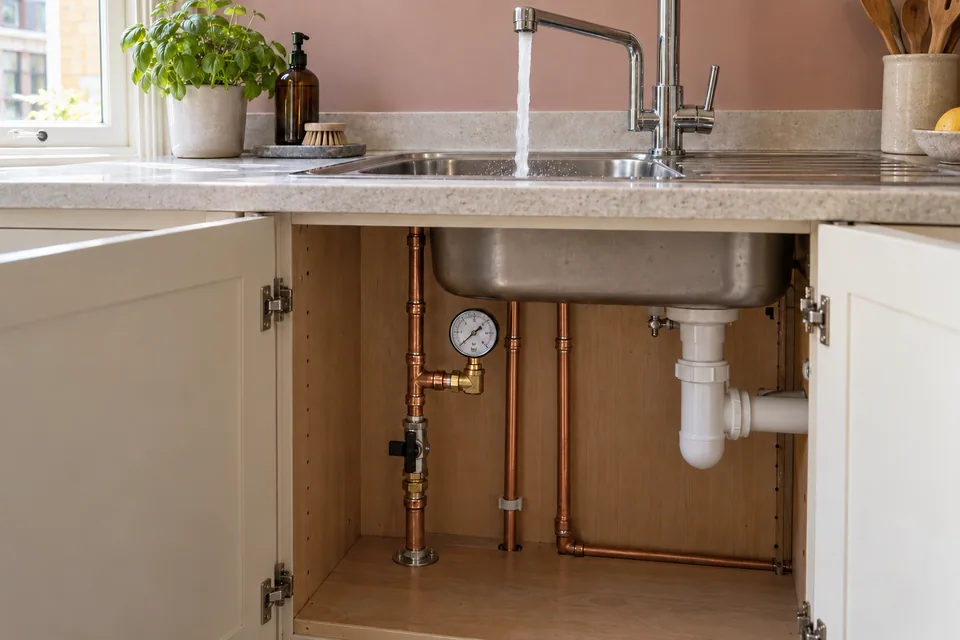
Pressure gauge on an incoming water pipe beneath a kitchen sink, with the cold tap running above
Measure supply conditions while water is being used.

01 · Understand the supply

Start with the water reaching your home

A pressure reading taken while nothing is running does not tell the whole story. The useful assessment combines static pressure, pressure during use and available flow, then relates those readings to the outlets you want to operate together.

We look at where the problem occurs: one shower, hot water only, the entire flat or several properties sharing a supply. Existing valves, filters, pipework and hot-water equipment can affect the result. If performance has suddenly changed, the cause needs investigating rather than assuming the original installation needs a larger pump.

A reading at the building entrance is not a substitute for understanding conditions at your flat. Where demand varies, measurements at a relevant busy period or further investigation may be needed.

For the distinction between a weak supply and a local restriction, see our guide to water pressure and flow problems.

Private home · Shared responsibilities

A private installation or a building-wide problem?

Before specifying equipment for a flat, we establish the proposed connection point and the responsibilities either side of it. A pump inside your cupboard cannot be selected independently of the pipework supplying the rest of the building.

  • Within your property: assess the incoming branch, existing restrictions and whether a suitable private booster or storage arrangement is practical.
  • On a shared supply: identify which questions need the freeholder, managing agent or building contractor involved, including access to risers and shared isolation.
  • At the incoming connection: investigate whether improving or separating the supply is a better route than adding equipment downstream.

We define the private installation scope and highlight dependencies before work is booked. Shared-system alterations require their own assessment and agreement; they are not silently included in a quotation for one dwelling. The aim is a useful improvement for your home without creating a problem for another resident.

02 · Select the right arrangement

A compact booster, an accumulator or a stored-water system?

There is no single best water booster for every W9 property. These arrangements solve different problems, and the right choice follows the assessment.

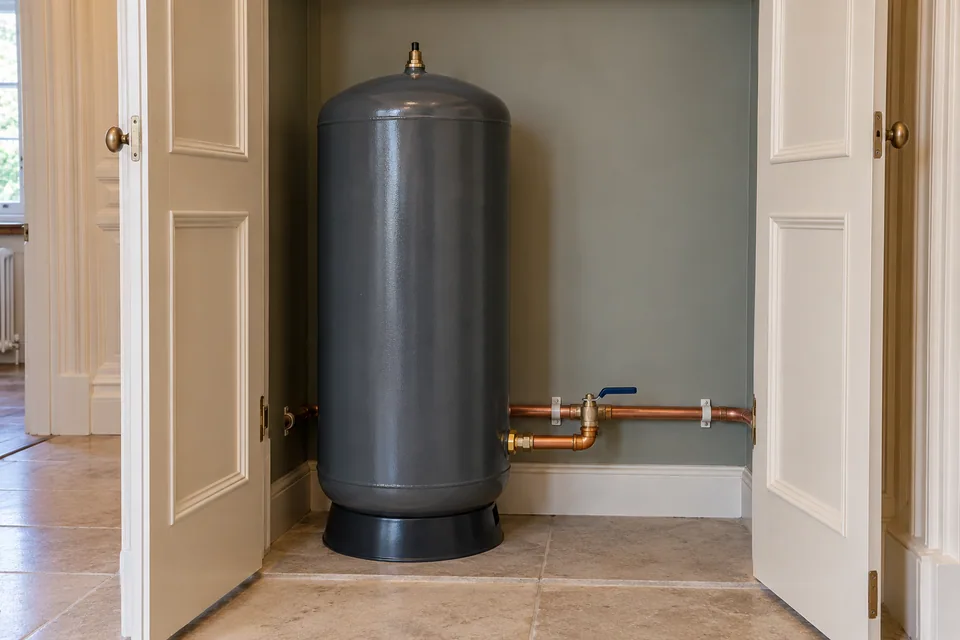
Tall cold-water accumulator with a single lower pipe connection inside an accessible utility cupboard
An accumulator is a different option from a tank-fed pump.
01

A compact mains booster

An inline unit can be an option where modest boosting is appropriate and the incoming supply meets the product's operating requirements. It takes less space than a storage installation, but its permitted delivery must suit the intended demand. A conventional gravity-fed shower pump is not an interchangeable substitute for a mains-water booster.

02

An accumulator without a pump

This is a pressurised water reserve that charges from a suitable supply and supports demand when outlets open. It can help with short periods of higher flow; it does not generate pressure above the supply charging it. The usable reserve depends on operating conditions and is not the vessel's full nominal volume.

03

A pump-assisted accumulator

Where natural charging conditions are insufficient, a compatible pump-assisted arrangement may be appropriate. The charging pump, vessel and intended draw-off must be selected together. Recovery between periods of use remains part of the calculation.

04

A break tank and booster pump

A cold-water storage tank feeding a selected pump provides another route for higher or more sustained demand. We consider the usable storage, incoming refill, pump performance and distribution pipework. If consumption outpaces refill for long enough, the stored reserve will run down.

Product families such as Stuart Turner Mainsboost and Salamander's mains-water range provide different options, not a universal specification. Our water booster and accumulator guide explains the wider comparisons.

03 · Space now, access later

Space, sound and access in an occupied apartment

A system should fit the home in everyday use, not simply fit through the cupboard door on installation day. We consider the filled weight and support, delivery route, access to controls, maintenance clearances and eventual removal of equipment.

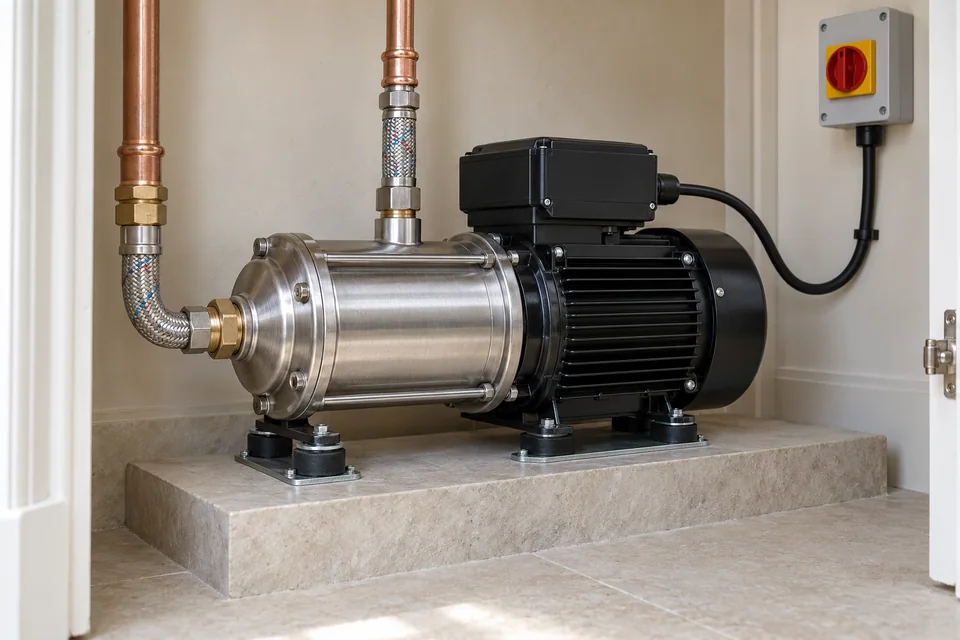
Pump location matters where a cupboard adjoins a bedroom or a neighbour's room. Suitable mounting, pipe supports and vibration control need to be considered alongside the building structure. We discuss these constraints before choosing a location; we do not promise that a pump will be inaudible.

Stored-water arrangements also need suitable access for inspection and cleaning, with overflow and drainage provisions where required. In flats, we can consider water leak protection options as part of the installation brief.

Where several systems share a utility area, our heating and plant-room installations in Maida Vale bring equipment layout and service access into the wider project.

Close view of a stainless-steel booster pump on resilient mounts with accessible pipework and an electrical isolator
Service access and vibration control belong in the installation plan.
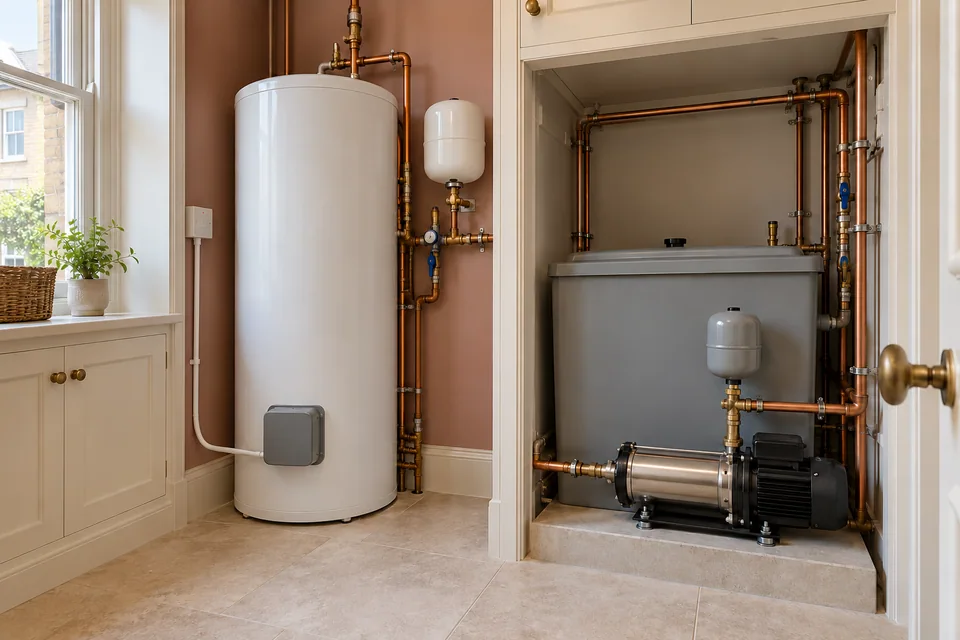
Utility-room view of a hot-water cylinder beside a separate cold-water booster arrangement
Water delivery and hot-water capacity need to be considered together.

04 · Coordinate cold and hot water

Keep water delivery and hot-water capacity in step

Improving the cold-water supply is only part of delivering a satisfying shower. The existing hot-water system must be able to heat or store enough water for the agreed use.

A combi boiler still has a limit to the hot-water flow it can heat to the required temperature. An electrically heated or boiler-fed cylinder has a finite store and a recovery time. A booster does not remove either limitation, and compatible hot and cold supplies to mixers need checking.

We assess whether your existing equipment can remain. If a change is needed, unvented cylinder installation in Maida Vale can be planned alongside the water-supply improvement, rather than treated as an unrelated purchase. Cylinder safety controls and manufacturer requirements remain essential.

This service concerns water delivered to taps and showers. Pressure loss in a sealed central-heating circuit is a separate issue.

One team · A considered installation

One coordinated plumbing and electrical installation

PEP combines plumbing installations in Maida Vale with the electrical installation work needed for powered equipment. That allows the connection point, pipe routes, controls and electrical supply to be considered together.

  1. Establish the brief. Discuss the symptoms, current equipment, proposed bathrooms and likely simultaneous use.
  2. Assess the property. Review supply measurements, access and the practical locations for suitable equipment.
  3. Define the proposal. Set out the equipment, associated work, approvals, exclusions and expected operating limits.
  4. Agree the installation sequence. Coordinate access and water interruptions, including building-management arrangements where necessary.
  5. Test and explain. Check operation under the agreed demand conditions and explain isolation, controls, maintenance and any fallback supply arrangement.

Our London heating and plant-room projects show examples of wider PEP installation work. For your project, the proposal should make clear which parts of that coordinated approach are included.

A quotation for the complete scope

What affects water booster installation cost in Maida Vale?

The price of a pump is not the price of a complete water-supply improvement. A compact installation on accessible pipework has a different scope from an accumulator or tank-fed system requiring new connections, electrical work and alterations to a cupboard.

The main variables are:

  • The selected equipment, usable reserve and required operating performance.
  • Changes to the incoming supply and distribution pipework.
  • Electrical supply, isolation, controls and any agreed leak protection.
  • Access, filled-load support, acoustic provisions and service clearances.
  • Joinery, making good, permissions and any work outside the private dwelling.

We provide a project-specific quotation once the scope is understood. It should identify inclusions, exclusions, VAT treatment and any third-party work or charges. Comparing these details is more useful than comparing an installation proposal with a supply-only product price.

Requirements · Permissions · Handover

Permissions, water regulations and ongoing care

Water-company requirements and permission to alter a managed building are separate matters. Under Water Regs UK guidance on pump notification, a pump inducing demand above 12 litres per minute requires notification to the local water undertaker, whether connected directly or indirectly to the supply pipe. A break tank is not an automatic exemption.

We establish the applicable notification and consent requirements for the proposed arrangement, alongside any freeholder or managing-agent conditions. Smaller equipment still needs to meet relevant water-fitting and manufacturer requirements.

The installation also needs an ongoing care plan. Depending on the equipment, this includes inspection, tank cleaning, checks to controls and pressure vessels, and maintaining access. At handover, we explain the manufacturer's requirements and the responsibilities for the installed system.

Maida Vale · Little Venice · W9

Maida Vale W9, Little Venice and nearby homes

We welcome installation enquiries across Maida Vale, including homes around Elgin Avenue, Lauderdale Road and Randolph Avenue, and W9 addresses near Warwick Avenue, Warrington Crescent and Clifton Gardens. We also assess projects around Sutherland Avenue and Shirland Road towards Maida Hill.

For Little Venice and addresses towards neighbouring districts, send the full postcode so we can confirm the location and access arrangements. Building type alone does not establish the supply problem or the equipment required.

For the wider service, visit water pressure booster installation across London.

Before you book

Questions before improving the water supply

Can a water booster be installed in a Maida Vale mansion flat?

It may be possible where the supply arrangement, space, structure and necessary permissions allow it. We check those conditions before selecting equipment. Being on an upper floor does not, by itself, tell us which solution is suitable.

What if the weak supply affects the whole building?

The shared installation may need investigating before private work proceeds. We can identify the dependencies relevant to your proposed installation, but alterations to communal equipment need an agreed building-wide scope and the appropriate parties involved.

Do I need an accumulator or a pump?

That depends on the measured pressure and flow, the pattern of demand and available space. An accumulator provides a usable reserve; a pump adds energy to the water. Some installations combine them, while others use a separate storage tank and pump.

Can I keep my existing electric cylinder or combi boiler?

Often the existing hot-water equipment can be retained if it is suitable for the proposed arrangement and demand. We assess compatibility rather than assuming replacement is necessary. A delivery improvement cannot compensate for insufficient heating output or stored hot-water capacity.

Will the system run two showers together?

That can be a design requirement, not a promise based on bathroom count. We need the showers' flow requirements, hot-water provision and expected duration of use. Pump performance, usable reserve, refill and pipework must support that combination.

Can the equipment go in my existing cupboard?

Possibly, but floor area is only one check. Height, filled weight, pipe routes, ventilation where required, maintenance space and a removal route also matter. Photographs and approximate dimensions help us prepare for the assessment.

Will a pump disturb neighbouring flats?

Noise and vibration depend on the equipment, mounting and building. We assess location and mitigation rather than relying on a product's description alone. A position immediately beside a bedroom may require reconsideration even when the equipment physically fits.

What approvals may be needed?

There may be water-company notification or consent requirements and separate lease, freeholder or management conditions. Any alterations affecting protected fabric need appropriate consideration too. The required route depends on the property and work, not simply its Maida Vale address.

How long will the water be off, and what happens in a power cut?

We agree the interruption plan after assessing the work and any shared isolation. Powered boosting stops during a power cut; access to water then depends on the design. We explain any suitable bypass, unboosted outlet or limited reserve, rather than assuming normal service continues.

What does the installation quotation include?

The proposal identifies the selected equipment and agreed plumbing, electrical, testing and handover work. It also makes clear whether access alterations, making good, supply changes and third-party costs are included or excluded, so you can assess the complete commitment.

Maida Vale W9 · Plan the next step

Tell us what happens when your home is using water

Start with the problem you want to solve, rather than a pump you have already chosen. Send your full postcode, property type and floor, whether hot or cold water is affected, and what happens when another outlet opens.

Photographs of the existing cylinder or boiler, incoming pipework and possible equipment location are helpful. If you are refurbishing, include the proposed bathrooms and programme. We can then discuss the right assessment and the scope of a practical installation.

Plan your Maida Vale water-supply improvement

Speak to our plumbing team: 07843 676 480.