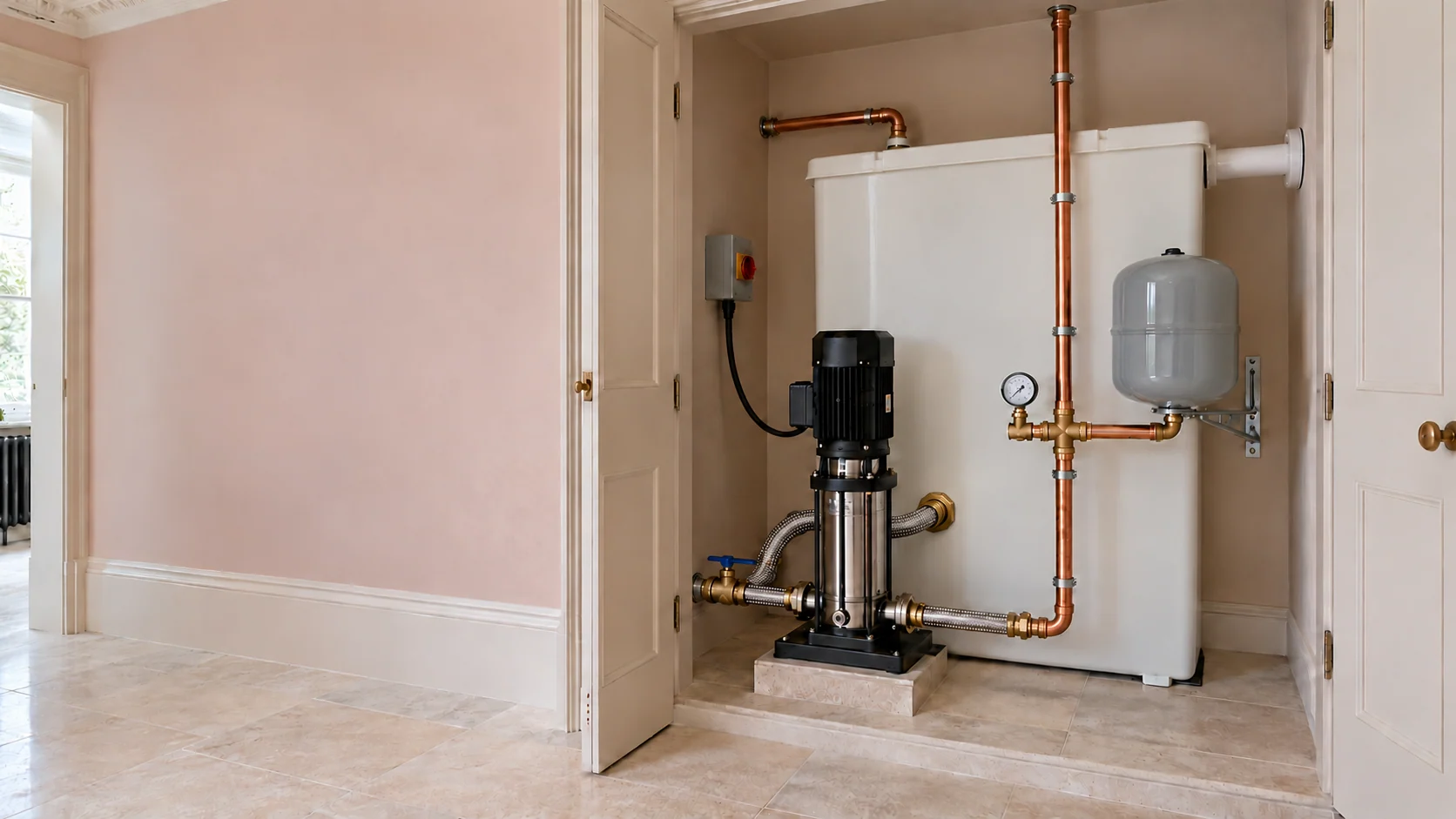
Domestic cold-water tank, vertical booster pump and pressure vessel arranged in an accessible apartment utility cupboard.

Paddington W2 · Planned domestic water installations

Water Pressure Booster & Accumulator Installation in Paddington, W2

A better water supply, planned around your home and the building serving it.

Mains water boosters · Accumulator installation · Cold-water storage and booster sets

NICEIC

A disappointing shower does not necessarily mean you need a pump. In a Paddington flat, the restriction might be inside the property, along a shared supply or within the building’s water system. Finding that distinction is the starting point for an improvement that makes sense.

PEP plans and installs domestic water pressure boosters, accumulators and tank-and-pump systems in Paddington W2. We assess the available supply, the water you want to use and the space for the equipment, bringing the associated plumbing and electrical work into one coordinated proposal.

Paddington W2 · Start with the building

The right improvement starts with understanding the building

Two flats with similar bathrooms can need very different solutions. One may have an independent supply and a straightforward route for new equipment. Another may depend on shared pipework, a communal booster or connections beyond the owner’s control.

We establish the relevant arrangement before recommending changes. The question is not only what could fit in the cupboard, but what it would connect to, which outlets it would serve and whether the proposed work stays within the private installation.

That approach also helps avoid unnecessary equipment. A restricted valve, unsuitable fitting or inadequate internal pipe may be the real obstacle. Where a broader refurbishment needs revised distribution, the work can be coordinated with our plumbing installation in Paddington.

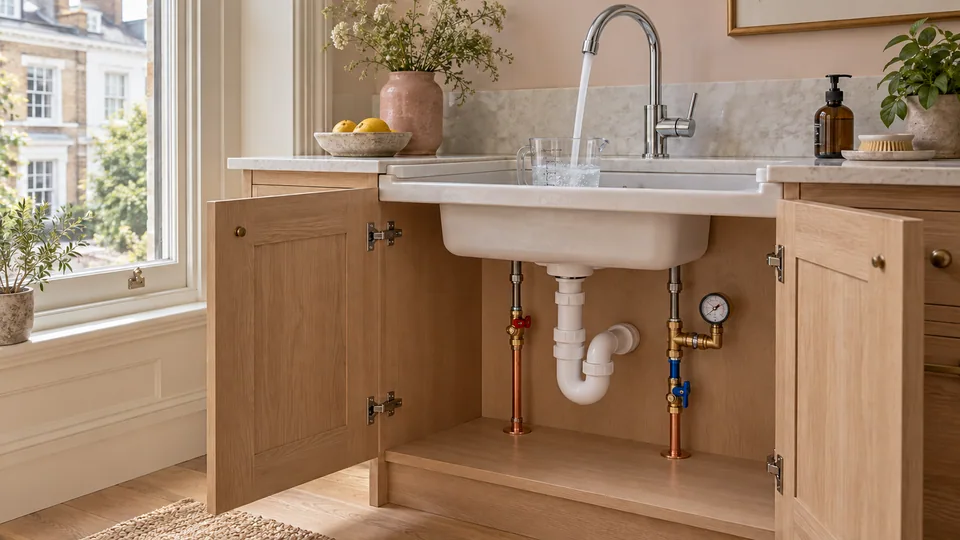
Pressure gauge connected to the cold-water supply below a utility sink while water runs into a measuring jug.
Assess running pressure and available flow before selecting equipment.

01 · Establish the actual restriction

Find the restriction before specifying the booster

Static pressure is a reading taken when water is not being drawn. It does not tell you how the supply behaves when the shower, kitchen tap and another bathroom are in use. We consider running pressure and available flow alongside the relevant pipework, valves, filters and existing equipment.

The pattern of the problem matters. Is one outlet weak, or does delivery fall throughout the flat? Has it always been disappointing, or did it change suddenly? Does the issue appear only when another outlet opens?

A recent loss of performance needs investigation as a possible fault or supply interruption, rather than an automatic recommendation for a new system. Our guide to understanding low water pressure and flow explains the initial distinctions. You do not need to diagnose the cause before contacting PEP.

Conversions · Mansion blocks · Managed apartments

Different Paddington homes need different installation plans

Converted terraces

In a conversion around Sussex Gardens, Gloucester Terrace or Westbourne Terrace, accessible pipework inside the flat may tell only part of the story. Supply routes, isolation and any shared connections need checking before the private installation can be specified.

Mansion-block flats

A service cupboard may offer enough room for the equipment but little room to maintain it. We consider the connections, support, neighbouring rooms and practical access, alongside any building requirements affecting the work.

Managed apartments

For an apartment around Paddington Basin, Merchant Square or Sheldon Square, existing building information can be important. We first establish whether the flat receives an independent supply or relies on shared equipment. A problem in a communal system should not simply be worked around by adding an individual pump.

These are starting points for assessment, not assumptions about every W2 address. The proposal follows your actual property.

02 · Match the solution to the supply

A compact booster, an accumulator or a stored-water system?

There is more than one way to improve water delivery. The appropriate choice depends on the incoming conditions, intended demand and installation space — not on choosing a particular pump first.

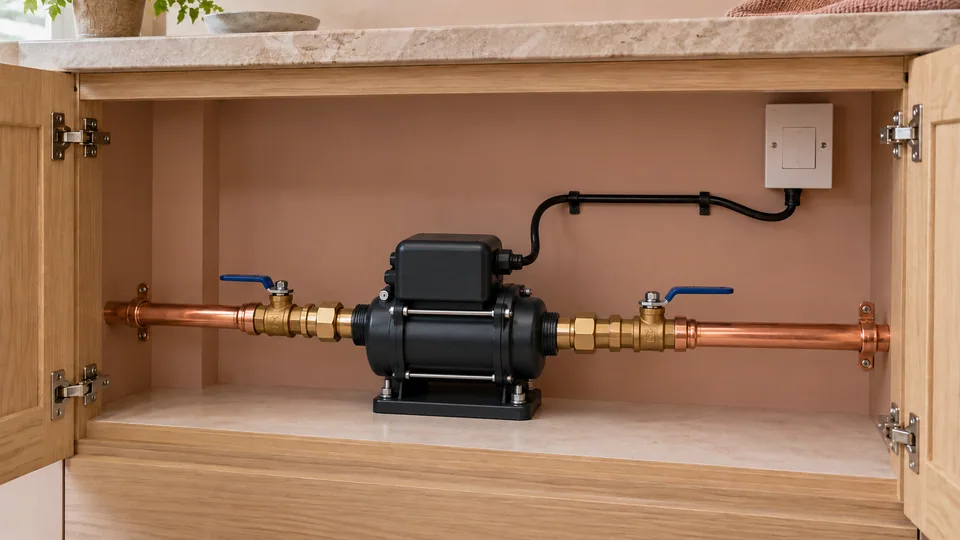
Compact inline water booster supported inside an accessible service cupboard, with copper connections and a wired electrical isolator.
A compact booster must suit the assessed supply and intended application.
Four possible approaches, selected around the assessed supply.
ApproachWhere it may helpWhat must be checked
Address restrictions or improve pipeworkWhere a valve, fitting or distribution route is limiting an otherwise suitable supply.The actual restriction and whether the remaining supply can support the proposed use.
Compact mains water boosterA defined improvement where a suitable unit matches the existing supply and required duty.The product’s permitted application and operating limits; a small pump is not an unlimited multi-bathroom supply.
Accumulator arrangementA reserve of pressurised water to assist delivery during overlapping demand.Charging conditions, useful draw-off, replenishment and whether the arrangement needs pumping.
Cold-water storage and booster pumpProjects where a separately designed stored-water and pumping arrangement is appropriate.Available refill, usable storage, pumping duty, hygiene provisions, support and service access.

Our water booster and accumulator guide looks more closely at the equipment types. The installation proposal should explain which approach suits your home and why the alternatives may not.

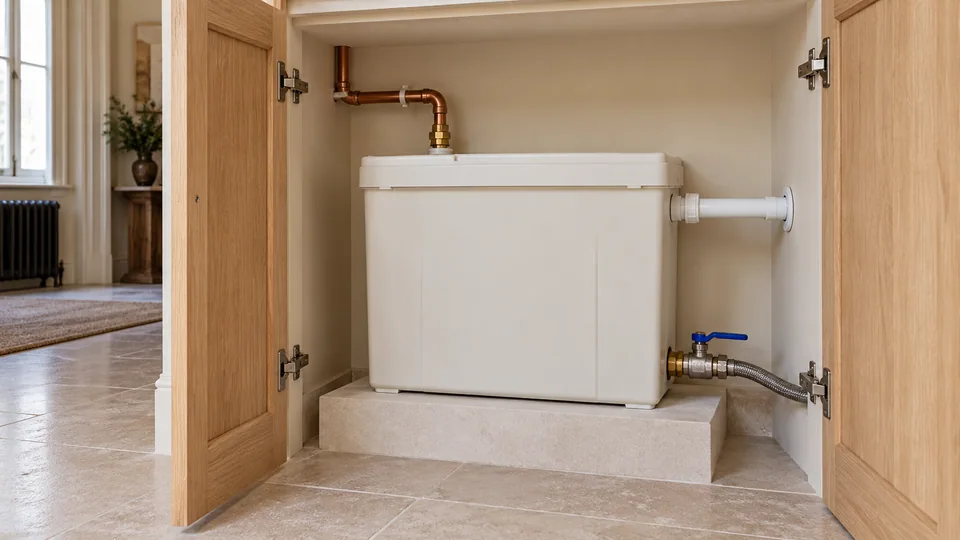
Covered rectangular cold-water storage tank with accessible lid and connections inside an open utility cupboard.
Allow for filled weight, connections, maintenance and eventual equipment replacement.

03 · Installation space · Future maintenance

Plan the space around installation and future maintenance

Equipment dimensions are only the beginning. The route into the property, the weight when filled, suitable support and the space for connecting pipework all affect what can be installed. Valves, controls and electrical isolation must remain accessible.

We also consider how the main components could be removed later. An installation that requires finished joinery to be dismantled for routine access is not a good use of a compact service space.

Location matters for noise and vibration, particularly where a cupboard adjoins a bedroom or a neighbouring flat. Product selection, mounting and the building’s construction all influence the result. We discuss those factors rather than promise that every pumped system will be silent.

For stored-water arrangements, appropriate hygiene, overflow and protective provisions belong in the layout from the outset. The aim is a neat installation that remains practical to operate and look after.

04 · Useful reserve · Recovery between uses

Agree what the home needs to deliver at the same time

A new shower can perform well on its own and disappoint when someone fills a bath. We therefore establish the intended combination of outlets and the duration of use, not simply the number of bathrooms.

Storage can help accommodate a period of higher demand, but the reserve is finite. An accumulator’s stated vessel size is not the same as usable water at the required pressure, and an unpumped accumulator cannot generate pressure above the supply charging it.

The reserve must also recover between uses. If demand repeatedly exceeds replenishment, adding a larger vessel alone may leave the underlying limitation unresolved. Useful capacity, operating conditions and refill need to be considered together.

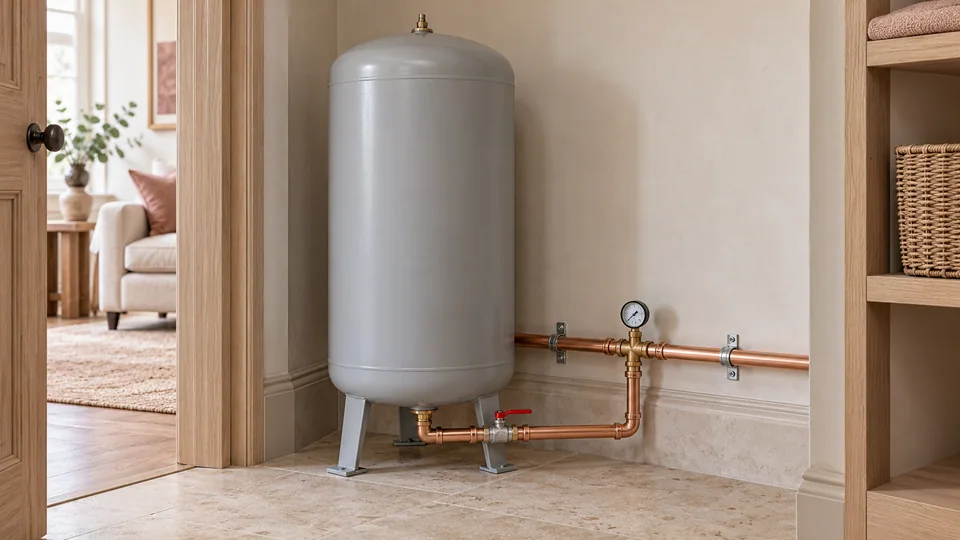
Upright cold-water accumulator on three feet, with a single bottom water connection and accessible isolation valve.
Useful reserve and replenishment matter more than nominal vessel size alone.
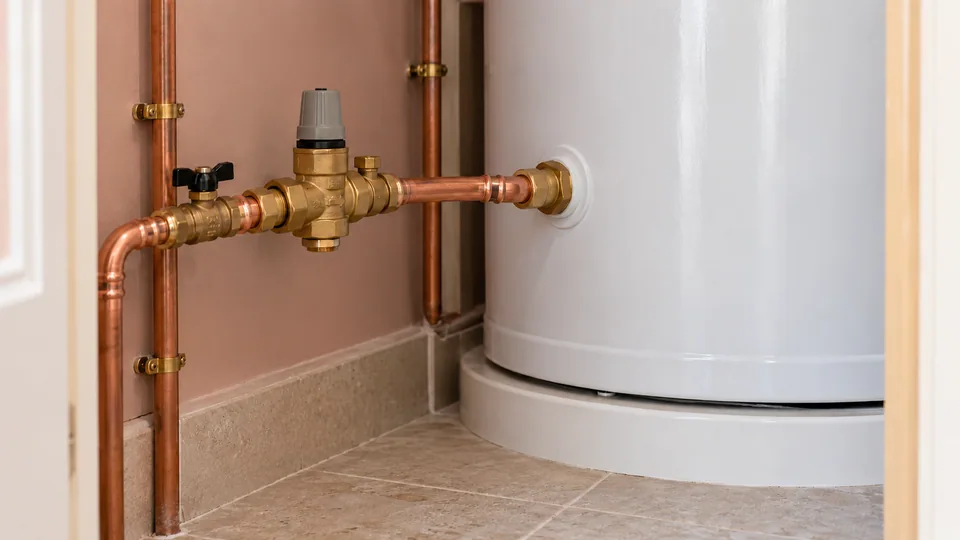
Pressure-reducing valve and supported copper cold-water inlet pipe beside an unvented hot-water cylinder.
Improved cold-water delivery must be coordinated with hot-water storage, recovery and distribution.

05 · Cold delivery and hot-water capacity

Match the water supply to the hot-water system

Improving cold-water delivery is only useful if the hot-water arrangement can support the intended result. We assess the supplies to showers and mixers together, rather than assume a change on one side will solve every performance issue.

Homes with an unvented cylinder

The incoming supply, stored hot-water capacity, recovery and distribution all contribute to performance. A larger cylinder does not remove an upstream restriction. Where storage also needs changing, our unvented cylinder installation in Paddington can be planned alongside the water-supply improvement.

Homes with a combi boiler

A suitable booster may improve the supply available to a combi, but it cannot increase the boiler’s heat output. Two showers may still exceed what the appliance can heat at the required temperature. If that is a separate limitation, boiler installation in Paddington can be considered within a wider hot-water proposal.

A conventional gravity-fed shower pump is a different type of equipment. It must not be treated as interchangeable with a mains booster. Domestic water boosting is also separate from restoring pressure in a sealed central-heating circuit.

Private installations · Shared responsibilities

Resolve shared-service access before agreeing the work

Where a connection, riser, supply valve or existing booster serves more than one home, the proposal needs to identify the boundary of the work. We establish what the owner can authorise and what requires information, access or agreement from the responsible building team.

This may affect the connection point, isolation arrangements, installation timing and the route for new pipework. Any necessary alteration to shared infrastructure should be separately defined, not left as an assumption within a private pump quotation.

If a managing agent already holds drawings, equipment details or alteration requirements, include them with your enquiry. They can help establish a workable route before decisions are made about the equipment.

Plumbing · Electrical · Heating coordination

The equipment and associated installation, planned together

PEP coordinates the water-system specification with the work needed to install it. Depending on the agreed arrangement, that can include equipment supply, pipework alterations, isolation, storage connections, suitable electrical supply and controls.

Our electrical services in Paddington can support the pump installation. Where the project includes a broader system upgrade, the layout can be coordinated with central heating and plant rooms in Paddington, while keeping domestic water delivery distinct from the heating circuit.

You can explore our London heating and plant-room work for examples of PEP’s wider installation experience. For your project, the important outcome is an agreed scope with clear responsibility for the equipment, its connections and the final checks.

Complete installation · Clear exclusions

What affects water booster installation costs in Paddington?

A pump-only price does not describe a complete installation. The cost depends on the selected approach, the condition of the existing services, the connections required and how the work can be accessed.

The proposal should distinguish the equipment and associated plumbing from electrical alterations, storage and support, any cylinder changes, and separately priced building or making-good work. Work involving shared infrastructure may need a different scope from work contained within the flat.

A compact unit in an accessible service area cannot be priced or programmed as though it were the same project as creating a new tank-and-pump space in a finished apartment. PEP sets out the proposed work and relevant exclusions so you can compare like with like.

From the first conversation · To checked handover

A clear route from the first enquiry to handover

  1. Establish the brief. Tell us what happens when water is used, which rooms are affected and what you are planning to change. Photographs and the full postcode help us understand the starting point.
  2. Assess the installation. We review the relevant supply measurements, existing equipment, practical space and any shared-service constraints.
  3. Agree the proposal. The selected approach, intended operating arrangement, associated work and access requirements are set out before installation.
  4. Install and check. The equipment and connections are completed, then operation is checked against the agreed scope and the manufacturer’s requirements.
  5. Explain and hand over. We cover normal operation, accessible isolation, relevant settings and care requirements, with the applicable installation documentation.

Water interruptions and any building access arrangements are discussed as part of planning. The programme follows the actual work, rather than a standard fitting time applied to every type of system.

Supplier requirements · Ongoing care

Water-supplier requirements and ongoing care

Equipment selection and installation must follow the applicable water fittings requirements and manufacturer’s instructions. A pump or booster that induces demand above 12 litres per minute needs notification to the local water undertaker, including where the connection is indirect.

A break tank does not automatically remove that requirement. The proposed arrangement and any necessary consent should be addressed before work begins. See the Water Regs UK guidance on pump and booster notification.

After installation, maintenance follows the equipment and storage arrangement actually selected. Accessible components, appropriate water turnover and clear care information help keep the system serviceable; they should be considered before the cupboard is finished.

Paddington · W2 · Full postcode enquiries

Water booster installation across Paddington W2

We welcome planned domestic installation enquiries in Paddington, including relevant W2 addresses around Sussex Gardens, Norfolk Square, Westbourne Terrace and Gloucester Terrace, together with Paddington Basin, Bayswater and Lancaster Gate.

For Little Venice, Westbourne and other boundary locations, send the full address and postcode. Neighbourhood names can cross postal boundaries. Our London service areas and London water pressure booster installations page explain the wider coverage.

Before you enquire

Questions about boosters and accumulators in Paddington

Can I install a booster pump in a Paddington flat?

Potentially, but suitability depends on the supply arrangement, proposed connection, demand and available space. We first establish what serves the flat and whether the work would affect shared services. An individual pump should not be selected solely because it fits inside a cupboard.

What if the building already has a communal booster?

The first step is to establish where performance is being lost. The issue may involve the building system, the supply to the flat or its internal plumbing. Any shared-system problem needs the responsible building team involved; another pump inside the flat is not an automatic solution.

Do I need to speak to the freeholder or managing agent?

That depends on the property and proposed work. Shared connections, access, isolation and alteration requirements should be clarified before installation is agreed. If you already have building guidance or drawings, send them with the enquiry so the scope can account for those requirements.

Can a compact booster fit in my existing cupboard?

Possibly. We need to consider connections, support, electrical isolation and service clearances as well as the unit’s dimensions. There also needs to be a practical way to inspect and eventually replace the equipment without unnecessarily dismantling the surrounding finishes.

Would an accumulator be better than a pump?

It depends on what the supply can deliver and how demand overlaps. An unpumped accumulator relies on suitable charging pressure; it is not a pressure-generating device. Some properties need a pumped arrangement, a different storage solution or an improvement to the supply itself.

How much of an accumulator’s stated capacity is usable?

The nominal vessel size is not a guaranteed quantity of water delivered at a useful pressure. Draw-off depends on the vessel, charging and operating conditions. We consider the useful reserve and replenishment for the proposed installation, rather than apply one percentage to every system.

Can the system support two showers at once?

That may be an achievable design objective. The showers, supply, pipework, selected equipment and hot-water system all need to support the expected use and duration. We assess those together before agreeing the operating arrangement, rather than promise simultaneous performance from a pump specification alone.

Will a booster make my combi boiler produce more hot water?

It cannot increase the boiler’s heating output. Improving an appropriate water supply may address one restriction, but the appliance’s ability to heat that water remains a separate limit. The proposed showers and temperature requirements need to be considered alongside the boiler.

Will a larger unvented cylinder solve weak incoming flow?

Not by itself. A cylinder stores hot water, while delivery still depends on its water supply and distribution. If the incoming supply is the restriction, increased cylinder capacity does not remove it. Storage, recovery and supply performance should be assessed together.

Will the pump cause noise in adjacent rooms?

Noise and vibration depend on the equipment, mounting, location and building construction. We consider the installation position and manufacturer’s requirements when planning the work. A suitable arrangement can help manage noise, but no general promise of silent operation is appropriate.

Will I have water during a power cut?

Normal pumped performance depends on electricity. Any remaining water delivery depends on the specific design, incoming conditions, stored pressure and any appropriate unboosted provision. We explain the selected arrangement rather than assume every installation continues to perform normally without power.

How much will installation cost, and how long will the water be off?

Both depend on the equipment, connections, access and associated work. We define the proposed installation and discuss expected interruptions before agreeing the programme. A short fitting time for a compact unit should not be assumed for a larger stored-water system or shared-service alterations.

Paddington W2 · Plan your next step

Tell us about your home, your building and the result you need

Send PEP the full postcode, property type, floor level and a short description of what happens when you use the water. Include the boiler or cylinder details, photographs of accessible equipment and available space, and any building information you already have.

If a refurbishment is being planned, tell us about the proposed bathrooms and project stage. You do not need to choose a pump or take your own pressure readings first. We can establish what needs assessing and develop the installation around the property.

Discuss your Paddington water-supply project