Mains water boosters · Accumulator installation · Cold-water storage and booster sets
When a shower weakens as another tap opens, or a new loft bathroom places extra demand on an older supply, the answer is not simply a bigger pump. It is a water-delivery system planned around what the home needs to do.
PEP plans and installs water pressure boosters, accumulators and stored-water boosting systems for Queen’s Park houses and flats. We bring together the incoming supply, useful storage, distribution pipework, hot water and associated electrics — with a clear installation scope before work begins.
Queen’s Park NW6 · Plan around the household
Start with the water your household wants to use together
A bathroom may work perfectly on its own and disappoint as soon as someone uses the kitchen. That difference matters more than a reassuring pressure reading taken with every outlet closed.
We start with the intended pattern of use: morning showers, bath filling, kitchen demand and the bathrooms being added during a refurbishment. We then consider the flow required, how long those demands overlap and how the existing hot-water system serves them.
The aim is a sensible, agreed level of simultaneous use. It is not to specify the largest equipment that will fit or promise that every outlet can run at full output indefinitely.
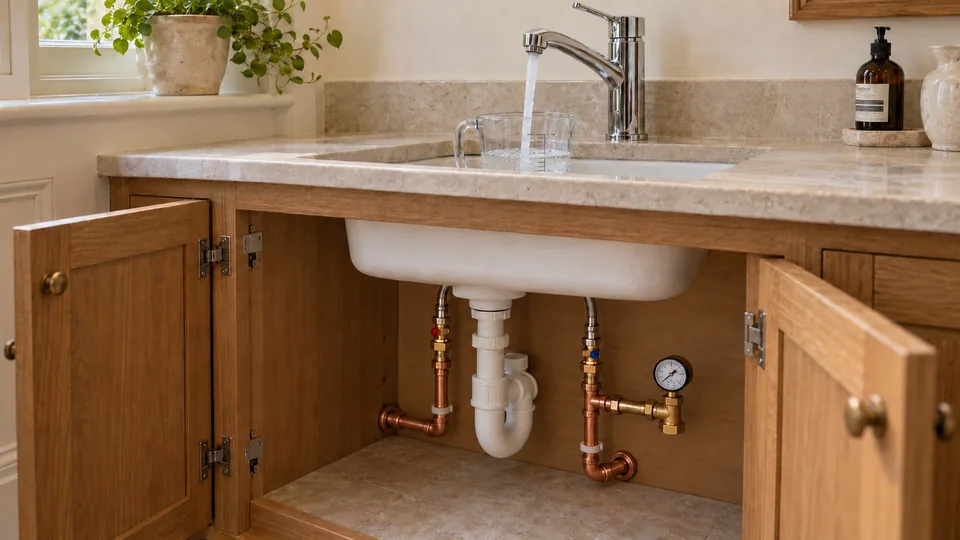
Running pressure and flow help establish what the supply can deliver.
01 · Establish the supply
Measure the supply before choosing equipment
Pressure and flow are related, but they are not interchangeable. Static pressure describes conditions without water being drawn. Running pressure and measured flow help show what remains available when the home is actually using water.
Our assessment considers the incoming supply, relevant pipe sizes and routes, accessible valves, filters and restrictions, and performance at the affected outlets. A restricted internal pipe or faulty fitting needs a different response from an incoming supply that cannot sustain the proposed combined demand.
A sudden deterioration should be investigated as a possible fault or supply interruption first. It does not automatically justify a booster installation. Our guide to understanding low water pressure and flow explains the distinction.
Extended houses · Conversions · Service spaces
A system that suits the Queen’s Park property
An extended family house
A loft conversion or additional bathroom can change demand without changing the supply beneath it. Planning the water upgrade alongside the refurbishment allows pipe routes, storage and future access to be resolved before cupboards and finishes are completed.
A converted flat
The first question is where the private installation begins. We need to understand any shared incoming pipework and the limits of the proposed work before deciding how an individual flat can be improved.
A compact utility or service cupboard
Space needs to accommodate more than the equipment itself. Valves, connections, electrical isolation and maintenance access must remain usable. Where distribution pipework also needs upgrading, this can form part of the wider plumbing installation in Queen’s Park.
02 · Match equipment to the requirement
Which water-pressure solution belongs in your home?
Several approaches can improve domestic water delivery. The right choice follows the supply assessment and intended use, rather than a preference for a particular pump or tank.
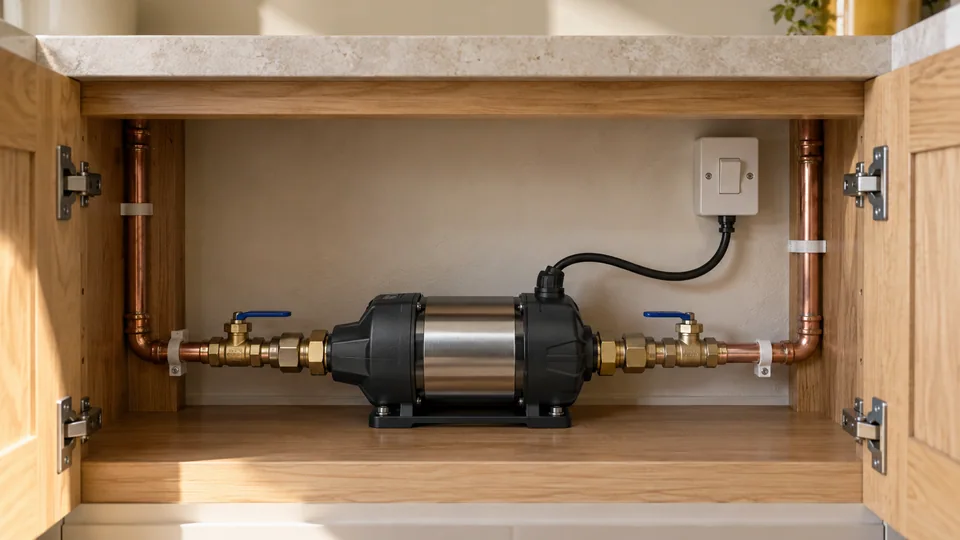
A compact booster must match the supply, required duty and intended application.
Four approaches, with different capabilities and constraints.
Approach
Where it may help
What must be checked
Correct restrictions or improve pipework
Where valves, fittings or undersized distribution are limiting delivery.
Whether the incoming supply can support the target demand once those restrictions are addressed.
Compact inline mains booster
A defined improvement where a suitable product matches the incoming supply and required duty.
Its permitted application and flow range. Compact does not mean unlimited multi-bathroom performance.
Accumulator system
A pressurised reserve to assist delivery during periods of overlapping demand.
Charging pressure, usable draw-off, replenishment and whether an unpumped or pumped arrangement is appropriate.
Break tank and booster pump
Projects needing a stored cold-water reserve and a separately selected pumping duty.
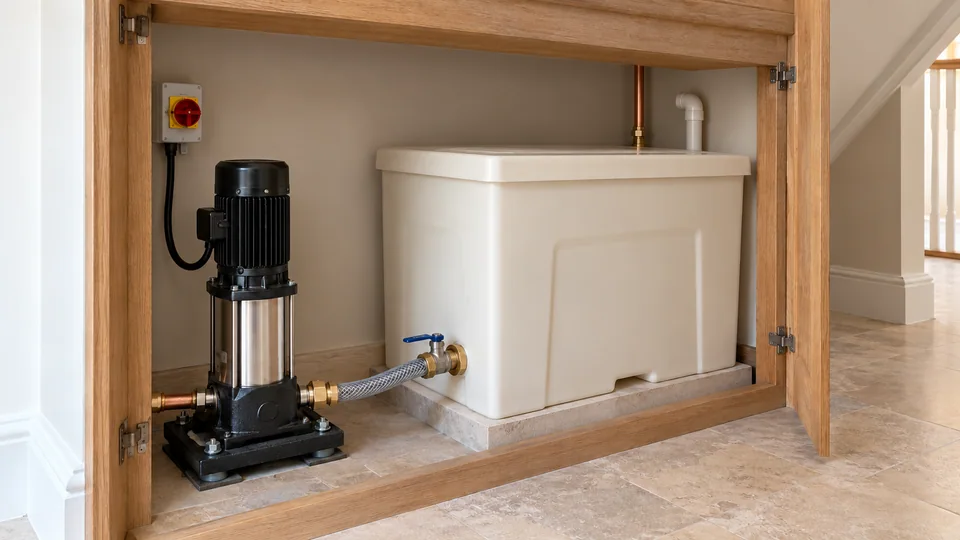
Usable storage, incoming refill, water turnover, support, space and ongoing service access.
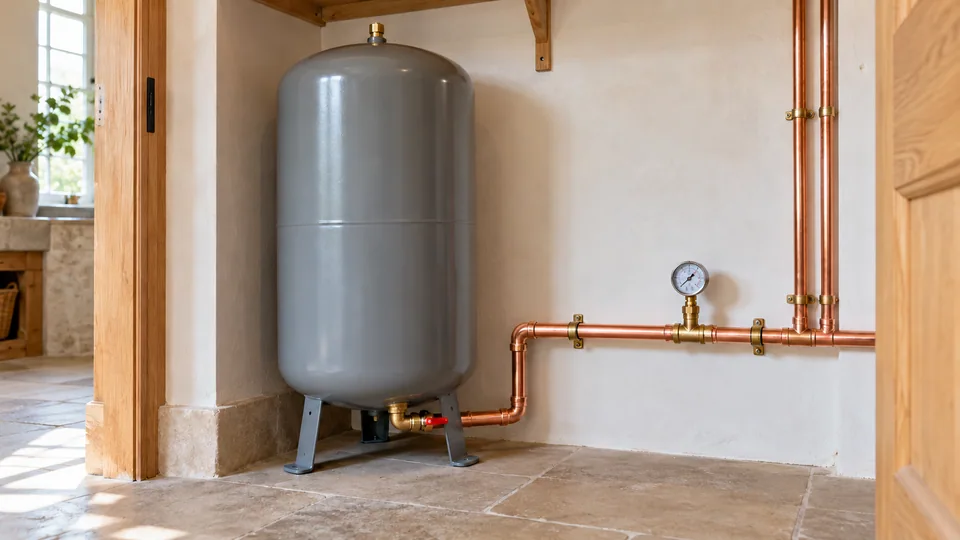
Usable draw-off and replenishment matter more than nominal vessel capacity alone.
03 · Reserve · Draw-off · Replenishment
Usable water, peak demand and replenishment
A vessel’s stated capacity is not automatically the volume available at useful operating pressure. The system must be selected around three connected questions.
How much usable reserve is available?
For a pressurised accumulator, draw-off depends on its design, charging conditions and operating settings. An unpumped accumulator stores water using the pressure available to charge it; it does not create a higher pressure of its own.
How long does combined demand last?
A brief overlap between a tap and a shower is different from two long showers followed by a bath. We consider the duration of demand, not just a peak flow figure.
What happens between uses?
The reserve needs time and sufficient incoming delivery to recover. If use repeatedly exceeds replenishment, a larger vessel alone may not solve the problem. Stored-water systems still have a finite reserve; pump output and incoming refill are separate parts of the calculation.
04 · Coordinate cold delivery and hot water
Better water delivery is only one part of better hot water
A booster can improve a suitable cold-water supply arrangement. It cannot increase a combi boiler’s heat output. If two showers require more hot water than the boiler can produce at the required temperature, boosting alone will not remove that limitation.
Where a boiler change is genuinely part of the project, our boiler installation in Queen’s Park can be considered alongside the water-supply proposal.
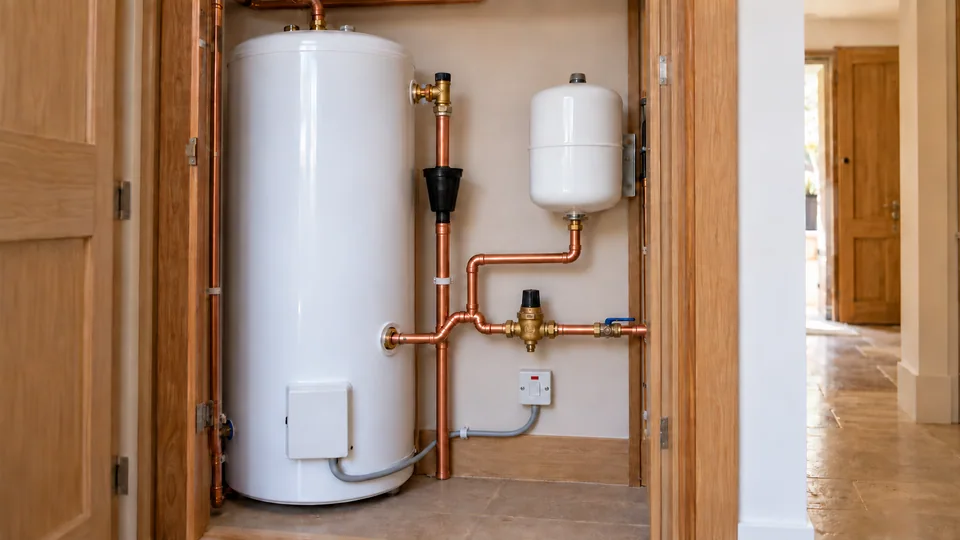
With an unvented cylinder, incoming delivery, usable hot-water storage, recovery and the supplies to mixers need to work together. Our unvented cylinder installation in Queen’s Park can be coordinated with the booster design rather than treated as a separate purchase.
Domestic water boosting is also separate from maintaining pressure in a sealed central-heating circuit. They solve different problems.
Incoming delivery, hot-water storage and recovery need to work together.
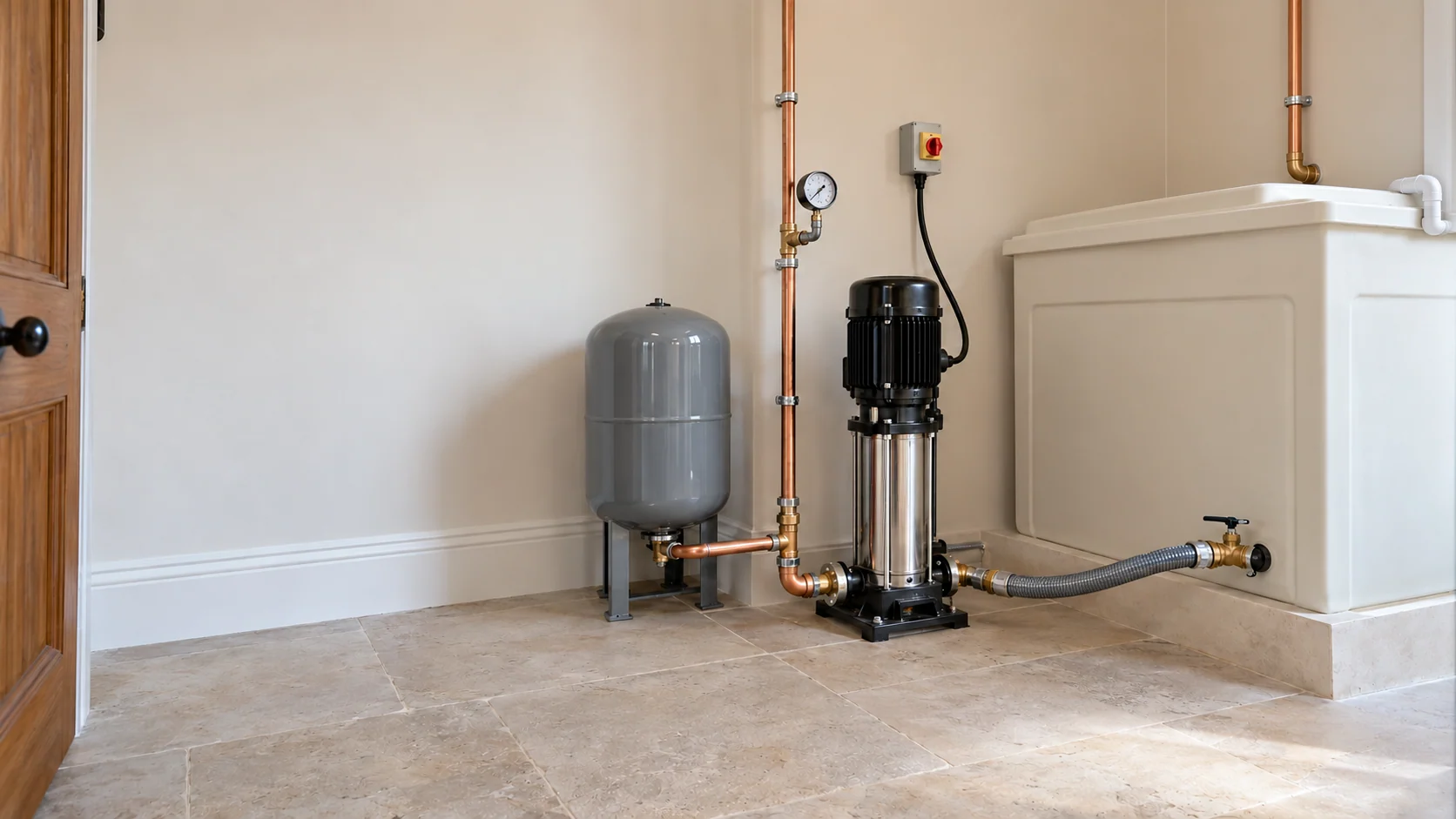
The layout needs room for inspection, servicing and future equipment removal.
05 · Plan access for the years ahead
Make room for the installation — and its future care
A workable layout considers the equipment’s filled weight, suitable support, connection routes and the clearances required for inspection and servicing. It should also allow a pump, valve or vessel to be removed later without dismantling the room around it.
Pump position matters, particularly near bedrooms or within converted buildings. We consider vibration transmission, manufacturer mounting requirements and the surrounding construction. Sensible installation can help manage noise; no pumped system should be sold as universally silent.
Storage arrangements also need appropriate overflow provisions, hygiene considerations and accessible isolation. A neat-looking cupboard is only a good result if the system inside remains practical to operate and maintain.
Private installations · Shared responsibilities
For flats, establish the private and shared boundaries early
A conversion may have shared incoming pipework, common service routes or equipment outside the flat. An individual booster must not be assumed suitable simply because there is space for it inside a kitchen unit.
We establish what serves the dwelling, what the owner can authorise and whether access or agreement is needed from a freeholder, managing agent or other affected party. Any necessary work to shared infrastructure must be identified separately from the private installation.
Not every Queen’s Park flat has the same arrangement. The proposal needs to follow the actual building, with permissions and supplier requirements resolved for the intended scope.
Plumbing · Electrical · Heating coordination
One coordinated plumbing and electrical installation
PEP’s scope brings the water system and its associated installation work together: equipment selection, pipework alterations, isolation, suitable electrical supply and the controls needed for the chosen arrangement.
You can also see our London heating and plant-room work for examples of our wider installation experience. The priority for your project is a defined, practical arrangement with clear responsibility for each part of the work.
Complete scope · Clear exclusions
Compare the complete scope, not just the pump price
The equipment is only one part of the cost. The proposal should identify the required pipework, electrical work, storage and support, access arrangements, commissioning and any separately priced building or making-good work.
A straightforward installation in an accessible service area is different from creating space in a finished flat or changing shared pipework. Cylinder or boiler alterations also need to be distinguished from the booster installation itself.
PEP prepares the scope around the property and the agreed demand. That gives you a meaningful basis for comparing proposals, rather than comparing headline prices for systems that include different work.
From the first conversation · To tested handover
From the first conversation to tested handover
Describe the problem and the plan. Tell us what happens when water is used, what bathrooms you have and what is changing. Photos and the full postcode help us understand the project.
Assess the property and supply. We establish relevant measurements, existing equipment, practical routes and any shared-service or permission issues.
Agree the proposal. The scope sets out the selected approach, intended use, necessary associated work and any constraints or exclusions.
Install and commission. The equipment, pipework and associated electrics are completed, with performance checked against the agreed operating arrangement.
Explain the system. Handover covers isolation, normal operation, relevant settings and the manufacturer’s care requirements, together with applicable documentation.
Requirements · Permissions · Future care
Water-supplier requirements and ongoing care
The installation must suit the applicable water fittings requirements and the chosen manufacturer’s instructions. Notification to the local water undertaker is required for a pump or booster inducing a demand exceeding 12 litres per minute, whether connected directly or indirectly to a supply pipe.
After installation, care follows the actual equipment and water-storage arrangement. Access, checks and manufacturer maintenance requirements belong in the plan from the beginning — not as an afterthought once the cupboard is finished.
Queen’s Park · NW6 · Full postcode enquiries
Water booster installation in Queen’s Park NW6
We welcome planned installation enquiries around Salusbury Road, Harvist Road, Chevening Road, Kingswood Avenue, Milman Road and Lonsdale Road, together with nearby NW6 addresses around Brondesbury Park.
For Kensal Rise, Chamberlayne Road, Kilburn Lane and other boundary locations, send the full address and postcode. Street names cross local boundaries, and the Westminster Queen’s Park Estate is a distinct area, commonly within W10.
Can a booster support two showers and the kitchen together?
It may be possible, but the supply, selected equipment, pipework and hot-water system all need to support that demand. We assess the intended overlap and duration before agreeing what the proposed installation is designed to deliver.
Does an accumulator work if incoming pressure is low?
An unpumped accumulator relies on the available charging pressure and does not generate a higher pressure itself. Low incoming pressure may call for a different arrangement, including a suitable pumped system, rather than simply adding an unpumped vessel.
How much of the stated vessel capacity is actually usable?
There is no universal percentage for every installation. Useful draw-off depends on the vessel, charging and operating pressures, settings and demand. We consider usable performance for the proposed arrangement rather than treating the nominal capacity as available water.
What happens when the stored reserve is exhausted?
Performance then depends on the incoming replenishment and the equipment’s operating and protection arrangements. A storage system cannot provide its peak delivery indefinitely if incoming water cannot keep up. Reserve and recovery must be assessed together.
Can the system fit in an existing utility cupboard?
Possibly, provided the space offers suitable support, connection routes and the required service clearances. Equipment dimensions alone are not enough: valves and electrical isolation must remain accessible, and larger components need a practical future removal route.
Can it be installed in a converted flat with a shared supply?
It depends on the building’s supply arrangement and the proposed connection. Shared infrastructure, access rights, permissions and possible effects on other users must be considered before deciding whether a private system is suitable and what work it requires.
Will it make a combi boiler heat more water?
No. Improving an appropriate incoming supply does not increase the boiler’s heat output. The amount of hot water it can produce at the required temperature remains a separate limit, so the boiler and intended use must be considered together.
Does a new unvented cylinder automatically solve weak flow?
No. A cylinder provides stored hot water, but the incoming supply and distribution still affect delivery. Increasing cylinder capacity does not remove an upstream restriction. Supply performance, storage, recovery and mixer supplies should be planned as one system.
Is this the same as a gravity-fed shower pump?
No. A conventional gravity-fed shower pump is designed for a different supply arrangement. It must not be assumed suitable for connection to mains-fed outlets or a combi system. The pump type needs to match the actual installation.
Will it be noisy, and what happens during a power cut?
Noise depends on the equipment, location, mounting and building. Normal pumped performance needs electricity. Any unboosted, bypass or residual supply during an outage depends on the specific design; continuous normal performance should not be assumed.
When does the water supplier need notification?
A pump or booster inducing demand exceeding 12 litres per minute requires notification, including direct and indirect connections. Other requirements may also apply to the proposed work. The supplier position and any required consent should be resolved before installation.
Queen’s Park NW6 · Plan your next step
Tell PEP what your Queen’s Park home needs to deliver
Send the full postcode, property type, existing boiler or cylinder details and what happens when more than one outlet runs. If you are renovating, include the proposed bathrooms, available service space and project stage.
You do not need to choose a pump or take your own pressure readings before contacting us. We can start with the problem, establish what needs assessing and build the installation proposal around the home.