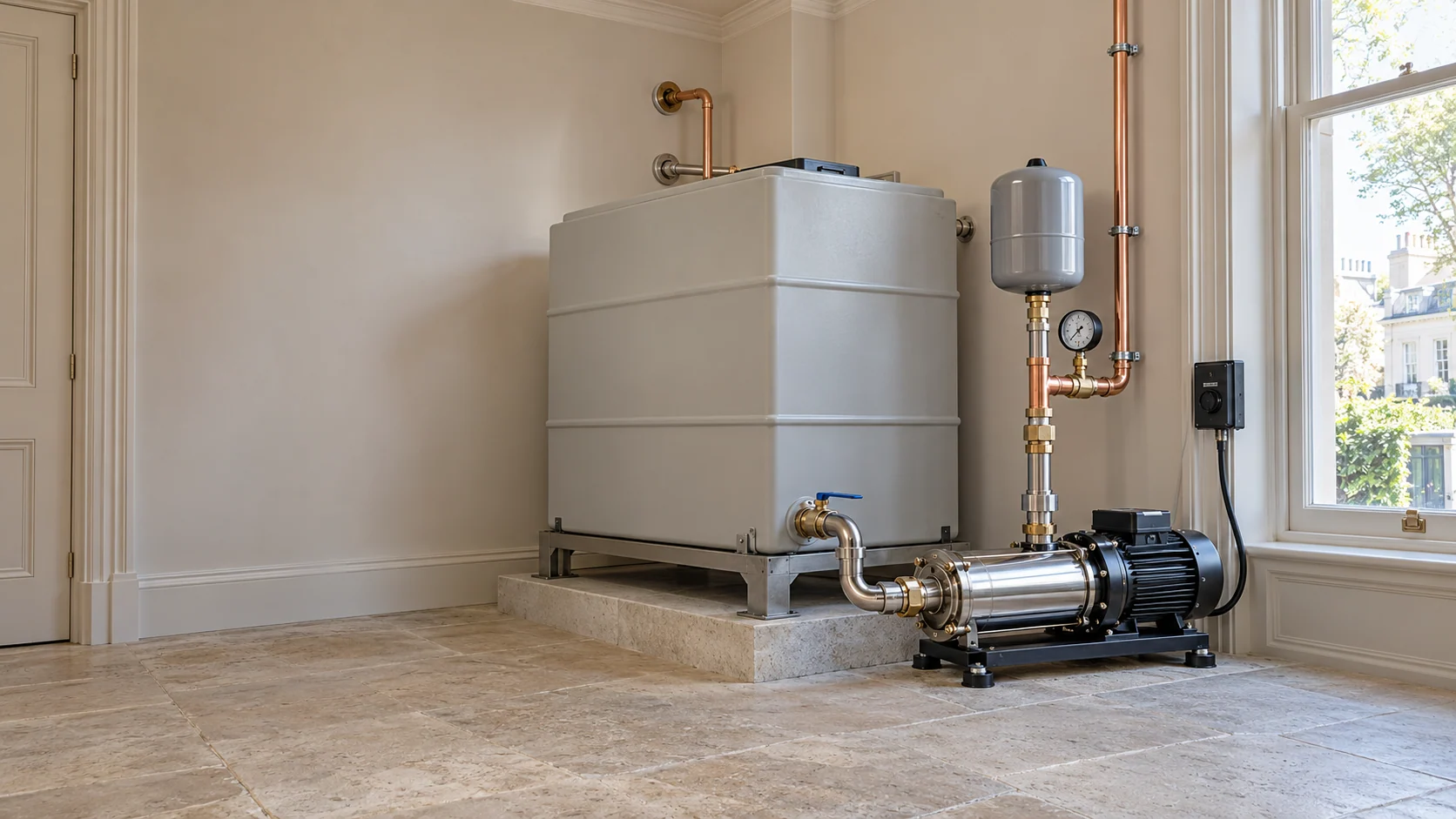
Tank-fed water pressure booster with a stainless-steel pump, pressure vessel and copper pipework in a period-style utility room

WATER BOOSTERS & ACCUMULATORS · ST JOHN’S WOOD NW8

Water Pressure Booster Installation in St John’s Wood, NW8

Comfort in every bathroom starts with a coordinated water supply.

Discuss your St John’s Wood water pressure project Call 07843 676 480

Mains water boosters · Accumulator installation · Cold-water storage and booster sets

NICEIC

A shower upstairs, another bathroom in use and a busy kitchen can reveal limitations that one running tap never shows. PEP plans and installs water pressure boosters, accumulators and tank-fed systems for St John’s Wood houses and flats, matching the equipment to the incoming supply and the way your household uses water.

From an existing home with disappointing flow to a refurbishment adding bathrooms, we bring pipework, electrical provision, hot-water requirements and commissioning into one defined installation scope.

St John’s Wood NW8 · Begin with the household

Plan the water supply around the bathrooms you want to use together

The useful starting point is what you want the home to deliver. Improving one upstairs shower, supplying a new en-suite and supporting several bathrooms can require quite different work.

  • For an existing house: identify where delivery falls away and whether restrictions, distribution pipework or available supply are responsible.
  • For a refurbishment: establish water demand before finalising bathroom fittings, cylinder capacity and the space allocated to equipment.
  • For a flat: establish which parts of the supply are private and which belong to the building before proposing alterations.

Our focus is a complete, appropriately sized installation. If the assessment points to a local restriction or an upstream supply issue, we explain that before recommending a booster.

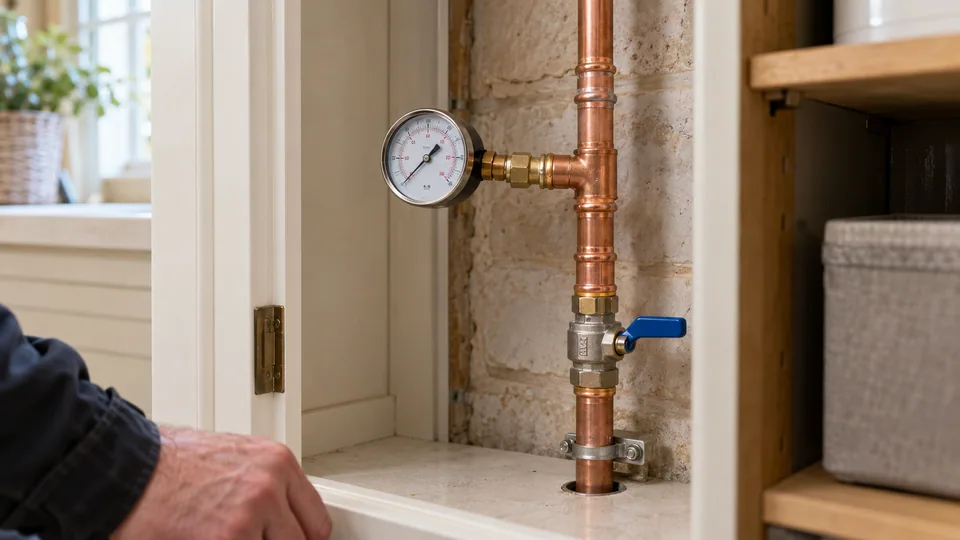
Pressure gauge connected to copper supply pipework in an open utility cupboard
Assess the available water supply before selecting the booster.

01 · Understand the supply

Find out what reaches the outlets—not just the incoming pipe

Static pressure, measured with outlets closed, cannot show how much water remains available when the home is busy. We assess running pressure and flow alongside the route, size and condition of the distribution pipework.

Height matters, as do long runs and restrictive fittings. A weak shower on the upper floor needs to be considered at its actual location. One slow tap, poor hot-water delivery and a whole-house reduction when a second outlet opens are different symptoms.

Where performance varies during the day, further observations may be needed to establish a representative design basis. Our guide to understanding water pressure and flow explains why these measurements matter. A domestic water booster addresses water supplied to taps and showers; it is not a remedy for pressure loss in a sealed central-heating circuit.

A clear brief · Measurable performance

One busy household, one agreed water-delivery brief

Before selecting equipment, we agree which outlets should work together and for how long. This makes the proposal more useful than a pump specification considered in isolation.

An illustrative brief: two showers operating during the morning, occasional kitchen use and an upper-floor bathroom at the end of the longest pipe run. This is a planning example, not a claim about a completed PEP project.

The assessment then connects four decisions:

  1. The combined flow required by the selected fittings.
  2. The pressure needed at those outlets after elevation and pipe losses.
  3. Any stored-water reserve and the time available for it to replenish.
  4. The simultaneous-use test to carry out at commissioning.

A pump’s maximum pressure and maximum flow are not necessarily available together. Selection needs to suit the required operating point, with realistic limits recorded in the proposal.

02 · Choose the right arrangement

Booster pump, accumulator or break tank?

We select the arrangement after assessing the supply, demand and available space. Each approach solves a different problem.

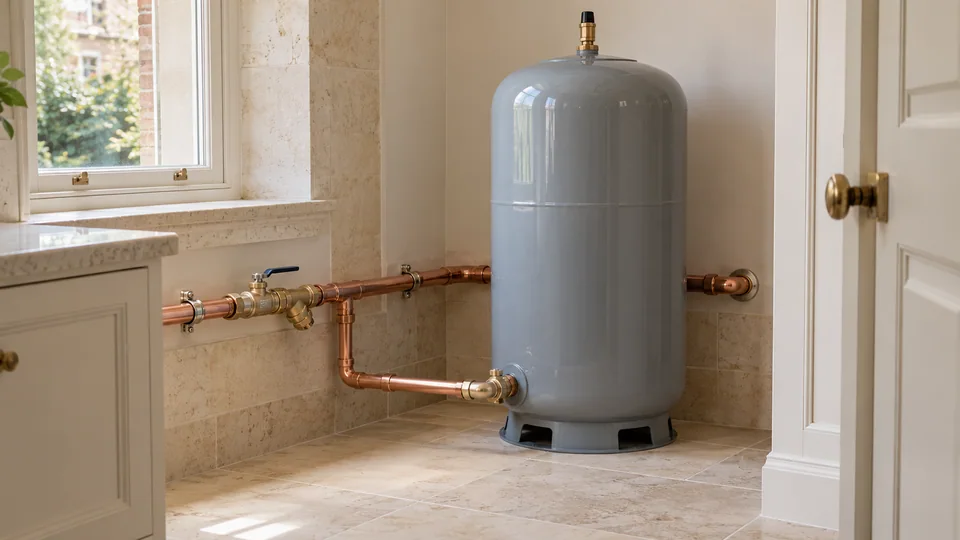
Floor-standing water accumulator connected to a copper distribution pipe in a spacious utility alcove
An accumulator stores a usable reserve; capacity and replenishment need to match demand.
01

A compact inline mains booster

A possible option for a modest improvement where the incoming supply and permitted application are suitable. It needs relatively little space but still requires access, an appropriate electrical supply and compliance with the product’s operating limits. It cannot provide an unlimited supply from an inadequate incoming feed.

02

A passive water accumulator

An accumulator stores water under pressure to help meet short periods of demand. It may suit a property with adequate charging pressure but limited delivery at busy moments. It does not create pressure above its charging supply, and usable water is less than the vessel’s nominal capacity. Space and replenishment time both matter.

03

A pump-assisted accumulator arrangement

Where supported by the selected system, a pump and accumulator can combine pressure improvement with a reserve. Equipment compatibility, incoming conditions, controls and recovery must be assessed together. Adding a vessel alone does not establish how long the required performance can be maintained.

04

A break tank with a booster pump

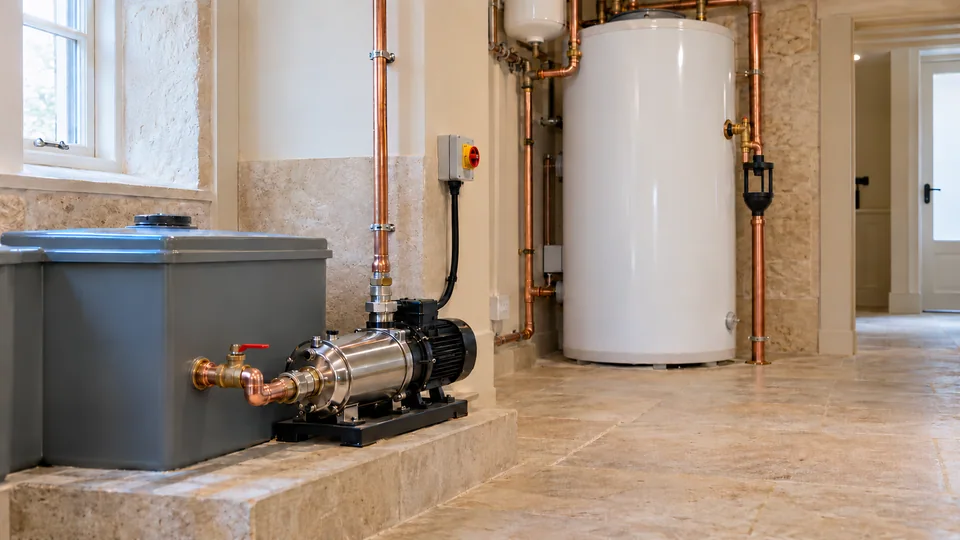
A suitable cold-water storage tank and pump can serve a more demanding installation where space, refill capacity and the required approvals allow. The design must accommodate a safe overflow route, hygienic storage, access and the full operating weight. If demand exceeds refill, the reserve is finite.

A conventional shower pump for a gravity-fed system is not interchangeable with a mains-water booster. For a fuller comparison, see our water booster and accumulator guide.

Water booster equipment and an unvented hot-water cylinder arranged in a residential plant room
Plan cold-water delivery alongside cylinder capacity and hot-water demand.

03 · Coordinate cold and hot water

Match cold-water delivery with hot-water capacity

Improving the cold-water supply is only part of achieving a satisfying shower. An unvented cylinder needs sufficient stored hot water and recovery for the intended use. A combi boiler remains limited by its hot-water output, even if its incoming supply improves.

We review the existing arrangement, the demands of the chosen fittings and compatibility with the proposed booster. Manufacturer-specified pressure controls and safety devices must remain correctly provided.

If your project also involves unvented cylinder installation in St John’s Wood, we can consider storage and water delivery together. An existing cylinder or boiler may remain suitable; replacement should follow an identified need rather than being assumed.

Private homes · Shared responsibilities

From private houses to managed mansion flats

St John’s Wood includes houses with space to plan a dedicated installation and apartments where every service route passes close to someone else’s home. Those differences affect both the design and the working arrangements.

In a house, we review possible utility, basement or plant-room locations alongside the route to upper bathrooms. In a managed block, we first establish responsibility for the incoming service, shared risers and any communal boosting. A private pump must not be assumed to solve a building-wide limitation.

Where management or freeholder agreement is needed, the proposal should identify the equipment, access requirements and affected services. Delivery routes, protection of shared areas, permitted working hours and planned water interruptions need agreement before installation.

04 · Space now, access later

Make room for the equipment—and for future servicing

The equipment footprint is only the beginning. We also consider installation and replacement access, room to inspect connections, tank cleaning where applicable, and support for the system when full. Structural advice may be needed for the proposed position.

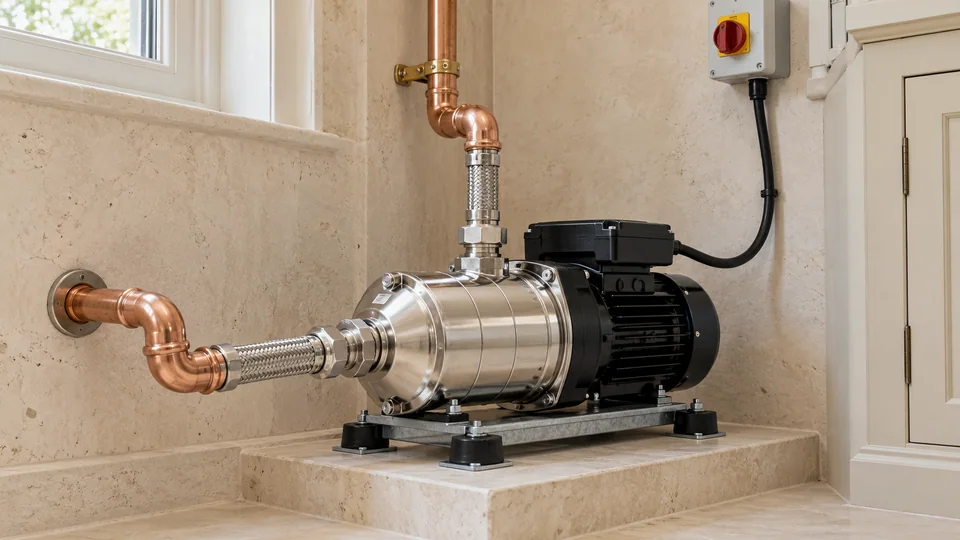
Noise control starts with location and mounting. Pipe supports, vibration transmission and proximity to bedrooms or neighbouring flats deserve attention before finishes are closed. A cupboard can conceal equipment visually without making it silent.

For a wider refurbishment, our St John’s Wood heating and plant-room installations can be coordinated with the water-supply layout. We can also discuss suitable water leak protection options where equipment sits near valuable finishes. Storage should suit actual use and the manufacturer’s hygiene and maintenance requirements, rather than simply being as large as space allows.

Close-up of a stainless-steel booster pump on vibration-isolating mounts with supported copper pipework
Equipment mounting, pipe supports and service access belong in the installation plan.

One team · A defined installation

Plumbing, power and controls in one defined installation

A successful upgrade needs clear responsibility for the connections around the equipment. PEP’s proposal brings the agreed work together:

  • Supply assessment, demand requirements and equipment selection.
  • Pipe routes, isolation, supports and associated plumbing installations in St John’s Wood.
  • Suitable power, protection and isolation, coordinated with electrical installation in St John’s Wood.
  • Commissioning against the agreed operating scenario, with relevant settings and readings recorded.
  • Handover covering normal operation, isolation points, documentation and maintenance requirements.

Specialist building work and making good should be identified in the quotation. For a broader view of our installation work, explore PEP’s London heating and plant-room projects.

A quotation for the complete scope

Water booster installation cost in St John’s Wood

A compact booster on an accessible supply and a stored-water installation serving several bathrooms are different projects. Comparing them by pump price alone misses much of the scope.

The quotation depends on the assessed demand, selected equipment, usable storage, pipework changes, electrical provision and access. Supports, overflow arrangements, acoustic measures and any agreed building work also affect the total.

We set out what is included, what is excluded, how VAT is treated and any matters requiring further investigation. This lets you compare complete proposals and understand who is responsible for each part. Photographs and a project outline help us start the discussion; final selection and pricing depend on the assessment.

Requirements · Permissions · Handover

Water regulations, permissions and handover

Notification requirements form part of planning the installation. Water Regs UK’s pump notification guidance states that the local water undertaker must be notified where a pump induces demand exceeding 12 litres per minute. This applies to direct and indirect connections; a break tank is not an automatic exemption. We establish the applicable notification and consent route before work proceeds.

Water-company requirements are separate from lease, freeholder or building-management permissions. Alterations affecting protected fabric may require additional checks.

At handover, operating instructions and maintenance information should remain accessible. Any inspection, cleaning or servicing schedule must suit the installed equipment and its manufacturer’s requirements.

St John’s Wood · NW8

St John’s Wood NW8 and nearby addresses

We welcome enquiries for St John’s Wood homes, including NW8 addresses around Hamilton Terrace, Lord’s, St John’s Wood High Street and Abbey Road. The individual property and supply arrangement determine the solution—not the street name.

For neighbouring Maida Vale W9, Hampstead NW3 or a boundary address, send your full postcode so we can confirm the project location. Our London water pressure booster installation page explains the wider service.

Before you book

Questions before choosing a water booster

Can a booster support two showers at the same time?

Potentially, provided the incoming supply, pump performance, any reserve and hot-water capacity support their combined demand. We use the selected shower fittings and expected duration to establish the requirement; the number of bathrooms alone is not enough.

Will it help a weak top-floor shower?

It may, but we first distinguish insufficient supply from restrictions in the shower or its pipework. The design must account for elevation and losses along the route to that bathroom.

Do I need a pump, an accumulator or a break tank?

That depends on measured pressure and flow, peak demand, available space and how quickly a reserve can refill. We explain the suitable options and their limitations before selecting equipment.

Can it be installed in a flat with a shared supply?

Sometimes. Supply ownership, communal equipment, neighbour impact, space and permissions must be reviewed first. A restriction in a shared riser may require a building-level response rather than a private installation.

Can I keep my existing unvented cylinder or combi boiler?

Often this can be considered, subject to condition, compatibility and capacity. A booster improves water delivery; it does not increase the boiler’s heat output or the cylinder’s stored hot-water volume.

How much space and service access will the equipment need?

It varies with the arrangement. We allow for connections, inspection, maintenance and eventual removal as well as the equipment itself. A vessel’s nominal litres do not describe its usable reserve or the full installation footprint.

How is noise and vibration managed?

Through appropriate selection, location, mounting and pipework support. Sound can travel through a building, so positioning next to a bedroom or a neighbouring apartment needs particular care. We do not promise a completely silent installation.

What happens during a power cut or a mains-water interruption?

It depends on the design. An electric pump cannot run without power, and stored water is finite. We explain any bypass, remaining unboosted supply or reserve; continued pressure and drinking-water availability must not be assumed.

What permissions or notifications may be required?

These can include the water undertaker’s requirements and separate freeholder or management consent. We identify the relevant route for the proposed system and property before installation is scheduled.

What is included in the installation quotation?

The agreed equipment and associated installation work, with commissioning, handover, exclusions and VAT treatment stated. Any third-party work, making good or unresolved supply issue should be clearly identified rather than left implicit.

St John’s Wood NW8 · Plan the next step

Tell us which outlets you want to use together

Send your postcode, property type and floor, the number of bathrooms and whether the problem affects hot water, cold water or both. Details of the boiler or cylinder, accessible photographs of the supply and proposed equipment space, and any refurbishment plans help us understand the project.

Tell us what changes when another tap or shower opens. We can then discuss the assessment needed and an appropriate route to a complete installation.

Discuss your St John’s Wood water pressure project Call 07843 676 480