
Ealing W5 · West Ealing W13 · Planned domestic installations
Water Pressure Booster & Accumulator Installation in Ealing
Adding another bathroom should not mean planning your morning around which tap is running.
Mains water boosters · Accumulator installation · Cold-water storage and booster sets

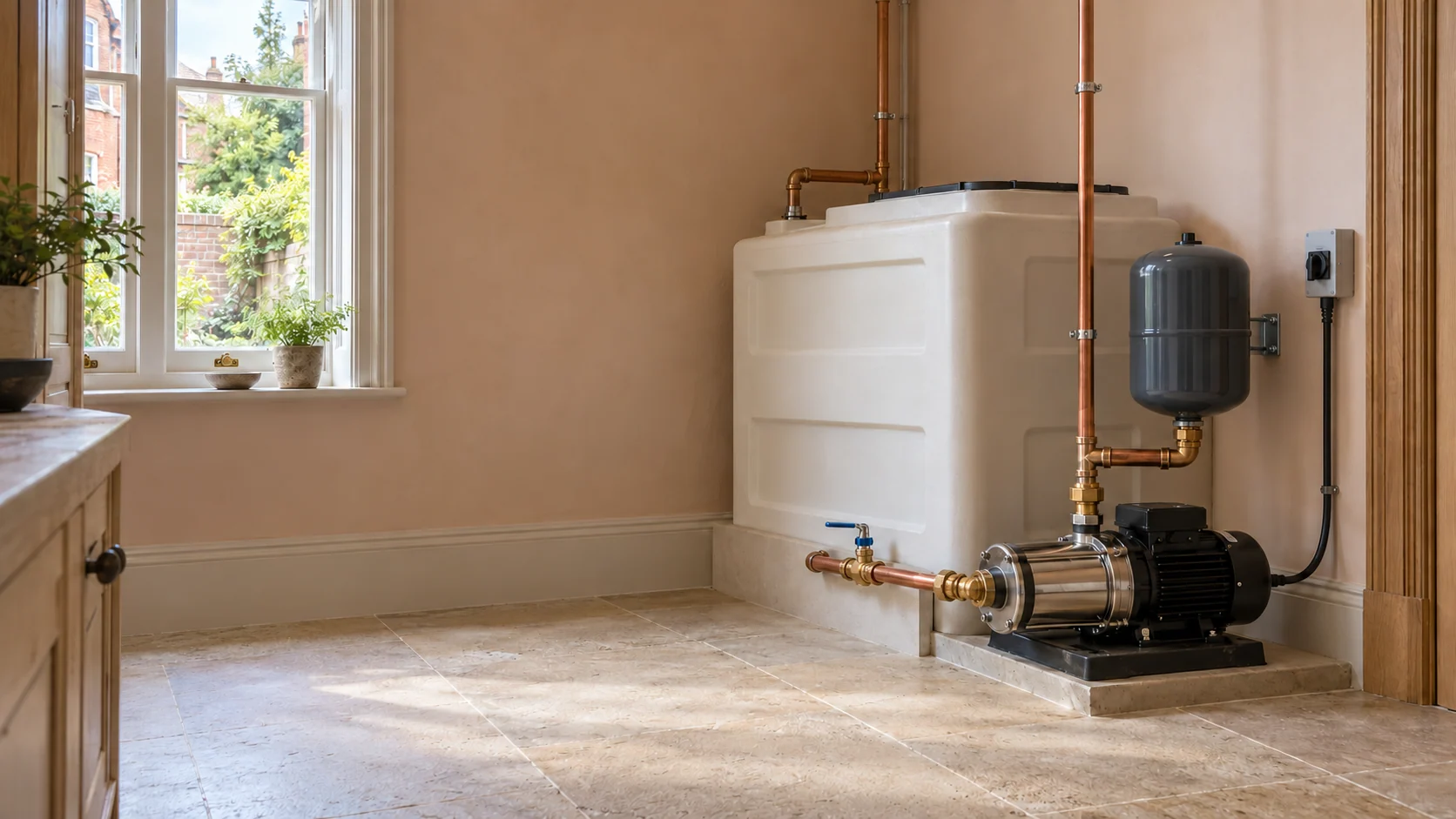
PEP assesses, specifies and installs water pressure boosters, accumulators and stored-water systems for Ealing homes. We establish what the incoming supply can deliver, what the completed property needs and which improvement makes sense before selecting equipment.
From a single-household upgrade to a wider refurbishment, we coordinate the water supply, associated pipework, electrical provision and hot-water requirements within an agreed installation scope.
Ealing W5 · West Ealing W13 · Plan ahead
Plan the water supply for the home you are creating
A rear extension can add a kitchen, utility room and downstairs shower. A loft conversion may introduce an en-suite above the existing bathroom. Each addition changes the demand on pipework that may have served a much simpler layout.
The useful question is not just whether the new shower works. It is whether the house can supply the combinations you expect to use: the upstairs shower while breakfast is being prepared, or two bathrooms during the same morning routine.
For an extended Northfields house, that might mean checking the incoming main before first fix. In a Pitshanger refurbishment, the opportunity may be to resolve distribution and equipment space while rooms are accessible. A converted flat near Ealing Broadway introduces a different consideration: which parts of the supply are private and which serve the building.
We plan around the property and proposed use, rather than assume every home needs a pump. Where the project includes new bathrooms, kitchens or substantial pipework changes, our plumbing installation in Ealing can be coordinated with the water-supply assessment.
01 · Establish the actual restriction
First find what is limiting the supply
A weak shower is a symptom, not a specification for a booster.
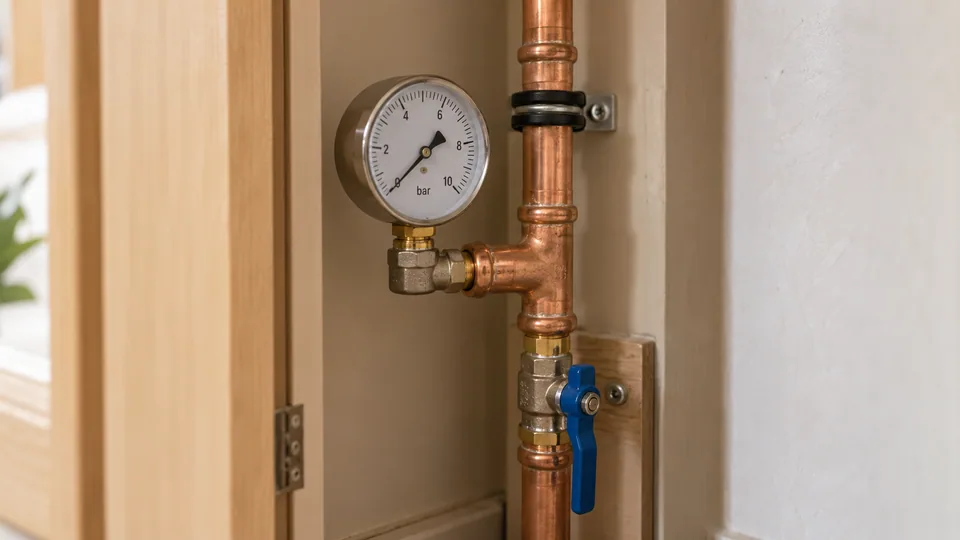
We compare the available supply with the demands of the installation. Static pressure describes the condition when water is not being drawn. Running pressure shows what remains under use. Flow is the volume delivered over time. A satisfactory static reading does not establish that several outlets will work well together.
Assessment may include accessible stop valves, pressure controls, filters, pipe sizes and routes, affected outlets and the existing hot-water arrangement. We also look at whether the problem is local to one fitting, occurs throughout the house or involves a shared supply.
If delivery has suddenly deteriorated and neighbouring properties are affected, a network issue needs checking before new equipment is specified. Thames Water's supply-checking guidance sets out useful first steps. In a managed building, the managing agent may need to investigate communal equipment or arrange access.
Our guide to understanding low water pressure and flow explains these distinctions. The installation proposal should follow the findings, not simply add a device to an unexplained problem.
02 · Match the improvement to the finding
Improve the supply pipe, add storage or fit a booster?
There is more than one route to better water delivery. Finding the limiting part of the system helps avoid paying for equipment that leaves the underlying problem untouched.
| Finding | Possible next step | What still needs checking |
|---|---|---|
| A restricted fitting or defective valve | Repair or replace the affected component | Retest before specifying additional equipment |
| A limiting incoming or distribution pipe | Investigate a suitable pipework or supply upgrade | Ownership, access, expected benefit and any supplier involvement |
| A suitable supply that struggles with short periods of higher demand | Consider an appropriately specified accumulator arrangement | Charging conditions, usable reserve and replenishment |
| Demand requiring stored water and pumped delivery | Consider a tank-and-booster system | Storage, refill rate, pump duty and installation space |
These are assessment routes, not automatic selections. Replacing an incoming pipe may involve responsibilities beyond the private installation, and adding storage cannot provide an unlimited supply. We explain the expected benefit, remaining constraints and any further investigation needed before the scope is agreed.
03 · Compact boosters · Accumulators · Stored water
Different water-boosting systems solve different problems
Compact inline mains boosters
An inline booster can suit a property where a modest improvement is appropriate and the incoming arrangement meets the selected product's requirements. Its small size can be useful where space is limited.
However, a compact pump has a defined operating range. Its advertised pressure does not tell you what will arrive at every outlet, and it should not be treated as a substitute for the storage or capacity needed by a higher-demand home.
Unpumped and pumped accumulators
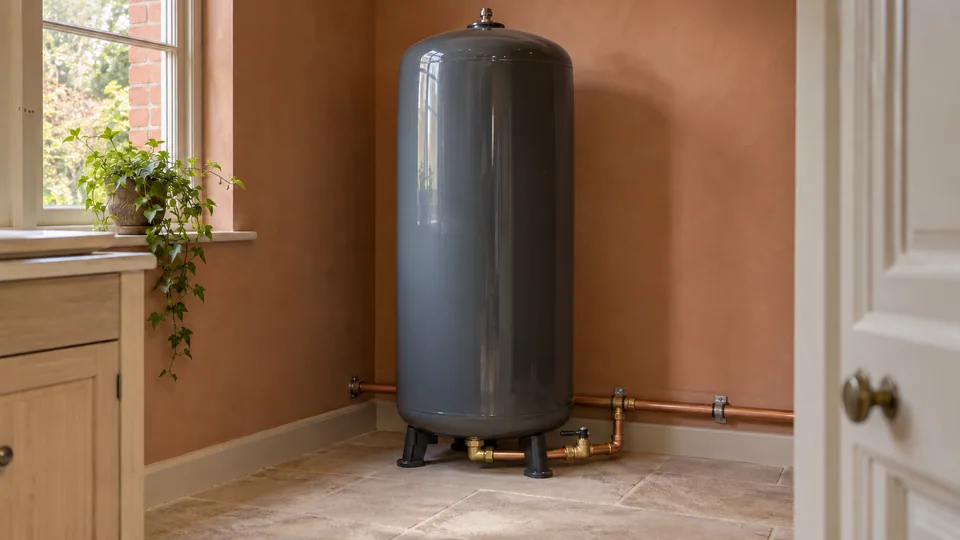
An accumulator stores water under pressure for later use. An unpumped vessel relies on suitable incoming conditions to charge; a pumped arrangement adds equipment to assist charging where the design calls for it.
The choice depends on the supply, required reserve and installation. We distinguish the vessel's nominal size from the water it can usefully deliver. The selected model and operating conditions determine the usable reserve, and the time between periods of demand matters.
Cold-water storage with a booster pump
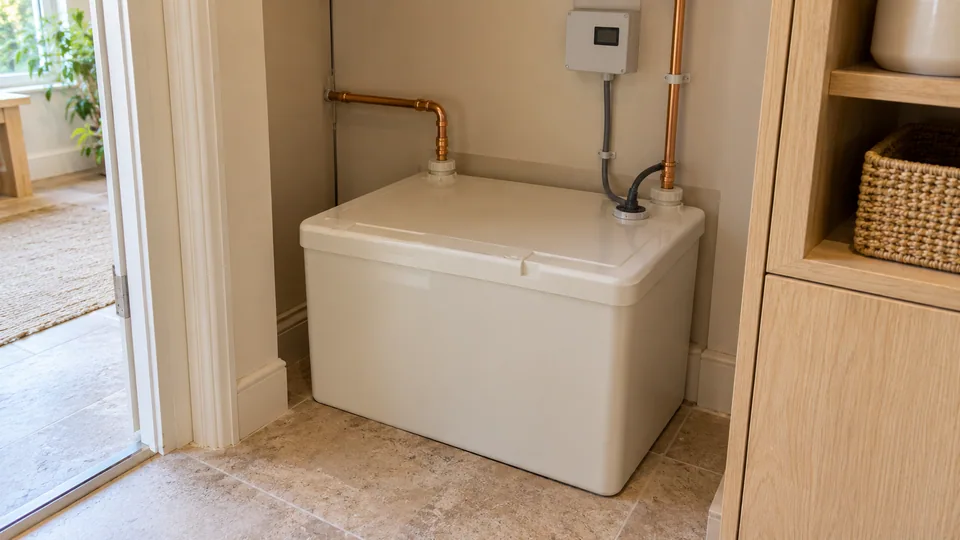
A tank-and-pump system provides stored cold water from which the pump supplies the installation. It can be appropriate where a larger reserve and a different delivery duty are needed.
We consider the tank's usable storage, incoming refill, pump performance, control arrangement and space as one system. The quoted pump output alone is not a promise of sustained performance at the showers.
Our guide to home water boosters and accumulators explores the options in more detail. For your installation, we select an arrangement around the measured supply and agreed use rather than choose a product from bathroom count alone.
04 · Useful reserve · Recovery between uses
What happens when two showers run together?
This is often the question that defines the project. Two shower heads can have very different water requirements, and an occasional overlap is not the same duty as several long showers in succession.
Tell us which outlets you want to use together and for how long. We consider their requirements alongside the supply and hot-water system, then assess whether the proposed arrangement can support that routine.
A reserve may cover a short peak but take time to recover afterwards. A longer draw can expose a refill limitation that a brief demonstration would miss. Where relevant, commissioning should therefore include the agreed combinations of outlets, with any operating limitations explained at handover.
The aim is a water-supply plan matched to everyday use, not an impressive gauge reading with every tap closed.
05 · Cold delivery and hot-water capacity
Match the boosted supply to the hot-water system
Unvented cylinders
An unvented cylinder stores hot water but depends on its cold-water supply for delivery. More hot-water storage cannot, by itself, make a restrictive incoming installation deliver a greater flow.
We consider the cylinder, inlet controls, cold supplies to mixers and distribution together. The arrangement must suit the intended use and the equipment's requirements, rather than improve one part of the system in isolation.
Where storage also needs changing, our unvented cylinder installation in Ealing can form part of the work. Our vented-to-unvented conversion guide explains the wider choices when an older hot-water system is being replaced.
Combi boilers
Improving the cold-water supply to a suitable combi installation does not increase the boiler's ability to heat water. Its output and the required temperature rise still limit hot-water performance.
If the household needs more simultaneous hot water than the existing arrangement can provide, that requirement belongs in the proposal. A booster should not be sold as the answer to a limitation that remains inside the hot-water system.
06 · Installation space · Future maintenance
Make room for equipment you can still maintain
Equipment selection and location belong together. A vessel that fits through the door is not necessarily practical once pipework, controls and future maintenance are considered.
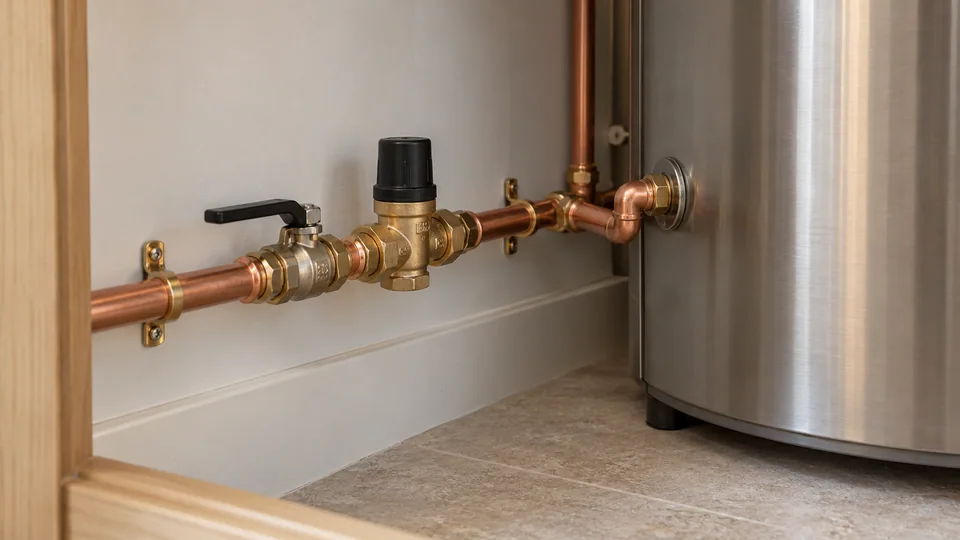
Depending on the arrangement, we assess the filled weight and support, route into the property, appropriate environmental conditions, electrical provision, isolation and access to serviceable parts. Storage installations also need suitable provisions for water hygiene, overflow and associated connections.
Noise and vibration deserve attention before equipment is positioned beside a bedroom or a frequently used living space. Product selection, mounting, pipework connections and the building itself all influence the result. We discuss these factors rather than promise that a pumped system will be silent.
A utility cupboard, garage or larger plant area may offer possibilities, but no location is suitable simply because there is an empty corner. For a wider refurbishment, our central heating and plant rooms in Ealing service helps coordinate the equipment layout. You can also see our heating and plant-room work across London.
Plumbing · Electrical · Heating coordination
A complete installation proposal, not just a pump
PEP brings the associated plumbing, heating and electrical requirements into one defined scope. That makes the connections between trades visible before equipment arrives or finished surfaces conceal the routes.
The proposal should identify:
- The supply findings and demand on which the selection is based.
- The equipment and any required storage or pressure controls.
- New pipework and connections to retained services.
- Electrical supply, isolation and associated installation tasks.
- Access, planned interruptions, making good and responsibilities.
- Commissioning, relevant documentation and maintenance information.
Where a new electrical provision is needed, our electrical installation in Ealing can be included in the coordination. Any work by the water supplier, managing agent or another contractor should be clearly distinguished from PEP's agreed work.
If concealed services or unresolved supply ownership prevent a firm specification, we explain what remains to be established. Additional investigation is preferable to presenting an incomplete assumption as a finished design.
Complete installation · Clear exclusions
What affects water booster installation costs in Ealing?
A small inline installation and a stored-water system with new electrical provision are different projects. A price for replacing a gravity-fed shower pump is not a useful comparison for a whole-house supply improvement.
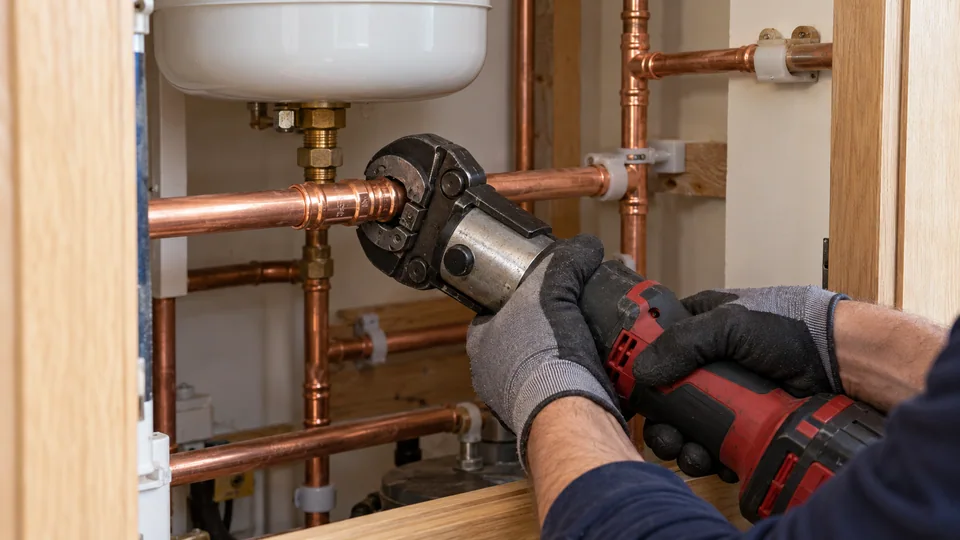
The cost depends on the chosen arrangement, equipment capacity, pipework changes, installation access, electrical work and the extent of any associated building work. Incoming-supply alterations or work involving shared services may require separate investigation and coordination.
We define those elements before agreeing the installation. The quotation should make inclusions, exclusions, applicable VAT and any provisional work clear, so you can compare the proposed result rather than just the price of the device.
If you are already planning an extension or refurbishment, discuss the supply early. Equipment space and routes are easier to resolve before kitchen cabinets, floors and decorations are complete.
From the first conversation · To checked handover
From assessment to a working water supply
1. Describe the home and the intended changes
Tell us what currently happens and what you want the completed installation to support. Plans and equipment photographs can help establish the starting point.
2. Assess the supply and agree the approach
We investigate the relevant delivery conditions, existing equipment and available space. The proposal explains the selected solution, associated work and any outstanding responsibilities.
3. Coordinate and install
The agreed work is sequenced around access, other trades and water interruptions. Retained services and new connections are dealt with as part of the installation plan.
4. Commission and hand over
We check operation against the agreed requirements, explain the controls and identify relevant maintenance. You should know what the system is intended to deliver and which conditions affect its performance.
Supplier requirements · Ongoing care
Water-supplier requirements and ongoing care
Notification requirements need checking before installation. Water Regs UK guidance on pump and booster notification states that the local water undertaker must be notified where a pump induces demand exceeding 12 litres per minute. This applies to direct and indirect connections to a supply pipe.
A break tank is therefore not an automatic exemption. The applicable requirements, consent arrangements and responsibility for dealing with them must be established for the proposed work.
After installation, follow the selected manufacturer's maintenance requirements. Access to controls, filters and serviceable equipment should remain available. Storage and charging arrangements should continue to suit actual household use rather than be left unreviewed after significant changes.
Ealing · W5 & W13 · Full postcode enquiries
Water booster installation across Ealing W5 and West Ealing W13
We welcome planned installation enquiries across Ealing Broadway and Haven Green, Ealing Common, Montpelier, Mount Park, North Ealing and South Ealing, together with Pitshanger and Brentham. Our coverage includes West Ealing, St Stephen's and relevant Northfields addresses.
Northfields includes W5 and W13 locations. For Hanger Hill and other boundary areas, send the full property postcode so we can confirm the address and practical arrangements.
For neighbouring W4 projects, see our water booster installation in Chiswick. Our London water booster installation service sets out the broader offer, and our Ealing service coverage brings together the related local services.
Before you enquire
Questions before installing a water booster in Ealing
Will a booster fix every weak shower?
No. A restricted fitting, defective control or hot-water limitation may need a different repair. We establish the cause and relevant supply conditions before deciding whether boosting is appropriate.
Should the incoming water main be improved first?
Sometimes. If a limiting pipe or supply arrangement is the main constraint, an upgrade may be worth investigating before additional equipment. The assessment needs to establish the expected benefit, ownership and any third-party work required.
Can an accumulator work without a pump?
Yes, where the incoming conditions and selected system suit it. An unpumped accumulator charges from the available supply; it does not create pressure beyond that charging arrangement. A pumped system is a different option, not an automatic requirement.
How much usable water does an accumulator store?
The vessel's nominal capacity is not its usable water reserve. The selected vessel, charging conditions and operating pressures affect what is available. We specify the arrangement around the required duty rather than apply a universal percentage to the size on the label.
Will it support two showers at the same time?
That depends on the showers, incoming supply, hot-water capacity and proposed system. We need to consider the duration and combination of use, not simply the number of bathrooms. The expected result should be established before installation.
Does a larger unvented cylinder solve low water pressure?
Not by itself. It changes hot-water storage capacity, not the capability of a restrictive incoming supply. The supply, cylinder controls and distribution need to work together.
Can you improve the supply to a combi boiler?
A suitable supply improvement may help where incoming delivery is the limitation. It cannot increase the boiler's heat output, so the appliance's hot-water capability still needs to match the intended use.
Can the equipment go in a cupboard, loft or garage?
Possibly, but the location must suit the selected equipment. We assess access, support, environmental conditions, connections and future maintenance. A loft location also requires careful consideration of the filled load and the route for installation.
How noisy will a booster installation be?
Noise depends on the equipment, duty, mounting and connected building services. We consider the location and vibration transmission during planning. A product description alone cannot establish what will be heard in an adjacent room.
Can I install a private booster in a converted flat?
Potentially, but the private supply and any shared services must be identified first. Restrictions or equipment serving several flats may require managing-agent involvement. A private installation should not be specified without understanding that boundary and the relevant permissions.
Does a storage tank mean water-company notification is unnecessary?
No. An indirect connection does not automatically remove notification requirements. We establish the relevant water-supplier requirements for the proposed arrangement before the work proceeds.
What should I send for an Ealing quotation?
Start with the full postcode, property type, current hot-water system and a description of the problem or planned changes. Tell us which outlets should work together. Plans and clear photographs of the existing equipment and available space can help us arrange the next step.
Ealing W5 & W13 · Plan your next step
Tell us how your home uses water
Whether you are adding an en-suite, replacing hot-water storage or improving an existing supply, begin with the result you need from the finished home.
Send your Ealing postcode, the planned changes and what happens when several outlets run. PEP can assess the installation and develop an appropriate scope for the supply, equipment and associated work.