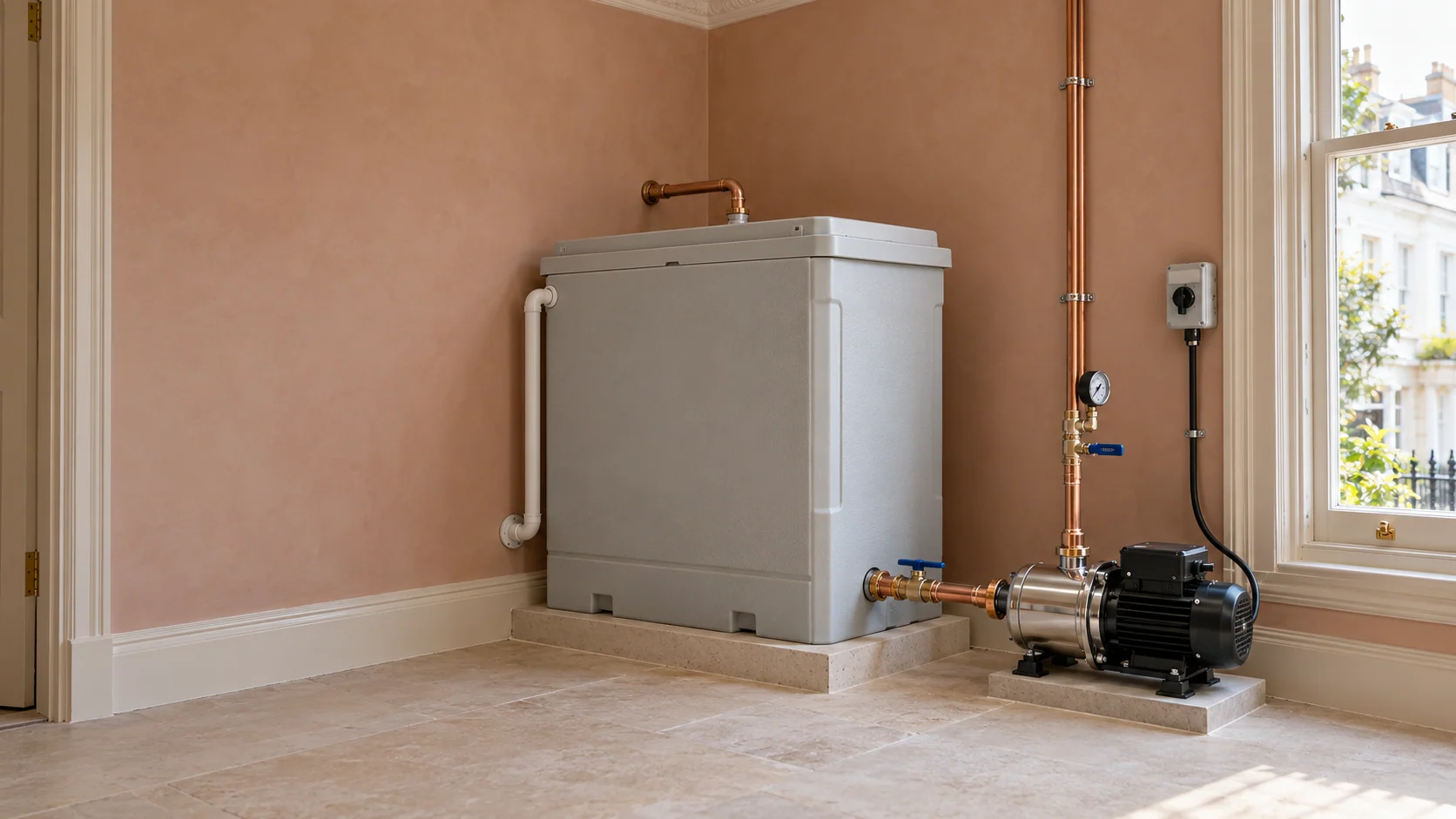
Cold-water break tank and booster pump with copper pipework in a warm rose-coloured period-home utility room.

Notting Hill W11 · Water supply upgrades for homes and flats

Water Pressure Booster & Accumulator Installation in Notting Hill

Bathrooms that work together. A water supply planned to match.

Speak to our plumbing team: 07843 676 480

Mains water boosters · Accumulator installation · Cold-water storage and booster sets

NICEIC

PEP plans and installs water pressure boosters, accumulators and cold-water storage systems in Notting Hill. We bring the incoming supply, household demand and hot-water installation into one design, so the equipment is chosen for the way you intend to use your home.

From a converted flat with a disappointing shower to a townhouse gaining another bathroom, we establish what the property can support and set out the work needed to improve it.

Notting Hill W11 · Plan for the whole home

Plan the water supply before choosing the bathroom fittings

A new en-suite changes more than the room layout. Two showers running before work, a bath filling downstairs and ordinary kitchen use can place demands on a connection that previously served a smaller household.

That is the right time to involve PEP: while the fittings, pipe routes and service space can still be considered together. For an existing home, the starting point is the behaviour you want to change — perhaps a shower that weakens when another tap opens, or delivery that is noticeably poorer upstairs.

We help translate those observations into a practical brief. The aim is to agree which outlets need to work together, assess the available supply and choose an appropriate improvement. Sometimes that means a booster and storage; sometimes the better first step is removing a restriction in the existing installation.

Private supply · Shared responsibilities

A private flat does not always have an independent supply

In a converted Notting Hill house, the entrance doors may be separate while parts of the water installation remain shared. A flat can depend on a common incoming pipe, a shared riser or equipment maintained for the whole building.

Before specifying a pump, we establish where the private installation begins, how it can be isolated and whether changes could affect neighbouring homes. Where the supply is communal, access, records and proposed alterations may need to be agreed with the freeholder or managing agent.

A whole-house project offers a different scope: there may be an opportunity to renew distribution, allocate storage space and plan the bathrooms around one supply design. Even then, the incoming connection must be assessed rather than assumed to be adequate.

We separate work inside your property from any changes to shared services. If a renewed or independent connection is an option, it belongs in that discussion before equipment is ordered.

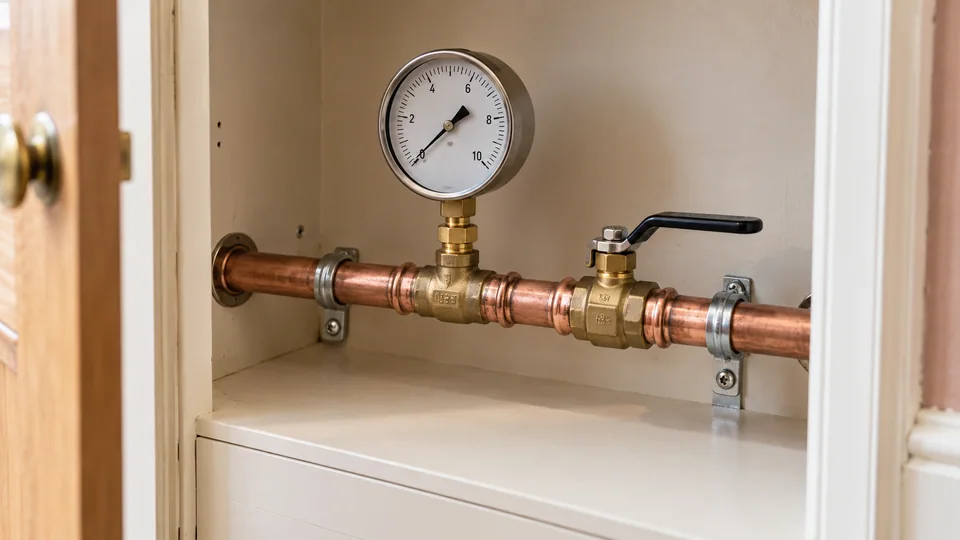
Analogue pressure gauge connected to a cold-water supply test point inside a utility cupboard.
Measure the available supply under demand before choosing equipment.

01 · Understand the supply

Follow the water from the connection to the shower

Pressure and flow describe different parts of the problem. Pressure is the force available; flow is the volume delivered over time. A promising reading with the outlets closed can fall substantially when the home starts using water.

Our assessment considers the supply under representative use and the route to the affected rooms. Depending on the installation, this includes:

  • Pressure and flow at appropriate points, including performance during simultaneous use.
  • Differences between floors and any reported changes at busy times.
  • Supply-pipe size and condition, isolation valves, strainers and pressure controls.
  • The requirements of the proposed taps, showers and hot-water equipment.
  • Whether the restriction lies within the home, shared services or the external supply.

When performance varies, further measurements may be needed rather than relying on one convenient reading. Our guide to low water pressure and flow explains the common distinctions; the site assessment determines what applies to your home.

02 · Select the right arrangement

Four ways to improve delivery — with different requirements

Water booster installation is not a single standard package. The suitable arrangement depends on the measured supply, the required performance and the space available for equipment and servicing.

01 · Compact boosting

Compact mains booster pumps

An inline mains booster can be appropriate for a modest improvement where the supply and the manufacturer's conditions allow it. Its small footprint is useful, but it does not provide a significant water reserve. A compact pump must not be mistaken for a stored-water system capable of supporting several demanding bathrooms.

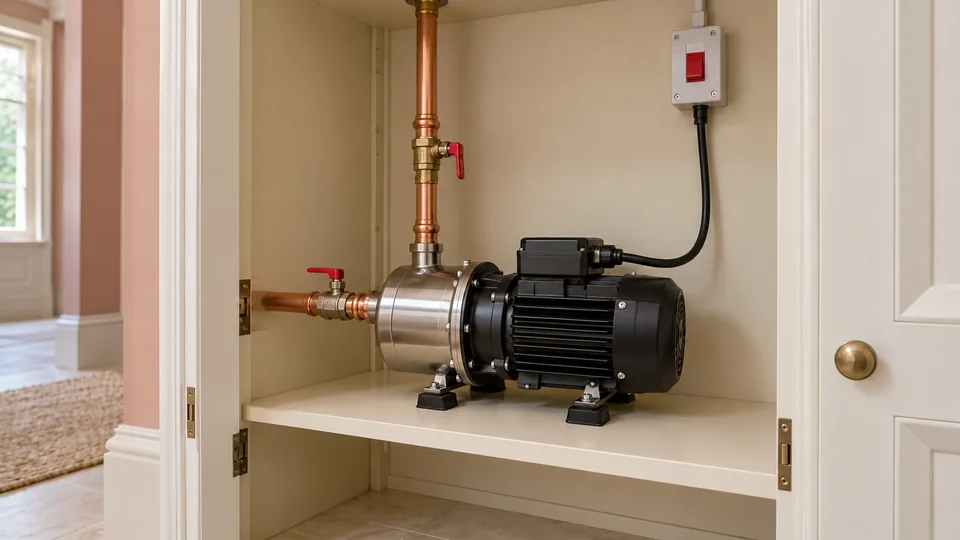
Compact water booster pump with supported copper pipework and a wall-mounted electrical isolator in a utility cupboard.
A compact pump must suit the measured supply and intended demand.
02

Unpumped water accumulators

An accumulator holds a reserve of cold water under pressure, helping meet short periods of demand beyond the incoming flow. It needs sufficient available pressure to charge. It cannot independently lift the supply above that charging pressure, and the usable reserve is smaller than the vessel's nominal capacity.

03

Pump-assisted accumulator systems

Where the conditions call for it, a compatible pump and controls can support accumulator charging. This is a specified system, not simply a pump attached to any vessel. We consider the charging conditions, useful reserve and recovery between periods of use.

04

Break tanks with booster pumps

A break tank stores cold water at atmospheric pressure for a booster pump to draw from. It can provide a larger reserve for suitable multi-bathroom projects, with the pump and storage matched to demand. The tank still needs to refill, and its location must accommodate hygienic storage, overflow arrangements, weight and maintenance.

For the wider comparison, read our guide to water boosters and accumulator systems. These cold-water arrangements perform a different job from a hot-water cylinder or a heating expansion vessel.

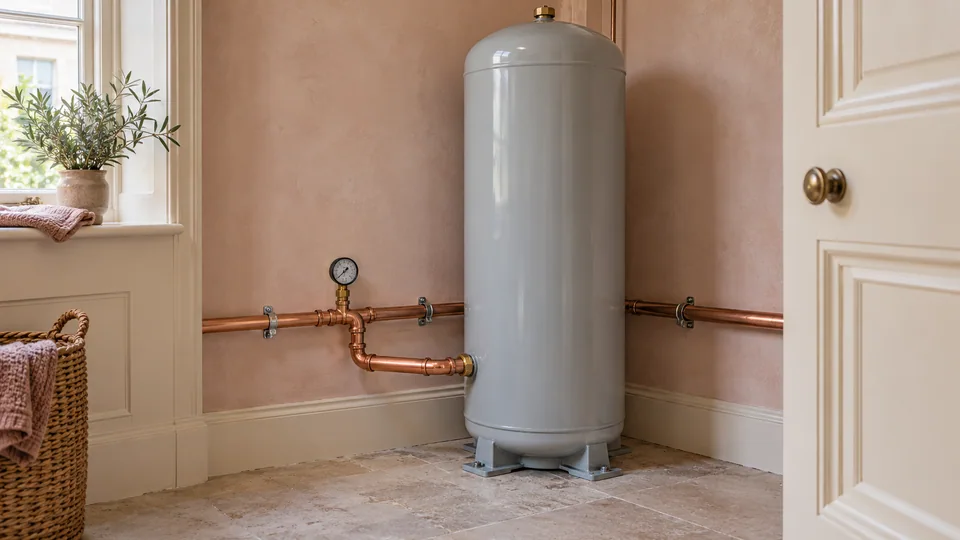
Unpumped cold-water accumulator with a low-level connection to the supply pipe in an accessible utility space.
An unpumped accumulator provides a finite reserve at the available charging pressure.

Demand · Reserve · Refill

Two showers at once is a design brief, not a pump size

The useful question is which showers, at what required delivery, and for how long. A pair of modest shower heads and two large outlets can demand very different volumes of water.

We consider their specified requirements alongside elevation, pipe routes and losses through fittings. The pump must be selected at a suitable operating point; a maximum flow figure on its own does not describe the pressure available in an upper-floor bathroom.

With storage, we also assess how the usable reserve covers the busy period and replenishes afterwards. If demand exceeds replenishment for long enough, the reserve is depleted. Explaining that balance is part of selecting the right system — not something to discover after the cupboard has been built around it.

03 · Coordinate cold and hot water

The hot-water installation has to keep pace

Improving cold-water delivery does not, by itself, increase the amount of hot water the home can produce. Both sides of the shower mixer need consideration.

For an unvented system, we review the cylinder's storage and reheating capacity, inlet controls and the arrangement serving the hot and cold outlets. A new unvented cylinder installation in Notting Hill can be planned alongside the water-supply upgrade, rather than specified in isolation.

A combi boiler remains limited by its hot-water heating capacity. Boosting its feed cannot make it heat an unlimited flow to the required temperature. Where the project involves several bathrooms, we discuss the complete hot-water strategy before promising what a pump can achieve.

For larger refurbishments, our Notting Hill heating and plant-room installations bring these requirements into the wider building-services layout.

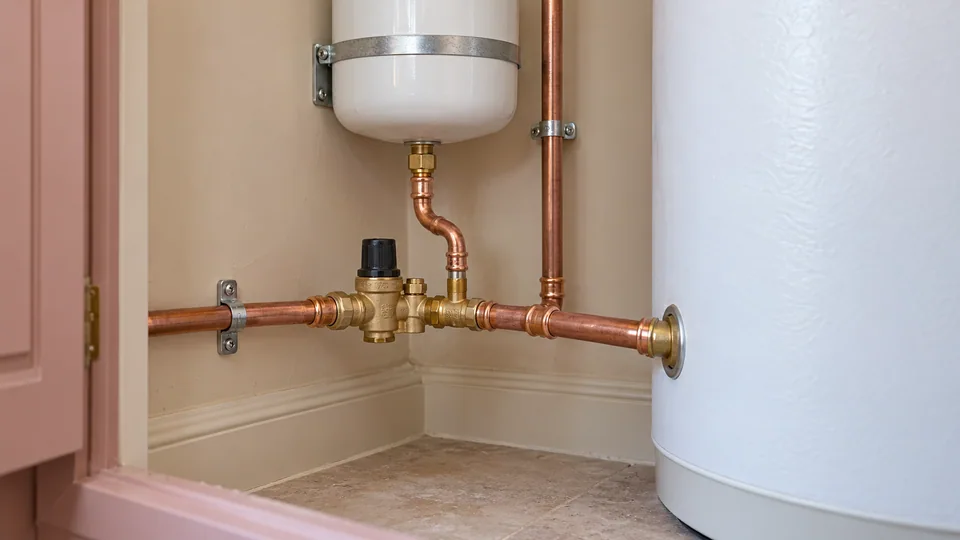
Press-fit cold-water pipework and inlet controls beside an unvented hot-water cylinder in a domestic plant cupboard.
Water delivery and hot-water capacity are separate design considerations.

Space now · Access later

Make room for maintenance, not just installation

In a finished W11 home, a suitable location has to work for the people living around it. A service cupboard beside a bedroom, or a floor shared with the flat below, needs particular attention to equipment noise and vibration.

We consider the pump location, mounting and pipe supports alongside access for isolation, inspection and replacement. Equipment dimensions alone are not enough: connection clearances, the delivery route and the full operating weight matter too. Where support needs structural confirmation, that is identified before installation.

Cold-water storage must also remain suitable for its intended use. Its capacity, turnover, surroundings and maintenance requirements need to be considered together, with appropriate backflow protection and overflow provision for the selected arrangement.

Where water storage sits within valuable interiors, water leak protection options can be discussed as part of the project. Detection and shut-off are additional measures, not substitutes for correct installation or maintenance.

PEP in W11 · Whole-property experience

Experience coordinating a five-storey Notting Hill home

PEP's work in Notting Hill includes the technical design and installation of plumbing, heating and electrical infrastructure throughout a five-storey private residence.

Our Notting Hill installation project shows that wider coordination experience: plant rooms, distribution and the connections between building services. We bring the same whole-property thinking to the planning of a new water-supply upgrade, with a scope defined for your particular home.

04 · A clear installation process

A coordinated installation, from assessment to handover

PEP can combine equipment selection, hydraulic connections, distribution alterations and the required power and controls within an agreed proposal. For refurbishment work, our plumbing installations in Notting Hill address the pipes carrying water to the rooms, while our electrical installation service covers the agreed supply, protection and isolation requirements.

  1. Understand the property. Discuss existing symptoms or the proposed layout, identify the supply arrangement and arrange the necessary assessment.
  2. Agree the design and scope. Set out the system, intended use, location, associated work and any permissions or information still required.
  3. Plan the work. Agree access, protection of retained finishes and interruptions to water. Coordinate with other trades or building management where relevant.
  4. Install and commission. Check the completed arrangement, controls and delivery under the agreed operating scenario, including simultaneous outlets where specified.
  5. Explain the system. Provide the relevant product information, settings and maintenance requirements, with the isolation arrangements and operating limits made clear.

Joinery, decoration, structural work, external connections and communal alterations are identified separately where relevant. You should know which parts PEP is delivering and which require another appointment.

A quotation for the complete scope

Water booster installation cost in Notting Hill

The cost is driven by the system and the work around it, not simply the price of a pump. A compact installation with suitable existing connections is a different project from adding storage, renewing distribution and integrating a cylinder across several floors.

The main variables include:

  • Equipment type, useful storage capacity and the agreed performance requirement.
  • Access, location, support and measures to manage vibration.
  • Pipework alterations, electrical work, controls and integration with retained systems.
  • Any shared-service coordination, approvals or changes to the incoming connection.
  • Commissioning, making good and the precise inclusions and exclusions.

We prepare the proposal around the assessed property and agreed scope, with VAT treatment stated. This gives you a basis for comparing complete installations rather than headline equipment prices or an hourly call-out rate.

Talk through the scope of your installation

Requirements · Permissions · Handover

Permissions, water regulations and ongoing care

Notification and consent requirements must be established before affected work begins. Water Regs UK states that the water undertaker must be notified when a pump induces demand exceeding 12 litres per minute, whether connected directly or indirectly to a supply pipe. A break tank is not an automatic exemption; smaller pumps still need a compliant installation.

Water-company requirements are separate from any lease, freeholder or managing-agent permission. We identify these interfaces in the project scope, together with appropriate fittings, backflow protection and the selected manufacturer's installation requirements.

The completed system also needs care. Maintenance depends on the equipment and water-storage arrangement, so the handover should explain what needs inspection and servicing. Accessible valves, controls and tanks make those future visits more straightforward.

Notting Hill · W11

Notting Hill W11 and nearby addresses

We welcome planned water booster and accumulator projects across Notting Hill, including Ladbroke Square, Ladbroke Gardens, Elgin Crescent, Pembridge, Colville and the surrounding residential streets.

We also consider neighbouring addresses around Ladbroke Grove, North Kensington, Westbourne Grove, Bayswater and Holland Park. These areas cross postcode boundaries, so please send the full postcode rather than relying on the district name alone.

Our London water pressure booster installation service explains the wider coverage and approach. The specification for your home will follow its actual supply and requirements, not a general assumption about pressure in the neighbourhood.

Before you book

Questions about water booster installations in Notting Hill

Can you install a water booster in a converted flat?

Potentially, but first we need to understand the incoming supply, the private and shared pipework, the available space and any permissions. An internal installation may be suitable; in other cases the restriction needs addressing at building level. We establish that boundary before specifying equipment.

Do I need a booster pump, an accumulator or both?

That depends on pressure, flow and the pattern of demand. An unpumped accumulator needs enough pressure to charge, while a pump-assisted system can provide a different operating arrangement. A break tank and booster may suit larger storage needs. Measurements and space determine the shortlist.

Will the installation let two showers run together?

That can be a design objective, but it needs the right cold-water delivery and enough hot-water capacity. We assess the chosen showers, their simultaneous requirements and the length of use, then agree a realistic operating brief. A pump alone does not guarantee the result.

Can I keep my existing combi boiler or unvented cylinder?

Often the supply upgrade can be planned around retained equipment, subject to condition, compatibility and performance. The cylinder's capacity or the combi's hot-water output may still limit use. We explain any necessary changes rather than assuming the water booster solves every constraint.

Will a water booster be noisy?

The result depends on the selected equipment and how it is installed. Position, mounting and pipework can all affect transmitted sound. We consider nearby bedrooms and adjoining properties when planning the layout; no pump should be described as universally silent.

How much space does an accumulator or break tank need?

It depends on the required usable reserve and the chosen product. Allowance is also needed for connections, maintenance and future removal. We check access and the filled weight, not just whether the empty unit fits through the cupboard door.

Do I need permission from Thames Water or my freeholder?

The requirements depend on the proposal and the property. Water-company notification or consent and building permissions are separate checks. We identify them before affected work, particularly where pumps, shared supplies or alterations outside the flat are involved.

Do you install Stuart Turner or Salamander systems?

We can assess suitable options from established manufacturers, including Stuart Turner and Salamander. Selection follows the required duty, supply conditions, space and current product instructions. If you have a preferred model, send the details before purchasing it so suitability can be checked.

What happens to the water supply during a power cut?

It depends on the arrangement. Pumps need power; a charged accumulator may provide a limited reserve, while a suitable bypass or separate mains-fed outlet may retain some unboosted supply. We explain the proposed system's behaviour and limitations rather than assuming uninterrupted service.

How disruptive is the installation?

Access and pipework changes determine the disruption. Connections require planned interruptions, and shared buildings may need coordinated shutdowns. We discuss sequencing and protection of finishes in advance, then confirm the likely programme once the scope is known.

Notting Hill W11 · Plan the next step

Tell us what you want the water supply to do

Send your Notting Hill postcode, the type of property and a brief description of the problem or planned refurbishment. If available, include the boiler or cylinder details, the proposed bathroom layout and photographs of the accessible service space.

You do not need to dismantle anything or take technical measurements yourself. We will discuss the project and the assessment needed to prepare a suitable proposal.

Discuss your Notting Hill water pressure project

Call the plumbing team: 07843 676 480