
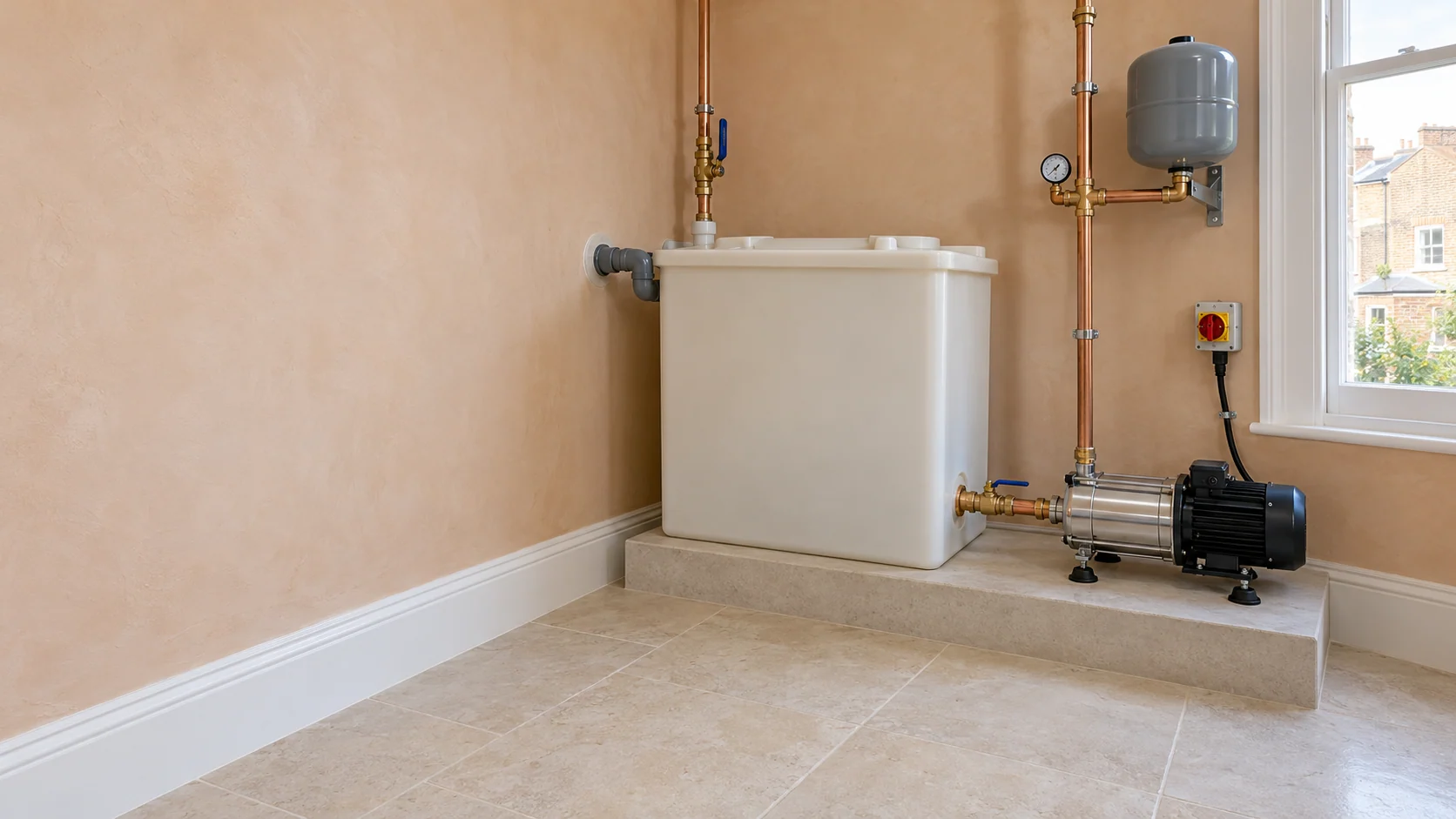
Water pressure boosters & accumulators · Hammersmith W6
Water Pressure Booster Installation in Hammersmith, W6
Water delivery that keeps up with the home you are planning.
Discuss your Hammersmith water pressure projectCall 07843 676 480
Mains water boosters · Accumulator installation · Cold-water storage and booster sets

PEP provides water pressure booster and accumulator installation in Hammersmith W6, helping homeowners match their water supply to the way they want to use their bathrooms and kitchen.
We assess the available supply before recommending equipment, then coordinate the pipework, electrical connections, controls and commissioning within an agreed installation scope. From a compact upgrade to a stored-water system for several bathrooms, the proposal starts with your property—not a pump chosen in advance.
Hammersmith W6 · Begin with your home
Water delivery planned around your Hammersmith home
A new shower can reveal a limitation that was less noticeable with the old fittings. An additional bathroom can change the morning routine. In a converted flat, opening a second tap may expose a restriction beyond the room being refurbished.
For a house around Brackenbury Village or Ravenscourt Park, the project might involve an upstairs en-suite and a busy family kitchen. In an apartment, it may centre on improving the private installation while respecting the building’s shared services.
We look at these requirements together. The aim is to identify a practical route to better water delivery, with the type of system, associated work and limitations made clear before installation.
01 · Understand the supply
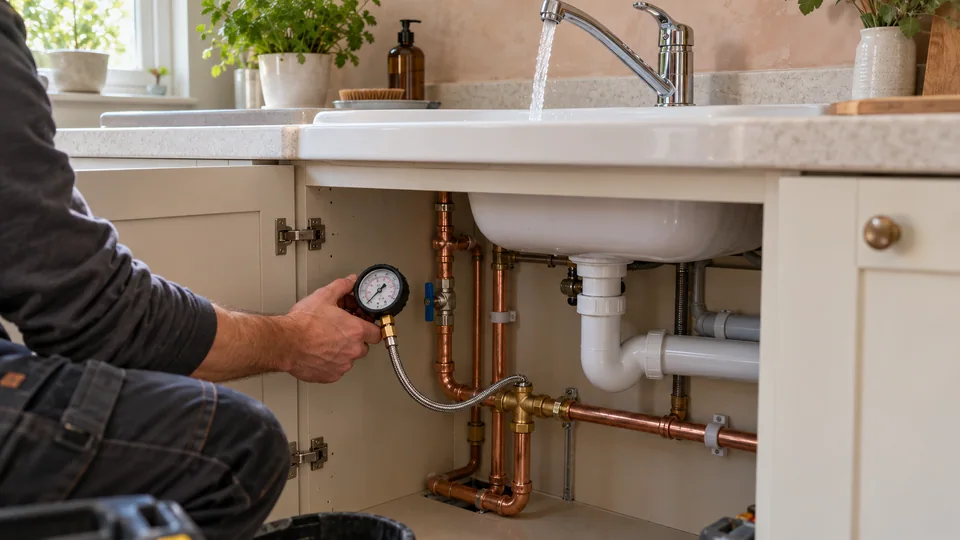
Find the supply limitation before choosing a booster
Pressure and flow describe different aspects of water delivery. A pressure reading taken with every outlet closed cannot establish what will happen when a shower, kitchen tap and another fitting operate together.
Our assessment considers the incoming supply, running pressure, available flow and distribution within the property. Pipe sizes, valves, existing pressure controls and the route to upper floors can all affect the result. A problem at one outlet needs a different investigation from poor delivery throughout the home.
Where performance varies, further readings may be needed to understand the conditions. A sudden loss of supply should first be checked for an interruption or fault, rather than treated as a reason to install permanent boosting equipment.
Restricted pipework or a faulty component may need attention instead of—or before—a booster. Our guide to understanding water pressure and flow explains the underlying distinctions.
02 · Choose the right arrangement
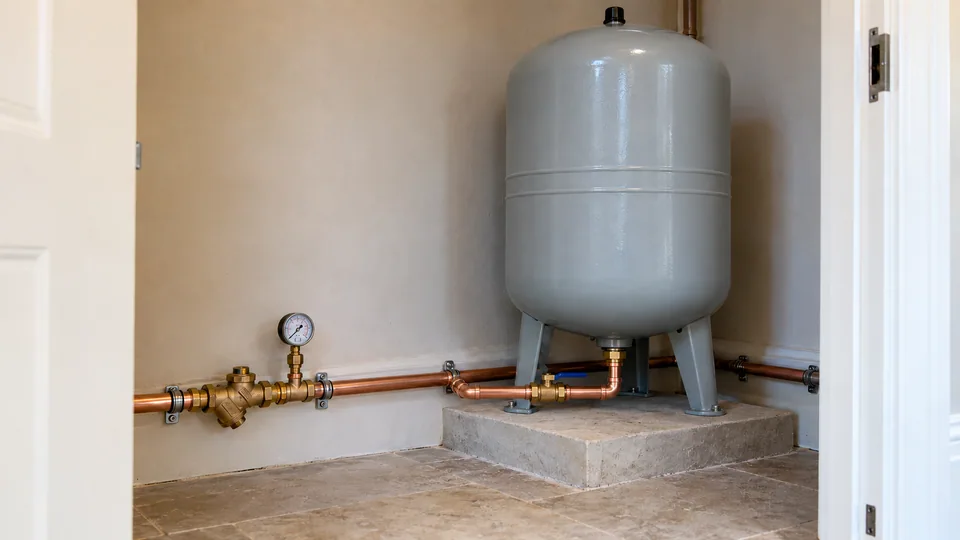
A compact booster, an accumulator or a tank-fed system?
The appropriate solution depends on the supply measurements, required delivery and available space. We explain the differences rather than present every arrangement as another version of the same pump.
| Arrangement | When it may suit | Important limitation |
|---|---|---|
| Compact inline mains booster | A limited improvement where the incoming conditions and product application are suitable. | Its output is finite. A small unit is not automatically suitable for several showers. |
| Passive accumulator | A pressurised reserve to supplement flow during periods of higher demand. | It needs suitable charging conditions and does not generate pressure above its charging supply. |
| Pump-assisted accumulator | A compatible system combining pressure boosting with a stored reserve. | The pump, vessel and controls must be selected together, including how the reserve is replenished. |
| Break tank and booster pump | A stored-water arrangement where demand needs to be buffered against the incoming supply. | Tank capacity, refill, pump duty, hygiene, full weight and access all matter. |
| Supply or pipework improvement | A restriction or unsuitable distribution is the main cause. | The work may extend beyond the equipment cupboard and require separate investigation or coordination. |
For water accumulator installation, vessel size alone is not a specification. The usable reserve depends on the proposed operating conditions, and the supply needs time to replenish it. Stored-water systems cannot provide an unlimited flow indefinitely.
Suitable options can include current Stuart Turner Mainsboost and Salamander mains-water boosting systems. Selection follows the required duty and installation conditions, not the brand name alone.
Our water booster and accumulator guide explores the arrangements in more detail.
The household brief · Concurrent demand
Design for the outlets you want to use together
“Two bathrooms” is not a complete water-demand brief. Two modest showers used separately differ from two high-flow showers running while someone fills a bath.
We establish which fittings are expected to operate together, their requirements and the likely duration of use. Height and distribution losses affect delivery at the outlet; the equipment’s headline performance is not necessarily what reaches the top-floor shower.
Those requirements also inform the checks after installation. The relevant combinations of outlets can be tested, with the available performance and operating limits explained. Where a refurbishment changes the pipe routes, our plumbing installations in Hammersmith service can cover the wider distribution work.
03 · Coordinate cold and hot water
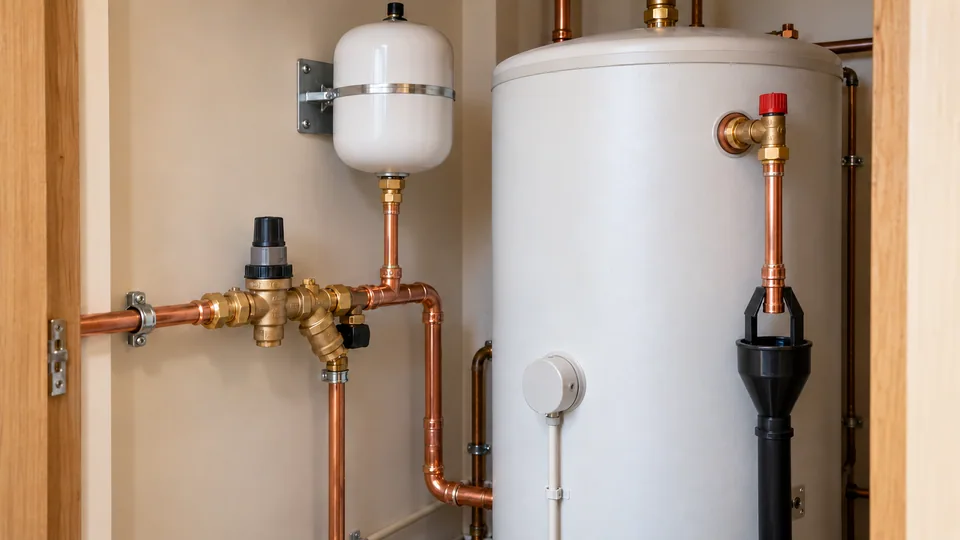
Cold-water delivery and hot-water capacity must agree
Improving the incoming cold-water supply is only part of achieving better bathroom performance. The hot-water system must also support the intended use.
Unvented cylinders
An unvented cylinder relies on its incoming supply, but cylinder volume, recovery and distribution remain separate considerations. Hot and cold supplies to mixers need to work together. Where storage is also changing, we can coordinate the booster proposal with unvented cylinder installation in Hammersmith.
Combi boilers
A suitable booster may improve the water available to a combi boiler, but it cannot increase the boiler’s heating output. More incoming water does not automatically deliver two satisfactory hot showers. We assess that limitation before recommending an upgrade.
04 · Space now, access later
A system that fits without sacrificing service access
A cupboard must accommodate more than the outline of a tank. Valves, connections, inspection and eventual component removal all require usable space.
We consider the route for bringing equipment into the property, its filled weight, suitable support and the manufacturer’s installation clearances. Cold-water storage also requires appropriate conditions, water turnover and access for maintenance; relevant overflow and drainage arrangements need planning.
Pump noise and vibration deserve particular attention beside bedrooms, living spaces and neighbouring flats. Equipment selection, mounting, pipe supports and connections influence how sound travels. We discuss these factors without promising that a powered system will be silent.
A utility area or service cupboard may be sufficient. Where the wider project involves reorganising equipment, our Hammersmith heating and plant-room installations service provides the broader scope.
One team · A defined installation
One coordinated installation scope
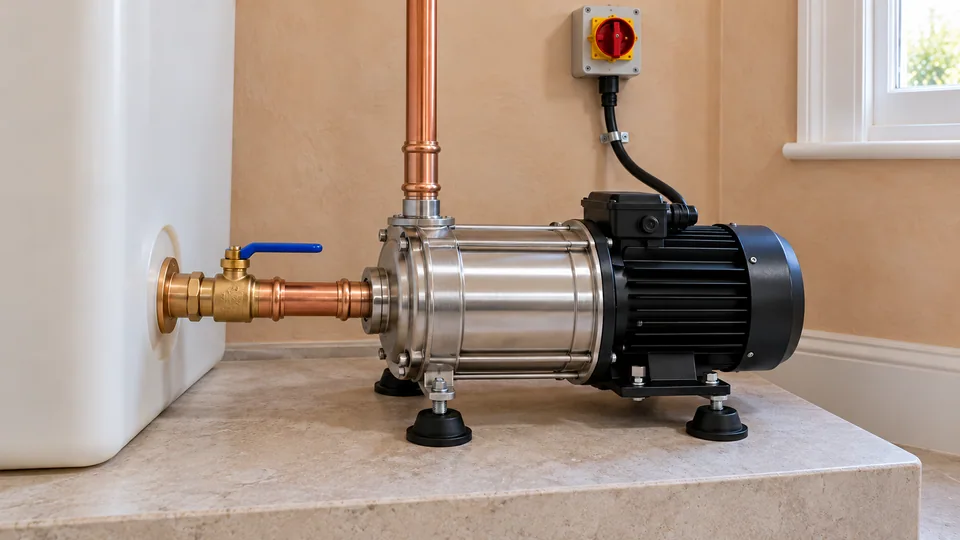
PEP brings the mechanical and electrical requirements into the same installation plan. Depending on the selected arrangement, the agreed work can include:
- Supply and installation of the specified pump, accumulator or cold-water storage equipment.
- New or altered distribution pipework, suitable isolation and required protective fittings.
- Support, insulation, accessible connections and equipment positioning.
- Electrical supply, protection, isolation and compatible controls.
- Commissioning, relevant checks under demand and an explanation of operation and maintenance.
The proposal identifies what is included and which items depend on investigation or another contractor. Structural work, joinery, decoration and making good should not be assumed to be part of every installation.
For associated power and controls, see electrical installation in Hammersmith. Where appropriate, water leak protection options can also be considered while services remain accessible.
A quotation for the complete scope
Water booster installation cost in Hammersmith
The price of the pump is only one element of the installed cost. A compact unit beside an accessible incoming supply and a stored-water arrangement requiring new routes, support and electrical provision are different projects.
The quotation needs to account for equipment duty and capacity, connection points, pipework, power, access, commissioning and any shared-service arrangements. Work through finished rooms or restricted communal access can also affect the installation programme.
We define the proposed scope after assessing the relevant conditions. Where a detail remains concealed or another party’s input is required, that uncertainty is identified rather than hidden inside an apparently complete price. Comparing quotations is easier when the equipment, associated work and exclusions are clearly stated.
From the brief · To the handover
From measured supply to a commissioned system
- Describe the project. Share the property details, existing difficulties and any planned changes to bathrooms, kitchen or hot-water equipment.
- Assess the supply and installation. Establish relevant measurements, distribution, space, access and the private/shared boundary.
- Agree the solution and scope. Review the proposed equipment, expected duty, limitations, associated work and outstanding requirements.
- Coordinate the installation. Plan access and water interruptions, complete the agreed connections and arrange the electrical work.
- Check and hand over. Verify operation, controls and relevant delivery under demand. Explain isolation, maintenance needs and the documentation included in the scope.
Requirements · Permissions · Responsibilities
Water regulations, building permissions and practical responsibilities
A booster installation must suit the water supply and comply with the applicable requirements. Installing a storage tank does not automatically remove notification obligations.
Water Regs UK guidance on pump notification states that the water undertaker must be notified where a pump induces demand exceeding 12 litres per minute, whether connected directly or indirectly to the supply pipe.
We establish the requirements relevant to the proposed arrangement, including any necessary supplier liaison and responsibilities. Freeholder or managing-agent consent, access to shared services and permission for work affecting the building are separate matters that may also need resolving before installation.
Hammersmith · W6
Water booster installation across Hammersmith W6
We welcome planned installation enquiries from Hammersmith Broadway, King Street, Hammersmith Grove, Brackenbury Village, Ravenscourt Park, St Peter’s Square and the Hammersmith riverside.
We also consider nearby Brook Green and addresses towards Stamford Brook, Barons Court and West Kensington. These neighbourhoods cross postcode boundaries; Brook Green includes both W6 and W14 addresses. Send the full postcode so we can confirm the location and discuss the project.
For neighbouring areas, explore water pressure booster installation in Chiswick or water pressure booster installation in Fulham. Our London water pressure booster installation page provides the wider service overview.
Before you book
Questions before choosing a water pressure system
Can a booster improve water pressure in an upper-floor Hammersmith flat?
It may, depending on the available supply and the cause of the limitation. We assess the route to the flat and its outlets, the hot-water arrangement and any shared infrastructure before recommending equipment.
What if the flat shares its incoming supply with other properties?
The shared arrangement needs to be understood first. The appropriate solution may require information or work beyond your private installation, with managing-agent involvement, access arrangements and relevant permissions agreed before proceeding.
Do I need a pump, an accumulator or a storage tank?
That depends on measured pressure, flow, demand and available space. A short peak in demand and a sustained shortfall are different problems. Sometimes correcting a restriction is more appropriate than installing additional equipment.
Can a small inline booster supply two showers at once?
Not automatically. The combined requirements of the showers must be checked against the water supply, equipment capability, pipework and hot-water system. A compact footprint does not establish multi-bathroom performance.
How long does an accumulator provide additional flow?
It depends on the usable stored water, operating conditions and rate of consumption. The reserve is finite and needs replenishing. We assess the expected pattern of use rather than promise a duration from nominal vessel size alone.
Can a booster work with an unvented hot-water cylinder?
A suitably designed arrangement can support an unvented installation. The cylinder’s supply requirements, controls and hot/cold distribution need to be checked alongside capacity and recovery. The equipment must be compatible as a complete system.
Will boosting the supply improve a combi boiler’s hot-water output?
It may improve delivery where the incoming supply is the restriction, but it does not add heating capacity. The boiler’s output and the requested water temperature still limit how much hot water it can provide.
Can the equipment fit inside an existing service cupboard?
Possibly, but dimensions are only part of the assessment. Connections, filled weight, support, installation conditions and service clearances must also be suitable. We check the access route as well as the final position.
How are noise, vibration and service access considered?
We review the equipment location, mounting and pipe connections, particularly near bedrooms and neighbouring properties. Clearances must allow maintenance and replacement. We explain the relevant acoustic considerations; complete silence cannot be guaranteed.
Does the water supplier need to be notified?
Notification can be required, including for a pump inducing demand above 12 litres per minute on a direct or indirect connection. The relevant requirements must be established for the proposed installation; a break tank is not an automatic exemption.
What affects the complete installation price?
Equipment selection, storage, pipework, electrical work, access and commissioning all contribute. Shared shutdowns and work through finished areas can change the scope. A meaningful quotation should identify the included work and any exclusions.
What information should I send before a survey?
Your postcode, property type, bathroom count, hot-water arrangement and the outlets you want to use together are useful starting points. Add photographs of accessible equipment, any drawings and the planned programme. Do not remove covers or disturb services to take photographs.
Hammersmith W6 · Plan the next step
Tell us what your Hammersmith home needs to supply
Whether you are improving an existing bathroom or planning a larger refurbishment, start with the way you want the home to work.
Send your postcode, plans or photographs, details of the current hot-water system and the fittings you expect to use together. Let us know if the property has shared services or building-management requirements.
PEP will help establish the next step towards a suitable water pressure booster or accumulator installation, with the equipment and associated work considered together.
Discuss your Hammersmith water pressure projectCall 07843 676 480