
Willesden & Willesden Green · NW10 / NW2
Water Pressure Booster & Accumulator Installation in Willesden
Water delivery planned for the shower, the kitchen — and the next person who needs them.
Mains water boosters · Accumulator installation · Cold-water storage and booster sets

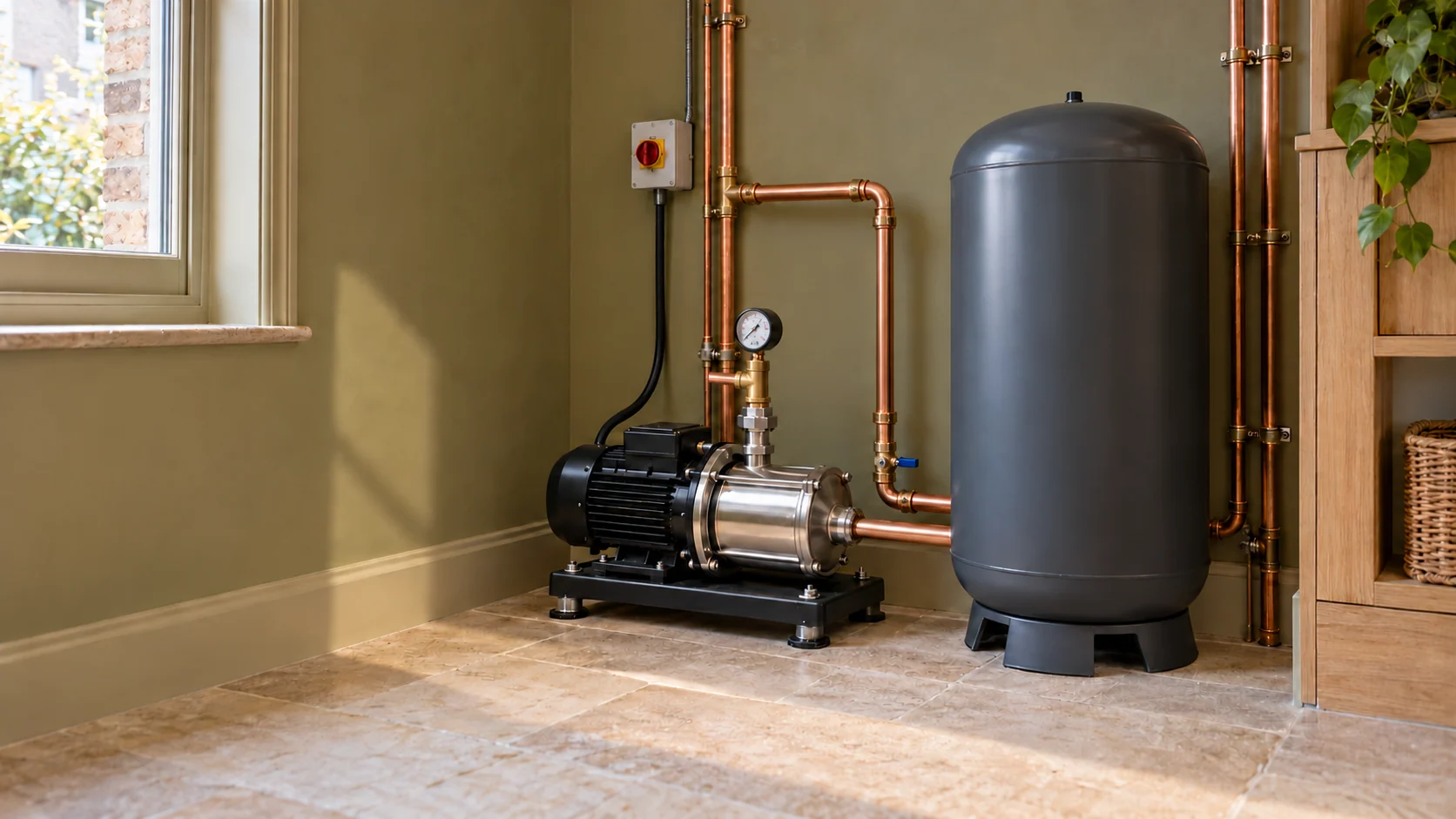
PEP designs and installs water pressure boosters, accumulators and cold-water storage systems for homes in Willesden and Willesden Green. We assess what reaches the property, what limits delivery and how the household uses water before specifying an installation.
Whether you are improving a compact flat or planning several bathrooms in a family house, we coordinate the equipment, pipework, electrical supply and hot-water connections within an agreed scope.
Willesden · Willesden Green · NW10 / NW2
A better supply for the moments when everyone needs water
A shower that works well on its own can feel very different when someone opens the kitchen tap. Adding another bathroom may expose a limitation that was barely noticeable before. The useful question is not simply whether a pump can be fitted, but what the finished installation needs to deliver.
Tell us about the busiest part of your day: two showers overlapping, a bath followed by another shower, or appliances filling while the family gets ready. We use that brief alongside the measured supply to explore an appropriate improvement.
For a smaller home, the answer may be a compact unit or work to an existing restriction. A larger property may need a carefully sized reserve and a different pumping arrangement. We explain the practical choices without assuming that more equipment is always better.
Where new bathrooms or a kitchen are part of the project, our plumbing installations in Willesden can bring the distribution layout into the same plan.
02 · Understand the actual supply
Find the limiting part of the system before buying a pump
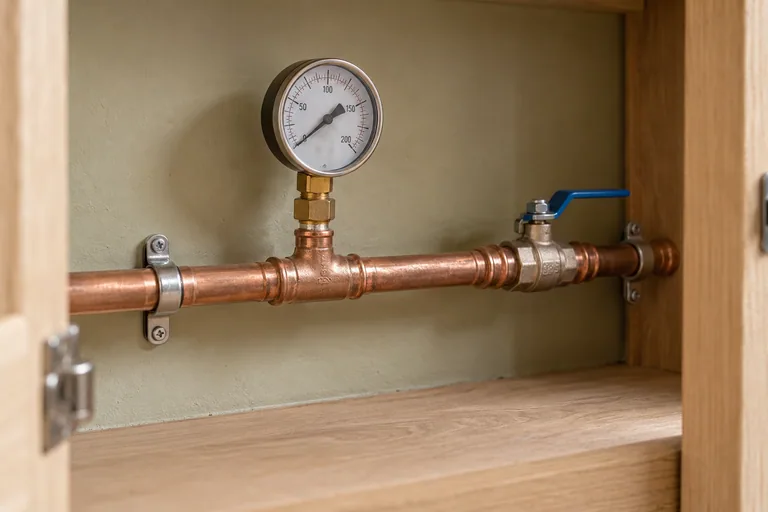
Pressure and flow describe different things. A standing pressure reading does not show how much water remains available when several outlets are drawing together. We consider the relevant measurements under demand, alongside the route the water takes through the installation.
The investigation may include accessible stop valves, strainers, pressure controls, existing equipment, pipe sizes and affected fittings. A single weak shower needs a different assessment from a reduction throughout the home. A newly developed problem also deserves investigation rather than an automatic upgrade.
If the shortfall appears to lie in the incoming pipe or shared building services, that finding shapes the next step. Sudden supply loss or a problem affecting neighbouring properties may require the water supplier’s involvement.
Our guide to low water pressure and flow explains the common distinctions. The installation proposal follows the assessment, including whether remedial pipework should come before boosting.
03 · Match the system to the measured supply
Three boosting arrangements — and the option of fixing the restriction
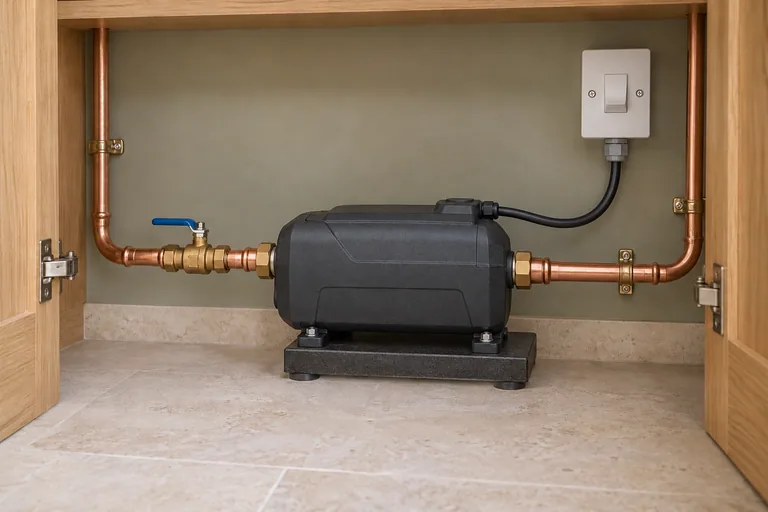
A compact inline mains booster
An inline unit can offer a practical improvement where its operating range suits the supply and required demand. Its smaller footprint may help in a property with limited equipment space.
It should not be sold as an unrestricted source for multiple high-demand outlets. Suitability depends on the selected model, its installation requirements and the connected system.
An accumulator, with or without a charging pump
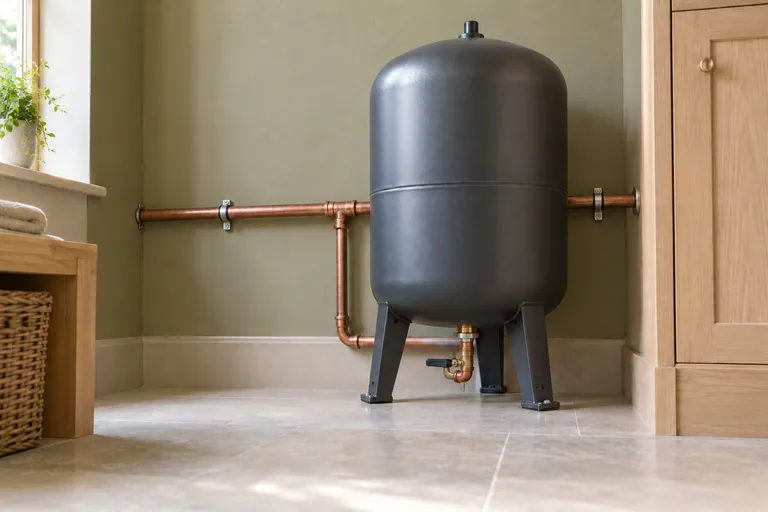
An accumulator stores a reserve of water under pressure. An unpumped arrangement relies on suitable incoming conditions to charge; a pumped arrangement assists that process as part of the specified system.
The choice involves more than vessel size. Available reserve, replenishment and the period of use all matter. An accumulator is also different from the hot-water cylinder that supplies your showers.
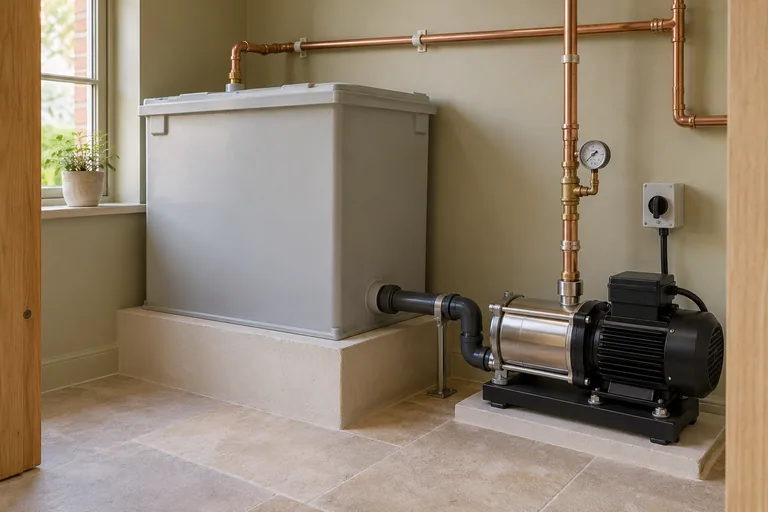
A cold-water tank and booster pump
A tank-and-pump installation stores cold water separately and supplies the connected outlets through a suitable pump arrangement. It may suit a more demanding residential project where the required duty and installation conditions justify it.
The design brings together storage, refill, pump control and distribution. Adequate space, water turnover and maintenance access are part of the decision.
04 · Useful reserve · Simultaneous use · Refill
Enough water for this use — and a realistic plan for the next
A specification should consider three connected requirements: the delivery needed while outlets run together, how long that demand lasts and how the reserve is restored afterwards.
A large number on a vessel label is not a promise that the same volume will be available at the required outlet pressure. Equally, a pump’s headline flow rate does not establish how long a stored-water system can sustain the household’s demand.
We consider usable capacity and refill alongside the proposed fittings and hot-water provision. This helps distinguish a system suited to a short overlap from one intended to support a longer sequence of showers and other use.
Those expectations belong in the discussion before equipment is ordered. A more useful brief than “make the pressure stronger” is “these outlets need to work together, for this routine, with these limits understood”.
06 · Cold-water delivery · Hot-water capacity
Bring the cold-water improvement and hot-water demand together
Unvented cylinders and stored hot water
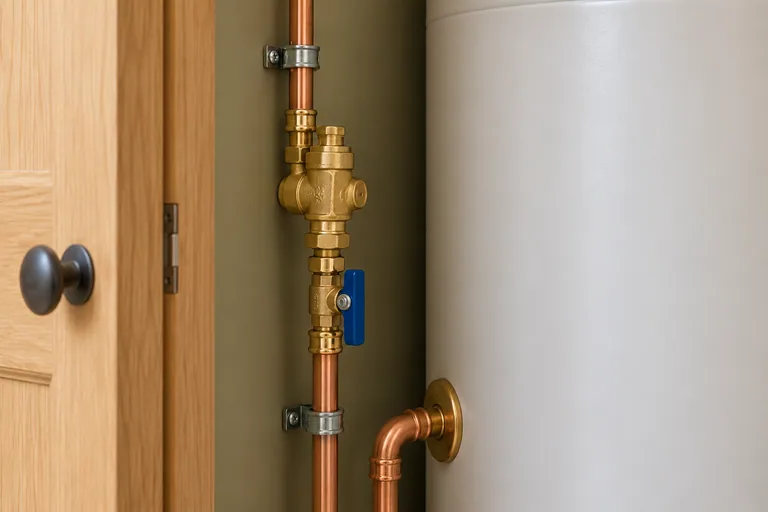
A cylinder provides a store of heated water, not an independent solution to every incoming-supply limitation. Capacity, reheating, inlet controls and distribution still need to match the intended use.
Where replacement or a new hot-water arrangement is appropriate, our unvented cylinder installation in Willesden can be coordinated with the supply work. Keeping an existing suitable cylinder may also be the right decision.
Combi boilers
Improving cold-water delivery does not increase a combi boiler’s heating output. The temperature rise and hot-water flow the appliance can provide remain important when assessing overlapping showers.
We consider the proposed water duty against the appliance and outlets rather than promise that a booster will create unlimited hot water.
Changing from gravity-fed hot water involves further design decisions. Our vented-to-unvented conversion guide explains the wider change; an existing shower pump cannot simply be assumed suitable for a mains-fed arrangement.
07 · Equipment location · Service access · Vibration
Choose a location that works after the cupboard is finished
The equipment must fit the building as well as the water demand. We consider access for delivery and installation, the space needed for future maintenance and the load when storage is full.
Pipe routes, valve access, electrical provision and ventilation or protection requirements depend on the chosen equipment. A storage arrangement may also need appropriate overflow or warning-pipe provision. These are design requirements, not details to squeeze into the remaining space.
Noise and vibration deserve particular attention near bedrooms or adjoining flats. We consider positioning, support, connections and manufacturer guidance, while being clear that electrically driven equipment cannot be promised to be silent.
A good installation remains accessible when joinery and finishes are complete. The dimensions of an empty cupboard alone are not enough to establish suitability.
Plumbing · Electrical · Clear responsibilities
One coordinated installation, with the responsibilities clearly defined
PEP brings the water-supply work together with the associated plumbing and electrical requirements. Depending on the proposal, the scope can include:
- Selected booster equipment, accumulator or cold-water storage.
- Agreed pipework alterations, isolation and suitable protection components.
- Electrical supply, controls and connections appropriate to the equipment.
- Integration with the retained or new hot-water installation.
- Commissioning, operational checks and an explanation of use and care.
Our electrical services in Willesden support the relevant electrical work. Larger projects can be coordinated with central heating and plant-room installations in Willesden.
Any structural work, new joinery, substantial making good, work on shared services or water-supplier alterations must be identified separately where applicable. The quotation should make those boundaries visible.
Complete installation · Defined inclusions
Water pressure booster installation costs in Willesden
The cost depends on the complete installation, not just the price of a pump. A compact improvement with accessible services is a different project from providing storage, new distribution and coordinated electrical work.
Equipment selection, pipe routes, access, occupied-home working, permissions and the condition of retained services can all affect the proposal. We establish what is included, how VAT is presented and which work remains outside the price.
Compare quotations against the same intended result: equipment, preparation, connections, commissioning and handover. Where assumptions or further investigation remain, these should be stated rather than hidden behind a low starting figure.
Tell us about your Willesden installation so we can discuss the brief and the appropriate assessment.
From first enquiry · To checked handover
From the first enquiry to a system you can use confidently
1. Explain what is happening — and what is changing
Send your full postcode, property type, hot-water arrangement and the combinations of use you want to support. Photographs of the existing services and possible equipment space help establish the starting point.
2. Assess the supply and agree the proposal
We assess the relevant conditions and discuss suitable options, limitations, access and responsibilities. The proposed work follows those findings.
3. Plan the work around the property
Equipment positions, routes, electrical work and interruptions are coordinated before installation. If the home remains occupied, we agree the practical sequence rather than assume uninterrupted water throughout the work.
4. Commission, explain and hand over
We check operation against the agreed scope, including relevant demand conditions. Handover covers the applicable records, controls, isolation, manufacturer instructions and maintenance requirements.
Supplier requirements · Ongoing care
Water-supplier requirements and future care belong in the plan
Before installation, the proposed arrangement must be checked against applicable water-supply requirements and the selected equipment’s instructions.
Water Regs UK states that a pump inducing demand above 12 litres per minute must be notified to the local water undertaker. This applies to both direct and indirect connections to a supply pipe. A break tank does not automatically remove that notification requirement.
The relevant supplier requirements and any necessary consent therefore need to be established for the actual project. A generic product description is not a substitute for that check.
After installation, servicing and inspection follow the system provided. We explain the relevant care requirements, access needs and applicable manufacturer warranty conditions. Appropriate storage sizing and water turnover are considered rather than adding capacity without regard to how the home uses it.
Willesden NW10 · Willesden Green NW2
Water booster installation in Willesden and Willesden Green
We welcome planned residential installation enquiries around Willesden High Road, Willesden Green, Walm Lane, Church End, Dudden Hill and relevant nearby parts of Roundwood and Harlesden.
The service includes relevant NW10 and NW2 addresses. For properties towards Dollis Hill, Gladstone Park or Mapesbury, send the full postcode and proposed scope so we can confirm the location and work.
Neighbourhood names and postcode districts do not share identical boundaries. For Brondesbury Park and enquiries towards Kensal Rise, see our water booster installations in Queen’s Park. For Acton and North Acton projects, see water booster installation in Acton.
Explore our Willesden services and coverage or the wider water pressure booster installation service across London.
Before you enquire
Questions about water boosters and accumulators in Willesden
Will a booster solve any weak shower?
No. The cause may be the shower fitting, a restriction, the hot-water system, internal distribution or the incoming supply. Identifying the limitation helps establish whether boosting is appropriate.
Should the incoming water pipe be improved first?
Possibly. If assessment identifies a restrictive or defective section, remedial work may be the better starting point. The proposal should distinguish pipework improvements from equipment intended to support demand.
Can an accumulator work without a pump?
An unpumped accumulator can suit an installation with appropriate incoming conditions. It stores a finite reserve at pressure; it is not a substitute for assessing charging conditions and household use.
How much water can an accumulator actually deliver?
Usable reserve is not necessarily the vessel’s nominal capacity. It depends on the selected system and operating conditions. The design also considers replenishment and the delivery needed at the outlets.
What happens when the stored reserve has been used?
Performance then depends on the incoming supply, refill and pump arrangement. Storage cannot sustain an excess of demand over replenishment indefinitely. We discuss that operating limitation before specifying capacity.
Can two showers and the kitchen work together?
That is a useful requirement to assess, not a result to promise from bathroom count alone. The outlet demands, duration, available supply, storage and hot-water capability all need to be considered.
Can you install a booster in a converted Willesden flat?
Potentially, subject to the supply arrangement, suitable space, the proposed work and necessary permissions. Shared services or communal equipment may need investigation by the responsible party before private alterations are appropriate.
Will it increase the amount of hot water from my combi?
It does not increase the boiler’s heating output. Improving supply conditions and meeting the household’s hot-water demand are related but separate questions, so both are assessed.
Do I need a new cylinder at the same time?
Not automatically. A suitable existing cylinder may remain. Its capacity, recovery, controls and distribution are considered alongside the supply improvement before replacement is recommended.
Will the installation be quiet, and what happens during a power cut?
Noise depends on the equipment, position and installation; silence cannot be guaranteed. During a power cut, operation depends on the system layout and available reserve. We explain any designed provision and limitations at handover.
Does adding a tank avoid water-supplier notification?
Not automatically. The notification rule for a pump inducing demand above 12 litres per minute covers direct and indirect supply-pipe connections. The actual arrangement and supplier requirements need checking.
Do you cover Willesden Green NW2 as well as Willesden NW10?
Yes, we welcome planned installation enquiries from both, with coverage confirmed using the full postcode and project details. We do not treat every NW2 or NW10 address as Willesden.
Willesden · Plan the right installation
Tell us what your Willesden home needs to deliver
Share the postcode, the existing problem, your hot-water system and any planned bathroom or kitchen changes. Tell us which outlets you would like to use together and whether the property is a house, a private flat or part of a managed building.
PEP can then discuss the appropriate assessment and a properly defined water-supply installation — from a compact improvement to a coordinated system with storage, pumping and hot-water integration.
Discuss your Willesden water-supply project Call PEP on 07843 676 480